Chapter 7

7.1 Sets

By the end of this section, you will be able to:
  1. Use set notation to represent unions, intersections, and complements of sets.
  2. Use Venn diagrams to solve counting problems.

7.1.1 Sets and Set Notation

In this section we introduce set operations and notations that underpin both counting and probability. The ideas are simple but essential — every probability computation and every counting argument in this chapter builds on them.

Definition 7.1: Set

Source: Applied Finite Mathematics

A set is a collection of objects. The objects that belong to the set are called its elements (or members). We name a set with a capital letter and list its members inside braces \(\{\ \}\).

For example, the members of a chess club might be written

$$C = \{\text{Ken, Bob, Tran, Shanti, Eric}\}.$$
Definition 7.2: Empty Set

Source: Applied Finite Mathematics

A set with no elements is called the empty set, denoted \(\varnothing\) (equivalently \(\{\ \}\)).

Context Pause: Why do we need a special symbol for "nothing"?

The empty set may feel like a technicality, but it's doing real work. When you intersect two groups that share no members — say, math majors enrolled in a preschool music class — the result isn't "invalid"; it's \(\varnothing\), a legitimate set. Having a named symbol lets us write equations about emptiness the same way we write equations about numbers. In probability, \(\varnothing\) represents the event "nothing happens," and it gets probability \(0\).

Insight Note: Sets ignore order and repetition

The set \(\{1, 2, 3\}\) is the same set as \(\{3, 1, 2\}\) or \(\{1, 1, 2, 3\}\). Sets care only about which elements are present, not how many times you wrote them or what order you listed them in. This distinguishes sets from lists and from tuples, which do care about order.

Try It Now 7.1.1

Source: Applied Finite Mathematics

List the elements of the set \(D\) of days of the week whose name starts with the letter T.

Solution
$$D = \{\text{Tuesday}, \text{Thursday}\}.$$

7.1.2 Set Equality and Subsets

We often compare sets. Two common relationships are equality (both sets contain exactly the same elements) and subset (one set is contained inside another).

Definition 7.3: Set Equality

Source: Applied Finite Mathematics

Two sets are equal if they have the same elements, regardless of order or repetition.

Definition 7.4: Subset

Source: Applied Finite Mathematics

A set \(A\) is a subset of a set \(B\) — written \(A \subseteq B\) — if every element of \(A\) is also an element of \(B\).

For example, if \(C = \{\text{Al, Bob, Chris, David, Ed}\}\) and \(A = \{\text{Bob, David}\}\), then every member of \(A\) is also in \(C\), so \(A \subseteq C\).

Context Pause: "Subset" vs "member"

Don't confuse \(A \subseteq B\) ("\(A\) is a subset of \(B\)") with \(a \in B\) ("\(a\) is a member of \(B\)"). The first is a relationship between two sets; the second is a relationship between an element and a set. Writing \(\{\text{Bob}\} \in C\) is a type error — \(\{\text{Bob}\}\) is a set, not a single person.

Insight Note: Every set contains two "trivial" subsets

For any set \(S\), two subsets always exist: the empty set \(\varnothing\) and \(S\) itself. Think of \(\varnothing\) as "take nothing" and \(S\) as "take everything." Every other subset is a middle choice. This matters for counting: a set with \(n\) elements has exactly \(2^n\) subsets — one for each yes/no decision per element.

Example 7.1.1

Source: Applied Finite Mathematics

List all the subsets of the set of primary colors \(\{\text{red, yellow, blue}\}\).

Solution

A subset is any group you can form by deciding to include or exclude each element. For three elements there are \(2^3 = 8\) subsets:

$$\varnothing,\ \{\text{red}\},\ \{\text{yellow}\},\ \{\text{blue}\},\ \{\text{red, yellow}\},\ \{\text{red, blue}\},\ \{\text{yellow, blue}\},\ \{\text{red, yellow, blue}\}.$$

Notice that the empty set and the whole set are both on this list — every set is a subset of itself, and \(\varnothing\) is a subset of every set.

Try It Now 7.1.2

Source: Applied Finite Mathematics

List all the subsets of \(\{\text{Aaliyah, Imani}\}\).

Solution

There are \(2^2 = 4\) subsets:

$$\varnothing,\ \{\text{Aaliyah}\},\ \{\text{Imani}\},\ \{\text{Aaliyah, Imani}\}.$$

7.1.3 Union of Two Sets

When we combine two groups into a single bigger group, we are taking their union.

Definition 7.5: Union

Source: Applied Finite Mathematics

The union of sets \(A\) and \(B\), written \(A \cup B\), is the set of all elements that are in \(A\), in \(B\), or in both.

Context Pause: "Or" in math is inclusive

Everyday English often treats "\(A\) or \(B\)" as meaning one but not both ("coffee or tea?"). In set theory, "or" is inclusive — elements that belong to both sets are included in \(A \cup B\) as well. When you compute a union, never count the overlap twice.

Insight Note: Union as coloring

Picture two overlapping circles. The union \(A \cup B\) is every region that gets shaded when you color in either circle — including the overlap. This is the mental image we'll use in Venn-diagram problems later.

Example 7.1.2

Source: Applied Finite Mathematics

Find the union of the sets \(F\) and \(B\):

$$F = \{\text{Layla, Omar, Fatima, Karim, Yasmin}\}$$

$$B = \{\text{Tariq, Omar, Karim, Amira}\}.$$

Solution

The union contains every element that appears in either set. Elements that appear in both (Omar, Karim) are listed only once:

$$F \cup B = \{\text{Layla, Tariq, Omar, Fatima, Karim, Amira, Yasmin}\}.$$

Try It Now 7.1.3

Source: Applied Finite Mathematics

Find \(\{\text{Ayasha, Mahkah, Shilah, Wakiza}\} \cup \{\text{Mahkah, Shilah, Wakiza, Aiyana}\}\).

Solution

$$\{\text{Ayasha, Mahkah, Shilah, Wakiza, Aiyana}\}.$$

7.1.4 Intersection of Two Sets

If union says "in either," intersection says "in both at the same time."

Definition 7.6: Intersection

Source: Applied Finite Mathematics

The intersection of sets \(A\) and \(B\), written \(A \cap B\), is the set of all elements that are common to both \(A\) and \(B\).

Intersections show up every time you filter

Any time you narrow a list using multiple conditions — "students enrolled in math and history," "cars that are red and manual transmission" — you are forming an intersection. The word "and" in everyday English usually maps directly onto \(\cap\) in set notation.

Intersection is always a subset of each set

For any sets \(A\) and \(B\), \((A \cap B) \subseteq A\) and \((A \cap B) \subseteq B\). This follows from the definition: every element in the intersection is, by definition, an element of both. Use this as a sanity check — if your computed intersection contains an element that isn't in one of the original sets, you've made an error.

Example 7.1.3

Source: Applied Finite Mathematics

Using the same sets \(F\) and \(B\) as in Example 7.1.2, find \(F \cap B\) where

$$F = \{\text{Aanya, Devansh, Priya, Arjun, Anaya}\},\quad B = \{\text{Kabir, Devansh, Arjun, Meera}\}.$$
Solution

Only the elements in both sets qualify. Devansh and Arjun are in both, so

$$F \cap B = \{\text{Devansh, Arjun}\}.$$
Try It Now 7.1.4

Source: Applied Finite Mathematics

Find \(\{\text{Emma, James, Olivia, Henry}\} \cap \{\text{James, Olivia, Henry, Charlotte}\}\).

Solution
$$\{\text{James, Olivia, Henry}\}.$$

7.1.5 Complement of a Set and Disjoint Sets

So far our sets have been described relative to each other. Sometimes we need a reference frame — a bigger, all-encompassing set that everything lives inside.

Definition 7.7: Universal Set

Source: Applied Finite Mathematics

A universal set, denoted \(U\), is the set of all elements under consideration in a given context.

Definition 7.8: Complement

Source: Applied Finite Mathematics

The complement of set \(A\), written \(\overline{A}\) (read "A-bar"), is the set of elements in the universal set \(U\) that are not in \(A\).

Definition 7.9: Disjoint Sets

Source: Applied Finite Mathematics

Two sets \(A\) and \(B\) are disjoint if their intersection is empty: \(A \cap B = \varnothing\). That is, they share no elements.

The complement of \(\{1, 2, 3\}\) is not a fixed set — it depends on what you declared the universal set to be. If \(U = \{1, 2, 3, 4, 5\}\), the complement is \(\{4, 5\}\). If \(U = \{1, 2, 3, 4, \ldots, 100\}\), the complement has \(97\) elements. Always fix \(U\) before you compute a complement.

A set \(A\) and its complement \(\overline{A}\) are always disjoint — nothing can be both in \(A\) and out of \(A\). But two sets can be disjoint without being complements. For example, if \(U = \{1, 2, 3, 4, 5\}\), the sets \(\{1\}\) and \(\{2\}\) are disjoint (no shared elements) but neither is the complement of the other. Complements fill out the rest of \(U\); disjoint sets just don't overlap.

Example 7.1.4

Source: Applied Finite Mathematics

Let the universal set \(U = \{\text{red, orange, yellow, green, blue, indigo, violet}\}\) and \(P = \{\text{red, yellow, blue}\}\). Find the complement of \(P\).

Solution

The complement consists of everything in \(U\) that is not in \(P\). Remove red, yellow, and blue from \(U\):

$$\overline{P} = \{\text{orange, green, indigo, violet}\}.$$

Intuitively: if \(U\) is all the colors of the spectrum and \(P\) is the primary colors, \(\overline{P}\) is the non-primary colors.

Example 7.1.5

Source: Applied Finite Mathematics

Let \(U = \{\text{red, orange, yellow, green, blue, indigo, violet}\}\) and \(P = \{\text{red, yellow, blue}\}\). Find a set \(R\) such that \(R\) is not the complement of \(P\) but \(R\) and \(P\) are disjoint.

Solution

Pick any nonempty proper subset of \(\overline{P}\). For example,

$$R = \{\text{orange, green}\}.$$

Then \(R \cap P = \varnothing\) (disjoint — no overlap), but

$$R \cup P = \{\text{red, yellow, blue, orange, green}\} \neq U,$$

so \(R\) is not the full complement of \(P\).

Example 7.1.6

Source: Applied Finite Mathematics

Let \(U = \{\text{red, orange, yellow, green, blue, indigo, violet}\}\), \(P = \{\text{red, yellow, blue}\}\), \(Q = \{\text{red, green}\}\), and \(R = \{\text{orange, green, indigo}\}\). Find \(\overline{P \cup Q} \cap \overline{R}\).

Solution

Work from the inside out.

Step 1 — Compute \(P \cup Q\):

$$P \cup Q = \{\text{red, yellow, blue, green}\}.$$

Step 2 — Take its complement (remove those four from \(U\)):

$$\overline{P \cup Q} = \{\text{orange, indigo, violet}\}.$$

Step 3 — Compute \(\overline{R}\):

$$\overline{R} = \{\text{red, yellow, blue, violet}\}.$$

Step 4 — Intersect (keep only elements in both):

$$\overline{P \cup Q} \cap \overline{R} = \{\text{violet}\}.$$

Try It Now 7.1.5

Source: Applied Finite Mathematics

Let \(U = \{a, b, c, d, e, f, g, h, i, j\}\), \(V = \{a, e, i, f, h\}\), and \(W = \{a, c, e, g, i\}\). Find \(\overline{V} \cap \overline{W}\).

Solution

First compute the complements:

$$\overline{V} = \{b, c, d, g, j\},\quad \overline{W} = \{b, d, f, h, j\}.$$

Then intersect — the elements in both:

$$\overline{V} \cap \overline{W} = \{b, d, j\}.$$

7.1.6 Venn Diagrams and Counting

John Venn (an English logician, late 1800s) invented a picture that makes set relationships immediately visible: each set is the inside of a circle, overlapping regions show intersections, and the rectangle enclosing everything represents the universal set. Venn diagrams are especially useful when we want to count how many elements lie in particular regions.

Context Pause: Why draw a picture for a counting problem?

In practice, surveys and data sets give you overlapping categories — people who jog and cycle, students who take math or history, and so on. The hardest part is not the arithmetic; it's keeping track of what has already been counted and what has not. A Venn diagram is a bookkeeping device. Fill in the innermost region first, then work outward, and every element ends up counted exactly once.

Insight Note: Innermost first, outermost last

Every Venn-diagram counting problem follows the same rhythm. Place the "all-three" count in the center, then use the two-way overlaps minus that center count for the pairwise regions, then use each set's total minus everything already inside its circle for the single-set regions, and finally subtract the total-inside-circles from the grand total to find the "none of these" region. If you remember the rhythm you will never double-count.

Example 7.1.7

Source: Applied Finite Mathematics

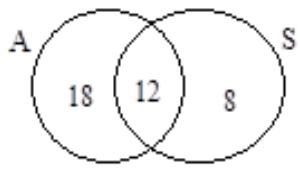
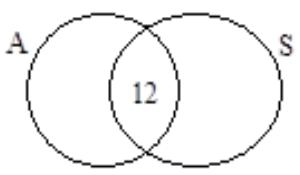
A survey of car enthusiasts showed that over a certain period, 30 drove cars with automatic transmissions, 20 drove cars with standard transmissions, and 12 drove cars of both types. Every surveyed person drove at least one type. How many people participated in the survey?
Solution

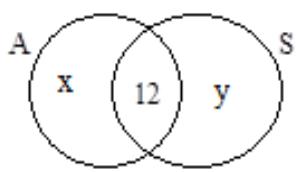
Let \(A\) be the set who drove automatics and \(S\) the set who drove standards.

Step 1 — Innermost region. 12 people drove both, so place \(12\) in \(A \cap S\).

Step 2 — Automatic-only region. Circle \(A\) must contain 30 total, so the non-overlapping part of \(A\) holds

$$x + 12 = 30 \implies x = 18.$$

Step 3 — Standard-only region. Circle \(S\) must contain 20, so its non-overlapping part holds

$$y + 12 = 20 \implies y = 8.$$

Step 4 — Add the regions. The survey total is

$$18 + 12 + 8 = 38.$$

Answer: \(38\) people participated in the survey.

Example 7.1.8

Source: Applied Finite Mathematics

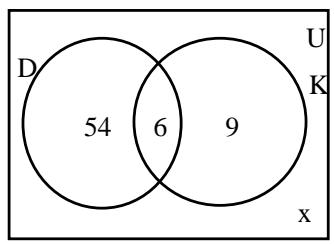
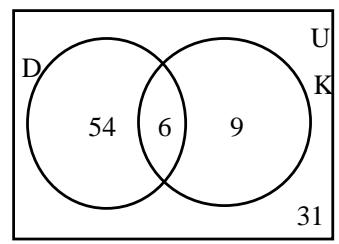
A survey of 100 people in California showed that 60 have visited Disneyland, 15 have visited Knott's Berry Farm, and 6 have visited both. How many have visited neither?
Solution

Let \(D\) be the set of Disneyland visitors and \(K\) the set of Knott's visitors.

Place \(6\) in \(D \cap K\). The Disneyland-only region holds \(60 - 6 = 54\); the Knott's-only region holds \(15 - 6 = 9\). Let \(x\) be the number who visited neither (inside \(U\) but outside both circles). Because the total is 100,

$$54 + 6 + 9 + x = 100 \implies x = 31.$$

Answer: \(31\) people visited neither place.

Example 7.1.9

Source: Applied Finite Mathematics

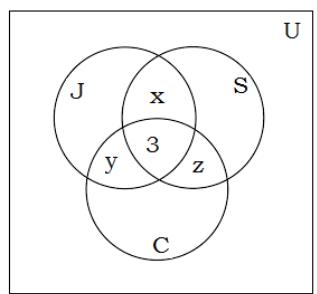
A survey of 100 exercise-conscious people gave the following data:

  • 50 jog, 30 swim, 35 cycle
  • 14 jog and swim
  • 7 swim and cycle
  • 9 jog and cycle
  • 3 take part in all three activities

a. How many jog but do not swim or cycle?

b. How many take part in only one of the activities?

c. How many do not take part in any of these activities?

Solution

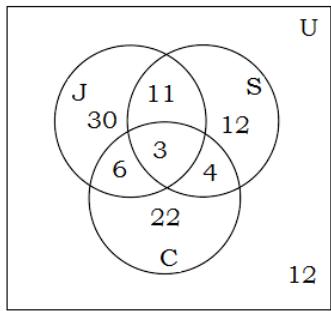
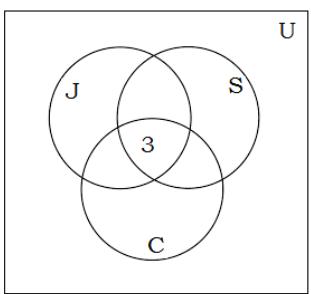
Let \(J\), \(S\), and \(C\) be the sets of joggers, swimmers, and cyclists. Fill the diagram from the innermost region outward so every person is counted exactly once.

Step 1 — Innermost region. Place \(3\) in \(J \cap S \cap C\) (people in all three).
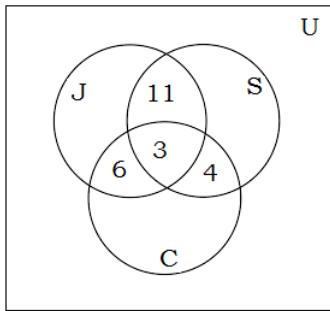
Step 2 — Pairwise-only regions. Each pairwise overlap count already includes the three who do all three, so subtract that \(3\):

  • Jog and swim only: \(14 - 3 = 11\)
  • Jog and cycle only: \(9 - 3 = 6\)
  • Swim and cycle only: \(7 - 3 = 4\)

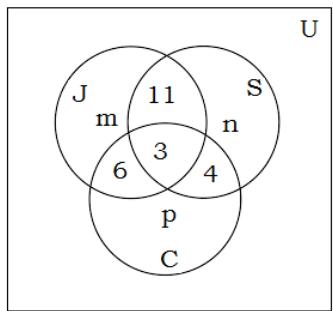
Step 3 — Single-activity regions. Each circle has a known total; subtract everything already inside it to get the single-activity region.

  • Jog only: \(m + 11 + 6 + 3 = 50 \implies m = 30\)
  • Swim only: \(n + 11 + 4 + 3 = 30 \implies n = 12\)
  • Cycle only: \(p + 6 + 4 + 3 = 35 \implies p = 22\)
Step 4 — None-of-the-above region. Add every number inside the three circles:

$$30 + 12 + 22 + 11 + 6 + 4 + 3 = 88.$$

Since 100 people were surveyed, the region outside all three circles holds \(100 - 88 = 12\).
Answers.

a. 30 people jog but do not swim or cycle.

b. \(30 + 12 + 22 = \mathbf{64}\) people take part in exactly one activity.

c. 12 people do not take part in any of these activities.

Try It Now 7.1.6

Source: Applied Finite Mathematics

In Ms. Eleanor's class of 35 students, 12 students are taking history, 18 are taking English, and 4 are taking both. Use a Venn diagram to determine how many students are taking neither history nor English.

Solution

Place \(4\) in the intersection. History-only: \(12 - 4 = 8\). English-only: \(18 - 4 = 14\). Total inside the two circles: \(8 + 4 + 14 = 26\). Neither: \(35 - 26 = \mathbf{9}\) students.

Example 7.2.1

Source: Applied Finite Mathematics

James has two blouses and three skirts. How many different outfits consisting of a blouse and a skirt can he wear?
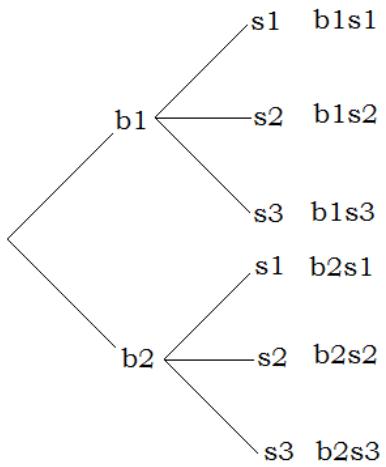
Solution

Step 1 — Enumerate directly. Call the blouses \(b_1, b_2\) and the skirts \(s_1, s_2, s_3\):

$$b_1 s_1,\ b_1 s_2,\ b_1 s_3,\ b_2 s_1,\ b_2 s_2,\ b_2 s_3.$$

That's six outfits. The tree diagram above organises the same six outfits visually.

Step 2 — Confirm by multiplication. The method has two steps: first pick a blouse (\(2\) choices), then pick a skirt (\(3\) choices for each blouse). Because every blouse can be paired with every skirt, the total is

$$2 \cdot 3 = 6 \text{ possibilities.}$$

Answer: \(6\) outfits.

Try It Now 7.2.1

Source: Applied Finite Mathematics

Malik is building a snack plate with one fruit (apple, banana, or cherry) and one cracker (wheat or rye). Draw a tree diagram and count the possible snack plates.

Solution

Two steps: fruit (\(3\) choices) then cracker (\(2\) choices per fruit). The tree has 3 top branches, each splitting into 2, so there are \(3 \cdot 2 = 6\) snack plates.

Example 7.2.2

Source: Applied Finite Mathematics

Aanya has two blouses, three skirts, and two pairs of pumps. How many different outfits (blouse + skirt + pumps) can they wear?
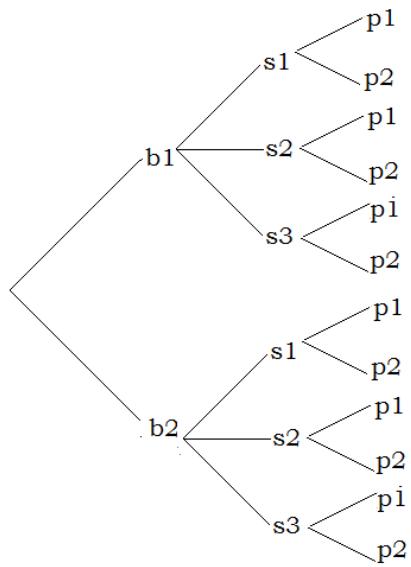
Solution

Step 1 — Label the items. Let \(b_1, b_2\) be the blouses, \(s_1, s_2, s_3\) the skirts, and \(p_1, p_2\) the pumps. The tree diagram adds a third level to the two-step tree from Example 7.2.1.

Step 2 — Count the branches. The tree now has \(12\) leaves, so there are \(12\) outfits.

Step 3 — Confirm with the multiplication axiom. Listing the choices at each step:

StepBlouseSkirtPumps
Choices232

$$2 \cdot 3 \cdot 2 = 12.$$

Answer: \(12\) possible outfits.

Try It Now 7.2.2

Source: Applied Finite Mathematics

A family dinner consists of one entree (4 choices), one side (3 choices), and one drink (2 choices). How many distinct dinners are possible?

Solution

Three steps with \(4\), \(3\), and \(2\) choices. By the multiplication axiom,

$$4 \cdot 3 \cdot 2 = 24 \text{ dinners.}$$

Example 7.3.1

Source: Applied Finite Mathematics

How many three-letter word sequences can be formed using the letters \(\{A, B, C, D\}\)?

Solution

Step 1 — Track the shrinking pool. Four choices for the first letter, three for the second (one is now used), two for the third.

Slot 1st 2nd 3rd
Choices 4 3 2

Step 2 — Multiply.

$$4 \cdot 3 \cdot 2 = 24 \text{ arrangements.}$$

Answer: \(24\) three-letter sequences.

Try It Now 7.3.1

Source: Applied Finite Mathematics

How many four-letter arrangements can be formed from the letters \(\{W, X, Y, Z\}\) if no letter repeats?

Solution

All four letters placed in four slots, no repetition:

$$4 \cdot 3 \cdot 2 \cdot 1 = 24 \text{ arrangements.}$$
Example 7.3.2

Source: Applied Finite Mathematics

How many permutations of the letters of the word ARTICLE have consonants in the first and last positions?

Solution

Step 1 — Identify the restricted pool. ARTICLE has \(7\) letters, \(4\) of which are consonants: R, T, C, L.

Step 2 — Fill the restricted slots first. The first slot must be one of the \(4\) consonants. Once one is chosen, \(3\) consonants remain for the last slot.

Step 3 — Fill the middle slots. After placing two letters, \(5\) letters remain for the \(5\) middle positions. Multiplication axiom: \(5 \cdot 4 \cdot 3 \cdot 2 \cdot 1\).

Slot 1st 2nd 3rd 4th 5th 6th 7th
Choices 4 5 4 3 2 1 3

Step 4 — Multiply.

$$4 \cdot 5 \cdot 4 \cdot 3 \cdot 2 \cdot 1 \cdot 3 = 1{,}440.$$

Answer: \(1{,}440\) permutations.

Example 7.3.3

Source: Applied Finite Mathematics

Given five letters \(\{A, B, C, D, E\}\), find:

a. The number of four-letter word sequences.

b. The number of three-letter word sequences.

c. The number of two-letter word sequences.

Solution

Each part is a straight shrinking-pool permutation starting from a pool of \(5\) letters.

(a) Four-letter sequences.

$$5 \cdot 4 \cdot 3 \cdot 2 = 120.$$

(b) Three-letter sequences.

$$5 \cdot 4 \cdot 3 = 60.$$

(c) Two-letter sequences.

$$5 \cdot 4 = 20.$$

Answer: (a) \(120\); (b) \(60\); (c) \(20\).

Try It Now 7.3.2

Source: Applied Finite Mathematics

How many permutations of the letters in PLANET have a vowel in the first position?

Solution

Step 1 — Count the restricted pool. PLANET has \(2\) vowels (A, E).

Step 2 — Place the first slot. \(2\) choices.

Step 3 — Fill the remaining \(5\) slots. \(5\) letters remain: \(5 \cdot 4 \cdot 3 \cdot 2 \cdot 1 = 120\).

Step 4 — Multiply.

$$2 \cdot 120 = 240 \text{ permutations.}$$

Example 7.3.4

Source: Applied Finite Mathematics

Compute the following using both formulas.

a. \(6P3\)

b. \(7P2\)

Solution

(a) \(6P3\).

Product form: \(n = 6\), \(r = 3\), so multiply three terms starting at \(6\):

$$6P3 = 6 \cdot 5 \cdot 4 = 120.$$

Factorial form:

$$6P3 = \dfrac{6!}{(6-3)!} = \dfrac{6!}{3!} = \dfrac{6 \cdot 5 \cdot 4 \cdot 3 \cdot 2 \cdot 1}{3 \cdot 2 \cdot 1} = 120.$$

(b) \(7P2\).

Product form: \(n = 7\), \(r = 2\):

$$7P2 = 7 \cdot 6 = 42.$$

Factorial form:

$$7P2 = \dfrac{7!}{5!} = \dfrac{7 \cdot 6 \cdot 5 \cdot 4 \cdot 3 \cdot 2 \cdot 1}{5 \cdot 4 \cdot 3 \cdot 2 \cdot 1} = 42.$$

Answer: (a) \(120\); (b) \(42\).

Try It Now 7.3.3

Source: Applied Finite Mathematics

Compute \(8P4\) using the product form.

Solution

\(n = 8\), \(r = 4\), multiply four terms starting at \(8\):

$$8P4 = 8 \cdot 7 \cdot 6 \cdot 5 = 1{,}680.$$
Example 7.3.5

Source: Applied Finite Mathematics

In how many different ways can \(4\) people be seated in a straight line if two of them insist on sitting next to each other?

Solution

Step 1 — Glue the two together. Call the people A, B, C, D, and suppose A and B must sit together. Treat AB as a single combined "super-person," leaving three items: AB, C, D.

Step 2 — Arrange the three items. Three items in three seats: \(3! = 6\) orderings.

Step 3 — Account for the internal order of AB. A and B can sit either as AB or BA — \(2!\) internal orderings.

Step 4 — Multiply.

$$3! \cdot 2! = 6 \cdot 2 = 12.$$

Sanity check — enumerate. With AB glued: ABCD, ABDC, CABD, DABC, CDAB, DCAB. With BA glued: BACD, BADC, CBAD, DBAC, CDBA, DCBA. That's \(12\) arrangements — match.

Answer: \(12\) seatings.

Example 7.3.6

Source: Applied Finite Mathematics

You have \(4\) math books and \(5\) history books to put on a shelf that has \(5\) slots. In how many ways can the books be shelved if the first three slots are filled with math books and the next two slots are filled with history books?

Solution

Step 1 — Count the math-book arrangements. Three slots from \(4\) math books: \(4P3 = 4 \cdot 3 \cdot 2 = 24\).

Step 2 — Count the history-book arrangements. Two slots from \(5\) history books: \(5P2 = 5 \cdot 4 = 20\).

Step 3 — Multiply. Every math-book arrangement pairs with every history-book arrangement.

$$(4P3)(5P2) = 24 \cdot 20 = 480.$$

Slot1st2nd3rd4th5th
Choices43254

Answer: \(480\) arrangements.

Try It Now 7.3.4

Source: Applied Finite Mathematics

In how many ways can \(6\) people be seated in a row if three specific people must sit together?

Solution

Step 1 — Glue the three together. Treat the trio as a single super-person, leaving \(4\) items to arrange.

Step 2 — Arrange the four items. \(4! = 24\).

Step 3 — Account for the internal order of the trio. \(3! = 6\) orderings within the glued group.

Step 4 — Multiply.

$$4! \cdot 3! = 24 \cdot 6 = 144 \text{ seatings.}$$

Example 7.4.1

Source: Applied Finite Mathematics

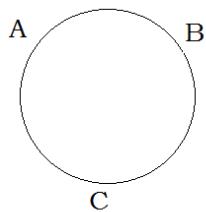
In how many different ways can five people be seated at a circular table?

Solution

Step 1 — Anchor the first person. The first person is a placeholder; their seat doesn't create a new arrangement.

Step 2 — Permute the remaining four. Four seats for four people: \(4 \cdot 3 \cdot 2 \cdot 1\).

Slot 1st (anchor) 2nd 3rd 4th 5th
Choices 1 4 3 2 1

Step 3 — Multiply.

$$(5 - 1)! = 4! = 24.$$

Answer: \(24\) seatings.

Example 7.4.2

Source: Applied Finite Mathematics

In how many ways can four couples be seated at a round table if the men and women want to sit alternately?

Solution

Step 1 — Anchor the first person. Say a man sits down first — one choice for the anchor seat.

Step 2 — Alternate by gender. The seat next to the anchor must hold a woman: \(4\) choices. The next seat holds a man: \(3\) choices remaining. Continue alternating, shrinking the pool of each gender as we go.

Slot 1st (man) 2nd (W) 3rd (M) 4th (W) 5th (M) 6th (W) 7th (M) 8th (W)
Choices 1 4 3 3 2 2 1 1

Step 3 — Multiply.

$$1 \cdot 4 \cdot 3 \cdot 3 \cdot 2 \cdot 2 \cdot 1 \cdot 1 = 144.$$

Answer: \(144\) seatings.

Try It Now 7.4.1

Source: Applied Finite Mathematics

In how many ways can six people be seated at a round table?

Solution

Anchor one person and arrange the remaining five:

$$(6 - 1)! = 5! = 120 \text{ seatings.}$$
Example 7.4.3

Source: Applied Finite Mathematics

Find the number of different permutations of the letters of the word MISSISSIPPI.

Solution

Step 1 — Count letters and repeats. MISSISSIPPI has \(11\) letters: \(4\) S's, \(4\) I's, \(2\) P's, and \(1\) M.

Step 2 — Apply the formula.

$$\dfrac{11!}{4!\, 4!\, 2!\, 1!} = \dfrac{39{,}916{,}800}{24 \cdot 24 \cdot 2 \cdot 1} = 34{,}650.$$

Answer: \(34{,}650\) permutations.

Example 7.4.4

Source: Applied Finite Mathematics

If a coin is tossed six times, how many different outcomes consist of 4 heads and 2 tails?

Solution

Step 1 — Reframe as a permutation with similar elements. Ordering the outcomes is the same as arranging the letters HHHHTT — \(6\) items with \(4\) H's and \(2\) T's.

Step 2 — Apply the formula.

$$\dfrac{6!}{4!\, 2!} = \dfrac{720}{24 \cdot 2} = 15.$$

Answer: \(15\) outcomes.

Example 7.4.5

Source: Applied Finite Mathematics

In how many different ways can 4 nickels, 3 dimes, and 2 quarters be arranged in a row?

Solution

Step 1 — Treat coins of the same denomination as identical. Nine coins total: \(4\) nickels, \(3\) dimes, \(2\) quarters.

Step 2 — Apply the formula.

$$\dfrac{9!}{4!\, 3!\, 2!} = \dfrac{362{,}880}{24 \cdot 6 \cdot 2} = 1{,}260.$$

Answer: \(1{,}260\) arrangements.

Example 7.4.6

Source: Applied Finite Mathematics

A stockbroker wants to assign 20 new clients equally to 4 of its salespeople. In how many different ways can this be done?

Solution

Step 1 — Reframe as an ordered partition. Each salesperson gets \(5\) clients. Think of it as arranging 20 labels — five "A"s, five "B"s, five "C"s, and five "D"s — where the label tells you which salesperson the client goes to.

Step 2 — Apply the formula.

$$\dfrac{20!}{5!\, 5!\, 5!\, 5!} = 11{,}732{,}745{,}024.$$

Answer: \(11{,}732{,}745{,}024\) assignments.

Example 7.4.7

Source: Applied Finite Mathematics

Challenge problem. A shopping mall has a straight row of 5 flagpoles at its main entrance plaza. It has 3 identical green flags and 2 identical yellow flags. How many distinct arrangements of flags on the flagpoles are possible?

Solution

Step 1 — Reframe as a permutation of GGGYY. Five letters, \(3\) G's, \(2\) Y's.

Step 2 — Apply the formula.

$$\dfrac{5!}{3!\, 2!} = \dfrac{120}{6 \cdot 2} = 10.$$

Step 3 — Enumerate to confirm. Listing the 10 distinct arrangements:

$$\text{GGGYY, GGYGY, GGYYG, GYGGY, GYGYG, GYYGG, YGGGY, YGGYG, YGYGG, YYGGG.}$$

Answer: \(10\) arrangements.

Try It Now 7.4.2

Source: Applied Finite Mathematics

How many distinct arrangements can be made from the letters of the word BANANA?

Solution

Step 1 — Count letters and repeats. BANANA has \(6\) letters: \(3\) A's, \(2\) N's, \(1\) B.

Step 2 — Apply the formula.

$$\dfrac{6!}{3!\, 2!\, 1!} = \dfrac{720}{6 \cdot 2} = 60 \text{ arrangements.}$$
Example 7.5.1

Source: Applied Finite Mathematics

Given the set of letters \(\{\mathrm{A}, \mathrm{B}, \mathrm{C}, \mathrm{D}\}\). List the combinations of three letters, and then from these combinations list the permutations of three letters.

Solution

Step 1 — List the combinations. Pick 3 letters at a time from 4 — ignoring order, we get

$$\mathrm{ABC}, \quad \mathrm{BCD}, \quad \mathrm{ACD}, \quad \mathrm{ABD}.$$

That's \(4\) combinations.

Step 2 — Expand each combination into \(3!\) permutations. Each three-letter combination can be arranged in \(3! = 6\) orders:

Combination Its \(6\) permutations
ABC ABC, ACB, BAC, BCA, CAB, CBA
BCD BCD, BDC, CBD, CDB, DBC, DCB
ACD ACD, ADC, CAD, CDA, DAC, DCA
ABD ABD, ADB, BAD, BDA, DAB, DBA

Step 3 — Connect the two counts. There are \(4 \cdot 3! = 24\) permutations total, matching \({}_4P_3 = 24\). Therefore

$$ {}_4P_3 \;=\; 3! \cdot {}_4C_3 \quad \implies \quad {}_4C_3 \;=\; \dfrac{{}_4P_3}{3!} \;=\; \dfrac{24}{6} \;=\; 4. $$

Answer: \(4\) combinations, each expanding into \(6\) permutations for \(24\) total.

Try It Now 7.5.1

Source: Applied Finite Mathematics

From the set \(\{\mathrm{P}, \mathrm{Q}, \mathrm{R}, \mathrm{S}\}\), list all combinations of two letters. How many are there, and how many two-letter permutations does this correspond to?

Solution

Step 1 — List the size-2 combinations.

$$\mathrm{PQ}, \quad \mathrm{PR}, \quad \mathrm{PS}, \quad \mathrm{QR}, \quad \mathrm{QS}, \quad \mathrm{RS}.$$

That's \(6\) combinations, so \({}_4C_2 = 6\).

Step 2 — Each combination has \(2! = 2\) permutations. Total permutations: \(6 \cdot 2 = 12 = {}_4P_2\). ✓

Answer: \(6\) combinations; \(12\) corresponding permutations.

Example 7.5.2

Source: Applied Finite Mathematics

Compute each combination.

a) \({}_5C_3\)

b) \({}_7C_3\)

Solution

Step 1 — Apply the formula to (a).

$$ {}_5C_3 = \dfrac{5!}{(5 - 3)!\, 3!} = \dfrac{5!}{2!\, 3!} = \dfrac{120}{2 \cdot 6} = \dfrac{120}{12} = 10. $$

Step 2 — Apply the formula to (b).

$$ {}_7C_3 = \dfrac{7!}{(7 - 3)!\, 3!} = \dfrac{7!}{4!\, 3!} = \dfrac{5040}{24 \cdot 6} = \dfrac{5040}{144} = 35. $$

Answer: \({}_5C_3 = 10\); \({}_7C_3 = 35\).

Example 7.5.3

Source: Applied Finite Mathematics

In how many different ways can a student select to answer five questions from a test that has seven questions, if the order of the selection is not important?

Solution

Step 1 — Identify order-matters or not. The student just needs to pick which questions to answer; the order of selection doesn't affect which five get answered. This is a combination problem.

Step 2 — Apply the formula.

$$ {}_7C_5 = \dfrac{7!}{(7 - 5)!\, 5!} = \dfrac{7!}{2!\, 5!} = \dfrac{5040}{2 \cdot 120} = \dfrac{5040}{240} = 21. $$

Answer: \(21\) ways.

Example 7.5.4

Source: Applied Finite Mathematics

Challenge problem. How many line segments can be drawn by connecting any two of the six points that lie on the circumference of a circle?

Solution

Step 1 — Check for order. The segment from A to B is the same segment as from B to A — order of the endpoints does not produce a new segment. This is a combination problem.

Step 2 — Apply the formula. Choose \(2\) endpoints out of \(6\):

$$ {}_6C_2 = \dfrac{6!}{(6 - 2)!\, 2!} = \dfrac{6!}{4!\, 2!} = \dfrac{720}{24 \cdot 2} = \dfrac{720}{48} = 15. $$

Answer: \(15\) line segments.

Example 7.5.5

Source: Applied Finite Mathematics

There are ten people at a party. If they all shake hands, how many handshakes are possible?

Solution

Step 1 — Check for order. Between any two people there is exactly one handshake — "Al shakes Bob" and "Bob shakes Al" is the same event. This is a combination problem.

Step 2 — Apply the formula.

$$ {}_{10}C_2 = \dfrac{10!}{(10 - 2)!\, 2!} = \dfrac{10!}{8!\, 2!} = \dfrac{10 \cdot 9}{2} = \dfrac{90}{2} = 45. $$

Answer: \(45\) handshakes.

Example 7.5.6

Source: Applied Finite Mathematics

Challenge problem. The shopping area of a town is in the shape of a square that is 5 blocks by 5 blocks. How many different routes can a taxi driver take to go from one corner of the shopping area to the opposite cater-corner?
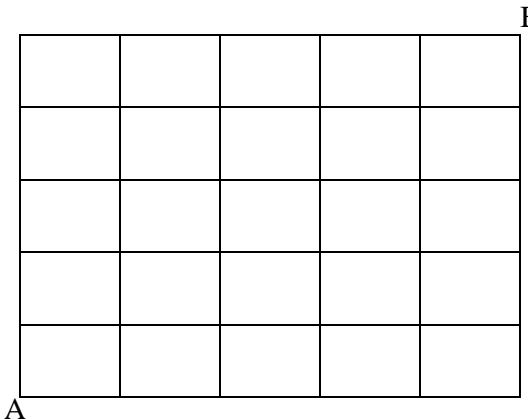
Solution

Step 1 — Model the route. To get from point A (lower-left) to point B (upper-right), the driver must travel \(5\) blocks east and \(5\) blocks north — \(10\) blocks total — in any order. Encode a route as a string of \(5\) H's (horizontal) and \(5\) V's (vertical), e.g.

$$\mathrm{HHHHHVVVVV}.$$

Step 2 — Count via combinations. Of the \(10\) block-positions, pick which \(5\) are the horizontal moves — the other \(5\) are automatically vertical. That's

$$ {}_{10}C_5 = \dfrac{10!}{5!\, 5!} = \dfrac{3{,}628{,}800}{120 \cdot 120} = \dfrac{3{,}628{,}800}{14{,}400} = 252. $$

Step 3 — Confirm via permutations with similar elements (section 7.4). The number of arrangements of \(\mathrm{HHHHHVVVVV}\) is

$$\dfrac{10!}{5!\, 5!} = 252,$$

which matches. Indeed, by definition \({}_{10}C_5 = \dfrac{10!}{5!\, 5!}\) — the two methods are the same calculation.

Answer: \(252\) routes.

Example 7.5.7

Source: Applied Finite Mathematics

If a coin is tossed six times, in how many ways can it fall four heads and two tails?

Solution

Step 1 — Solve via similar elements (section 7.4 review). Arranging HHHHTT — \(6\) items, \(4\) H's, \(2\) T's:

$$\dfrac{6!}{4!\, 2!} = \dfrac{720}{24 \cdot 2} = \dfrac{720}{48} = 15.$$

Step 2 — Solve via combinations. There are \(6\) toss-positions; choose which \(4\) are heads — the other \(2\) are automatically tails:

$$ {}_6C_4 = \dfrac{6!}{2!\, 4!} = 15. $$

Equivalently, pick which \(2\) are tails: \({}_6C_2 = \dfrac{6!}{4!\, 2!} = 15\).

Step 3 — Note the symmetry. Both calculations give \(15\), illustrating \({}_6C_4 = {}_6C_2\) — "choose \(4\) to be H" and "choose \(2\) to be T" are the same decision.

Answer: \(15\) outcomes.

Try It Now 7.5.2

Source: Applied Finite Mathematics

A pizza shop offers \(8\) different toppings. In how many ways can you pick \(3\) toppings for a pizza?

Solution

Step 1 — Order or not? Choosing olives-then-mushrooms gives the same pizza as mushrooms-then-olives. This is a combination problem.

Step 2 — Apply the formula.

$$ {}_8C_3 = \dfrac{8!}{(8 - 3)!\, 3!} = \dfrac{8!}{5!\, 3!} = \dfrac{8 \cdot 7 \cdot 6}{3 \cdot 2 \cdot 1} = \dfrac{336}{6} = 56. $$

Answer: \(56\) three-topping pizzas.

Example 7.6.1

Source: Applied Finite Mathematics

How many five-person committees consisting of 2 men and 3 women can be chosen from a total of 4 men and 4 women?

Solution

Step 1 — Identify the two pools. We pull \(2\) men from a pool of \(4\) men, and \(3\) women from a pool of \(4\) women. The two selections are independent.

Step 2 — Count each pool with a combination.

$$\text{Men: } {}_4\mathrm{C}_2 = \dfrac{4!}{2!\,2!} = 6.$$ $$\text{Women: } {}_4\mathrm{C}_3 = \dfrac{4!}{3!\,1!} = 4.$$

Step 3 — Apply the multiplication axiom. Every 2-man committee can be paired with every 3-woman committee.

$$6 \cdot 4 = 24.$$

Answer: \(24\) five-person committees.

Example 7.6.2

Source: Applied Finite Mathematics

How many five-letter word sequences consisting of 2 vowels and 3 consonants can be formed from the letters of the word INTRODUCE?

Solution

Step 1 — Count vowels and consonants in INTRODUCE. The nine letters are I, N, T, R, O, D, U, C, E: that is \(4\) vowels (I, O, U, E) and \(5\) consonants (N, T, R, D, C).

Step 2 — Choose the letters. Pick \(2\) of the \(4\) vowels and \(3\) of the \(5\) consonants.

$${}_4\mathrm{C}_2 \cdot {}_5\mathrm{C}_3 = 6 \cdot 10 = 60.$$

Step 3 — Arrange the chosen letters. Each 5-letter group can be ordered in \(5!\) different sequences.

$$60 \cdot 5! = 60 \cdot 120 = 7{,}200.$$

Answer: \(7{,}200\) word sequences.

Try It Now 7.6.1

Source: Applied Finite Mathematics

A club has 5 men and 7 women. In how many ways can a committee of 2 men and 2 women be chosen?

Solution

Step 1 — One combination per pool.

$${}_5\mathrm{C}_2 \cdot {}_7\mathrm{C}_2 = 10 \cdot 21 = 210.$$

Answer: \(210\) committees.

Example 7.6.3

Source: Applied Finite Mathematics

A high school club consists of 4 freshmen, 5 sophomores, 5 juniors, and 6 seniors. How many ways can a committee of 4 people be chosen that includes

a) One student from each class?

b) All juniors?

c) Two freshmen and 2 seniors?

d) No freshmen?

e) At least three seniors?

Solution

Part (a) — One from each class. Pick \(1\) from each pool and multiply.

$${}_4\mathrm{C}_1 \cdot {}_5\mathrm{C}_1 \cdot {}_5\mathrm{C}_1 \cdot {}_6\mathrm{C}_1 = 4 \cdot 5 \cdot 5 \cdot 6 = 600.$$

Part (b) — All juniors. Pick all \(4\) members from the \(5\) juniors and nothing from the rest.

$${}_5\mathrm{C}_4 = 5.$$

Part (c) — Two freshmen and two seniors. Pick \(2\) of the \(4\) freshmen and \(2\) of the \(6\) seniors.

$${}_4\mathrm{C}_2 \cdot {}_6\mathrm{C}_2 = 6 \cdot 15 = 90.$$

Part (d) — No freshmen. The committee must come entirely from the remaining \(5 + 5 + 6 = 16\) non-freshman students.

$${}_{16}\mathrm{C}_4 = \dfrac{16!}{4!\,12!} = 1{,}820.$$

Part (e) — At least three seniors. Split into "exactly 3 seniors" and "exactly 4 seniors." With \(6\) seniors and \(4 + 5 + 5 = 14\) non-seniors:

$$\underbrace{{}_6\mathrm{C}_3 \cdot {}_{14}\mathrm{C}_1}_{\text{3 seniors}} + \underbrace{{}_6\mathrm{C}_4}_{\text{4 seniors}} = 20 \cdot 14 + 15 = 280 + 15 = 295.$$

Answer: (a) \(600\), (b) \(5\), (c) \(90\), (d) \(1{,}820\), (e) \(295\).

Try It Now 7.6.2

Source: Applied Finite Mathematics

From a group of 4 men and 6 women, how many 4-person committees contain at least 3 women?

Solution

Step 1 — Split into cases. "At least 3 women" means exactly 3 women or exactly 4 women.

Step 2 — Count each case.

$${}_6\mathrm{C}_3 \cdot {}_4\mathrm{C}_1 + {}_6\mathrm{C}_4 = 20 \cdot 4 + 15 = 80 + 15 = 95.$$

Answer: \(95\) committees.

Example 7.6.4

Source: Applied Finite Mathematics

A standard deck of playing cards has \(52\) cards consisting of \(4\) suits each with \(13\) cards. In how many different ways can a 5-card hand consisting of four cards of one suit and one of another be drawn?

Solution

Step 1 — Choose the first suit. Any of the \(4\) suits can supply the four-of-a-suit.

$${}_4\mathrm{C}_1 = 4.$$

Step 2 — Choose 4 cards from that suit. Each suit has \(13\) cards.

$${}_{13}\mathrm{C}_4 = 715.$$

Step 3 — Choose the other suit. One of the remaining \(3\) suits supplies the single card.

$${}_3\mathrm{C}_1 = 3.$$

Step 4 — Choose 1 card from that suit.

$${}_{13}\mathrm{C}_1 = 13.$$

Step 5 — Multiply.

$$4 \cdot 715 \cdot 3 \cdot 13 = 111{,}540.$$

Answer: \(111{,}540\) five-card hands.

Try It Now 7.6.3

Source: Applied Finite Mathematics

How many 5-card hands from a standard deck contain exactly 3 hearts and 2 spades?

Solution

Step 1 — Pick the hearts and the spades separately.

$${}_{13}\mathrm{C}_3 \cdot {}_{13}\mathrm{C}_2 = 286 \cdot 78 = 22{,}308.$$

Answer: \(22{,}308\) hands.

Example 7.7.1

Source: Applied Finite Mathematics

Find the coefficient of the term \(x^2 y^5\) in the expansion of \((x + y)^7\).

Solution

Step 1 — Rewrite the seventh power as seven factors.

$$(x + y)^7 = (x + y)(x + y)(x + y)(x + y)(x + y)(x + y)(x + y).$$

Step 2 — Decide how to get \(x^2 y^5\) from the product. We need an \(x\) from exactly two of the seven factors and a \(y\) from the other five.

Step 3 — Count the ways. Choose which \(2\) of the \(7\) factors contribute an \(x\):

$$\binom{7}{2} = \dfrac{7!}{2!\,5!} = 21.$$

Answer: The coefficient of \(x^2 y^5\) is \(21\).

Try It Now 7.7.1

Source: Applied Finite Mathematics

Find the coefficient of the term \(x^3 y^2\) in the expansion of \((x + y)^5\).

Solution

Choose which \(2\) of the \(5\) factors contribute a \(y\):

$$\binom{5}{2} = \dfrac{5!}{2!\,3!} = 10.$$

The coefficient is \(10\).

Example 7.7.2

Source: Applied Finite Mathematics

Expand \((x + y)^7\).

Solution

Step 1 — Write the skeleton without coefficients. Powers of \(x\) step down from \(7\); powers of \(y\) step up from \(0\):

$$(x + y)^7 = \square\,x^7 + \square\,x^6 y + \square\,x^5 y^2 + \square\,x^4 y^3 + \square\,x^3 y^4 + \square\,x^2 y^5 + \square\,x y^6 + \square\,y^7.$$

Step 2 — Fill in each coefficient with \(\binom{7}{r}\).

Term \(\binom{7}{r}\) Value
\(x^7\) \(\binom{7}{0}\) \(1\)
\(x^6 y\) \(\binom{7}{1}\) \(7\)
\(x^5 y^2\) \(\binom{7}{2}\) \(21\)
\(x^4 y^3\) \(\binom{7}{3}\) \(35\)
\(x^3 y^4\) \(\binom{7}{4}\) \(35\)
\(x^2 y^5\) \(\binom{7}{5}\) \(21\)
\(x y^6\) \(\binom{7}{6}\) \(7\)
\(y^7\) \(\binom{7}{7}\) \(1\)

Step 3 — Assemble the expansion.

$$(x + y)^7 = x^7 + 7x^6 y + 21 x^5 y^2 + 35 x^4 y^3 + 35 x^3 y^4 + 21 x^2 y^5 + 7 x y^6 + y^7.$$

Answer: \((x + y)^7 = x^7 + 7x^6 y + 21 x^5 y^2 + 35 x^4 y^3 + 35 x^3 y^4 + 21 x^2 y^5 + 7 x y^6 + y^7\).

Example 7.7.3

Source: Applied Finite Mathematics

Expand \((3a - 2b)^4\).

Solution

Step 1 — Match the template \((x + y)^n\). Let \(x = 3a\) and \(y = -2b\); then \(n = 4\).

Step 2 — Apply the Binomial Theorem.

$$(3a - 2b)^4 = \binom{4}{0}(3a)^4 + \binom{4}{1}(3a)^3(-2b) + \binom{4}{2}(3a)^2(-2b)^2 + \binom{4}{3}(3a)(-2b)^3 + \binom{4}{4}(-2b)^4.$$

Step 3 — Evaluate each coefficient and power carefully. The coefficients are \(\binom{4}{0}, \binom{4}{1}, \binom{4}{2}, \binom{4}{3}, \binom{4}{4} = 1, 4, 6, 4, 1\). Compute each piece:

- \(1 \cdot (3a)^4 = 1 \cdot 81 a^4 = 81 a^4\) - \(4 \cdot (3a)^3 \cdot (-2b) = 4 \cdot 27 a^3 \cdot (-2 b) = -216 a^3 b\) - \(6 \cdot (3a)^2 \cdot (-2b)^2 = 6 \cdot 9 a^2 \cdot 4 b^2 = 216 a^2 b^2\) - \(4 \cdot (3a) \cdot (-2b)^3 = 4 \cdot 3 a \cdot (-8 b^3) = -96 a b^3\) - \(1 \cdot (-2b)^4 = 16 b^4\)

Step 4 — Combine.

$$(3a - 2b)^4 = 81 a^4 - 216 a^3 b + 216 a^2 b^2 - 96 a b^3 + 16 b^4.$$

Answer: \((3a - 2b)^4 = 81 a^4 - 216 a^3 b + 216 a^2 b^2 - 96 a b^3 + 16 b^4\).

Try It Now 7.7.2

Source: Applied Finite Mathematics

Expand \((x - 2y)^4\).

Solution

Let \(X = x\) and \(Y = -2y\) in \((X + Y)^4\). The coefficients are \(1, 4, 6, 4, 1\):

$$(x - 2y)^4 = x^4 + 4 x^3(-2y) + 6 x^2(-2y)^2 + 4 x(-2y)^3 + (-2y)^4.$$

Simplify each term:

$$(x - 2y)^4 = x^4 - 8 x^3 y + 24 x^2 y^2 - 32 x y^3 + 16 y^4.$$
Example 7.7.4

Source: Applied Finite Mathematics

Find the fifth term of the expansion \((3a - 2b)^7\).

Solution

Step 1 — Identify the pieces. Match \((x + y)^n\) with \(x = 3a\), \(y = -2b\), \(n = 7\). The term number is \(r = 5\), so the exponent on \(y\) is \(r - 1 = 4\) and the exponent on \(x\) is \(7 - 4 = 3\).

Step 2 — Coefficient. The coefficient is \(\binom{7}{4}\):

$$\binom{7}{4} = \dfrac{7!}{4!\,3!} = 35.$$

Step 3 — Assemble the term.

$$(35)(3a)^3(-2b)^4 = 35 \cdot 27 a^3 \cdot 16 b^4.$$

Step 4 — Multiply the constants. \(35 \cdot 27 = 945\) and \(945 \cdot 16 = 15{,}120\).

Answer: The fifth term is \(15{,}120\, a^3 b^4\).

Try It Now 7.7.3

Source: Applied Finite Mathematics

Find the third term of the expansion \((2x - 3y)^6\).

Solution

Match \((x + y)^n\) with \(x = 2x\), \(y = -3y\), \(n = 6\). For the third term, \(r = 3\) so the exponent on \(y\) is \(2\) and on \(x\) is \(4\). The coefficient is

$$\binom{6}{2} = \dfrac{6!}{2!\,4!} = 15.$$

The third term is

$$15\,(2x)^4(-3y)^2 = 15 \cdot 16 x^4 \cdot 9 y^2 = 2{,}160\, x^4 y^2.$$

Problem Set 7.1

Source: Applied Finite Mathematics

Find the indicated sets.

Problem 1. List all subsets of the following set: \(\{\text{Priya, Meera}\}\).

Problem 1 Solution

Step 1 — Identify the set and its size:

The set is \(\{\text{Priya, Meera}\}\), which has 2 elements. A set with \(n\) elements has \(2^n\) subsets, so we expect \(2^2 = 4\) subsets.

Step 2 — List all subsets systematically:

Start with the empty set, then single-element subsets, then the full set:

  • \(\emptyset\) (the empty set)
  • \(\{\text{Priya}\}\)
  • \(\{\text{Meera}\}\)
  • \(\{\text{Priya, Meera}\}\)

Answer: The subsets are \(\emptyset\), \(\{\text{Priya}\}\), \(\{\text{Meera}\}\), \(\{\text{Priya, Meera}\}\).

Problem 2. List all subsets of the following set: \(\{\text{Diego, Camila, Valentina}\}\).

Problem 2 Solution

Step 1 — Identify the set and its size:

The set is \(\{\text{Diego, Camila, Valentina}\}\), which has 3 elements. A set with \(n\) elements has \(2^n\) subsets, so we expect \(2^3 = 8\) subsets.

Step 2 — List all subsets systematically:

Start with the empty set, then single-element subsets, then two-element subsets, then the full set:

  • \(\emptyset\)
  • \(\{\text{Diego}\}\)
  • \(\{\text{Camila}\}\)
  • \(\{\text{Valentina}\}\)
  • \(\{\text{Diego, Camila}\}\)
  • \(\{\text{Diego, Valentina}\}\)
  • \(\{\text{Camila, Valentina}\}\)
  • \(\{\text{Diego, Camila, Valentina}\}\)

Answer: The 8 subsets are \(\emptyset\), \(\{\text{Diego}\}\), \(\{\text{Camila}\}\), \(\{\text{Valentina}\}\), \(\{\text{Diego, Camila}\}\), \(\{\text{Diego, Valentina}\}\), \(\{\text{Camila, Valentina}\}\), \(\{\text{Diego, Camila, Valentina}\}\).

Problem 3. List the elements of the following set: \(\{\text{Santiago, Isabela, Andres, Gabriela}\} \cap \{\text{Isabela, Andres, Gabriela, Nicolas}\}\).

Problem 3 Solution

Step 1 — Identify the two sets:

The first set is \(\{\text{Santiago, Isabela, Andres, Gabriela}\}\) and the second set is \(\{\text{Isabela, Andres, Gabriela, Nicolas}\}\).

Step 2 — Find the intersection:

The intersection consists of all elements that appear in both sets. Comparing element by element:

  • Isabela appears in both ✓
  • Andres appears in both ✓
  • Gabriela appears in both ✓
  • Santiago appears only in the first set ✗
  • Nicolas appears only in the second set ✗

Answer: \(\{\text{Isabela, Andres, Gabriela}\}\)

Problem 4. List the elements of the following set: \(\{\text{Lucia, Rafael, Elena, Maria}\} \cup \{\text{Rafael, Elena, Maria, Sofia}\}\).

Problem 4 Solution

Step 1 — Identify the two sets:

The first set is \(\{\text{Lucia, Rafael, Elena, Maria}\}\) and the second set is \(\{\text{Rafael, Elena, Maria, Sofia}\}\).

Step 2 — Find the union:

The union consists of all elements that appear in either set (without duplicates). Combining all distinct elements:

  • Lucia (from first set)
  • Rafael (in both, listed once)
  • Elena (in both, listed once)
  • Maria (in both, listed once)
  • Sofia (from second set)

Answer: \(\{\text{Lucia, Rafael, Elena, Maria, Sofia}\}\)

Problems 5–8: Let the universal set \(U = \{a, b, c, d, e, f, g, h, i, j\}\), \(V = \{a, e, i, f, h\}\), \(W = \{a, c, e, g, i\}\). List the members of the following sets.

Problem 5. \(V \cup W\)

Problem 5 Solution

Step 1 — Identify the sets:

\(V = \{a, e, i, f, h\}\) and \(W = \{a, c, e, g, i\}\).

Step 2 — Find the union \(V \cup W\):

The union contains every element that is in \(V\) or in \(W\) (or both). Combining all distinct elements from both sets:

  • From \(V\): \(a, e, i, f, h\)
  • From \(W\) (not already listed): \(c, g\)

Answer: \(V \cup W = \{a, c, e, f, g, h, i\}\)

Problem 6. \(V \cap W\)

Problem 6 Solution

Step 1 — Identify the sets:

\(V = \{a, e, i, f, h\}\) and \(W = \{a, c, e, g, i\}\).

Step 2 — Find the intersection \(V \cap W\):

The intersection contains only the elements that appear in both \(V\) and \(W\). Checking each element of \(V\):

  • \(a\): is in \(W\) ✓
  • \(e\): is in \(W\) ✓
  • \(i\): is in \(W\) ✓
  • \(f\): not in \(W\) ✗
  • \(h\): not in \(W\) ✗

Answer: \(V \cap W = \{a, e, i\}\)

Problem 7. \(\overline{V \cup W}\)

Problem 7 Solution

Step 1 — Find \(V \cup W\):

From Problem 5, \(V \cup W = \{a, c, e, f, g, h, i\}\).

Step 2 — Take the complement with respect to \(U\):

The complement \(\overline{V \cup W}\) consists of all elements of \(U\) that are not in \(V \cup W\).

$$U = \{a, b, c, d, e, f, g, h, i, j\}$$ $$V \cup W = \{a, c, e, f, g, h, i\}$$

Removing the elements of \(V \cup W\) from \(U\), the remaining elements are \(b, d, j\).

Answer: \(\overline{V \cup W} = \{b, d, j\}\)

Problem 8. \(\overline{V \cap W}\)

Problem 8 Solution

Step 1 — Find \(V \cap W\):

From Problem 6, \(V \cap W = \{a, e, i\}\).

Step 2 — Take the complement with respect to \(U\):

The complement \(\overline{V \cap W}\) consists of all elements of \(U\) that are not in \(V \cap W\).

$$U = \{a, b, c, d, e, f, g, h, i, j\}$$ $$V \cap W = \{a, e, i\}$$

Removing \(a, e, i\) from \(U\), the remaining elements are \(b, c, d, f, g, h, j\).

Answer: \(\overline{V \cap W} = \{b, c, d, f, g, h, j\}\)

Problems 9–12: Let the universal set \(U = \{1, 2, 3, 4, 5, 6, 7, 8, 9, 10\}\), \(A = \{1, 2, 3, 4, 5\}\), \(B = \{1, 3, 4, 6\}\), \(C = \{2, 4, 6\}\). List the members of the following sets.

Problem 9. \(A \cup B\)

Problem 9 Solution

Step 1 — Identify the sets:

\(A = \{1, 2, 3, 4, 5\}\) and \(B = \{1, 3, 4, 6\}\).

Step 2 — Find the union \(A \cup B\):

The union contains every element in \(A\) or \(B\). Combining all distinct elements:

  • From \(A\): \(1, 2, 3, 4, 5\)
  • From \(B\) (not already listed): \(6\)

Answer: \(A \cup B = \{1, 2, 3, 4, 5, 6\}\)

Problem 10. \(A \cap C\)

Problem 10 Solution

Step 1 — Identify the sets:

\(A = \{1, 2, 3, 4, 5\}\) and \(C = \{2, 4, 6\}\).

Step 2 — Find the intersection \(A \cap C\):

The intersection contains elements in both \(A\) and \(C\). Checking each element of \(C\):

  • \(2\): is in \(A\) ✓
  • \(4\): is in \(A\) ✓
  • \(6\): not in \(A\) ✗

Answer: \(A \cap C = \{2, 4\}\)

Problem 11. \(\overline{A \cup B} \cap C\)

Problem 11 Solution

Step 1 — Find \(A \cup B\):

From Problem 9, \(A \cup B = \{1, 2, 3, 4, 5, 6\}\).

Step 2 — Find the complement \(\overline{A \cup B}\):

The complement consists of all elements of \(U\) not in \(A \cup B\).

$$U = \{1, 2, 3, 4, 5, 6, 7, 8, 9, 10\}$$ $$A \cup B = \{1, 2, 3, 4, 5, 6\}$$ $$\overline{A \cup B} = \{7, 8, 9, 10\}$$

Step 3 — Find \(\overline{A \cup B} \cap C\):

Now intersect \(\{7, 8, 9, 10\}\) with \(C = \{2, 4, 6\}\). No element of \(\{7, 8, 9, 10\}\) appears in \(C\), so the intersection is empty.

Answer: \(\overline{A \cup B} \cap C = \emptyset\)

Problem 12. \(A \cup \overline{B \cap C}\)

Problem 12 Solution

Step 1 — Find \(B \cap C\):

\(B = \{1, 3, 4, 6\}\) and \(C = \{2, 4, 6\}\). The elements common to both are \(4\) and \(6\).

$$B \cap C = \{4, 6\}$$

Step 2 — Find the complement \(\overline{B \cap C}\):

Remove \(\{4, 6\}\) from \(U = \{1, 2, 3, 4, 5, 6, 7, 8, 9, 10\}\):

$$\overline{B \cap C} = \{1, 2, 3, 5, 7, 8, 9, 10\}$$

Step 3 — Find \(A \cup \overline{B \cap C}\):

Combine all elements of \(A = \{1, 2, 3, 4, 5\}\) with \(\overline{B \cap C} = \{1, 2, 3, 5, 7, 8, 9, 10\}\). The union includes every element from either set:

$$A \cup \overline{B \cap C} = \{1, 2, 3, 4, 5, 7, 8, 9, 10\}$$

Answer: \(A \cup \overline{B \cap C} = \{1, 2, 3, 4, 5, 7, 8, 9, 10\}\)

Use Venn diagrams to find the number of elements in the following sets.

Problem 13. In Mx. Yuki's class of 35 students, 12 students are taking history, 18 are taking English, and 4 are taking both. Draw a Venn diagram and use it to determine how many students are taking neither history nor English.

Problem 13 Solution

Step 1 — Set up the Venn diagram:

Draw two overlapping circles: one for History (H) and one for English (E). The overlapping region represents students taking both.

Step 2 — Fill in the overlap (both subjects):

The intersection has 4 students.

Step 3 — Fill in the History-only region:

History only = total History − both = \(12 - 4 = 8\).

Step 4 — Fill in the English-only region:

English only = total English − both = \(18 - 4 = 14\).

Step 5 — Find the number taking at least one subject:

At least one = History only + English only + both = \(8 + 14 + 4 = 26\).

Step 6 — Find the number taking neither:

Neither = total students − at least one = \(35 - 26 = 9\).

Answer: 9 students are taking neither history nor English.

Problem 14. In a survey of 1200 college students, 700 used Spotify to listen to music and 400 used iTunes to listen to music; of these, 100 used both.

  1. Draw a Venn diagram and find the number of people in each region of the diagram.
  2. How many used either Spotify or iTunes?
Problem 14 Solution

Step 1 — Set up the Venn diagram:

Draw two overlapping circles: one for Spotify (S) and one for iTunes (I).

Step 2 — Fill in the overlap (both services):

The intersection has 100 students.

Step 3 — Fill in the Spotify-only region:

Spotify only = total Spotify − both = \(700 - 100 = 600\).

Step 4 — Fill in the iTunes-only region:

iTunes only = total iTunes − both = \(400 - 100 = 300\).

Step 5 — Fill in the neither region:

Neither = total surveyed − (Spotify only + iTunes only + both) = \(1200 - (600 + 300 + 100) = 1200 - 1000 = 200\).

Step 6 — Answer part (a):

The Venn diagram regions contain: Spotify only = 600, iTunes only = 300, both = 100, neither = 200.

Step 7 — Answer part (b):

"Either Spotify or iTunes" means using at least one of the two services:

$$600 + 300 + 100 = 1000$$

Answer (a): Spotify only = 600, iTunes only = 300, both = 100, neither = 200.

Answer (b): 1000 students used either Spotify or iTunes.

Problem 15. A survey of athletes revealed that for their minor aches and pains, 30 used aspirin, 50 used ibuprofen, and 15 used both. How many athletes were surveyed?.

Problem 15 Solution

Step 1 — Set up the Venn diagram:

Draw two overlapping circles: one for Aspirin (A) and one for Ibuprofen (I).

Step 2 — Fill in the overlap (both medications):

The intersection has 15 athletes.

Step 3 — Fill in the Aspirin-only region:

Aspirin only = total Aspirin − both = \(30 - 15 = 15\).

Step 4 — Fill in the Ibuprofen-only region:

Ibuprofen only = total Ibuprofen − both = \(50 - 15 = 35\).

Step 5 — Find the total number of athletes surveyed:

Total = Aspirin only + Ibuprofen only + both = \(15 + 35 + 15 = 65\).

Answer: 65 athletes were surveyed.

Problem 16. In 2016, 80 college students were surveyed about what video services they subscribed to. Suppose the survey showed that 50 use Amazon Prime, 30 use Netflix, 20 use Hulu. Of those, 13 use Amazon Prime and Netflix, 9 use Amazon Prime and Hulu, 7 use Netflix and Hulu. 3 students use all three services.

  1. Draw a Venn diagram and use it to determine the number of people in each region of the diagram.
  2. How many use at least one of these?
  3. How many use none of these?
Problem 16 Solution

Step 1 — Set up the Venn diagram:

Draw three overlapping circles: Amazon Prime (A), Netflix (N), and Hulu (H).

Step 2 — Fill in the center (all three services):

All three = 3.

Step 3 — Fill in the two-service-only regions:

  • A∩N only (not H) = \(13 - 3 = 10\)
  • A∩H only (not N) = \(9 - 3 = 6\)
  • N∩H only (not A) = \(7 - 3 = 4\)

Step 4 — Fill in the single-service-only regions:

  • Amazon Prime only = \(50 - 10 - 6 - 3 = 31\)
  • Netflix only = \(30 - 10 - 4 - 3 = 13\)
  • Hulu only = \(20 - 6 - 4 - 3 = 7\)

Step 5 — Answer part (a):

The Venn diagram regions are: Amazon Prime only = 31, Netflix only = 13, Hulu only = 7, A∩N only = 10, A∩H only = 6, N∩H only = 4, all three = 3.

Step 6 — Answer part (b) — at least one service:

$$31 + 13 + 7 + 10 + 6 + 4 + 3 = 74$$

Step 7 — Answer part (c) — none of these:

$$80 - 74 = 6$$

Answer (a): Amazon Prime only = 31, Netflix only = 13, Hulu only = 7, A∩N only = 10, A∩H only = 6, N∩H only = 4, all three = 3.

Answer (b): 74 students use at least one of these services.

Answer (c): 6 students use none of these services.

Problem 17. A survey of 100 students at a college finds that 50 take math, 40 take English, and 30 take history. Of these 15 take English and math, 10 take English and history, 10 take math and history, and 5 take all three subjects. Draw a Venn diagram and find the numbers in each region. Use the diagram to answer the questions below.

  1. Find the number of students taking math but not the other two subjects.
  2. The number of students taking English or math but not history.
  3. The number of students taking none of these subjects.
Problem 17 Solution

Step 1 — Set up the Venn diagram:

Draw three overlapping circles: Math (M), English (E), and History (H).

Step 2 — Fill in the center (all three subjects):

All three = 5.

Step 3 — Fill in the two-subject-only regions:

  • E∩M only (not H) = \(15 - 5 = 10\)
  • E∩H only (not M) = \(10 - 5 = 5\)
  • M∩H only (not E) = \(10 - 5 = 5\)

Step 4 — Fill in the single-subject-only regions:

  • Math only = \(50 - 10 - 5 - 5 = 30\)
  • English only = \(40 - 10 - 5 - 5 = 20\)
  • History only = \(30 - 5 - 5 - 5 = 15\)

Step 5 — Find the number taking none:

Students in at least one = \(30 + 20 + 15 + 10 + 5 + 5 + 5 = 90\).

None = \(100 - 90 = 10\).

Step 6 — Answer part (a):

Students taking math but not the other two = Math only = 30.

Step 7 — Answer part (b):

Students taking English or math but not history = English only + Math only + E∩M only = \(20 + 30 + 10 = 60\).

Step 8 — Answer part (c):

Students taking none = 10.

Answer (a): 30 students take math but not the other two subjects.

Answer (b): 60 students take English or math but not history.

Answer (c): 10 students take none of these subjects.

Problem 18. In a survey of investors it was found that 100 invested in stocks, 60 in mutual funds, and 50 in bonds. Of these, 35 invested in stocks and mutual funds, 30 in mutual funds and bonds, 28 in stocks and bonds, and 20 in all three. Draw a Venn diagram and find the numbers in each region. Use the diagram to answer the questions below.

  1. Find the number of investors that participated in the survey.
  2. How many invested in stocks or mutual funds but not in bonds?
  3. How many invested in exactly one type of investment?
Problem 18 Solution

Step 1 — Set up the Venn diagram:

Draw three overlapping circles: Stocks (S), Mutual Funds (M), and Bonds (B).

Step 2 — Fill in the center (all three):

All three = 20.

Step 3 — Fill in the two-investment-only regions:

  • S∩M only (not B) = \(35 - 20 = 15\)
  • M∩B only (not S) = \(30 - 20 = 10\)
  • S∩B only (not M) = \(28 - 20 = 8\)

Step 4 — Fill in the single-investment-only regions:

  • Stocks only = \(100 - 15 - 8 - 20 = 57\)
  • Mutual Funds only = \(60 - 15 - 10 - 20 = 15\)
  • Bonds only = \(50 - 10 - 8 - 20 = 12\)

Step 5 — Answer part (a) — total investors:

$$57 + 15 + 12 + 15 + 8 + 10 + 20 = 137$$

Step 6 — Answer part (b) — stocks or mutual funds but not bonds:

This includes Stocks only + Mutual Funds only + S∩M only:

$$57 + 15 + 15 = 87$$

Step 7 — Answer part (c) — exactly one type of investment:

Stocks only + Mutual Funds only + Bonds only:

$$57 + 15 + 12 = 84$$

Answer (a): 137 investors participated in the survey.

Answer (b): 87 investors invested in stocks or mutual funds but not in bonds.

Answer (c): 84 investors invested in exactly one type of investment.

Problem 19. Using the same data as Problem 17 (100 students: 50 math, 40 English, 30 history; 15 E∩M, 10 E∩H, 10 M∩H, 5 in all three). For each of the following, draw a Venn diagram, shade the indicated set, and determine how many students are in it.

  1. Students who take at least one of these classes.
  2. Students who take exactly one of these classes.
  3. Students who take at least two of these classes.
  4. Students who take exactly two of these classes.
  5. Students who take at most two of these classes.
  6. Students who take English or Math but not both.
  7. Students who take Math or History but not English.
  8. Students who take all of these classes.
Problem 19 Solution

Step 1 — Recall the Venn diagram regions from Problem 17:

  • Math only = 30
  • English only = 20
  • History only = 15
  • E∩M only = 10
  • E∩H only = 5
  • M∩H only = 5
  • All three = 5
  • None = 10

Step 2 — Answer part (a) — at least one class:

$$30 + 20 + 15 + 10 + 5 + 5 + 5 = 90$$

Step 3 — Answer part (b) — exactly one class:

$$30 + 20 + 15 = 65$$

Step 4 — Answer part (c) — at least two classes:

$$10 + 5 + 5 + 5 = 25$$

Step 5 — Answer part (d) — exactly two classes:

$$10 + 5 + 5 = 20$$

Step 6 — Answer part (e) — at most two classes:

This means 0, 1, or 2 classes (everyone except those in all three):

$$100 - 5 = 95$$

Alternatively: none + exactly one + exactly two = \(10 + 65 + 20 = 95\).

Step 7 — Answer part (f) — English or Math but not both:

This is \((E \cup M) \setminus (E \cap M)\). Students in English or Math but not both:

  • English only = 20
  • Math only = 30
  • E∩H only (English and History, but not Math) = 5
  • M∩H only (Math and History, but not English) = 5
$$20 + 30 + 5 + 5 = 60$$

Step 8 — Answer part (g) — Math or History but not English:

Students in Math or History who do not take English:

  • Math only = 30
  • History only = 15
  • M∩H only = 5
$$30 + 15 + 5 = 50$$

Step 9 — Answer part (h) — all three classes:

All three = 5.

Answer (a): 90 students take at least one of these classes.

Answer (b): 65 students take exactly one of these classes.

Answer (c): 25 students take at least two of these classes.

Answer (d): 20 students take exactly two of these classes.

Answer (e): 95 students take at most two of these classes.

Answer (f): 60 students take English or Math but not both.

Answer (g): 50 students take Math or History but not English.

Answer (h): 5 students take all of these classes.

Problem 20. Using the same data as Problem 18 (investors: 100 stocks, 60 mutual funds, 50 bonds; 35 S∩M, 30 M∩B, 28 S∩B, 20 in all three). For each of the following, draw a Venn diagram, shade the indicated set, and determine how many investors are in it.

  1. Investors who invested in mutual funds only.
  2. Investors who invested in stocks and bonds but not mutual funds.
  3. Investors who invested in exactly one of these investments.
  4. Investors who invested in exactly two of these investments.
  5. Investors who invested in at least two of these investments.
  6. Investors who invested in at most two of these investments.
  7. Investors who did not invest in bonds.
  8. Investors who invested in all three investments.
Problem 20 Solution

Step 1 — Recall the Venn diagram regions from Problem 18:

  • Stocks only = 57
  • Mutual Funds only = 15
  • Bonds only = 12
  • S∩M only = 15
  • S∩B only = 8
  • M∩B only = 10
  • All three = 20
  • Total investors = 137

Step 2 — Answer part (a) — mutual funds only:

Mutual Funds only = 15.

Step 3 — Answer part (b) — stocks and bonds but not mutual funds:

S∩B only = 8.

Step 4 — Answer part (c) — exactly one investment:

Stocks only + Mutual Funds only + Bonds only = \(57 + 15 + 12 = 84\).

Step 5 — Answer part (d) — exactly two investments:

S∩M only + S∩B only + M∩B only = \(15 + 8 + 10 = 33\).

Step 6 — Answer part (e) — at least two investments:

Exactly two + all three = \(33 + 20 = 53\).

Step 7 — Answer part (f) — at most two investments:

Total − all three = \(137 - 20 = 117\).

Alternatively: exactly one + exactly two + none = \(84 + 33 + 0 = 117\). (Note: every surveyed investor is in at least one region, so "none" = 0.)

Step 8 — Answer part (g) — did not invest in bonds:

Stocks only + Mutual Funds only + S∩M only = \(57 + 15 + 15 = 87\).

Step 9 — Answer part (h) — all three investments:

All three = 20.

Answer (a): 15 investors invested in mutual funds only.

Answer (b): 8 investors invested in stocks and bonds but not mutual funds.

Answer (c): 84 investors invested in exactly one of these investments.

Answer (d): 33 investors invested in exactly two of these investments.

Answer (e): 53 investors invested in at least two of these investments.

Answer (f): 117 investors invested in at most two of these investments.

Answer (g): 87 investors did not invest in bonds.

Answer (h): 20 investors invested in all three investments.
7.2 Tree Diagrams and the Multiplication Axiom

Learning Objectives

In this section, you will learn to:
  1. Use tree diagrams to count possible outcomes in a multi-step process.
  2. Use the multiplication axiom to count possible outcomes in a multi-step process.

7.2.1 Counting with Tree Diagrams

Counting techniques are the backbone of probability. Before we can ask "what are the chances…?" we need to know how many outcomes are possible in total. A tree diagram is a visual method that lays out every outcome of a multi-step process, step by step, so we can count them directly.

Context Pause: Why count first? Every probability in the next chapter has the form \(P(\text{event}) = \dfrac{\text{favorable outcomes}}{\text{total outcomes}}\). If you can't count the total, you can't compute the probability. Counting techniques — trees, the multiplication axiom, permutations, and combinations — are the toolkit for the denominator. They're worth mastering.
Insight Note: A tree grows one level per step If a process has \(k\) steps, the finished tree has \(k\) levels of branches: each level represents one decision. The leaves of the tree (the endpoints of the final level) are the complete outcomes. Count the leaves and you've counted every possibility.

7.2.2 The Multiplication Axiom

Tree diagrams are great for visualization but painful once the numbers grow. A shortcut is hiding in the arithmetic we just did: we multiplied the number of choices at each step. That shortcut is called the multiplication axiom.

Context Pause: Adding the third step doesn't double the work

Adding a new step to a counting problem doesn't mean we redraw everything — it just means we multiply in one more factor. If we add shoes to the outfit problem above with \(2\) choices, the total becomes \(2 \cdot 3 \cdot 2 = 12\), not a new tree to enumerate by hand.

Insight Note: The axiom abstracts the tree

The multiplication axiom doesn't replace the tree — it summarises it. Every time you multiply, you're counting branches at a level of the tree you could have drawn. When a problem gets too big for a tree, the axiom is what the tree would have told you if you'd drawn it.

The Multiplication Axiom

If a first task can be done in \(m\) ways, and for each of those a second task can be done in \(n\) ways, then the two-task process can be completed in \(m \cdot n\) ways.

The axiom extends to any number of tasks: multiply the number of choices at each step.

7.2.3 Applying the Multiplication Axiom

With the axiom in hand, we can count the outcomes of processes where a tree diagram would be unwieldy. The examples that follow illustrate three common patterns: fixed slots with repetition, restricted slots (no repetition), and the full enumeration of short arrangements.

Context Pause: Watch for "no repetition" wording

Many counting problems turn on one phrase: with repetition (each step has the same number of choices every time) or without repetition (each choice removes one option from the next step). The arithmetic changes from \(n \cdot n \cdot n \cdots\) to \(n \cdot (n-1) \cdot (n-2) \cdots\). Read the wording carefully.

Insight Note: Multiplication doesn't care about order

The multiplication axiom counts the number of ordered outcomes. If the problem says "how many arrangements?" you use multiplication. If the problem says "how many unordered selections?" that's a different counting technique we'll develop in later sections. For now, the axiom applies whenever order matters.

Example 7.2.3

A truck license plate consists of a letter followed by four digits. How many such license plates are possible?

Solution

Step 1 — Count the slot options. There are \(26\) letters and \(10\) digits. Each slot is independent (repetition is allowed):

| Slot | Letter | Digit | Digit | Digit | Digit | |---|---|---|---|---|---| | Choices | 26 | 10 | 10 | 10 | 10 |

Step 2 — Multiply.

\[26 \cdot 10 \cdot 10 \cdot 10 \cdot 10 = 260{,}000.\]

Answer: \(260{,}000\) plates.

Example 7.2.4

In how many different ways can a 3-question true/false test be answered?

Solution

Step 1 — Count the slot options. Each question has \(2\) independent choices (true or false):

| Question | 1 | 2 | 3 | |---|---|---|---| | Choices | 2 | 2 | 2 |

Step 2 — Apply the multiplication axiom.

\[2 \cdot 2 \cdot 2 = 8 \text{ ways.}\]

Step 3 — Enumerate for confidence.

\[\text{TTT, TTF, TFT, TFF, FTT, FTF, FFT, FFF}.\]

Each letter is the answer to the corresponding question (first letter = question 1's answer, etc.).

Answer: \(8\) ways.

Example 7.2.5

In how many different ways can four people be seated in a row of four chairs?

Solution

Step 1 — Track the shrinking pool. There are \(4\) choices for the first chair. Once one person sits, only \(3\) remain for the second chair, then \(2\) for the third, and \(1\) for the last:

| Chair | 1st | 2nd | 3rd | 4th | |---|---|---|---|---| | Choices | 4 | 3 | 2 | 1 |

Step 2 — Multiply.

\[4 \cdot 3 \cdot 2 \cdot 1 = 24.\]

Answer: \(24\) arrangements.

Example 7.2.6

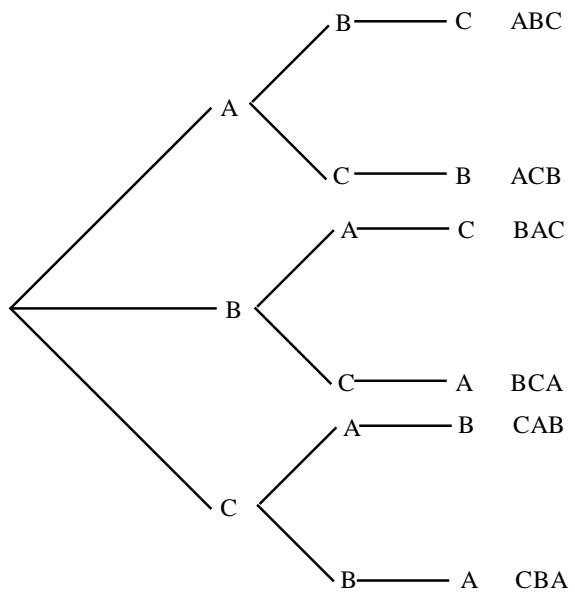
How many three-letter word sequences can be formed using the letters \(\{A, B, C\}\) if no letter is repeated?

Solution

Step 1 — Track the shrinking pool. Three slots, no repetition. Like stacking three lettered blocks: \(3\) choices for the first, \(2\) remaining for the second, \(1\) for the last.

| Slot | 1st | 2nd | 3rd | |---|---|---|---| | Choices | 3 | 2 | 1 |

Step 2 — Multiply.

\[3 \cdot 2 \cdot 1 = 6 \text{ sequences.}\]

Step 3 — Enumerate. The six sequences (shown in the tree above): ABC, ACB, BAC, BCA, CAB, CBA.

Answer: \(6\) sequences.

Try It Now 7.2.3

A coffee shop is running a giveaway: the prize is an ordered sequence of three different beverages chosen from a menu of \(5\). How many distinct prize sequences are possible?

Solution

Three slots, no repetition, from a pool of \(5\) beverages:

\[5 \cdot 4 \cdot 3 = 60 \text{ sequences.}\]

Problem Set 7.2

Source: Applied Finite Mathematics

Problems 1–6: Use a tree diagram or the multiplication axiom.

Problem 21. Layla has 3 shirts and 2 pairs of pants. Use a tree diagram to determine the number of possible outfits.

Problem 21 Solution

Step 1 — Identify the choices at each stage: Layla must choose one shirt and one pair of pants. She has 3 choices for the shirt and 2 choices for the pants.

Step 2 — Draw the tree diagram structure: The first level of branches represents the 3 shirts (call them \(S_1, S_2, S_3\)). From each shirt branch, two sub-branches represent the 2 pairs of pants (\(P_1, P_2\)). This gives \(3 \times 2 = 6\) paths through the tree.

Step 3 — List all outfits: The six complete paths are: \(S_1P_1,\; S_1P_2,\; S_2P_1,\; S_2P_2,\; S_3P_1,\; S_3P_2\)

Step 4 — Apply the multiplication axiom: By the multiplication axiom, the total number of outfits is \(3 \times 2 = 6\).

Answer: 6 possible outfits

Problem 22. In a city election, there are 2 candidates for mayor and 3 for supervisor. Use a tree diagram to find the number of ways to fill the two offices.

Problem 22 Solution

Step 1 — Identify the choices at each stage: There are 2 candidates for mayor and 3 candidates for supervisor. A voter (or selection process) must choose one for each office.

Step 2 — Draw the tree diagram structure: The first level has 2 branches (one for each mayoral candidate). From each of those, 3 sub-branches represent the supervisor candidates. This gives \(2 \times 3 = 6\) paths.

Step 3 — List all combinations: If the mayoral candidates are \(M_1, M_2\) and the supervisor candidates are \(S_1, S_2, S_3\), the six outcomes are: \(M_1S_1,\; M_1S_2,\; M_1S_3,\; M_2S_1,\; M_2S_2,\; M_2S_3\)

Step 4 — Apply the multiplication axiom: By the multiplication axiom, the total number of ways is \(2 \times 3 = 6\).

Answer: 6 ways to fill the two offices

Problem 23. There are 4 roads from Town A to Town B and 2 roads from Town B to Town C. Use a tree diagram to find the number of ways one can travel from Town A to Town C (passing through Town B).

Problem 23 Solution

Step 1 — Identify the choices at each stage: To travel from Town A to Town C (through Town B), a traveler must first choose one of 4 roads from A to B, then choose one of 2 roads from B to C.

Step 2 — Draw the tree diagram structure: The first level has 4 branches (one for each A-to-B road). From each of those, 2 sub-branches represent the B-to-C roads. This gives \(4 \times 2 = 8\) paths.

Step 3 — List all routes: If the A-to-B roads are \(R_1, R_2, R_3, R_4\) and the B-to-C roads are \(T_1, T_2\), the eight routes are: \(R_1T_1,\; R_1T_2,\; R_2T_1,\; R_2T_2,\; R_3T_1,\; R_3T_2,\; R_4T_1,\; R_4T_2\)

Step 4 — Apply the multiplication axiom: By the multiplication axiom, the total number of routes is \(4 \times 2 = 8\).

Answer: 8 possible routes from Town A to Town C

Problem 24. Brown Home Construction offers a selection of 3 floor plans, 2 roof types, and 2 exterior wall types. Use a tree diagram to determine the number of possible homes available.

Problem 24 Solution

Step 1 — Identify the choices at each stage:

A home buyer must choose: 3 floor plans, then 2 roof types, then 2 exterior wall types.

Step 2 — Draw the tree diagram structure:

The first level has 3 branches (floor plans). Each of those splits into 2 sub-branches (roof types). Each of those splits into 2 more sub-branches (exterior wall types). This gives \(3 \times 2 \times 2 = 12\) paths.

Step 3 — Apply the multiplication axiom:

By the multiplication axiom, the total number of possible homes is:

\(3 \times 2 \times 2 = 12\)

Answer: 12 possible homes

Problem 25. For lunch, a small restaurant offers 2 types of soups, 3 kinds of sandwiches, and 2 types of soft drinks. Use a tree diagram to determine the number of possible meals consisting of a soup, a sandwich, and a soft drink.

Problem 25 Solution

Step 1 — Identify the choices at each stage:
A meal consists of one soup (2 choices), one sandwich (3 choices), and one soft drink (2 choices).

Step 2 — Draw the tree diagram structure:
The first level has 2 branches (soups). Each of those splits into 3 sub-branches (sandwiches). Each of those splits into 2 more sub-branches (soft drinks). This gives \(2 \times 3 \times 2 = 12\) paths.

Step 3 — Apply the multiplication axiom:
By the multiplication axiom, the total number of possible meals is:
\(2 \times 3 \times 2 = 12\)

Answer: 12 possible meals

Problem 26. A California license plate consists of a number from 1 to 5, then three letters followed by three digits. How many such plates are possible?

Problems 7–10: Use the multiplication axiom.

Problem 26 Solution

Step 1 — Identify the choices at each position on the plate:

A California license plate has the format: [number 1–5][letter][letter][letter][digit][digit][digit].

Step 2 — Count the choices for each position:

  • Position 1 (number 1–5): 5 choices
  • Positions 2–4 (three letters, with repetition allowed): \(26 \times 26 \times 26\) choices
  • Positions 5–7 (three digits, with repetition allowed): \(10 \times 10 \times 10\) choices

Step 3 — Apply the multiplication axiom:

\[ 5 \times 26^3 \times 10^3 = 5 \times 17{,}576 \times 1{,}000 = 87{,}880{,}000 \]

Answer: 87,880,000 possible license plates

Problem 27. A license plate consists of three letters followed by three digits. How many license plates are possible if no letter may be repeated?

Problem 27 Solution

Step 1 — Identify the choices for each position: A license plate has three letters followed by three digits. The constraint is that no letter may be repeated, but there is no restriction on the digits.

Step 2 — Count the choices for the letter positions:

  • First letter: 26 choices (any letter A–Z)
  • Second letter: 25 choices (cannot repeat the first letter)
  • Third letter: 24 choices (cannot repeat either of the first two letters)

Step 3 — Count the choices for the digit positions: Each of the three digit positions has 10 choices (0–9), with repetition allowed: \(10 \times 10 \times 10 = 1{,}000\)

Step 4 — Apply the multiplication axiom:

\[ 26 \times 25 \times 24 \times 10 \times 10 \times 10 = 15{,}600 \times 1{,}000 = 15{,}600{,}000 \]

Answer: 15,600,000 possible license plates

Problem 28. How many different 4-letter radio station call letters can be made if the first letter must be K or W and no letters can be repeated?

Problem 28 Solution

Step 1 — Identify the constraints:

We need a 4-letter sequence. The first letter must be K or W, and no letter can be repeated.

Step 2 — Count the choices for each position:

  • First letter: 2 choices (K or W)
  • Second letter: 25 choices (any of the remaining 25 letters)
  • Third letter: 24 choices (remaining letters after two are used)
  • Fourth letter: 23 choices (remaining letters after three are used)

Step 3 — Apply the multiplication axiom:

\[ 2 \times 25 \times 24 \times 23 = 27{,}600 \]

Answer: 27,600 different call letters

Problem 29. How many seven-digit telephone numbers are possible if the first two digits cannot be ones or zeros?

Problem 29 Solution

Step 1 — Identify the constraints:

A seven-digit telephone number has 7 positions. The first two digits cannot be 0 or 1, so they must be chosen from \(\{2, 3, 4, 5, 6, 7, 8, 9\}\).

Step 2 — Count the choices for each position:

  • First digit: 8 choices (digits 2–9)
  • Second digit: 8 choices (digits 2–9)
  • Digits 3–7: 10 choices each (digits 0–9, no restrictions)

Step 3 — Apply the multiplication axiom:

\[ 8 \times 8 \times 10^5 = 64 \times 100{,}000 = 6{,}400{,}000 \]

Answer: 6,400,000 possible telephone numbers

Problem 30. How many 3-letter word sequences can be formed using the letters \(\{a, b, c, d\}\) if no letter is to be repeated?

Use a tree diagram for problems 7.2.11 and 7.2.12:

Problem 30 Solution

Step 1 — Identify the constraints:

We need to form a 3-letter sequence using the letters \(\{a, b, c, d\}\) with no letter repeated.

Step 2 — Count the choices for each position:

  • First position: 4 choices (a, b, c, or d)
  • Second position: 3 choices (any of the remaining 3 letters)
  • Third position: 2 choices (any of the remaining 2 letters)

Step 3 — Apply the multiplication axiom:

\[ 4 \times 3 \times 2 = 24 \]

Answer: 24 different 3-letter word sequences

Problem 31. A family has two children. Use a tree diagram to determine all four possible outcomes by gender.

Problem 31 Solution

Step 1 — Set up the tree diagram:
The first child can be either a boy (B) or a girl (G). The second child can also be either B or G.

Step 2 — Draw the branches:

  • First branch: B or G (for the first child)
  • From each first branch, two sub-branches: B or G (for the second child)

Step 3 — List all four outcomes:
Reading each path from root to leaf:

  1. BB (first child is a boy, second child is a boy)
  2. BG (first child is a boy, second child is a girl)
  3. GB (first child is a girl, second child is a boy)
  4. GG (first child is a girl, second child is a girl)

Step 4 — Verify by the multiplication axiom:
\(2 \times 2 = 4\) outcomes, which matches our list.

Answer: The four possible outcomes are BB, BG, GB, and GG.

Problem 32. A coin is tossed three times and the sequence of heads and tails is recorded. Use a tree diagram to list all the possible outcomes.

Problem 32 Solution

Step 1 — Set up the tree diagram:
Each toss has two possible outcomes: heads (H) or tails (T). With three tosses, the tree has three levels.

Step 2 — Draw the branches:

  • First toss: 2 branches (H, T)
  • Second toss: each branch splits into 2 (H, T), giving 4 paths so far
  • Third toss: each of those splits into 2 (H, T), giving 8 total paths

Step 3 — List all eight outcomes:
Reading each path from root to leaf:

  1. HHH
  2. HHT
  3. HTH
  4. HTT
  5. THH
  6. THT
  7. TTH
  8. TTT

Step 4 — Verify by the multiplication axiom:
\(2 \times 2 \times 2 = 2^3 = 8\) outcomes, which matches our list.

Answer: The eight possible outcomes are HHH, HHT, HTH, HTT, THH, THT, TTH, TTT.

Problems 13–18: Use the multiplication axiom.

Problem 33. In how many ways can a 4-question true/false test be answered?

Problem 33 Solution

Step 1 — Identify the choices for each question:

Each of the 4 questions has 2 possible answers: True (T) or False (F).

Step 2 — Apply the multiplication axiom:

Since each question is independent, the total number of ways to answer the test is:

\[ 2 \times 2 \times 2 \times 2 = 2^4 = 16 \]

Answer: 16 possible ways to answer the test

Problem 34. In how many ways can three people be arranged to stand in a straight line?

Problem 34 Solution

Step 1 — Identify the choices for each position in the line: Three people are to be arranged in a line. We fill the positions one at a time.

Step 2 — Count the choices for each position:

  • First position: 3 choices (any of the 3 people)
  • Second position: 2 choices (either of the remaining 2 people)
  • Third position: 1 choice (the last remaining person)

Step 3 — Apply the multiplication axiom:

\[ 3 \times 2 \times 1 = 6 \]

Answer: 6 possible arrangements

Problem 35. A combination lock is opened by first turning to the left, then to the right, and then to the left again. If there are 30 digits on the dial, how many possible combinations are there?

Problem 35 Solution

Step 1 — Identify the choices for each turn:

The lock requires three turns: left, right, left. Each turn selects one of the 30 digits on the dial.

Step 2 — Count the choices for each turn:

  • First turn (left): 30 choices
  • Second turn (right): 30 choices
  • Third turn (left): 30 choices

There is no restriction stated that digits cannot be repeated, so each turn independently has 30 choices.

Step 3 — Apply the multiplication axiom:

\[ 30 \times 30 \times 30 = 30^3 = 27{,}000 \]

Answer: 27,000 possible combinations

Problem 36. How many different answers are possible for a multiple-choice test with 10 questions and five possible answers for each question?

Problem 36 Solution

Step 1 — Identify the choices for each question:

Each of the 10 questions has 5 possible answers (A, B, C, D, E).

Step 2 — Apply the multiplication axiom:

Since each question is independent, the total number of different answer sheets is:

\[ 5 \times 5 \times 5 \times 5 \times 5 \times 5 \times 5 \times 5 \times 5 \times 5 = 5^{10} = 9{,}765{,}625 \]

Answer: 9,765,625 different possible answer sheets

Problem 37. In the past, a college required students to use a 4-digit PIN (Personal Identification Number) as their password for its registration system. How many different PINs are possible if each must have 4 digits with no restrictions on selection or arrangement of the digits used?

Problem 37 Solution

Step 1 — Identify the choices for each digit:

A 4-digit PIN uses digits 0–9. There are no restrictions on selection or arrangement, meaning digits may be repeated.

Step 2 — Count the choices for each position:

Each of the 4 positions has 10 choices (digits 0 through 9).

Step 3 — Apply the multiplication axiom:

\[ 10 \times 10 \times 10 \times 10 = 10^4 = 10{,}000 \]

Answer: 10,000 different PINs are possible

Problem 38. The college decided that a more secure password system is needed. New passwords must have 3 numerical digits followed by 6 letters. There are no restrictions on the selection of the numerical digits. However, the letters I and O are not permitted. How many different passwords are possible?

Problem 38 Solution

Step 1 — Identify the structure of the password:

A password consists of 3 numerical digits followed by 6 letters. We must determine the number of choices for each position.

Step 2 — Count the choices for the digit positions:

Each of the 3 digit positions has 10 choices (0–9), with no restrictions:

\[ 10 \times 10 \times 10 = 10^3 = 1{,}000 \]

Step 3 — Count the choices for the letter positions:

The letters I and O are not permitted, so each letter position has \(26 - 2 = 24\) choices. There are 6 letter positions, and there is no restriction on repetition:

\[ 24 \times 24 \times 24 \times 24 \times 24 \times 24 = 24^6 = 191{,}102{,}976 \]

Step 4 — Apply the multiplication axiom:

\[ 10^3 \times 24^6 = 1{,}000 \times 191{,}102{,}976 = 191{,}102{,}976{,}000 \]

Answer: 191,102,976,000 different passwords are possible

7.3 Permutations

Learning Objectives

In this section, you will learn to:
  1. Count the number of permutations (ordered arrangements) of \(n\) items taken \(r\) at a time.
  2. Count permutations when extra conditions are imposed on the arrangements.
  3. Perform calculations using factorials.

7.3.1 What Is a Permutation?

In Example 7.2.6 we counted the ordered arrangements of the letters \(\{A, B, C\}\) when no letter was repeated. The tree diagram gave us six arrangements:

$$\text{ABC, ACB, BAC, BCA, CAB, CBA.}$$

Arrangements like these — where order matters and no element repeats — are called permutations.

Definition 7.10: Permutation

Source: Applied Finite Mathematics

A permutation of a set of elements is an ordered arrangement in which each element is used exactly once.

Context Pause: "Order matters" is the whole game

Counting techniques split into two big families: ones where order matters (permutations) and ones where it doesn't (combinations, coming in section 7.5). "ABC" and "CBA" are the same combination of letters but different permutations. Whenever a problem asks for "arrangements," "orderings," "sequences," or anything where swapping two items creates a new answer, you are counting permutations.

Insight Note: Permutations are the multiplication axiom with a shrinking pool

Every permutation problem you have seen so far has used the same pattern: \(n\) choices for the first slot, \(n-1\) for the second (because one is now used), \(n-2\) for the third, and so on. The multiplication axiom is the permutation formula — nothing new, just a name for a common case.

7.3.2 Permutations with Restrictions

Many real problems add a twist: a letter must be in a certain slot, two people must sit together, the first item must be a vowel. The trick is to place the restricted slots first, then fill the remaining slots with the multiplication axiom.

Handle restrictions before general choices

If a slot has a rule attached ("must be a consonant," "must be odd"), fill that slot first. Once the pool for that slot is resolved, the other slots draw from the remaining items as usual. Trying to fill restricted slots last is how double-counting errors sneak in.

Restrictions shrink the front, not the back

The restriction usually lives on a specific position (first, last, middle). After you handle that position, the remaining arrangement is still a straight shrinking-pool permutation. So a restricted problem is always a small permutation problem glued to a larger one by the multiplication axiom.

7.3.3 Factorials and the \(nPr\) Formula

When we count permutations of \(n\) objects taken \(r\) at a time, it's convenient to have a single symbol for the answer. That symbol is \(nPr\) (sometimes written \({}_nP_r\) or \(P(n, r)\)).

Definition 7.11: Factorial

Definition 7.11: Factorial

Source: Applied Finite Mathematics

For a natural number \(n\), the factorial of \(n\), written \(n!\), is the product of all positive integers from \(n\) down to \(1\):

$$n! = n (n - 1)(n - 2)(n - 3) \cdots 3 \cdot 2 \cdot 1.$$

By convention, \(0! = 1\).

Definition 7.12: Permutations of \(n\) Objects Taken \(r\) at a Time

Definition 7.12: Permutations of \(n\) Objects Taken \(r\) at a Time

Source: Applied Finite Mathematics

The number of permutations of \(n\) objects taken \(r\) at a time, written \(nPr\), is

$$nPr = n(n - 1)(n - 2) \cdots (n - r + 1),$$

or equivalently,

$$nPr = \dfrac{n!}{(n - r)!}.$$

Both formulas give the same answer; become comfortable with both.

Context Pause: Why two formulas for the same thing?

The product form \(n(n-1)\cdots(n-r+1)\) is usually easier to compute by hand — you stop multiplying after \(r\) terms. The factorial-quotient form \(\dfrac{n!}{(n-r)!}\) matches how calculators and statistical software compute it internally, and it makes the connection to combinations (section 7.5) clean. Different tools, same idea.

Insight Note: \(0! = 1\) is a convenience, not a mystery

Every formula that uses factorials — \(nPr\), \(nCr\), the binomial theorem — needs \(0! = 1\) so that edge cases work out correctly. It isn't a mathematical accident; it's the definition that keeps the algebra clean. Accept it and move on.

Example 7.3.4

Try It Now 7.3.3

7.3.4 Combined Arrangements

Sometimes an arrangement has two independent pieces — and each piece is itself a permutation. The multiplication axiom lets us combine them: count each piece on its own, then multiply.

Combine permutations by multiplying

If a problem splits naturally into independent parts ("math books in slots 1–3, history books in slots 4–5"), handle each part as its own permutation and multiply the results. This is the same multiplication axiom we have been using all along, just applied to permutation counts instead of raw choice counts.

"Glue two items together" trick

When two specific items must sit next to each other, treat them as a single combined item. That reduces the problem from \(n\) items to \(n-1\) items. Then multiply by the number of ways the two glued items can be ordered relative to each other (usually \(2!\)).

Problem Set 7.3

Source: Applied Finite Mathematics

Problems 1–8: Do the following problems using permutations.

Problem 39. How many three-letter words can be made using the letters \(\{a, b, c, d, e\}\) if no repetitions are allowed?

Problem 39 Solution

Step 1 — Shrinking pool. Three slots from \(5\) letters, no repetition:

$$5 \cdot 4 \cdot 3 = 60.$$

Answer: \(60\) words.

Problem 40. A grocery store has five checkout counters and seven clerks. How many different ways can the 7 clerks be assigned to the 5 counters?

Problem 40 Solution

Step 1 — Order matters. Assign \(5\) of the \(7\) clerks to \(5\) distinct counters:

$$7P5 = 7 \cdot 6 \cdot 5 \cdot 4 \cdot 3 = 2{,}520.$$

Answer: \(2{,}520\) assignments.

Problem 41. A group of fifteen people who are members of an investment club wish to choose a president and a secretary. How many different ways can this be done?

Problem 41 Solution

Step 1 — Two ordered positions from \(15\).

$$15P2 = 15 \cdot 14 = 210.$$

Answer: \(210\) ways.

Problem 42. Compute the following.

  1. \(9P2\)
  2. \(6P4\)
  3. \(8P3\)
  4. \(7P4\)
Problem 42 Solution

(a) \(9P2\): \(9 \cdot 8 = 72\).

(b) \(6P4\): \(6 \cdot 5 \cdot 4 \cdot 3 = 360\).

(c) \(8P3\): \(8 \cdot 7 \cdot 6 = 336\).

(d) \(7P4\): \(7 \cdot 6 \cdot 5 \cdot 4 = 840\).

Problem 43. In how many ways can the letters of the word CUPERTINO be arranged if each letter is used only once in each arrangement?

Problem 43 Solution

Step 1 — Count distinct letters. CUPERTINO has \(9\) distinct letters: C, U, P, E, R, T, I, N, O.

Step 2 — Arrange all \(9\) in \(9\) slots.

$$9! = 362{,}880.$$

Answer: \(362{,}880\) arrangements.

Problem 44. How many permutations of the letters of the word PROBLEM end in a vowel?

Problem 44 Solution

Step 1 — Identify the restricted pool. PROBLEM has \(7\) distinct letters; vowels are O and E (\(2\) vowels).

Step 2 — Fill the last slot. \(2\) choices.

Step 3 — Fill the remaining \(6\) slots. \(6! = 720\).

Step 4 — Multiply.

$$2 \cdot 720 = 1{,}440.$$

Answer: \(1{,}440\) permutations.

Problem 45. How many permutations of the letters of the word SECURITY end in a consonant?

Problem 45 Solution

Step 1 — Identify the restricted pool. SECURITY has \(8\) distinct letters; consonants are S, C, R, T, Y (\(5\) consonants).

Step 2 — Fill the last slot. \(5\) choices.

Step 3 — Fill the remaining \(7\) slots. \(7! = 5{,}040\).

Step 4 — Multiply.

$$5 \cdot 5{,}040 = 25{,}200.$$

Answer: \(25{,}200\) permutations.

Problem 46. How many permutations of the letters PRODUCT have consonants in the second and third positions?

Problem 46 Solution

Step 1 — Identify the restricted pool. PRODUCT has \(7\) distinct letters; consonants are P, R, D, C, T (\(5\) consonants).

Step 2 — Fill slots 2 and 3 with consonants. \(5\) choices for slot 2, \(4\) remaining for slot 3.

Step 3 — Fill the other \(5\) slots. \(5! = 120\).

Step 4 — Multiply.

$$5 \cdot 4 \cdot 120 = 2{,}400.$$

Answer: \(2{,}400\) permutations.

Problems 9–16: Do the following problems using permutations.

Problem 47. How many three-digit numbers are there?

Problem 47 Solution

Step 1 — First digit can't be \(0\). \(9\) choices for the hundreds place, \(10\) for tens, \(10\) for units:

$$9 \cdot 10 \cdot 10 = 900.$$

Answer: \(900\) three-digit numbers.

Problem 48. How many three-digit odd numbers are there?

Problem 48 Solution

Step 1 — Last digit must be odd. \(5\) choices: \(\{1, 3, 5, 7, 9\}\).

Step 2 — First digit can't be \(0\). \(9\) choices.

Step 3 — Tens digit has no restriction. \(10\) choices.

Step 4 — Multiply.

$$9 \cdot 10 \cdot 5 = 450.$$

Answer: \(450\) three-digit odd numbers.

Problem 49. In how many different ways can five people be seated in a row if two of them insist on sitting next to each other?

Problem 49 Solution

Step 1 — Glue the two together. Five people with two tied becomes \(4\) items: \(4! = 24\).

Step 2 — Internal order of the tied pair. \(2! = 2\).

Step 3 — Multiply.

$$4! \cdot 2! = 24 \cdot 2 = 48.$$

Answer: \(48\) seatings.

Problem 50. In how many different ways can five people be seated in a row if two of them insist on not sitting next to each other?

Problem 50 Solution

Step 1 — Total arrangements. \(5! = 120\).

Step 2 — Subtract the together-arrangements from Problem 11. \(120 - 48 = 72\).

Answer: \(72\) seatings where the two do not sit together.

Problem 51. In how many ways can 3 English, 3 history, and 2 math books be set on a shelf if the English books are set on the left, history books in the middle, and math books on the right?

Problem 51 Solution

Step 1 — Order inside each group. Subjects are fixed in place (E left, H middle, M right), so only internal orderings matter.

  • English: \(3! = 6\)
  • History: \(3! = 6\)
  • Math: \(2! = 2\)

Step 2 — Multiply.

$$6 \cdot 6 \cdot 2 = 72.$$

Answer: \(72\) arrangements.

Problem 52. In how many ways can 3 English, 3 history, and 2 math books be set on a shelf if they are grouped by subject?

Problem 52 Solution

Step 1 — Order the three subject groups. \(3! = 6\).

Step 2 — Internal orderings. \(3! \cdot 3! \cdot 2! = 72\) (from Problem 13).

Step 3 — Multiply.

$$3! \cdot 72 = 6 \cdot 72 = 432.$$

Answer: \(432\) arrangements.

Problem 53. You have 5 math books and 6 history books to put on a shelf with five slots. In how many ways can you put the books on the shelf if the first two slots are to be filled with math books and the next three with history books?

Problem 53 Solution

Step 1 — First two slots from \(5\) math books. \(5P2 = 5 \cdot 4 = 20\).

Step 2 — Next three slots from \(6\) history books. \(6P3 = 6 \cdot 5 \cdot 4 = 120\).

Step 3 — Multiply.

$$20 \cdot 120 = 2{,}400.$$

Answer: \(2{,}400\) arrangements.

Problem 54. You have 5 math books and 6 history books to put on a shelf with five slots. In how many ways can you put the books on the shelf if the first two slots are to be filled with the books of one subject and the next three slots are to be filled with the books of the other subject?

Problem 54 Solution

Case A — First 2 math, next 3 history. \(5P2 \cdot 6P3 = 20 \cdot 120 = 2{,}400\) (same as Problem 15).

Case B — First 2 history, next 3 math. \(6P2 \cdot 5P3 = 30 \cdot 60 = 1{,}800\).

Add the cases.

$$2{,}400 + 1{,}800 = 4{,}200.$$

Answer: \(4{,}200\) arrangements.

Problems 17–22: Do the following problems using permutations.

Problem 55. A bakery has 9 different fancy cakes. In how many ways can 5 of the 9 fancy cakes be lined up in a row in the bakery display case?

Problem 55 Solution

Step 1 — Five of nine ordered. \(9P5 = 9 \cdot 8 \cdot 7 \cdot 6 \cdot 5 = 15{,}120\).

Answer: \(15{,}120\) displays.

Problem 56. A landscaper has 6 different flowering plants. She needs to plant 4 of them in a row in a garden. How many different ways can 4 of the 6 plants be arranged in a row?

Problem 56 Solution

Step 1 — Four of six ordered. \(6P4 = 6 \cdot 5 \cdot 4 \cdot 3 = 360\).

Answer: \(360\) arrangements.

Problem 57. At an auction of used construction vehicles, there are 7 different vehicles for sale. In how many orders could these 7 vehicles be listed in the auction program?

Problem 57 Solution

Step 1 — All seven ordered. \(7! = 5{,}040\).

Answer: \(5{,}040\) orders.

Problem 58. A landscaper has 6 different flowering plants and 4 different non-flowering bushes. She needs to plant a row of 6 plants in a garden. There must be a bush at each end, and four flowering plants in a row in between the bushes. How many different arrangements in a row are possible?

Problem 58 Solution

Step 1 — Bushes at the two ends. \(4P2 = 4 \cdot 3 = 12\).

Step 2 — Four flowers in the middle four slots. \(6P4 = 6 \cdot 5 \cdot 4 \cdot 3 = 360\).

Step 3 — Multiply.

$$12 \cdot 360 = 4{,}320.$$

Answer: \(4{,}320\) arrangements.

Problem 59. In how many ways can all 7 letters of the word QUIETLY be arranged if the letters Q and U must be next to each other in the order QU?

Problem 59 Solution

Step 1 — Glue QU as one item. QUIETLY has \(7\) letters; gluing Q and U gives \(6\) items to arrange.

Step 2 — Arrange six items. \(6! = 720\).

Step 3 — Fix internal order. Q must come before U, so no \(2!\) multiplier.

Answer: \(720\) arrangements.

Problem 60. In how many ways can the letters ABCDEXY be arranged if

a) the X and Y must be next to each other in either order (XY or YX)?

b) the X and Y cannot be next to each other?

Problem 60 Solution

(a) X and Y together, either order. Glue XY as one item: \(6\) items, \(6! = 720\). Two internal orderings (XY or YX): \(2! = 2\). Total:

$$6! \cdot 2! = 720 \cdot 2 = 1{,}440.$$

(b) X and Y not together. All permutations of \(7\) distinct letters \(= 7! = 5{,}040\). Subtract the together-arrangements from part (a):

$$5{,}040 - 1{,}440 = 3{,}600.$$

Answer: (a) \(1{,}440\); (b) \(3{,}600\).

7.4 Circular Permutations and Permutations with Similar Elements

Learning Objectives

By the end of this section, you will be able to:

In this section, you will learn to:
  1. Count the number of permutations of items arranged in a circle.
  2. Count the number of permutations when some of the items are identical (indistinguishable).

In this section we address two questions that straight-line permutations cannot:

  1. In how many different ways can five people be seated in a circle?
  2. In how many different ways can the letters of the word MISSISSIPPI be arranged?

The first question is a circular permutation; the second is a permutation with similar elements. Both are small tweaks of the multiplication axiom — once you see why the tweak is needed, the formulas drop right out.

7.4.1 Circular Permutations

Suppose we want to seat three people — A, B, and C — around a round table. In a straight line there are \(3! = 6\) arrangements. How many truly different seatings are there around the circle?

Only two. Once you fix where A sits, each of the remaining people has a position relative to A. Rotating the whole table clockwise or counterclockwise doesn't create a new seating — it just spins the same arrangement. The six straight-line permutations collapse into two circular ones: clockwise A → B → C, and clockwise A → C → B.

The rule: in a circular permutation, the first person is a placeholder. Wherever they sit, rotations produce identical arrangements. The remaining \(n - 1\) people can still be arranged in \((n - 1)!\) ways.

Context Pause: Why rotations don't count as new arrangements

Picture the table on a lazy Susan. Spin it, and every guest still has the same neighbors on the same sides — no one has changed seats relative to anyone else. Circular permutations count relative positions, not absolute ones. Any time a problem is about order around a loop (a round table, a merry-go-round, a dance circle), fix one element as the anchor and permute the rest.

Insight Note: Circular = linear divided by rotations

A circle of \(n\) items has \(n\) rotations that all look the same, so the straight-line count \(n!\) overcounts by a factor of \(n\). Dividing: \(\dfrac{n!}{n} = (n - 1)!\). Same answer, built from the multiplication axiom you already know.

Definition 7.13: Circular Permutations

Source: Applied Finite Mathematics

The number of permutations of \(n\) elements arranged in a circle is

$$(n - 1)!.$$

7.4.2 Permutations with Similar Elements

Now consider the letters of the word ELEMENT. The word has \(7\) letters, but the letter E appears three times. If we pretend all seven letters are different, we would get \(7!\) permutations — but because the three E's are indistinguishable, many of those "different" arrangements are actually the same.

Label the E's temporarily so we can track them: \(\mathrm{E}_1, \mathrm{L}, \mathrm{E}_2, \mathrm{M}, \mathrm{E}_3, \mathrm{N}, \mathrm{T}\). Take one specific arrangement, say

$$\mathrm{LE_1ME_2NE_3T}.$$

If we rearrange only the subscripts on the E's, we get \(3!\) different labeled arrangements that all look the same once we erase the subscripts:

$$\mathrm{LE_1ME_2NE_3T}, \quad \mathrm{LE_1ME_3NE_2T}, \quad \mathrm{LE_2ME_1NE_3T},$$ $$\mathrm{LE_2ME_3NE_1T}, \quad \mathrm{LE_3ME_2NE_1T}, \quad \mathrm{LE_3ME_1NE_2T}.$$

All six reduce to the single unlabeled arrangement LEMENET. The same overcounting happens for every unlabeled arrangement. If there are \(n\) distinguishable permutations of ELEMENT, the labeled version has \(n \cdot 3!\) permutations. But we also know the labeled version has exactly \(7!\) permutations. Therefore

$$n \cdot 3! = 7! \quad \implies \quad n = \dfrac{7!}{3!} = 840.$$

That division-by-repeats idea generalizes to any word (or ordered set) with repeated items.

Context Pause: Repeats shrink the count

When objects repeat, the straight \(n!\) count overcounts by the number of ways you could rearrange the repeats among themselves. Dividing by \(r_1! \cdot r_2! \cdots r_k!\) removes exactly that overcount. You'll see this formula again in binomial and multinomial coefficients — it's the same arithmetic.

Insight Note: Think of it as labeling then un-labeling

Start by treating every item as distinct (\(n!\)). Then, for each group of repeats, un-distinguish them by dividing by the number of internal reorderings (\(r_i!\)). Label-then-cancel is a mental shortcut that works for every problem in this section.

Definition 7.14: Permutations with Similar Elements

Source: Applied Finite Mathematics

The number of permutations of \(n\) elements taken \(n\) at a time, with \(r_1\) elements of one kind, \(r_2\) elements of another kind, and so on, where \(n = r_1 + r_2 + \cdots + r_k\), is

$$\dfrac{n!}{r_1!\, r_2! \cdots r_k!}.$$

This quantity is also called an ordered partition.

Summary

Circular Permutations

The number of permutations of \(n\) elements arranged in a circle is

$$(n - 1)!.$$

Permutations with Similar Elements (Ordered Partitions)

The number of permutations of \(n\) elements taken \(n\) at a time, with \(r_1\) elements of one kind, \(r_2\) elements of another kind, and so on, where \(n = r_1 + r_2 + \cdots + r_k\), is

$$\dfrac{n!}{r_1!\, r_2! \cdots r_k!}.$$

Problem Set 7.4

Source: Applied Finite Mathematics

Problems 7.4.1–7.4.8: Do the following problems using circular permutations or permutations with similar elements.

Problem 61. In how many different ways can five children hold hands to play "Ring Around the Rosy"?

Problem 61 Solution

Step 1 — Recognize a circular permutation. Five children holding hands in a ring — rotations don't create new arrangements.

Step 2 — Apply the formula.

$$(5 - 1)! = 4! = 24.$$

Answer: \(24\) ways.

Problem 62. In how many ways can three people be made to sit at a round table?

Problem 62 Solution

Step 1 — Circular permutation with \(n = 3\).

$$(3 - 1)! = 2! = 2.$$

Answer: \(2\) ways.

Problem 63. In how many different ways can six children ride a merry-go-round with six horses?

Problem 63 Solution

Step 1 — Circular permutation with \(n = 6\). The six horses are distinguishable, but rotations of the merry-go-round are not.

$$(6 - 1)! = 5! = 120.$$

Answer: \(120\) ways.

Problem 64. In how many ways can three couples be seated at a round table so that men and women sit alternately?

Problem 64 Solution

Step 1 — Anchor a man. Six people total (3 men, 3 women) alternating around the table. The first man is the placeholder.

Step 2 — Fill by alternating genders. The seat next to the anchor holds a woman (\(3\) choices); next a man (\(2\)); next a woman (\(2\)); next a man (\(1\)); next a woman (\(1\)).

Slot 1st (M) 2nd (W) 3rd (M) 4th (W) 5th (M) 6th (W)
Choices 1 3 2 2 1 1

Step 3 — Multiply.

$$1 \cdot 3 \cdot 2 \cdot 2 \cdot 1 \cdot 1 = 12.$$

Answer: \(12\) seatings.

Problem 65. In how many ways can six trinkets be arranged on a chain?

Problem 65 Solution

Step 1 — Circular permutation with flip symmetry. A chain can be flipped over, so clockwise and counter-clockwise orderings are the same arrangement. Divide the circular count by \(2\).

Step 2 — Apply the formula.

$$\dfrac{(6 - 1)!}{2} = \dfrac{5!}{2} = \dfrac{120}{2} = 60.$$

Answer: \(60\) arrangements.

Problem 66. In how many ways can five keys be put on a key ring?

Problem 66 Solution

Step 1 — Key ring has flip symmetry. Same reasoning as a chain.

$$\dfrac{(5 - 1)!}{2} = \dfrac{4!}{2} = \dfrac{24}{2} = 12.$$

Answer: \(12\) arrangements.

Problem 67. Find the number of different permutations of the letters of the word MASSACHUSETTS.

Problem 67 Solution

Step 1 — Count letters and repeats. MASSACHUSETTS has \(13\) letters: \(4\) S's, \(2\) A's, \(2\) T's, and one each of M, C, H, U, E.

Step 2 — Apply the similar-elements formula.

$$\dfrac{13!}{4!\, 2!\, 2!} = \dfrac{6{,}227{,}020{,}800}{24 \cdot 2 \cdot 2} = 64{,}864{,}800.$$

Answer: \(64{,}864{,}800\) permutations.

Problem 68. Find the number of different permutations of the letters of the word MATHEMATICS.

Problems 7.4.9–7.4.16: Do the following problems using circular permutations or permutations with similar elements.

Problem 68 Solution

Step 1 — Count letters and repeats. MATHEMATICS has \(11\) letters: \(2\) M's, \(2\) A's, \(2\) T's, and one each of H, E, I, C, S.

Step 2 — Apply the similar-elements formula.

$$\dfrac{11!}{2!\, 2!\, 2!} = \dfrac{39{,}916{,}800}{8} = 4{,}989{,}600.$$

Answer: \(4{,}989{,}600\) permutations.

Problem 69. Seven flags are to be flown on seven poles: 3 flags are red, 2 are white, and 2 are blue. How many different arrangements are possible?

Problem 69 Solution

Step 1 — Identify the repeats. Seven flags: \(3\) red, \(2\) white, \(2\) blue.

Step 2 — Apply the similar-elements formula.

$$\dfrac{7!}{3!\, 2!\, 2!} = \dfrac{5{,}040}{6 \cdot 2 \cdot 2} = 210.$$

Answer: \(210\) arrangements.

Problem 70. How many different ways can 3 pennies, 2 nickels, and 5 dimes be arranged in a row?

Problem 70 Solution

Step 1 — Identify the repeats. Ten coins: \(3\) pennies, \(2\) nickels, \(5\) dimes (coins of the same denomination are identical).

Step 2 — Apply the similar-elements formula.

$$\dfrac{10!}{3!\, 2!\, 5!} = \dfrac{3{,}628{,}800}{6 \cdot 2 \cdot 120} = 2{,}520.$$

Answer: \(2{,}520\) arrangements.

Problem 71. How many four-digit numbers can be made using two 2's and two 3's?

Problem 71 Solution

Step 1 — Four digits: two 2's and two 3's. \(n = 4\), \(r_1 = 2\), \(r_2 = 2\).

$$\dfrac{4!}{2!\, 2!} = \dfrac{24}{4} = 6.$$

Answer: \(6\) four-digit numbers.

Problem 72. How many five-digit numbers can be made using two 6's and three 7's?

Problem 72 Solution

Step 1 — Five digits: two 6's and three 7's. \(n = 5\), \(r_1 = 2\), \(r_2 = 3\).

$$\dfrac{5!}{2!\, 3!} = \dfrac{120}{12} = 10.$$

Answer: \(10\) five-digit numbers.

Problem 73. If a coin is tossed 5 times, how many different outcomes of 3 heads and 2 tails are possible?

Problem 73 Solution

Step 1 — Reframe as a permutation of HHHTT. \(n = 5\), \(3\) H's, \(2\) T's.

$$\dfrac{5!}{3!\, 2!} = \dfrac{120}{12} = 10.$$

Answer: \(10\) outcomes.

Problem 74. If a coin is tossed 10 times, how many different outcomes of 7 heads and 3 tails are possible?

Problem 74 Solution

Step 1 — Reframe as a permutation of HHHHHHHTTT. \(n = 10\), \(7\) H's, \(3\) T's.

$$\dfrac{10!}{7!\, 3!} = \dfrac{3{,}628{,}800}{5{,}040 \cdot 6} = 120.$$

Answer: \(120\) outcomes.

Problem 75. If a team plays ten games, how many different outcomes of 6 wins and 4 losses are possible?

Problem 75 Solution

Step 1 — Reframe as a permutation of WWWWWWLLLL. \(n = 10\), \(6\) W's, \(4\) L's.

$$\dfrac{10!}{6!\, 4!} = \dfrac{3{,}628{,}800}{720 \cdot 24} = 210.$$

Answer: \(210\) outcomes.

Problem 76. If a team plays ten games, how many different ways can the team have a winning season?

Problem 76 Solution

Step 1 — Define a winning season. More wins than losses in \(10\) games means at least \(6\) wins (\(k = 6, 7, 8, 9, 10\)).

Step 2 — Count each win total using similar elements. For \(k\) wins and \(10 - k\) losses,

$$\dfrac{10!}{k!\,(10 - k)!}.$$
\(k\) wins Count
\(6\) \(\dfrac{10!}{6!\,4!} = 210\)
\(7\) \(\dfrac{10!}{7!\,3!} = 120\)
\(8\) \(\dfrac{10!}{8!\,2!} = 45\)
\(9\) \(\dfrac{10!}{9!\,1!} = 10\)
\(10\) \(\dfrac{10!}{10!\,0!} = 1\)

Step 3 — Sum.

$$210 + 120 + 45 + 10 + 1 = 386.$$

Answer: \(386\) winning seasons.

7.5 Combinations

Learning Objectives

By the end of this section, you will be able to:

In this section, you will learn to:
  1. Count the number of combinations of \(r\) items chosen from \(n\) — selections without regard to order.
  2. Use factorials and the \({}_nC_r\) formula to compute combinations.

In section 7.3 we counted permutations — arrangements where order matters. A committee of two people, though, isn't an arrangement at all: "Al and Bob" is the same committee as "Bob and Al." This section introduces combinations, the right tool for counting unordered selections.

7.5.1 Permutations vs. Combinations

Suppose we have the set \(\{\mathrm{A}, \mathrm{B}, \mathrm{C}\}\) and we want two-letter word sequences. We get six permutations:

$$\mathrm{AB}, \quad \mathrm{BA}, \quad \mathrm{BC}, \quad \mathrm{CB}, \quad \mathrm{AC}, \quad \mathrm{CA}.$$

Now treat the letters as people — Al, Bob, Chris — and form two-person committees. This time there are only three:

$$\mathrm{AB}, \quad \mathrm{BC}, \quad \mathrm{AC}.$$

The committee "Al and Bob" is identical to "Bob and Al" — order is irrelevant. Each committee corresponds to \(2!\) permutations (the two orders of its members), so the \(6\) permutations collapse into \(6/2! = 3\) committees.

Just as \({}_nP_r\) counts permutations of \(n\) objects taken \(r\) at a time, we write \({}_nC_r\) for the number of combinations of \(n\) objects taken \(r\) at a time. In the example above, \({}_3P_2 = 6\) and \({}_3C_2 = 3\).

Context Pause: When does order matter?

Before you pick a formula, ask: if I swap two items, do I have the same thing or a different thing? A password (A-B-C vs C-B-A) is different — use permutations. A committee (Al-Bob vs Bob-Al) is the same — use combinations. Seating arrangements, race finishes, and lineups are permutation problems. Committees, card hands, lottery picks, and "choose \(r\) items" selections are combination problems.

Insight Note: Combinations are permutations divided by \(r!\)

Every \(r\)-element subset can be arranged in \(r!\) different orders. So the \({}_nP_r\) permutations of size \(r\) collapse into \({}_nP_r / r!\) combinations — because each combination was counted \(r!\) times, once per internal ordering. That single observation is the whole formula.

7.5.2 The Combination Formula

Using the relationship we just derived, \({}_nC_r = {}_nP_r / r!\), we can plug in the permutation formula \({}_nP_r = \dfrac{n!}{(n - r)!}\) to get a clean formula for combinations:

$$ {}_nC_r \;=\; \dfrac{{}_nP_r}{r!} \;=\; \dfrac{n!}{(n - r)!\, r!}. $$
Context Pause: The symmetry of combinations

Notice that \({}_nC_r = {}_nC_{n-r}\). Choosing \(r\) items to include is the same decision as choosing \(n - r\) items to leave out — either way, you've split the pile into two groups of the same sizes. That's why \({}_6C_4 = {}_6C_2 = 15\) below. Use it to save arithmetic: compute whichever side has the smaller \(r!\).

Insight Note: The \({}_nC_r\) symbol has many names

You may see the same quantity written \(\binom{n}{r}\), "\(n\) choose \(r\)", \(C(n, r)\), or \({}_nC_r\). They all mean the exact same thing: the number of ways to pick \(r\) items from \(n\) without regard to order. In probability and algebra, these are also called binomial coefficients — they're the numbers that appear when you expand \((x + y)^n\).

Definition 7.15: Combination

Source: Applied Finite Mathematics

A combination of a set of elements is a selection where each element is used at most once and order does not matter.

Definition 7.16: The Number of Combinations of \(n\) Objects Taken \(r\) at a Time

Source: Applied Finite Mathematics

The number of ways to choose \(r\) items from \(n\) distinct items, without regard to order, is

$$ {}_nC_r \;=\; \dfrac{n!}{(n - r)!\, r!}, $$

where \(n\) and \(r\) are natural numbers with \(0 \le r \le n\).

Summary

Combination

A selection of items from a set where order does not matter and no item is repeated.

The \({}_nC_r\) Formula

The number of combinations of \(n\) distinct objects taken \(r\) at a time is

$$ {}_nC_r \;=\; \dfrac{n!}{(n - r)!\, r!}. $$

Key Identities

\({}_nC_r = {}_nC_{n-r}\) (symmetry); \({}_nC_0 = {}_nC_n = 1\); \({}_nP_r = r! \cdot {}_nC_r\).

Problem Set 7.5

Source: Applied Finite Mathematics

Do the following problems using combinations.

Problem 77. How many different 3-person committees can be chosen from ten people?

Problem 77 Solution

Step 1 — Identify the type. A committee is an unordered selection — order does not matter. Use combinations.

Step 2 — Apply the formula. Choose \(3\) people from \(10\):

$$ {}_{10}C_3 = \dfrac{10!}{(10 - 3)!\, 3!} = \dfrac{10!}{7!\, 3!} = \dfrac{10 \cdot 9 \cdot 8}{3 \cdot 2 \cdot 1} = \dfrac{720}{6} = 120. $$

Answer: \(120\) committees.

Problem 78. How many different 5-player teams can be chosen from eight players?

Problem 78 Solution

Step 1 — Identify the type. A team is an unordered selection.

Step 2 — Apply the formula. Choose \(5\) players from \(8\):

$$ {}_8C_5 = \dfrac{8!}{3!\, 5!} = \dfrac{8 \cdot 7 \cdot 6}{3 \cdot 2 \cdot 1} = \dfrac{336}{6} = 56. $$

Answer: \(56\) teams.

Problem 79. In how many ways can a person choose to vote for three out of five candidates on a ballot for a school board election?

Problem 79 Solution

Step 1 — Identify the type. Voting for three candidates means selecting three names — order of selection does not matter. Use combinations.

Step 2 — Apply the formula. Choose \(3\) from \(5\):

$$ {}_5C_3 = \dfrac{5!}{2!\, 3!} = \dfrac{5 \cdot 4}{2 \cdot 1} = \dfrac{20}{2} = 10. $$

Answer: \(10\) ways.

Problem 80. Compute the following.

a) \({}_9C_2\)

b) \({}_6C_4\)

c) \({}_8C_3\)

d) \({}_7C_4\)

Problem 80 Solution

Step 1 — Compute (a).

$$ {}_9C_2 = \dfrac{9!}{7!\, 2!} = \dfrac{9 \cdot 8}{2} = \dfrac{72}{2} = 36. $$

Step 2 — Compute (b).

$$ {}_6C_4 = \dfrac{6!}{2!\, 4!} = \dfrac{6 \cdot 5}{2} = \dfrac{30}{2} = 15. $$

Step 3 — Compute (c).

$$ {}_8C_3 = \dfrac{8!}{5!\, 3!} = \dfrac{8 \cdot 7 \cdot 6}{3 \cdot 2 \cdot 1} = \dfrac{336}{6} = 56. $$

Step 4 — Compute (d).

$$ {}_7C_4 = \dfrac{7!}{3!\, 4!} = \dfrac{7 \cdot 6 \cdot 5}{3 \cdot 2 \cdot 1} = \dfrac{210}{6} = 35. $$

Answer: (a) \(36\); (b) \(15\); (c) \(56\); (d) \(35\).

Problem 81. How many 5-card hands can be chosen from a deck of cards?

Problem 81 Solution

Step 1 — Identify the type. A poker hand is a set of \(5\) cards — order within a hand doesn't matter. Use combinations.

Step 2 — Apply the formula. Choose \(5\) cards from a \(52\)-card deck:

$$ {}_{52}C_5 = \dfrac{52!}{47!\, 5!} = \dfrac{52 \cdot 51 \cdot 50 \cdot 49 \cdot 48}{5 \cdot 4 \cdot 3 \cdot 2 \cdot 1} = \dfrac{311{,}875{,}200}{120} = 2{,}598{,}960. $$

Answer: \(2{,}598{,}960\) five-card hands.

Problem 82. How many 13-card bridge hands can be chosen from a deck of cards?

Problem 82 Solution

Step 1 — Identify the type. A bridge hand is a set of \(13\) cards — order doesn't matter. Use combinations.

Step 2 — Apply the formula. Choose \(13\) cards from \(52\):

$$ {}_{52}C_{13} = \dfrac{52!}{39!\, 13!} = 635{,}013{,}559{,}600. $$

Answer: \(635{,}013{,}559{,}600\) bridge hands.

Problem 83. There are twelve people at a party. If they all shake hands, how many different handshakes are there?

Problem 83 Solution

Step 1 — Identify the type. A handshake involves two distinct people; "A shakes B" and "B shakes A" are the same handshake. Use combinations.

Step 2 — Apply the formula. Choose \(2\) people from \(12\):

$$ {}_{12}C_2 = \dfrac{12!}{10!\, 2!} = \dfrac{12 \cdot 11}{2} = \dfrac{132}{2} = 66. $$

Answer: \(66\) handshakes.

Problem 84. In how many ways can a student choose to do four questions out of five on a test?

Problem 84 Solution

Step 1 — Identify the type. The student just picks which four questions to do — order doesn't matter. Use combinations.

Step 2 — Apply the formula. Choose \(4\) from \(5\):

$$ {}_5C_4 = \dfrac{5!}{1!\, 4!} = 5. $$

Answer: \(5\) ways.

Problem 85. Five points lie on a circle. How many chords can be drawn through them?

Problem 85 Solution

Step 1 — Identify the type. A chord is determined by choosing \(2\) of the \(5\) points — the order of the endpoints doesn't matter. Use combinations.

Step 2 — Apply the formula.

$$ {}_5C_2 = \dfrac{5!}{3!\, 2!} = \dfrac{5 \cdot 4}{2} = 10. $$

Answer: \(10\) chords.

Problem 86. How many diagonals does a hexagon have?

Problem 86 Solution

Step 1 — Count all segments connecting two vertices. A hexagon has \(6\) vertices, so the number of segments between pairs of vertices is

$$ {}_6C_2 = \dfrac{6!}{4!\, 2!} = \dfrac{6 \cdot 5}{2} = 15. $$

Step 2 — Subtract the sides. A hexagon has \(6\) sides, which are edges of the polygon, not diagonals.

$$15 - 6 = 9.$$

Answer: \(9\) diagonals.

Problem 87. There are five teams in a league. How many games are played if every team plays each other twice?

Problem 87 Solution

Step 1 — Count distinct pairings. Each game pairs two teams — order-free — so the number of distinct matchups is

$$ {}_5C_2 = \dfrac{5!}{3!\, 2!} = \dfrac{5 \cdot 4}{2} = 10. $$

Step 2 — Each pair plays twice. Multiply by \(2\):

$$10 \cdot 2 = 20.$$

Answer: \(20\) games.

Problem 88. A team plays 15 games a season. In how many ways can it have 8 wins and 7 losses?

Problem 88 Solution

Step 1 — Reframe as choosing which games are wins. Of the \(15\) games, pick which \(8\) are wins; the other \(7\) are losses.

Step 2 — Apply the formula.

$$ {}_{15}C_8 = \dfrac{15!}{7!\, 8!} = 6{,}435. $$

Answer: \(6{,}435\) ways.

Problem 89. In how many different ways can a 4-child family have 2 boys and 2 girls?

Problem 89 Solution

Step 1 — Reframe as choosing which children are boys. Of the \(4\) children (in birth order), pick which \(2\) are boys; the other \(2\) are girls.

Step 2 — Apply the formula.

$$ {}_4C_2 = \dfrac{4!}{2!\, 2!} = \dfrac{24}{4} = 6. $$

Answer: \(6\) different gender sequences.

Problem 90. A coin is tossed five times. In how many ways can it fall three heads and two tails?

Problem 90 Solution

Step 1 — Reframe as choosing which tosses are heads. Of the \(5\) tosses, pick which \(3\) land heads; the other \(2\) are tails.

Step 2 — Apply the formula.

$$ {}_5C_3 = \dfrac{5!}{2!\, 3!} = \dfrac{5 \cdot 4}{2} = 10. $$

Answer: \(10\) outcomes.

Problem 91. The shopping area of a town is a square that is six blocks by six blocks. How many different routes can a taxi driver take to go from one corner of the shopping area to the opposite cater-corner?

Problem 91 Solution

Step 1 — Model the route. To go from one corner to the opposite corner of a \(6 \times 6\) grid, the driver travels \(6\) east-blocks and \(6\) north-blocks — \(12\) blocks total — in some order.

Step 2 — Count via combinations. Choose which \(6\) of the \(12\) block-positions are east moves; the other \(6\) are automatically north:

$$ {}_{12}C_6 = \dfrac{12!}{6!\, 6!} = 924. $$

Answer: \(924\) routes.

Problem 92. If the shopping area in the previous problem has a rectangular form of 5 blocks by 3 blocks, then how many different routes can a taxi driver take to drive from one end of the shopping area to the opposite kidney corner end?

Problem 92 Solution

Step 1 — Model the route. To cross a \(5 \times 3\) grid, the driver travels \(5\) blocks in one direction and \(3\) in the other — \(8\) blocks total.

Step 2 — Count via combinations. Choose which \(5\) of the \(8\) block-positions are the long-direction moves; the other \(3\) are automatically the short-direction moves:

$$ {}_8C_5 = \dfrac{8!}{3!\, 5!} = \dfrac{8 \cdot 7 \cdot 6}{3 \cdot 2 \cdot 1} = \dfrac{336}{6} = 56. $$

Answer: \(56\) routes.

Problem 93. A team of 7 workers is assigned to a project. In how many ways can 3 of the 7 workers be selected to make a presentation to the management about their progress on the project?

Problem 93 Solution

Step 1 — Identify the type. The \(3\) presenters form an unordered selection from the \(7\) workers. Use combinations.

Step 2 — Apply the formula.

$$ {}_7C_3 = \dfrac{7!}{4!\, 3!} = \dfrac{7 \cdot 6 \cdot 5}{3 \cdot 2 \cdot 1} = \dfrac{210}{6} = 35. $$

Answer: \(35\) ways.

Problem 94. A real estate company has 12 houses listed for sale by their clients. In how many ways can 5 of the 12 houses be selected to be featured in an advertising brochure?

Problem 94 Solution

Step 1 — Identify the type. Featuring \(5\) houses in the brochure is an unordered selection from the \(12\) listings.

Step 2 — Apply the formula.

$$ {}_{12}C_5 = \dfrac{12!}{7!\, 5!} = \dfrac{12 \cdot 11 \cdot 10 \cdot 9 \cdot 8}{5 \cdot 4 \cdot 3 \cdot 2 \cdot 1} = \dfrac{95{,}040}{120} = 792. $$

Answer: \(792\) ways.

Problem 95. A frozen yogurt store has 9 toppings to choose from. In how many ways can 3 of the 9 toppings be selected?

Problem 95 Solution

Step 1 — Identify the type. Selecting \(3\) toppings from \(9\) is an unordered choice.

Step 2 — Apply the formula.

$$ {}_9C_3 = \dfrac{9!}{6!\, 3!} = \dfrac{9 \cdot 8 \cdot 7}{3 \cdot 2 \cdot 1} = \dfrac{504}{6} = 84. $$

Answer: \(84\) ways.

Problem 96. A kindergarten teacher has 14 books about a holiday. In how many ways can she select 4 of the books to read to her class in the week before the holiday?

Problem 96 Solution

Step 1 — Identify the type. Selecting \(4\) books from \(14\) is an unordered choice.

Step 2 — Apply the formula.

$$ {}_{14}C_4 = \dfrac{14!}{10!\, 4!} = \dfrac{14 \cdot 13 \cdot 12 \cdot 11}{4 \cdot 3 \cdot 2 \cdot 1} = \dfrac{24{,}024}{24} = 1{,}001. $$

Answer: \(1{,}001\) ways.

7.6 Combinations Involving Several Sets

Learning Objectives

By the end of this section, you will be able to:

In this section, you will learn to:
  1. Count the number of items selected when the selection is made from more than one set.
  2. Count the number of items selected when there are restrictions on how many come from each set.

In Section 7.5 we solved the basic combination problem of choosing \(r\) objects from a single pool of \(n\). Real problems are rarely that clean — committees pull from separate pools of men and women, hands of cards pull from four suits, playlists pull from different genres. This section shows how to combine \({}_n\mathrm{C}_r\) with the multiplication axiom to count selections drawn from several sets.

7.6.1 Selecting from Several Sets

When a selection draws a fixed number of items from each of several distinct pools, we compute one combination per pool and multiply. This is just the multiplication axiom from Section 7.2 applied to each \({}_n\mathrm{C}_r\) factor.

Context Pause: Why we multiply combinations

A committee with 2 men picked from 4 and 3 women picked from 4 is really two independent selections glued together. The men's side offers \({}_4\mathrm{C}_2 = 6\) options and the women's side offers \({}_4\mathrm{C}_3 = 4\) options. Every men's pick can be paired with every women's pick, so the multiplication axiom gives \(6 \cdot 4 = 24\) total committees. Whenever a problem says "pick \(r_1\) from this set AND \(r_2\) from that set," the word and becomes multiplication.

Insight Note: One factor per "from" phrase

Re-read any committee or playlist problem and circle every phrase of the form "\(r\) from the \(n\) [things]." Each circle becomes one \({}_n\mathrm{C}_r\) factor. Multiply the circles together and you are done.

Definition 7.20: Combinations from Several Sets

Source: Applied Finite Mathematics

When a selection draws \(r_i\) objects from the \(i\)-th of several disjoint pools of sizes \(n_1, n_2, \ldots, n_k\), the total number of such selections is the product

$${}_{n_1}\mathrm{C}_{r_1} \cdot {}_{n_2}\mathrm{C}_{r_2} \cdots {}_{n_k}\mathrm{C}_{r_k}.$$

7.6.2 Combinations with Restrictions

Some problems add words like all, none, or at least. These translate into a short list of cases that we handle separately, then add together. The tools are still combinations and the multiplication axiom — we just use addition to combine disjoint cases.

Context Pause: "At least" means "add the cases"

Combinations cannot directly count "at least three" in one formula. Instead, split the requirement into exact cases — exactly three OR exactly four — and add. As long as the cases cannot overlap, adding is safe. This is the same addition principle you met when counting events that can happen in alternative ways.

Insight Note: No-freshmen = choose from the rest

"No freshmen on the committee" is the same as "every committee member is a non-freshman." Instead of subtracting, just shrink the pool: pick all members from the non-freshman students and you automatically exclude the freshmen.

7.6.3 Combinations Applied to a Deck of Cards

Card-hand problems are a classic testing ground for combinations because the deck has a rich structure — \(52\) cards split into \(4\) suits of \(13\) denominations — and a single hand can require picking from several pieces of that structure at once. The method is exactly the same as before: one \({}_n\mathrm{C}_r\) factor per "from" phrase, multiplied together, with cases added when the problem says at least or or.

A Standard Deck of 52 Playing Cards

A standard deck of \(52\) playing cards has \(4\) suits with \(13\) cards in each suit. The suits are diamonds (\(\diamondsuit\), red), hearts (\(\heartsuit\), red), spades (\(\spadesuit\), black), and clubs (\(\clubsuit\), black). Each suit contains \(13\) denominations: the numbers \(2, 3, 4, \ldots, 10\) and the four special cards Jack (J), Queen (Q), King (K), and Ace (A). The Jack, Queen, and King are called face cards because they have pictures on them. A standard deck therefore has \(3 \cdot 4 = 12\) face cards and \(4 \cdot 4 = 16\) cards of any given non-numeric denomination across the suits. Many examples and homework problems in this book refer to a standard deck of \(52\) playing cards, so keep this structure handy.

Summary

Selecting from Several Sets

When a selection pulls \(r_i\) items from the \(i\)-th of several distinct pools of size \(n_i\), the number of ways to make the selection is

$${}_{n_1}\mathrm{C}_{r_1} \cdot {}_{n_2}\mathrm{C}_{r_2} \cdots {}_{n_k}\mathrm{C}_{r_k}.$$

Restrictions: "At least" / "At most"

Split the requirement into disjoint exact-count cases, count each case with the selecting-from-several-sets rule above, then add the counts.

"None of this type"

A restriction "none from pool \(X\)" is the same as "every member comes from the pools other than \(X\)." Shrink the available pool and apply a single combination.

Problem Set 7.6

Source: Applied Finite Mathematics

Problems 7.6.1–7.6.6: Do the following problems using combinations drawn from several sets.

Problem 97. How many 5-person committees consisting of three boys and two girls can be chosen from a group of four boys and four girls?

Problem 97 Solution

Step 1 — Identify the pools. Pick \(3\) boys from \(4\) and \(2\) girls from \(4\).

Step 2 — Multiply the combinations.

$${}_4\mathrm{C}_3 \cdot {}_4\mathrm{C}_2 = 4 \cdot 6 = 24.$$

Answer: \(24\) committees.

Problem 98. A club has 4 men, 5 women, 8 boys and 10 girls as members. In how many ways can a group of 2 men, 3 women, 4 boys and 4 girls be chosen?

Problem 98 Solution

Step 1 — One combination per pool. Pick \(2\) men from \(4\), \(3\) women from \(5\), \(4\) boys from \(8\), \(4\) girls from \(10\).

Step 2 — Evaluate each combination.

$${}_4\mathrm{C}_2 = 6, \quad {}_5\mathrm{C}_3 = 10, \quad {}_8\mathrm{C}_4 = 70, \quad {}_{10}\mathrm{C}_4 = 210.$$

Step 3 — Multiply.

$$6 \cdot 10 \cdot 70 \cdot 210 = 882{,}000.$$

Answer: \(882{,}000\) groups.

Problem 99. How many 4-person committees chosen from 4 men and 6 women will have at least 3 men?

Problem 99 Solution

Step 1 — Split "at least 3 men" into exact cases. With \(4\) men and \(6\) women, "at least \(3\) men" means exactly \(3\) men or all \(4\) men.

Step 2 — Count each case.

$${}_4\mathrm{C}_3 \cdot {}_6\mathrm{C}_1 + {}_4\mathrm{C}_4 = 4 \cdot 6 + 1 = 25.$$

Answer: \(25\) committees.

Problem 100. A batch contains 10 transistors of which three are defective. If three are chosen, in how many ways can they be selected with two defective?

Problem 100 Solution

Step 1 — Identify the pools. Of the \(10\) transistors, \(3\) are defective and \(7\) are non-defective. We want exactly \(2\) defective and \(1\) non-defective.

Step 2 — Multiply the combinations.

$${}_3\mathrm{C}_2 \cdot {}_7\mathrm{C}_1 = 3 \cdot 7 = 21.$$

Answer: \(21\) ways.

Problem 101. In how many ways can five counters labeled A, B, C, D and E at a store be staffed by two men and three women chosen from a group of four men and six women?

Problem 101 Solution

Step 1 — Choose the people. Pick \(2\) men from \(4\) and \(3\) women from \(6\).

$${}_4\mathrm{C}_2 \cdot {}_6\mathrm{C}_3 = 6 \cdot 20 = 120.$$

Step 2 — Assign them to the five labeled counters. Counters A, B, C, D, E are distinguishable, so the \(5\) selected people can be arranged in \(5! = 120\) ways.

Step 3 — Multiply.

$$120 \cdot 120 = 14{,}400.$$

Answer: \(14{,}400\) staffings.

Problem 102. How many 4-letter word sequences consisting of two vowels and two consonants can be made from the letters of the word PHOENIX if no letter is repeated?

Problems 7.6.7–7.6.12: Three marbles are chosen from an urn that contains 5 red, 4 white, and 3 blue marbles. How many samples of the following type are possible?

Problem 102 Solution

Step 1 — Count vowels and consonants in PHOENIX. The letters are P, H, O, E, N, I, X: \(3\) vowels (O, E, I) and \(4\) consonants (P, H, N, X).

Step 2 — Choose the letters. Pick \(2\) of the \(3\) vowels and \(2\) of the \(4\) consonants.

$${}_3\mathrm{C}_2 \cdot {}_4\mathrm{C}_2 = 3 \cdot 6 = 18.$$

Step 3 — Arrange each 4-letter group. \(4! = 24\).

Step 4 — Multiply.

$$18 \cdot 24 = 432.$$

Answer: \(432\) word sequences.

Problem 103. All three white.

Problem 103 Solution

Step 1 — Choose all 3 from the 4 white marbles.

$${}_4\mathrm{C}_3 = 4.$$

Answer: \(4\) samples.

Problem 104. Two blue and one white.

Problem 104 Solution

Step 1 — Two blue from 3, one white from 4.

$${}_3\mathrm{C}_2 \cdot {}_4\mathrm{C}_1 = 3 \cdot 4 = 12.$$

Answer: \(12\) samples.

Problem 105. One of each color.

Problem 105 Solution

Step 1 — One of each color. \(5\) red, \(4\) white, \(3\) blue.

$${}_5\mathrm{C}_1 \cdot {}_4\mathrm{C}_1 \cdot {}_3\mathrm{C}_1 = 5 \cdot 4 \cdot 3 = 60.$$

Answer: \(60\) samples.

Problem 106. All three of the same color.

Problem 106 Solution

Step 1 — Three cases, one per color. All three red, all three white, or all three blue — these are disjoint, so add.

$${}_5\mathrm{C}_3 + {}_4\mathrm{C}_3 + {}_3\mathrm{C}_3 = 10 + 4 + 1 = 15.$$

Answer: \(15\) samples.

Problem 107. At least two red.

Problem 107 Solution

Step 1 — Split "at least 2 red" into exact cases. Exactly \(2\) red (and \(1\) non-red) or exactly \(3\) red. Non-red marbles: \(4 + 3 = 7\).

Step 2 — Count each case.

$${}_5\mathrm{C}_2 \cdot {}_7\mathrm{C}_1 + {}_5\mathrm{C}_3 = 10 \cdot 7 + 10 = 70 + 10 = 80.$$

Answer: \(80\) samples.

Problem 108. None red.

Problems 7.6.13–7.6.18: Five coins are chosen from a bag that contains 4 dimes, 5 nickels, and 6 pennies. How many samples of five coins of the following types are possible?

Problem 108 Solution

Step 1 — "None red" = choose all 3 from the non-red marbles. There are \(4 + 3 = 7\) non-red marbles.

$${}_7\mathrm{C}_3 = 35.$$

Answer: \(35\) samples.

Problem 109. At least four nickels.

Problem 109 Solution

Step 1 — Split "at least 4 nickels" into exact cases. There are \(5\) nickels and \(4 + 6 = 10\) non-nickels. Exactly \(4\) nickels (and \(1\) non-nickel) or exactly \(5\) nickels.

Step 2 — Count each case.

$${}_5\mathrm{C}_4 \cdot {}_{10}\mathrm{C}_1 + {}_5\mathrm{C}_5 = 5 \cdot 10 + 1 = 51.$$

Answer: \(51\) samples.

Problem 110. No pennies.

Problem 110 Solution

Step 1 — "No pennies" = choose all 5 from dimes and nickels. There are \(4 + 5 = 9\) non-penny coins.

$${}_9\mathrm{C}_5 = 126.$$

Answer: \(126\) samples.

Problem 111. Five of a kind.

Problem 111 Solution

Step 1 — Check which denominations have enough coins for "all 5". Dimes: only \(4\) available, impossible. Nickels: \(5\) available, \({}_5\mathrm{C}_5 = 1\). Pennies: \(6\) available, \({}_6\mathrm{C}_5 = 6\).

Step 2 — Add the two feasible cases.

$$0 + 1 + 6 = 7.$$

Answer: \(7\) samples.

Problem 112. Four of a kind.

Problem 112 Solution

Step 1 — Three cases: four dimes, four nickels, or four pennies, plus one coin of any other type.

- Four dimes: \({}_4\mathrm{C}_4 \cdot {}_{11}\mathrm{C}_1 = 1 \cdot 11 = 11\). (The \(11\) non-dimes are \(5\) nickels + \(6\) pennies.) - Four nickels: \({}_5\mathrm{C}_4 \cdot {}_{10}\mathrm{C}_1 = 5 \cdot 10 = 50\). (The \(10\) non-nickels are \(4\) dimes + \(6\) pennies.) - Four pennies: \({}_6\mathrm{C}_4 \cdot {}_9\mathrm{C}_1 = 15 \cdot 9 = 135\). (The \(9\) non-pennies are \(4\) dimes + \(5\) nickels.)

Step 2 — Add the disjoint cases.

$$11 + 50 + 135 = 196.$$

Answer: \(196\) samples.

Problem 113. Two of one kind and two of another kind.

Problem 113 Solution

Step 1 — Identify the structure. "Two of one kind and two of another kind" accounts for \(4\) coins; the fifth coin must be of the remaining third kind (otherwise we would have "two, two, and one more of a kind already counted," which contradicts the wording).

Step 2 — Enumerate the three kind-pair choices.

- Doubles dimes + nickels, third coin a penny: \({}_4\mathrm{C}_2 \cdot {}_5\mathrm{C}_2 \cdot {}_6\mathrm{C}_1 = 6 \cdot 10 \cdot 6 = 360\). - Doubles dimes + pennies, third coin a nickel: \({}_4\mathrm{C}_2 \cdot {}_6\mathrm{C}_2 \cdot {}_5\mathrm{C}_1 = 6 \cdot 15 \cdot 5 = 450\). - Doubles nickels + pennies, third coin a dime: \({}_5\mathrm{C}_2 \cdot {}_6\mathrm{C}_2 \cdot {}_4\mathrm{C}_1 = 10 \cdot 15 \cdot 4 = 600\).

Step 3 — Add.

$$360 + 450 + 600 = 1{,}410.$$

Answer: \(1{,}410\) samples.

Problem 114. Three of one kind and two of another kind.

Problems 7.6.19–7.6.24: Find the number of different ways to draw a 5-card hand from a deck to have the following combinations.

Problem 114 Solution

Step 1 — Pick the "three of" denomination and the "two of" denomination. The roles are distinguishable, so the six ordered pairs of distinct denominations are separate cases. Let \(D = 4, N = 5, P = 6\).

- 3D, 2N: \({}_4\mathrm{C}_3 \cdot {}_5\mathrm{C}_2 = 4 \cdot 10 = 40\). - 3D, 2P: \({}_4\mathrm{C}_3 \cdot {}_6\mathrm{C}_2 = 4 \cdot 15 = 60\). - 3N, 2D: \({}_5\mathrm{C}_3 \cdot {}_4\mathrm{C}_2 = 10 \cdot 6 = 60\). - 3N, 2P: \({}_5\mathrm{C}_3 \cdot {}_6\mathrm{C}_2 = 10 \cdot 15 = 150\). - 3P, 2D: \({}_6\mathrm{C}_3 \cdot {}_4\mathrm{C}_2 = 20 \cdot 6 = 120\). - 3P, 2N: \({}_6\mathrm{C}_3 \cdot {}_5\mathrm{C}_2 = 20 \cdot 10 = 200\).

Step 2 — Add.

$$40 + 60 + 60 + 150 + 120 + 200 = 630.$$

Answer: \(630\) samples.

Problem 115. Three face cards.

Problem 115 Solution

Step 1 — There are 12 face cards (J, Q, K of each suit) and 40 non-face cards. Choose \(3\) face cards and \(2\) non-face cards.

Step 2 — Multiply the combinations.

$${}_{12}\mathrm{C}_3 \cdot {}_{40}\mathrm{C}_2 = 220 \cdot 780 = 171{,}600.$$

Answer: \(171{,}600\) hands.

Problem 116. A heart flush (all hearts).

Problem 116 Solution

Step 1 — All 5 from the 13 hearts.

$${}_{13}\mathrm{C}_5 = 1{,}287.$$

Answer: \(1{,}287\) hands.

Problem 117. Two hearts and three diamonds.

Problem 117 Solution

Step 1 — Two hearts from 13 and three diamonds from 13.

$${}_{13}\mathrm{C}_2 \cdot {}_{13}\mathrm{C}_3 = 78 \cdot 286 = 22{,}308.$$

Answer: \(22{,}308\) hands.

Problem 118. Two cards of one suit, and three of another suit.

Problem 118 Solution

Step 1 — Choose the two suits (order matters). The "three-of-a-suit" role and the "two-of-a-suit" role are different, so we pick one suit for the three and a different suit for the two.

$${}_4\mathrm{C}_1 \cdot {}_3\mathrm{C}_1 = 4 \cdot 3 = 12 \text{ suit orderings.}$$

Step 2 — Choose the cards within each suit.

$${}_{13}\mathrm{C}_3 \cdot {}_{13}\mathrm{C}_2 = 286 \cdot 78 = 22{,}308.$$

Step 3 — Multiply.

$$12 \cdot 22{,}308 = 267{,}696.$$

Answer: \(267{,}696\) hands.

Problem 119. Two kings and three queens.

Problem 119 Solution

Step 1 — Two kings from 4 and three queens from 4.

$${}_4\mathrm{C}_2 \cdot {}_4\mathrm{C}_3 = 6 \cdot 4 = 24.$$

Answer: \(24\) hands.

Problem 120. 2 cards of one value and 3 of another value.

Problems 7.6.25–7.6.26: The party affiliation of the 100 United States Senators in the \(114^{\text{th}}\) Congress, January 2015, was: 44 Democrats, 54 Republicans, and 2 Independents.

Problem 120 Solution

Step 1 — Choose the two values (order matters). \(13\) choices for the value that appears three times, then \(12\) remaining choices for the value that appears twice.

Step 2 — Choose the cards within each value. Each value has \(4\) cards (one per suit).

$$13 \cdot {}_4\mathrm{C}_3 \cdot 12 \cdot {}_4\mathrm{C}_2 = 13 \cdot 4 \cdot 12 \cdot 6 = 3{,}744.$$

Answer: \(3{,}744\) hands.

Problem 121. In how many ways could a 10-person committee be selected if it is to contain 4 Democrats, 5 Republicans, and 1 Independent?

Problem 121 Solution

Step 1 — One combination per party. Pick \(4\) of \(44\) Democrats, \(5\) of \(54\) Republicans, \(1\) of \(2\) Independents.

Step 2 — Evaluate each combination.

$${}_{44}\mathrm{C}_4 = 135{,}751, \quad {}_{54}\mathrm{C}_5 = 3{,}162{,}510, \quad {}_2\mathrm{C}_1 = 2.$$

Step 3 — Multiply.

$$135{,}751 \cdot 3{,}162{,}510 \cdot 2 = 858{,}627{,}790{,}020.$$

Answer: \(858{,}627{,}790{,}020\) committees.

Problem 122. In how many different ways could a 10-person committee be selected with 6 or 7 Republicans and the rest Democrats (with no Independents)?

Problems 7.6.27–7.6.28: The 100 United States Senators in the \(114^{\text{th}}\) Congress, January 2015, included 80 men and 20 women. Suppose a committee of senators is working on legislation about wage discrimination by gender.

Problem 122 Solution

Step 1 — Split on the number of Republicans. Case A: \(6\) Republicans and \(4\) Democrats. Case B: \(7\) Republicans and \(3\) Democrats.

Step 2 — Count each case.

$$\text{Case A: } {}_{54}\mathrm{C}_6 \cdot {}_{44}\mathrm{C}_4 = 25{,}827{,}165 \cdot 135{,}751 = 3{,}506{,}063{,}475{,}915.$$ $$\text{Case B: } {}_{54}\mathrm{C}_7 \cdot {}_{44}\mathrm{C}_3 = 177{,}100{,}560 \cdot 13{,}244 = 2{,}345{,}519{,}816{,}640.$$

Step 3 — Add.

$$3{,}506{,}063{,}475{,}915 + 2{,}345{,}519{,}816{,}640 = 5{,}851{,}583{,}292{,}555.$$

Answer: \(5{,}851{,}583{,}292{,}555\) committees.

Problem 123. In how many ways could a 12-person committee be selected to contain equal numbers of men and women?

Problem 123 Solution

Step 1 — Equal numbers means 6 men and 6 women.

$${}_{80}\mathrm{C}_6 \cdot {}_{20}\mathrm{C}_6 = 300{,}500{,}200 \cdot 38{,}760 = 11{,}647{,}387{,}752{,}000.$$

Answer: \(11{,}647{,}387{,}752{,}000\) committees.

Problem 124. In how many ways could a 6-person committee be selected to contain fewer women than men?

Problems 7.6.29–7.6.32: Jorge has 6 rock songs, 7 rap songs and 4 country songs that he likes to listen to while he exercises. He randomly selects six (6) of these songs to create a playlist to listen to today while he exercises. How many different playlists of 6 songs can be selected that satisfy each of the following? (We care which songs are selected to be on the playlist, but not what order they are selected or listed in.)

Problem 124 Solution

Step 1 — Enumerate "fewer women than men" cases for a 6-person committee. Fewer women than men in a 6-person committee means the women count \(w\) satisfies \(w < 6 - w\), so \(w \in \{0, 1, 2\}\) and men count \(m = 6 - w\).

Step 2 — Count each case.

- \(w = 0, m = 6\): \({}_{80}\mathrm{C}_6 \cdot {}_{20}\mathrm{C}_0 = 300{,}500{,}200 \cdot 1 = 300{,}500{,}200\). - \(w = 1, m = 5\): \({}_{80}\mathrm{C}_5 \cdot {}_{20}\mathrm{C}_1 = 24{,}040{,}016 \cdot 20 = 480{,}800{,}320\). - \(w = 2, m = 4\): \({}_{80}\mathrm{C}_4 \cdot {}_{20}\mathrm{C}_2 = 1{,}581{,}580 \cdot 190 = 300{,}500{,}200\).

Step 3 — Add the disjoint cases.

$$300{,}500{,}200 + 480{,}800{,}320 + 300{,}500{,}200 = 1{,}081{,}800{,}720.$$

Answer: \(1{,}081{,}800{,}720\) committees.

Problem 125. Playlist has 2 songs of each type.

Problem 125 Solution

Step 1 — Two of each type. \(6\) rock, \(7\) rap, \(4\) country.

$${}_6\mathrm{C}_2 \cdot {}_7\mathrm{C}_2 \cdot {}_4\mathrm{C}_2 = 15 \cdot 21 \cdot 6 = 1{,}890.$$

Answer: \(1{,}890\) playlists.

Problem 126. Playlist has no country songs.

Problem 126 Solution

Step 1 — "No country songs" = choose all 6 from the 13 rock-and-rap songs.

$${}_{13}\mathrm{C}_6 = 1{,}716.$$

Answer: \(1{,}716\) playlists.

Problem 127. Playlist has 3 rock, 2 rap, and 1 country song.

Problem 127 Solution

Step 1 — Pick 3 rock from 6, 2 rap from 7, 1 country from 4.

$${}_6\mathrm{C}_3 \cdot {}_7\mathrm{C}_2 \cdot {}_4\mathrm{C}_1 = 20 \cdot 21 \cdot 4 = 1{,}680.$$

Answer: \(1{,}680\) playlists.

Problem 128. Playlist has 3 or 4 rock songs and all the rest are rap songs.

Problem 128 Solution

Step 1 — "3 or 4 rock, rest rap" splits into two disjoint cases. Case A: \(3\) rock and \(3\) rap. Case B: \(4\) rock and \(2\) rap.

Step 2 — Count each case.

$$\text{Case A: } {}_6\mathrm{C}_3 \cdot {}_7\mathrm{C}_3 = 20 \cdot 35 = 700.$$ $$\text{Case B: } {}_6\mathrm{C}_4 \cdot {}_7\mathrm{C}_2 = 15 \cdot 21 = 315.$$

Step 3 — Add.

$$700 + 315 = 1{,}015.$$

Answer: \(1{,}015\) playlists.

7.7 Binomial Theorem

Learning Objectives

By the end of this section, you will be able to:

In this section, you will learn to:
  1. Recognize the pattern of coefficients and powers in a binomial expansion \((x + y)^n\).
  2. Use the Binomial Theorem to expand \((x + y)^n\) without multiplying out the factors.
  3. Find a specific term (or the coefficient of a specific term) inside a binomial expansion.

We close the chapter with one more payoff from combinations. Multiplying \((x + y)^n\) out by hand gets miserable fast — by the time you reach \((x + y)^{10}\) there are over a thousand terms to collect. The Binomial Theorem replaces that grind with a tidy formula whose coefficients are exactly the combination counts \(\binom{n}{r}\) you already know how to compute.

7.7.1 Patterns in Binomial Expansions

Before we state the theorem, let's look at what the first several expansions actually do. Multiply each by hand and you get:

$$(x + y)^2 = x^2 + 2xy + y^2$$ $$(x + y)^3 = x^3 + 3x^2 y + 3xy^2 + y^3$$ $$(x + y)^4 = x^4 + 4x^3 y + 6x^2 y^2 + 4xy^3 + y^4$$ $$(x + y)^5 = x^5 + 5x^4 y + 10x^3 y^2 + 10x^2 y^3 + 5xy^4 + y^5$$ $$(x + y)^6 = x^6 + 6x^5 y + 15x^4 y^2 + 20x^3 y^3 + 15x^2 y^4 + 6xy^5 + y^6$$

Three patterns jump out.

  1. The expansion of \((x + y)^n\) has exactly \(n + 1\) terms.
  2. In each term, the powers of \(x\) and \(y\) add to \(n\).
  3. The powers of \(x\) start at \(n\) and step down by one each term; the powers of \(y\) start at \(0\) and step up by one each term.

So the shape of the expansion is easy — the only question left is what are the coefficients?

Context Pause: Where the coefficients come from

The expansion \((x + y)^3 = (x + y)(x + y)(x + y)\) becomes a product of three factors. If we multiply out without collecting, every product is built by picking an \(x\) or a \(y\) from each factor:

$$xxx + xxy + xyx + xyy + yxx + yxy + yyx + yyy.$$

The term \(x^2 y\) happens exactly when we pick \(x\) from two of the three factors and \(y\) from the third. The number of ways to do that is \(\binom{3}{2} = 3\). That is why the coefficient of \(x^2 y\) in \((x + y)^3\) is \(3\) — it is literally counting how many of the eight products simplify to \(x^2 y\).

Insight Note: Combinations in disguise

Every coefficient in a binomial expansion is a combination count. To read off the coefficient of \(x^{n-r} y^r\) in \((x + y)^n\), ask: out of \(n\) factors, in how many ways can I pick the \(r\) that contribute a \(y\)? The answer is \(\binom{n}{r}\). The powers of \(x\) and \(y\) track the choice; the coefficient counts the ways to make the choice.

Definition 7.23: Binomial Coefficient

Source: Applied Finite Mathematics

The binomial coefficient \(\binom{n}{r}\), also written \(_n C_r\), is the number of ways to choose \(r\) objects from \(n\):

$$\binom{n}{r} = {}_n C_r = \dfrac{n!}{r!\,(n - r)!}.$$

In a binomial expansion, \(\binom{n}{r}\) is the coefficient of the term \(x^{n-r} y^r\).

7.7.2 The Binomial Theorem

Once you believe the coefficient of \(x^{n-r} y^r\) is always \(\binom{n}{r}\), the formula for the whole expansion follows. Writing out \((x + y)^n\) term by term:

$$(x + y)^n = \binom{n}{0} x^n + \binom{n}{1} x^{n-1} y + \binom{n}{2} x^{n-2} y^2 + \cdots + \binom{n}{n-1} x y^{n-1} + \binom{n}{n} y^n.$$

That is the Binomial Theorem. Every coefficient is a combination count; every exponent pair sums to \(n\); there are \(n + 1\) terms.

Context Pause: Why this beats multiplying out

Expanding \((x + y)^{10}\) by repeated distribution means tracking \(2^{10} = 1{,}024\) products and then collecting like terms. The Binomial Theorem skips that entirely — it tells you there are \(11\) terms and it tells you the coefficient of each by computing a single combination. The formula is not a trick; it is the accounting that distribution would have done for you, already tidied up.

Insight Note: Symmetry of the coefficients

Because \(\binom{n}{r} = \binom{n}{n - r}\), the coefficients of a binomial expansion read the same forwards and backwards: \(1, n, \ldots, n, 1\). If you ever compute \(\binom{7}{5}\), you can use \(\binom{7}{2} = 21\) instead — same number, fewer factorials. That symmetry is also why Pascal's triangle is left-right mirrored.

Definition 7.24: Binomial Theorem

Source: Applied Finite Mathematics

For any positive integer \(n\),

$$(x + y)^n = \sum_{r = 0}^{n} \binom{n}{r} x^{n-r} y^r = \binom{n}{0} x^n + \binom{n}{1} x^{n-1} y + \cdots + \binom{n}{n} y^n.$$

7.7.3 Finding a Specific Term

Sometimes you do not need the whole expansion — you just need one term, say the fifth term of \((3a - 2b)^7\). The Binomial Theorem lets you jump straight to it.

Writing the expansion in order, the \(r\)-th term uses \(\binom{n}{r - 1}\) and carries \(y\) to the power \(r - 1\):

$$\text{\(r\)-th term} = \binom{n}{r - 1}\, x^{n - (r - 1)}\, y^{r - 1}.$$

The off-by-one is the one thing to watch. If you want the \(5\)-th term, the exponent on \(y\) is \(4\), not \(5\).

Context Pause: Counting terms, starting from 1

Textbooks number the terms starting at \(r = 1\) (the pure \(x^n\) term). Because the exponent on \(y\) starts at \(0\), it will always be one less than the term number. That's the source of every "off-by-one" mistake students make here. Write down the term number, subtract one, then plug into the formula.

Insight Note: You only need one combination

Finding the fifth term of \((x + y)^{12}\) takes exactly one combination calculation — \(\binom{12}{4}\) — not twelve. The Binomial Theorem turns "find a particular term" into a lookup, which is why this technique shows up often on finite-math exams.

Definition 7.25: The \(r\)-th Term of a Binomial Expansion

Source: Applied Finite Mathematics

In the expansion of \((x + y)^n\), the \(r\)-th term is

$$\binom{n}{r - 1}\, x^{n - (r - 1)}\, y^{r - 1}.$$

Summary

Patterns in \((x + y)^n\)

- \(n + 1\) terms.

- In each term, the exponents of \(x\) and \(y\) sum to \(n\).

- Powers of \(x\) start at \(n\) and decrease; powers of \(y\) start at \(0\) and increase.

Binomial Theorem

For any positive integer \(n\),

$$(x + y)^n = \sum_{r = 0}^{n} \binom{n}{r} x^{n-r} y^r = \binom{n}{0} x^n + \binom{n}{1} x^{n-1} y + \cdots + \binom{n}{n} y^n.$$

\(r\)-th Term Formula

The \(r\)-th term of \((x + y)^n\) is

$$\binom{n}{r - 1}\, x^{n - (r - 1)}\, y^{r - 1}.$$

Remember: the exponent on \(y\) is one less than the term number.

Problem Set 7.7

Source: Applied Finite Mathematics

Use the Binomial Theorem to do the following problems.

Problem 129. Expand \((a + b)^5\).

Problem 129 Solution

Step 1 — Identify \(n\) and the coefficients. For \((a + b)^5\), \(n = 5\). The coefficients \(\binom{5}{r}\) for \(r = 0, 1, 2, 3, 4, 5\) are \(1, 5, 10, 10, 5, 1\).

Step 2 — Apply the Binomial Theorem. Powers of \(a\) step down from \(5\); powers of \(b\) step up from \(0\):

$$(a + b)^5 = a^5 + 5 a^4 b + 10 a^3 b^2 + 10 a^2 b^3 + 5 a b^4 + b^5.$$

Answer: \((a + b)^5 = a^5 + 5 a^4 b + 10 a^3 b^2 + 10 a^2 b^3 + 5 a b^4 + b^5\).

Problem 130. Expand \((a - b)^6\).

Problem 130 Solution

Step 1 — Identify \(n\) and the coefficients. For \((a - b)^6\), \(n = 6\). The coefficients \(\binom{6}{r}\) are \(1, 6, 15, 20, 15, 6, 1\).

Step 2 — Set \(y = -b\) in the Binomial Theorem. Because \(y = -b\), each term carries a factor \((-1)^r\), so the signs alternate starting positive:

$$(a - b)^6 = a^6 - 6 a^5 b + 15 a^4 b^2 - 20 a^3 b^3 + 15 a^2 b^4 - 6 a b^5 + b^6.$$

Answer: \((a - b)^6 = a^6 - 6 a^5 b + 15 a^4 b^2 - 20 a^3 b^3 + 15 a^2 b^4 - 6 a b^5 + b^6\).

Problem 131. Expand \((x - 2y)^5\).

Problem 131 Solution

Step 1 — Match the template \((x + y)^n\). Let \(y = -2y\) and \(n = 5\). Coefficients \(\binom{5}{r}\) are \(1, 5, 10, 10, 5, 1\).

Step 2 — Apply the theorem.

$$(x - 2y)^5 = x^5 + 5 x^4 (-2y) + 10 x^3 (-2y)^2 + 10 x^2 (-2y)^3 + 5 x (-2y)^4 + (-2y)^5.$$

Step 3 — Simplify each term.

- \(5 x^4 (-2y) = -10 x^4 y\) - \(10 x^3 (-2y)^2 = 10 x^3 \cdot 4 y^2 = 40 x^3 y^2\) - \(10 x^2 (-2y)^3 = 10 x^2 \cdot (-8 y^3) = -80 x^2 y^3\) - \(5 x (-2y)^4 = 5 x \cdot 16 y^4 = 80 x y^4\) - \((-2y)^5 = -32 y^5\)

Step 4 — Combine.

$$(x - 2y)^5 = x^5 - 10 x^4 y + 40 x^3 y^2 - 80 x^2 y^3 + 80 x y^4 - 32 y^5.$$

Answer: \((x - 2y)^5 = x^5 - 10 x^4 y + 40 x^3 y^2 - 80 x^2 y^3 + 80 x y^4 - 32 y^5\).

Problem 132. Expand \((2x - 3y)^4\).

Problem 132 Solution

Step 1 — Match the template \((x + y)^n\). Let \(x = 2x\), \(y = -3y\), \(n = 4\). Coefficients \(\binom{4}{r}\) are \(1, 4, 6, 4, 1\).

Step 2 — Apply the theorem.

$$(2x - 3y)^4 = (2x)^4 + 4 (2x)^3 (-3y) + 6 (2x)^2 (-3y)^2 + 4 (2x) (-3y)^3 + (-3y)^4.$$

Step 3 — Simplify each term.

- \((2x)^4 = 16 x^4\) - \(4 (2x)^3 (-3y) = 4 \cdot 8 x^3 \cdot (-3 y) = -96 x^3 y\) - \(6 (2x)^2 (-3y)^2 = 6 \cdot 4 x^2 \cdot 9 y^2 = 216 x^2 y^2\) - \(4 (2x) (-3y)^3 = 4 \cdot 2 x \cdot (-27 y^3) = -216 x y^3\) - \((-3y)^4 = 81 y^4\)

Step 4 — Combine.

$$(2x - 3y)^4 = 16 x^4 - 96 x^3 y + 216 x^2 y^2 - 216 x y^3 + 81 y^4.$$

Answer: \((2x - 3y)^4 = 16 x^4 - 96 x^3 y + 216 x^2 y^2 - 216 x y^3 + 81 y^4\).

Problem 133. Find the third term of \((2x - 3y)^6\).

Problem 133 Solution

Step 1 — Identify the pieces. Match \((x + y)^n\) with \(x = 2x\), \(y = -3y\), \(n = 6\). For the third term, \(r = 3\), so the exponent on \(y\) is \(r - 1 = 2\) and the exponent on \(x\) is \(6 - 2 = 4\).

Step 2 — Coefficient.

$$\binom{6}{2} = \dfrac{6!}{2!\,4!} = 15.$$

Step 3 — Assemble the term.

$$15\,(2x)^4(-3y)^2 = 15 \cdot 16 x^4 \cdot 9 y^2.$$

Step 4 — Multiply the constants. \(15 \cdot 16 = 240\) and \(240 \cdot 9 = 2{,}160\).

Answer: The third term is \(2{,}160\, x^4 y^2\).

Problem 134. Find the sixth term of \((5x + y)^8\).

Problem 134 Solution

Step 1 — Identify the pieces. Match \((x + y)^n\) with \(x = 5x\), \(y = y\), \(n = 8\). For the sixth term, \(r = 6\), so the exponent on \(y\) is \(5\) and the exponent on \(x\) is \(3\).

Step 2 — Coefficient.

$$\binom{8}{5} = \binom{8}{3} = \dfrac{8!}{3!\,5!} = 56.$$

Step 3 — Assemble the term.

$$56\,(5x)^3\,y^5 = 56 \cdot 125 x^3 \cdot y^5.$$

Step 4 — Multiply the constants. \(56 \cdot 125 = 7{,}000\).

Answer: The sixth term is \(7{,}000\, x^3 y^5\).

Problem 135. Find the coefficient of the \(x^3 y^4\) term in the expansion of \((2x + y)^7\).

Problem 135 Solution

Step 1 — Identify the pieces. Match \((x + y)^n\) with \(x = 2x\), \(y = y\), \(n = 7\). The target term is \(x^3 y^4\), so the exponent on \(y\) is \(4\) — meaning \(r = 4\) in \(\binom{n}{r}\).

Step 2 — Compute \(\binom{7}{4}\).

$$\binom{7}{4} = \dfrac{7!}{4!\,3!} = 35.$$

Step 3 — Assemble the term and pull out the coefficient.

$$35\,(2x)^3\, y^4 = 35 \cdot 8 x^3 \cdot y^4 = 280\, x^3 y^4.$$

Answer: The coefficient of \(x^3 y^4\) is \(280\).

Problem 136. Find the coefficient of the \(a^4 b^6\) term in the expansion of \((3a - b)^{10}\).

Problem 136 Solution

Step 1 — Identify the pieces. Match \((x + y)^n\) with \(x = 3a\), \(y = -b\), \(n = 10\). The target term is \(a^4 b^6\), so the exponent on the \(y\)-slot \((-b)\) is \(6\) — meaning \(r = 6\) in \(\binom{n}{r}\).

Step 2 — Compute \(\binom{10}{6}\).

$$\binom{10}{6} = \binom{10}{4} = \dfrac{10!}{4!\,6!} = 210.$$

Step 3 — Assemble the term.

$$210\,(3a)^4\,(-b)^6 = 210 \cdot 81 a^4 \cdot b^6.$$

Because \((-b)^6 = b^6\), the sign is positive.

Step 4 — Multiply the constants. \(210 \cdot 81 = 17{,}010\).

Answer: The coefficient of \(a^4 b^6\) is \(17{,}010\).

Problem 137. A coin is tossed 5 times. In how many ways is it possible to get three heads and two tails?

Problem 137 Solution

Step 1 — Connect coin tosses to binomial coefficients. The number of ways to get \(k\) heads in \(n\) tosses is \(\binom{n}{k}\) — the same count as the coefficient of \(H^k T^{n-k}\) in \((H + T)^n\).

Step 2 — Apply with \(n = 5\) and \(k = 3\).

$$\binom{5}{3} = \dfrac{5!}{3!\,2!} = 10.$$

Answer: \(10\) ways.

Problem 138. A coin is tossed 10 times. In how many ways is it possible to get seven heads and three tails?

Problem 138 Solution

Step 1 — Apply the same reasoning as Problem 7.7.9 with \(n = 10\) and \(k = 7\).

$$\binom{10}{7} = \binom{10}{3} = \dfrac{10!}{3!\,7!} = 120.$$

Answer: \(120\) ways.

Problem 139. How many subsets are there of a set that has 6 elements?

Problem 139 Solution

Step 1 — Count subsets by size. A set with \(6\) elements has \(\binom{6}{r}\) subsets of size \(r\), for \(r = 0, 1, \ldots, 6\). The total is

$$\binom{6}{0} + \binom{6}{1} + \binom{6}{2} + \binom{6}{3} + \binom{6}{4} + \binom{6}{5} + \binom{6}{6}.$$

Step 2 — Recognize the Binomial Theorem with \(x = y = 1\). Setting \(x = 1\) and \(y = 1\) in \((x + y)^n\) gives

$$(1 + 1)^n = \sum_{r = 0}^{n} \binom{n}{r} \cdot 1^{n-r} \cdot 1^r = \sum_{r = 0}^{n} \binom{n}{r} = 2^n.$$

Step 3 — Evaluate at \(n = 6\). \(2^6 = 64\).

Answer: \(64\) subsets.

Problem 140. How many subsets are there of a set that has \(n\) elements?

Problem 140 Solution

Step 1 — Count subsets by size. A set with \(n\) elements has \(\binom{n}{r}\) subsets of each size \(r\); the total is \(\sum_{r = 0}^{n} \binom{n}{r}\).

Step 2 — Apply the Binomial Theorem with \(x = y = 1\).

$$(1 + 1)^n = \sum_{r = 0}^{n} \binom{n}{r} = 2^n.$$

Answer: \(2^n\) subsets.