7.1 Sets
- Use set notation to represent unions, intersections, and complements of sets.
- Use Venn diagrams to solve counting problems.
7.1.1 Sets and Set Notation
In this section we introduce set operations and notations that underpin both counting and probability. The ideas are simple but essential — every probability computation and every counting argument in this chapter builds on them.
Source: Applied Finite Mathematics
A set is a collection of objects. The objects that belong to the set are called its elements (or members). We name a set with a capital letter and list its members inside braces \(\{\ \}\).
For example, the members of a chess club might be written
$$C = \{\text{Ken, Bob, Tran, Shanti, Eric}\}.$$Show visualization
Source: Applied Finite Mathematics
A set with no elements is called the empty set, denoted \(\varnothing\) (equivalently \(\{\ \}\)).
Show visualization
Context Pause: Why do we need a special symbol for "nothing"?
The empty set may feel like a technicality, but it's doing real work. When you intersect two groups that share no members — say, math majors enrolled in a preschool music class — the result isn't "invalid"; it's \(\varnothing\), a legitimate set. Having a named symbol lets us write equations about emptiness the same way we write equations about numbers. In probability, \(\varnothing\) represents the event "nothing happens," and it gets probability \(0\).
Insight Note: Sets ignore order and repetition
The set \(\{1, 2, 3\}\) is the same set as \(\{3, 1, 2\}\) or \(\{1, 1, 2, 3\}\). Sets care only about which elements are present, not how many times you wrote them or what order you listed them in. This distinguishes sets from lists and from tuples, which do care about order.
Source: Applied Finite Mathematics
List the elements of the set \(D\) of days of the week whose name starts with the letter T.
Solution
7.1.2 Set Equality and Subsets
We often compare sets. Two common relationships are equality (both sets contain exactly the same elements) and subset (one set is contained inside another).
Source: Applied Finite Mathematics
Two sets are equal if they have the same elements, regardless of order or repetition.
Show visualization
Source: Applied Finite Mathematics
A set \(A\) is a subset of a set \(B\) — written \(A \subseteq B\) — if every element of \(A\) is also an element of \(B\).
For example, if \(C = \{\text{Al, Bob, Chris, David, Ed}\}\) and \(A = \{\text{Bob, David}\}\), then every member of \(A\) is also in \(C\), so \(A \subseteq C\).
Show visualization
Context Pause: "Subset" vs "member"
Don't confuse \(A \subseteq B\) ("\(A\) is a subset of \(B\)") with \(a \in B\) ("\(a\) is a member of \(B\)"). The first is a relationship between two sets; the second is a relationship between an element and a set. Writing \(\{\text{Bob}\} \in C\) is a type error — \(\{\text{Bob}\}\) is a set, not a single person.
Insight Note: Every set contains two "trivial" subsets
For any set \(S\), two subsets always exist: the empty set \(\varnothing\) and \(S\) itself. Think of \(\varnothing\) as "take nothing" and \(S\) as "take everything." Every other subset is a middle choice. This matters for counting: a set with \(n\) elements has exactly \(2^n\) subsets — one for each yes/no decision per element.
Source: Applied Finite Mathematics
List all the subsets of the set of primary colors \(\{\text{red, yellow, blue}\}\).
Solution
A subset is any group you can form by deciding to include or exclude each element. For three elements there are \(2^3 = 8\) subsets:
$$\varnothing,\ \{\text{red}\},\ \{\text{yellow}\},\ \{\text{blue}\},\ \{\text{red, yellow}\},\ \{\text{red, blue}\},\ \{\text{yellow, blue}\},\ \{\text{red, yellow, blue}\}.$$
Notice that the empty set and the whole set are both on this list — every set is a subset of itself, and \(\varnothing\) is a subset of every set.
Source: Applied Finite Mathematics
List all the subsets of \(\{\text{Aaliyah, Imani}\}\).
Solution
There are \(2^2 = 4\) subsets:
$$\varnothing,\ \{\text{Aaliyah}\},\ \{\text{Imani}\},\ \{\text{Aaliyah, Imani}\}.$$
7.1.3 Union of Two Sets
When we combine two groups into a single bigger group, we are taking their union.
Source: Applied Finite Mathematics
The union of sets \(A\) and \(B\), written \(A \cup B\), is the set of all elements that are in \(A\), in \(B\), or in both.
Show visualization
Context Pause: "Or" in math is inclusive
Everyday English often treats "\(A\) or \(B\)" as meaning one but not both ("coffee or tea?"). In set theory, "or" is inclusive — elements that belong to both sets are included in \(A \cup B\) as well. When you compute a union, never count the overlap twice.
Insight Note: Union as coloring
Picture two overlapping circles. The union \(A \cup B\) is every region that gets shaded when you color in either circle — including the overlap. This is the mental image we'll use in Venn-diagram problems later.
Source: Applied Finite Mathematics
Find the union of the sets \(F\) and \(B\):
$$F = \{\text{Layla, Omar, Fatima, Karim, Yasmin}\}$$
$$B = \{\text{Tariq, Omar, Karim, Amira}\}.$$
Solution
The union contains every element that appears in either set. Elements that appear in both (Omar, Karim) are listed only once:
$$F \cup B = \{\text{Layla, Tariq, Omar, Fatima, Karim, Amira, Yasmin}\}.$$
Source: Applied Finite Mathematics
Find \(\{\text{Ayasha, Mahkah, Shilah, Wakiza}\} \cup \{\text{Mahkah, Shilah, Wakiza, Aiyana}\}\).
Solution
$$\{\text{Ayasha, Mahkah, Shilah, Wakiza, Aiyana}\}.$$
7.1.4 Intersection of Two Sets
If union says "in either," intersection says "in both at the same time."
Source: Applied Finite Mathematics
The intersection of sets \(A\) and \(B\), written \(A \cap B\), is the set of all elements that are common to both \(A\) and \(B\).
Show visualization
Intersections show up every time you filter
Any time you narrow a list using multiple conditions — "students enrolled in math and history," "cars that are red and manual transmission" — you are forming an intersection. The word "and" in everyday English usually maps directly onto \(\cap\) in set notation.
Intersection is always a subset of each set
For any sets \(A\) and \(B\), \((A \cap B) \subseteq A\) and \((A \cap B) \subseteq B\). This follows from the definition: every element in the intersection is, by definition, an element of both. Use this as a sanity check — if your computed intersection contains an element that isn't in one of the original sets, you've made an error.
Source: Applied Finite Mathematics
Using the same sets \(F\) and \(B\) as in Example 7.1.2, find \(F \cap B\) where
$$F = \{\text{Aanya, Devansh, Priya, Arjun, Anaya}\},\quad B = \{\text{Kabir, Devansh, Arjun, Meera}\}.$$Solution
Only the elements in both sets qualify. Devansh and Arjun are in both, so
$$F \cap B = \{\text{Devansh, Arjun}\}.$$Source: Applied Finite Mathematics
Find \(\{\text{Emma, James, Olivia, Henry}\} \cap \{\text{James, Olivia, Henry, Charlotte}\}\).
Solution
7.1.5 Complement of a Set and Disjoint Sets
So far our sets have been described relative to each other. Sometimes we need a reference frame — a bigger, all-encompassing set that everything lives inside.
Source: Applied Finite Mathematics
A universal set, denoted \(U\), is the set of all elements under consideration in a given context.
Show visualization
Source: Applied Finite Mathematics
The complement of set \(A\), written \(\overline{A}\) (read "A-bar"), is the set of elements in the universal set \(U\) that are not in \(A\).
Show visualization
Source: Applied Finite Mathematics
Two sets \(A\) and \(B\) are disjoint if their intersection is empty: \(A \cap B = \varnothing\). That is, they share no elements.
Show visualization
The complement of \(\{1, 2, 3\}\) is not a fixed set — it depends on what you declared the universal set to be. If \(U = \{1, 2, 3, 4, 5\}\), the complement is \(\{4, 5\}\). If \(U = \{1, 2, 3, 4, \ldots, 100\}\), the complement has \(97\) elements. Always fix \(U\) before you compute a complement.
A set \(A\) and its complement \(\overline{A}\) are always disjoint — nothing can be both in \(A\) and out of \(A\). But two sets can be disjoint without being complements. For example, if \(U = \{1, 2, 3, 4, 5\}\), the sets \(\{1\}\) and \(\{2\}\) are disjoint (no shared elements) but neither is the complement of the other. Complements fill out the rest of \(U\); disjoint sets just don't overlap.
Source: Applied Finite Mathematics
Let the universal set \(U = \{\text{red, orange, yellow, green, blue, indigo, violet}\}\) and \(P = \{\text{red, yellow, blue}\}\). Find the complement of \(P\).
Solution
The complement consists of everything in \(U\) that is not in \(P\). Remove red, yellow, and blue from \(U\):
$$\overline{P} = \{\text{orange, green, indigo, violet}\}.$$
Intuitively: if \(U\) is all the colors of the spectrum and \(P\) is the primary colors, \(\overline{P}\) is the non-primary colors.
Source: Applied Finite Mathematics
Let \(U = \{\text{red, orange, yellow, green, blue, indigo, violet}\}\) and \(P = \{\text{red, yellow, blue}\}\). Find a set \(R\) such that \(R\) is not the complement of \(P\) but \(R\) and \(P\) are disjoint.
Solution
Pick any nonempty proper subset of \(\overline{P}\). For example,
$$R = \{\text{orange, green}\}.$$
Then \(R \cap P = \varnothing\) (disjoint — no overlap), but
$$R \cup P = \{\text{red, yellow, blue, orange, green}\} \neq U,$$
so \(R\) is not the full complement of \(P\).
Source: Applied Finite Mathematics
Let \(U = \{\text{red, orange, yellow, green, blue, indigo, violet}\}\), \(P = \{\text{red, yellow, blue}\}\), \(Q = \{\text{red, green}\}\), and \(R = \{\text{orange, green, indigo}\}\). Find \(\overline{P \cup Q} \cap \overline{R}\).
Solution
Work from the inside out.
Step 1 — Compute \(P \cup Q\):
$$P \cup Q = \{\text{red, yellow, blue, green}\}.$$
Step 2 — Take its complement (remove those four from \(U\)):
$$\overline{P \cup Q} = \{\text{orange, indigo, violet}\}.$$
Step 3 — Compute \(\overline{R}\):
$$\overline{R} = \{\text{red, yellow, blue, violet}\}.$$
Step 4 — Intersect (keep only elements in both):
$$\overline{P \cup Q} \cap \overline{R} = \{\text{violet}\}.$$
Source: Applied Finite Mathematics
Let \(U = \{a, b, c, d, e, f, g, h, i, j\}\), \(V = \{a, e, i, f, h\}\), and \(W = \{a, c, e, g, i\}\). Find \(\overline{V} \cap \overline{W}\).
Solution
First compute the complements:
$$\overline{V} = \{b, c, d, g, j\},\quad \overline{W} = \{b, d, f, h, j\}.$$
Then intersect — the elements in both:
$$\overline{V} \cap \overline{W} = \{b, d, j\}.$$
7.1.6 Venn Diagrams and Counting
John Venn (an English logician, late 1800s) invented a picture that makes set relationships immediately visible: each set is the inside of a circle, overlapping regions show intersections, and the rectangle enclosing everything represents the universal set. Venn diagrams are especially useful when we want to count how many elements lie in particular regions.
Context Pause: Why draw a picture for a counting problem?
In practice, surveys and data sets give you overlapping categories — people who jog and cycle, students who take math or history, and so on. The hardest part is not the arithmetic; it's keeping track of what has already been counted and what has not. A Venn diagram is a bookkeeping device. Fill in the innermost region first, then work outward, and every element ends up counted exactly once.
Insight Note: Innermost first, outermost last
Every Venn-diagram counting problem follows the same rhythm. Place the "all-three" count in the center, then use the two-way overlaps minus that center count for the pairwise regions, then use each set's total minus everything already inside its circle for the single-set regions, and finally subtract the total-inside-circles from the grand total to find the "none of these" region. If you remember the rhythm you will never double-count.
Source: Applied Finite Mathematics
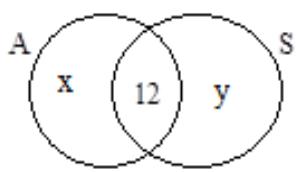
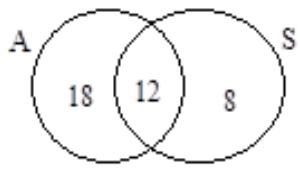
A survey of car enthusiasts showed that over a certain period, 30 drove cars with automatic transmissions, 20 drove cars with standard transmissions, and 12 drove cars of both types. Every surveyed person drove at least one type. How many people participated in the survey?
Solution
Let \(A\) be the set who drove automatics and \(S\) the set who drove standards.
Step 1 — Innermost region. 12 people drove both, so place \(12\) in \(A \cap S\).
Step 2 — Automatic-only region. Circle \(A\) must contain 30 total, so the non-overlapping part of \(A\) holds
$$x + 12 = 30 \implies x = 18.$$
Step 3 — Standard-only region. Circle \(S\) must contain 20, so its non-overlapping part holds
$$y + 12 = 20 \implies y = 8.$$
Step 4 — Add the regions. The survey total is
$$18 + 12 + 8 = 38.$$
Answer: \(38\) people participated in the survey.
Source: Applied Finite Mathematics
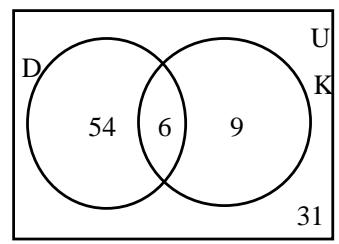
A survey of 100 people in California showed that 60 have visited Disneyland, 15 have visited Knott's Berry Farm, and 6 have visited both. How many have visited neither?
Solution
Let \(D\) be the set of Disneyland visitors and \(K\) the set of Knott's visitors.
Place \(6\) in \(D \cap K\). The Disneyland-only region holds \(60 - 6 = 54\); the Knott's-only region holds \(15 - 6 = 9\). Let \(x\) be the number who visited neither (inside \(U\) but outside both circles). Because the total is 100,
$$54 + 6 + 9 + x = 100 \implies x = 31.$$
Answer: \(31\) people visited neither place.
Source: Applied Finite Mathematics
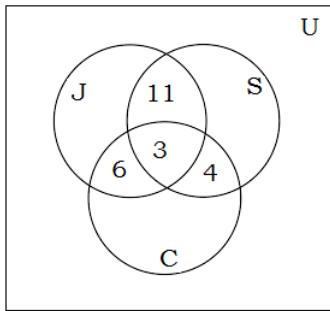
A survey of 100 exercise-conscious people gave the following data:
- 50 jog, 30 swim, 35 cycle
- 14 jog and swim
- 7 swim and cycle
- 9 jog and cycle
- 3 take part in all three activities
a. How many jog but do not swim or cycle?
b. How many take part in only one of the activities?
c. How many do not take part in any of these activities?
Solution
Let \(J\), \(S\), and \(C\) be the sets of joggers, swimmers, and cyclists. Fill the diagram from the innermost region outward so every person is counted exactly once.
Step 1 — Innermost region. Place \(3\) in \(J \cap S \cap C\) (people in all three).
Step 2 — Pairwise-only regions. Each pairwise overlap count already includes the three who do all three, so subtract that \(3\):
- Jog and swim only: \(14 - 3 = 11\)
- Jog and cycle only: \(9 - 3 = 6\)
- Swim and cycle only: \(7 - 3 = 4\)
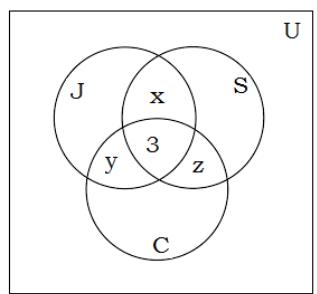
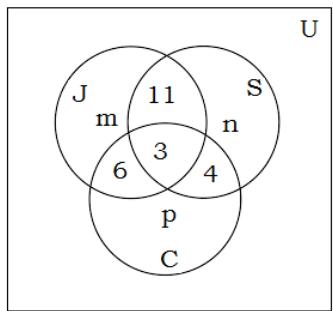
Step 3 — Single-activity regions. Each circle has a known total; subtract everything already inside it to get the single-activity region.
- Jog only: \(m + 11 + 6 + 3 = 50 \implies m = 30\)
- Swim only: \(n + 11 + 4 + 3 = 30 \implies n = 12\)
- Cycle only: \(p + 6 + 4 + 3 = 35 \implies p = 22\)
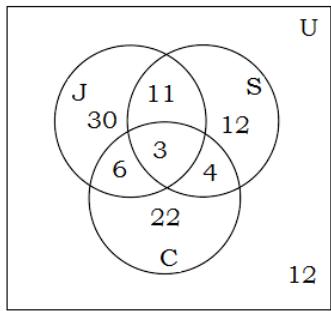
Step 4 — None-of-the-above region. Add every number inside the three circles:
$$30 + 12 + 22 + 11 + 6 + 4 + 3 = 88.$$
Since 100 people were surveyed, the region outside all three circles holds \(100 - 88 = 12\).
Answers.
a. 30 people jog but do not swim or cycle.
b. \(30 + 12 + 22 = \mathbf{64}\) people take part in exactly one activity.
c. 12 people do not take part in any of these activities.
Source: Applied Finite Mathematics
In Ms. Eleanor's class of 35 students, 12 students are taking history, 18 are taking English, and 4 are taking both. Use a Venn diagram to determine how many students are taking neither history nor English.
Solution
Place \(4\) in the intersection. History-only: \(12 - 4 = 8\). English-only: \(18 - 4 = 14\). Total inside the two circles: \(8 + 4 + 14 = 26\). Neither: \(35 - 26 = \mathbf{9}\) students.
Problem Set 7.1
Source: Applied Finite Mathematics
Find the indicated sets.
Problem 1. List all subsets of the following set: \(\{\text{Priya, Meera}\}\).
Problem 1 Solution
Step 1 — Identify the set and its size:
The set is \(\{\text{Priya, Meera}\}\), which has 2 elements. A set with \(n\) elements has \(2^n\) subsets, so we expect \(2^2 = 4\) subsets.
Step 2 — List all subsets systematically:
Start with the empty set, then single-element subsets, then the full set:
- \(\emptyset\) (the empty set)
- \(\{\text{Priya}\}\)
- \(\{\text{Meera}\}\)
- \(\{\text{Priya, Meera}\}\)
Answer: The subsets are \(\emptyset\), \(\{\text{Priya}\}\), \(\{\text{Meera}\}\), \(\{\text{Priya, Meera}\}\).
Problem 2. List all subsets of the following set: \(\{\text{Diego, Camila, Valentina}\}\).
Problem 2 Solution
Step 1 — Identify the set and its size:
The set is \(\{\text{Diego, Camila, Valentina}\}\), which has 3 elements. A set with \(n\) elements has \(2^n\) subsets, so we expect \(2^3 = 8\) subsets.
Step 2 — List all subsets systematically:
Start with the empty set, then single-element subsets, then two-element subsets, then the full set:
- \(\emptyset\)
- \(\{\text{Diego}\}\)
- \(\{\text{Camila}\}\)
- \(\{\text{Valentina}\}\)
- \(\{\text{Diego, Camila}\}\)
- \(\{\text{Diego, Valentina}\}\)
- \(\{\text{Camila, Valentina}\}\)
- \(\{\text{Diego, Camila, Valentina}\}\)
Answer: The 8 subsets are \(\emptyset\), \(\{\text{Diego}\}\), \(\{\text{Camila}\}\), \(\{\text{Valentina}\}\), \(\{\text{Diego, Camila}\}\), \(\{\text{Diego, Valentina}\}\), \(\{\text{Camila, Valentina}\}\), \(\{\text{Diego, Camila, Valentina}\}\).
Problem 3. List the elements of the following set: \(\{\text{Santiago, Isabela, Andres, Gabriela}\} \cap \{\text{Isabela, Andres, Gabriela, Nicolas}\}\).
Problem 3 Solution
Step 1 — Identify the two sets:
The first set is \(\{\text{Santiago, Isabela, Andres, Gabriela}\}\) and the second set is \(\{\text{Isabela, Andres, Gabriela, Nicolas}\}\).
Step 2 — Find the intersection:
The intersection consists of all elements that appear in both sets. Comparing element by element:
- Isabela appears in both ✓
- Andres appears in both ✓
- Gabriela appears in both ✓
- Santiago appears only in the first set ✗
- Nicolas appears only in the second set ✗
Answer: \(\{\text{Isabela, Andres, Gabriela}\}\)
Problem 4. List the elements of the following set: \(\{\text{Lucia, Rafael, Elena, Maria}\} \cup \{\text{Rafael, Elena, Maria, Sofia}\}\).
Problem 4 Solution
Step 1 — Identify the two sets:
The first set is \(\{\text{Lucia, Rafael, Elena, Maria}\}\) and the second set is \(\{\text{Rafael, Elena, Maria, Sofia}\}\).
Step 2 — Find the union:
The union consists of all elements that appear in either set (without duplicates). Combining all distinct elements:
- Lucia (from first set)
- Rafael (in both, listed once)
- Elena (in both, listed once)
- Maria (in both, listed once)
- Sofia (from second set)
Answer: \(\{\text{Lucia, Rafael, Elena, Maria, Sofia}\}\)
Problems 5–8: Let the universal set \(U = \{a, b, c, d, e, f, g, h, i, j\}\), \(V = \{a, e, i, f, h\}\), \(W = \{a, c, e, g, i\}\). List the members of the following sets.
Problem 5. \(V \cup W\)
Problem 5 Solution
Step 1 — Identify the sets:
\(V = \{a, e, i, f, h\}\) and \(W = \{a, c, e, g, i\}\).
Step 2 — Find the union \(V \cup W\):
The union contains every element that is in \(V\) or in \(W\) (or both). Combining all distinct elements from both sets:
- From \(V\): \(a, e, i, f, h\)
- From \(W\) (not already listed): \(c, g\)
Answer: \(V \cup W = \{a, c, e, f, g, h, i\}\)
Problem 6. \(V \cap W\)
Problem 6 Solution
Step 1 — Identify the sets:
\(V = \{a, e, i, f, h\}\) and \(W = \{a, c, e, g, i\}\).
Step 2 — Find the intersection \(V \cap W\):
The intersection contains only the elements that appear in both \(V\) and \(W\). Checking each element of \(V\):
- \(a\): is in \(W\) ✓
- \(e\): is in \(W\) ✓
- \(i\): is in \(W\) ✓
- \(f\): not in \(W\) ✗
- \(h\): not in \(W\) ✗
Answer: \(V \cap W = \{a, e, i\}\)
Problem 7. \(\overline{V \cup W}\)
Problem 7 Solution
Step 1 — Find \(V \cup W\):
From Problem 5, \(V \cup W = \{a, c, e, f, g, h, i\}\).
Step 2 — Take the complement with respect to \(U\):
The complement \(\overline{V \cup W}\) consists of all elements of \(U\) that are not in \(V \cup W\).
$$U = \{a, b, c, d, e, f, g, h, i, j\}$$ $$V \cup W = \{a, c, e, f, g, h, i\}$$Removing the elements of \(V \cup W\) from \(U\), the remaining elements are \(b, d, j\).
Answer: \(\overline{V \cup W} = \{b, d, j\}\)
Problem 8. \(\overline{V \cap W}\)
Problem 8 Solution
Step 1 — Find \(V \cap W\):
From Problem 6, \(V \cap W = \{a, e, i\}\).
Step 2 — Take the complement with respect to \(U\):
The complement \(\overline{V \cap W}\) consists of all elements of \(U\) that are not in \(V \cap W\).
$$U = \{a, b, c, d, e, f, g, h, i, j\}$$ $$V \cap W = \{a, e, i\}$$Removing \(a, e, i\) from \(U\), the remaining elements are \(b, c, d, f, g, h, j\).
Answer: \(\overline{V \cap W} = \{b, c, d, f, g, h, j\}\)
Problems 9–12: Let the universal set \(U = \{1, 2, 3, 4, 5, 6, 7, 8, 9, 10\}\), \(A = \{1, 2, 3, 4, 5\}\), \(B = \{1, 3, 4, 6\}\), \(C = \{2, 4, 6\}\). List the members of the following sets.
Problem 9. \(A \cup B\)
Problem 9 Solution
Step 1 — Identify the sets:
\(A = \{1, 2, 3, 4, 5\}\) and \(B = \{1, 3, 4, 6\}\).
Step 2 — Find the union \(A \cup B\):
The union contains every element in \(A\) or \(B\). Combining all distinct elements:
- From \(A\): \(1, 2, 3, 4, 5\)
- From \(B\) (not already listed): \(6\)
Answer: \(A \cup B = \{1, 2, 3, 4, 5, 6\}\)
Problem 10. \(A \cap C\)
Problem 10 Solution
Step 1 — Identify the sets:
\(A = \{1, 2, 3, 4, 5\}\) and \(C = \{2, 4, 6\}\).
Step 2 — Find the intersection \(A \cap C\):
The intersection contains elements in both \(A\) and \(C\). Checking each element of \(C\):
- \(2\): is in \(A\) ✓
- \(4\): is in \(A\) ✓
- \(6\): not in \(A\) ✗
Answer: \(A \cap C = \{2, 4\}\)
Problem 11. \(\overline{A \cup B} \cap C\)
Problem 11 Solution
Step 1 — Find \(A \cup B\):
From Problem 9, \(A \cup B = \{1, 2, 3, 4, 5, 6\}\).
Step 2 — Find the complement \(\overline{A \cup B}\):
The complement consists of all elements of \(U\) not in \(A \cup B\).
$$U = \{1, 2, 3, 4, 5, 6, 7, 8, 9, 10\}$$ $$A \cup B = \{1, 2, 3, 4, 5, 6\}$$ $$\overline{A \cup B} = \{7, 8, 9, 10\}$$Step 3 — Find \(\overline{A \cup B} \cap C\):
Now intersect \(\{7, 8, 9, 10\}\) with \(C = \{2, 4, 6\}\). No element of \(\{7, 8, 9, 10\}\) appears in \(C\), so the intersection is empty.
Answer: \(\overline{A \cup B} \cap C = \emptyset\)
Problem 12. \(A \cup \overline{B \cap C}\)
Problem 12 Solution
Step 1 — Find \(B \cap C\):
\(B = \{1, 3, 4, 6\}\) and \(C = \{2, 4, 6\}\). The elements common to both are \(4\) and \(6\).
$$B \cap C = \{4, 6\}$$Step 2 — Find the complement \(\overline{B \cap C}\):
Remove \(\{4, 6\}\) from \(U = \{1, 2, 3, 4, 5, 6, 7, 8, 9, 10\}\):
$$\overline{B \cap C} = \{1, 2, 3, 5, 7, 8, 9, 10\}$$Step 3 — Find \(A \cup \overline{B \cap C}\):
Combine all elements of \(A = \{1, 2, 3, 4, 5\}\) with \(\overline{B \cap C} = \{1, 2, 3, 5, 7, 8, 9, 10\}\). The union includes every element from either set:
$$A \cup \overline{B \cap C} = \{1, 2, 3, 4, 5, 7, 8, 9, 10\}$$Answer: \(A \cup \overline{B \cap C} = \{1, 2, 3, 4, 5, 7, 8, 9, 10\}\)
Use Venn diagrams to find the number of elements in the following sets.
Problem 13. In Mx. Yuki's class of 35 students, 12 students are taking history, 18 are taking English, and 4 are taking both. Draw a Venn diagram and use it to determine how many students are taking neither history nor English.
Problem 13 Solution
Step 1 — Set up the Venn diagram:
Draw two overlapping circles: one for History (H) and one for English (E). The overlapping region represents students taking both.
Step 2 — Fill in the overlap (both subjects):
The intersection has 4 students.
Step 3 — Fill in the History-only region:
History only = total History − both = \(12 - 4 = 8\).
Step 4 — Fill in the English-only region:
English only = total English − both = \(18 - 4 = 14\).
Step 5 — Find the number taking at least one subject:
At least one = History only + English only + both = \(8 + 14 + 4 = 26\).
Step 6 — Find the number taking neither:
Neither = total students − at least one = \(35 - 26 = 9\).
Answer: 9 students are taking neither history nor English.
Problem 14. In a survey of 1200 college students, 700 used Spotify to listen to music and 400 used iTunes to listen to music; of these, 100 used both.
- Draw a Venn diagram and find the number of people in each region of the diagram.
- How many used either Spotify or iTunes?
Problem 14 Solution
Step 1 — Set up the Venn diagram:
Draw two overlapping circles: one for Spotify (S) and one for iTunes (I).
Step 2 — Fill in the overlap (both services):
The intersection has 100 students.
Step 3 — Fill in the Spotify-only region:
Spotify only = total Spotify − both = \(700 - 100 = 600\).
Step 4 — Fill in the iTunes-only region:
iTunes only = total iTunes − both = \(400 - 100 = 300\).
Step 5 — Fill in the neither region:
Neither = total surveyed − (Spotify only + iTunes only + both) = \(1200 - (600 + 300 + 100) = 1200 - 1000 = 200\).
Step 6 — Answer part (a):
The Venn diagram regions contain: Spotify only = 600, iTunes only = 300, both = 100, neither = 200.
Step 7 — Answer part (b):
"Either Spotify or iTunes" means using at least one of the two services:
$$600 + 300 + 100 = 1000$$Answer (a): Spotify only = 600, iTunes only = 300, both = 100, neither = 200.
Answer (b): 1000 students used either Spotify or iTunes.
Problem 15. A survey of athletes revealed that for their minor aches and pains, 30 used aspirin, 50 used ibuprofen, and 15 used both. How many athletes were surveyed?.
Problem 15 Solution
Step 1 — Set up the Venn diagram:
Draw two overlapping circles: one for Aspirin (A) and one for Ibuprofen (I).
Step 2 — Fill in the overlap (both medications):
The intersection has 15 athletes.
Step 3 — Fill in the Aspirin-only region:
Aspirin only = total Aspirin − both = \(30 - 15 = 15\).
Step 4 — Fill in the Ibuprofen-only region:
Ibuprofen only = total Ibuprofen − both = \(50 - 15 = 35\).
Step 5 — Find the total number of athletes surveyed:
Total = Aspirin only + Ibuprofen only + both = \(15 + 35 + 15 = 65\).
Answer: 65 athletes were surveyed.
Problem 16. In 2016, 80 college students were surveyed about what video services they subscribed to. Suppose the survey showed that 50 use Amazon Prime, 30 use Netflix, 20 use Hulu. Of those, 13 use Amazon Prime and Netflix, 9 use Amazon Prime and Hulu, 7 use Netflix and Hulu. 3 students use all three services.
- Draw a Venn diagram and use it to determine the number of people in each region of the diagram.
- How many use at least one of these?
- How many use none of these?
Problem 16 Solution
Step 1 — Set up the Venn diagram:
Draw three overlapping circles: Amazon Prime (A), Netflix (N), and Hulu (H).
Step 2 — Fill in the center (all three services):
All three = 3.
Step 3 — Fill in the two-service-only regions:
- A∩N only (not H) = \(13 - 3 = 10\)
- A∩H only (not N) = \(9 - 3 = 6\)
- N∩H only (not A) = \(7 - 3 = 4\)
Step 4 — Fill in the single-service-only regions:
- Amazon Prime only = \(50 - 10 - 6 - 3 = 31\)
- Netflix only = \(30 - 10 - 4 - 3 = 13\)
- Hulu only = \(20 - 6 - 4 - 3 = 7\)
Step 5 — Answer part (a):
The Venn diagram regions are: Amazon Prime only = 31, Netflix only = 13, Hulu only = 7, A∩N only = 10, A∩H only = 6, N∩H only = 4, all three = 3.
Step 6 — Answer part (b) — at least one service:
$$31 + 13 + 7 + 10 + 6 + 4 + 3 = 74$$Step 7 — Answer part (c) — none of these:
$$80 - 74 = 6$$Answer (a): Amazon Prime only = 31, Netflix only = 13, Hulu only = 7, A∩N only = 10, A∩H only = 6, N∩H only = 4, all three = 3.
Answer (b): 74 students use at least one of these services.
Answer (c): 6 students use none of these services.
Problem 17. A survey of 100 students at a college finds that 50 take math, 40 take English, and 30 take history. Of these 15 take English and math, 10 take English and history, 10 take math and history, and 5 take all three subjects. Draw a Venn diagram and find the numbers in each region. Use the diagram to answer the questions below.
- Find the number of students taking math but not the other two subjects.
- The number of students taking English or math but not history.
- The number of students taking none of these subjects.
Problem 17 Solution
Step 1 — Set up the Venn diagram:
Draw three overlapping circles: Math (M), English (E), and History (H).
Step 2 — Fill in the center (all three subjects):
All three = 5.
Step 3 — Fill in the two-subject-only regions:
- E∩M only (not H) = \(15 - 5 = 10\)
- E∩H only (not M) = \(10 - 5 = 5\)
- M∩H only (not E) = \(10 - 5 = 5\)
Step 4 — Fill in the single-subject-only regions:
- Math only = \(50 - 10 - 5 - 5 = 30\)
- English only = \(40 - 10 - 5 - 5 = 20\)
- History only = \(30 - 5 - 5 - 5 = 15\)
Step 5 — Find the number taking none:
Students in at least one = \(30 + 20 + 15 + 10 + 5 + 5 + 5 = 90\).
None = \(100 - 90 = 10\).
Step 6 — Answer part (a):
Students taking math but not the other two = Math only = 30.
Step 7 — Answer part (b):
Students taking English or math but not history = English only + Math only + E∩M only = \(20 + 30 + 10 = 60\).
Step 8 — Answer part (c):
Students taking none = 10.
Answer (a): 30 students take math but not the other two subjects.
Answer (b): 60 students take English or math but not history.
Answer (c): 10 students take none of these subjects.
Problem 18. In a survey of investors it was found that 100 invested in stocks, 60 in mutual funds, and 50 in bonds. Of these, 35 invested in stocks and mutual funds, 30 in mutual funds and bonds, 28 in stocks and bonds, and 20 in all three. Draw a Venn diagram and find the numbers in each region. Use the diagram to answer the questions below.
- Find the number of investors that participated in the survey.
- How many invested in stocks or mutual funds but not in bonds?
- How many invested in exactly one type of investment?
Problem 18 Solution
Step 1 — Set up the Venn diagram:
Draw three overlapping circles: Stocks (S), Mutual Funds (M), and Bonds (B).
Step 2 — Fill in the center (all three):
All three = 20.
Step 3 — Fill in the two-investment-only regions:
- S∩M only (not B) = \(35 - 20 = 15\)
- M∩B only (not S) = \(30 - 20 = 10\)
- S∩B only (not M) = \(28 - 20 = 8\)
Step 4 — Fill in the single-investment-only regions:
- Stocks only = \(100 - 15 - 8 - 20 = 57\)
- Mutual Funds only = \(60 - 15 - 10 - 20 = 15\)
- Bonds only = \(50 - 10 - 8 - 20 = 12\)
Step 5 — Answer part (a) — total investors:
$$57 + 15 + 12 + 15 + 8 + 10 + 20 = 137$$Step 6 — Answer part (b) — stocks or mutual funds but not bonds:
This includes Stocks only + Mutual Funds only + S∩M only:
$$57 + 15 + 15 = 87$$Step 7 — Answer part (c) — exactly one type of investment:
Stocks only + Mutual Funds only + Bonds only:
$$57 + 15 + 12 = 84$$Answer (a): 137 investors participated in the survey.
Answer (b): 87 investors invested in stocks or mutual funds but not in bonds.
Answer (c): 84 investors invested in exactly one type of investment.
Problem 19. Using the same data as Problem 17 (100 students: 50 math, 40 English, 30 history; 15 E∩M, 10 E∩H, 10 M∩H, 5 in all three). For each of the following, draw a Venn diagram, shade the indicated set, and determine how many students are in it.
- Students who take at least one of these classes.
- Students who take exactly one of these classes.
- Students who take at least two of these classes.
- Students who take exactly two of these classes.
- Students who take at most two of these classes.
- Students who take English or Math but not both.
- Students who take Math or History but not English.
- Students who take all of these classes.
Problem 19 Solution
Step 1 — Recall the Venn diagram regions from Problem 17:
- Math only = 30
- English only = 20
- History only = 15
- E∩M only = 10
- E∩H only = 5
- M∩H only = 5
- All three = 5
- None = 10
Step 2 — Answer part (a) — at least one class:
$$30 + 20 + 15 + 10 + 5 + 5 + 5 = 90$$Step 3 — Answer part (b) — exactly one class:
$$30 + 20 + 15 = 65$$Step 4 — Answer part (c) — at least two classes:
$$10 + 5 + 5 + 5 = 25$$Step 5 — Answer part (d) — exactly two classes:
$$10 + 5 + 5 = 20$$Step 6 — Answer part (e) — at most two classes:
This means 0, 1, or 2 classes (everyone except those in all three):
$$100 - 5 = 95$$Alternatively: none + exactly one + exactly two = \(10 + 65 + 20 = 95\).
Step 7 — Answer part (f) — English or Math but not both:
This is \((E \cup M) \setminus (E \cap M)\). Students in English or Math but not both:
- English only = 20
- Math only = 30
- E∩H only (English and History, but not Math) = 5
- M∩H only (Math and History, but not English) = 5
Step 8 — Answer part (g) — Math or History but not English:
Students in Math or History who do not take English:
- Math only = 30
- History only = 15
- M∩H only = 5
Step 9 — Answer part (h) — all three classes:
All three = 5.
Answer (a): 90 students take at least one of these classes.
Answer (b): 65 students take exactly one of these classes.
Answer (c): 25 students take at least two of these classes.
Answer (d): 20 students take exactly two of these classes.
Answer (e): 95 students take at most two of these classes.
Answer (f): 60 students take English or Math but not both.
Answer (g): 50 students take Math or History but not English.
Answer (h): 5 students take all of these classes.
Problem 20. Using the same data as Problem 18 (investors: 100 stocks, 60 mutual funds, 50 bonds; 35 S∩M, 30 M∩B, 28 S∩B, 20 in all three). For each of the following, draw a Venn diagram, shade the indicated set, and determine how many investors are in it.
- Investors who invested in mutual funds only.
- Investors who invested in stocks and bonds but not mutual funds.
- Investors who invested in exactly one of these investments.
- Investors who invested in exactly two of these investments.
- Investors who invested in at least two of these investments.
- Investors who invested in at most two of these investments.
- Investors who did not invest in bonds.
- Investors who invested in all three investments.
Problem 20 Solution
Step 1 — Recall the Venn diagram regions from Problem 18:
- Stocks only = 57
- Mutual Funds only = 15
- Bonds only = 12
- S∩M only = 15
- S∩B only = 8
- M∩B only = 10
- All three = 20
- Total investors = 137
Step 2 — Answer part (a) — mutual funds only:
Mutual Funds only = 15.
Step 3 — Answer part (b) — stocks and bonds but not mutual funds:
S∩B only = 8.
Step 4 — Answer part (c) — exactly one investment:
Stocks only + Mutual Funds only + Bonds only = \(57 + 15 + 12 = 84\).
Step 5 — Answer part (d) — exactly two investments:
S∩M only + S∩B only + M∩B only = \(15 + 8 + 10 = 33\).
Step 6 — Answer part (e) — at least two investments:
Exactly two + all three = \(33 + 20 = 53\).
Step 7 — Answer part (f) — at most two investments:
Total − all three = \(137 - 20 = 117\).
Alternatively: exactly one + exactly two + none = \(84 + 33 + 0 = 117\). (Note: every surveyed investor is in at least one region, so "none" = 0.)
Step 8 — Answer part (g) — did not invest in bonds:
Stocks only + Mutual Funds only + S∩M only = \(57 + 15 + 15 = 87\).
Step 9 — Answer part (h) — all three investments:
All three = 20.
Answer (a): 15 investors invested in mutual funds only.
Answer (b): 8 investors invested in stocks and bonds but not mutual funds.
Answer (c): 84 investors invested in exactly one of these investments.
Answer (d): 33 investors invested in exactly two of these investments.
Answer (e): 53 investors invested in at least two of these investments.
Answer (f): 117 investors invested in at most two of these investments.
Answer (g): 87 investors did not invest in bonds.
Answer (h): 20 investors invested in all three investments.