1.3 Trigonometric Functions
Learning Objectives
- Convert angle measures between degrees and radians.
- Recognize the triangular and circular definitions of the basic trigonometric functions.
- Write the basic trigonometric identities.
- Identify the graphs and periods of the trigonometric functions.
- Describe the shift of a sine or cosine graph from the equation of the function.
Trigonometric functions show up everywhere you look in science and engineering: the voltage in your wall socket oscillates as a sine wave, a guitar string vibrates according to cosine, the position of a pendulum traces out a sine curve, and even the daylight hours through the year follow a shifted sinusoid. In fact, almost any repetitive, or cyclical, motion can be modeled by some combination of trigonometric functions. In this section we define the six basic trigonometric functions and explore their key identities and graphs — tools you will reach for constantly throughout calculus.
1.3.1 Radian Measure
To use trigonometric functions precisely, we first need a way to measure angles. You are already comfortable with degrees, but mathematicians and scientists almost always work in radians because radians connect angle size directly to arc length on the unit circle — a circle of radius 1.
You have almost certainly seen sine and cosine in a geometry or precalculus course. Here we build on that foundation with the unit-circle definition — the one that works for ANY angle, not just the acute angles of a right triangle. The right-triangle shortcut is still useful, but the unit-circle perspective is what lets us talk about \(\sin(2\pi/3)\) or \(\cos(-5\pi/6)\) without confusion.
Here is the idea: given an angle \(\theta\), draw it in standard position at the center of the unit circle and let \(s\) be the length of the arc it cuts off (Figure 1.30). We define the radian measure of \(\theta\) to be exactly that arc length \(s\). An angle whose arc has length 1 has radian measure 1.
Figure 1.30 — The radian measure of an angle \(\theta\) is the arc length \(s\) of the associated arc on the unit circle.
Since a full rotation sweeps the entire circumference \(2\pi\), an angle of \(360°\) equals \(2\pi\) radians. Cutting that in half gives us the conversion anchor: \(180° = \pi\) radians. Table 1.8 collects the most common conversions.
| Degrees | Radians |
|---|---|
| \(0°\) | \(0\) |
| \(30°\) | \(\dfrac{\pi}{6}\) |
| \(45°\) | \(\dfrac{\pi}{4}\) |
| \(60°\) | \(\dfrac{\pi}{3}\) |
| \(90°\) | \(\dfrac{\pi}{2}\) |
| \(120°\) | \(\dfrac{2\pi}{3}\) |
| \(180°\) | \(\pi\) |
| \(270°\) | \(\dfrac{3\pi}{2}\) |
| \(360°\) | \(2\pi\) |
The conversion factor approach lets you translate any angle mechanically without memorizing special cases. We just multiply by the appropriate ratio and simplify.
Express \(210°\) using radians. Then express \(\frac{11\pi}{6}\) rad using degrees.
Solution
Degrees to radians:
$$210° = 210° \cdot \frac{\pi}{180°} = \frac{210\pi}{180} = \frac{7\pi}{6} \text{ rad}.$$Radians to degrees:
$$\frac{11\pi}{6} \text{ rad} = \frac{11\pi}{6} \cdot \frac{180°}{\pi} = \frac{11 \cdot 180°}{6} = 330°.$$- Express \(225°\) using radians.
- Express \(\frac{5\pi}{3}\) rad using degrees.
Solution
We use the conversion factor \(1 = \frac{\pi \text{ rad}}{180°} = \frac{180°}{\pi \text{ rad}}\).
Part 1 — degrees to radians:
$$225° = 225° \cdot \frac{\pi}{180°} = \frac{225\pi}{180} = \frac{5\pi}{4} \text{ rad}.$$Part 2 — radians to degrees:
$$\frac{5\pi}{3} \text{ rad} = \frac{5\pi}{3} \cdot \frac{180°}{\pi} = \frac{5 \cdot 180°}{3} = 300°.$$Answer: \(225° = \frac{5\pi}{4}\) rad and \(\frac{5\pi}{3}\) rad \(= 300°\).
1.3.2 The Six Basic Trigonometric Functions
Let \(P = (x,y)\) be a point on the unit circle centered at the origin \(O\). Let \(\theta\) be an angle with an initial side along the positive \(x\)-axis and a terminal side given by the line segment \(OP\). The trigonometric functions are defined as
$$ \begin{array}{l} \sin \theta = y \qquad\qquad \csc \theta = \dfrac{1}{y} \\[8pt] \cos \theta = x \qquad\qquad \sec \theta = \dfrac{1}{x} \\[8pt] \tan \theta = \dfrac{y}{x} \qquad\qquad \cot \theta = \dfrac{x}{y} \end{array} $$If \(x = 0\), then \(\sec \theta\) and \(\tan \theta\) are undefined. If \(y = 0\), then \(\cot \theta\) and \(\csc \theta\) are undefined.
The mnemonic SOH-CAH-TOA ("Sine = Opposite/Hypotenuse, Cosine = Adjacent/Hypotenuse, Tangent = Opposite/Adjacent") reminds you how the three primary functions behave in a right triangle — and the unit-circle definition lines up perfectly: on the unit circle, the "adjacent" side is \(x\), the "opposite" side is \(y\), and the "hypotenuse" is 1.
For a point \(P = (x,y)\) on a circle of arbitrary radius \(r\), the same angle \(\theta\) gives
$$ \cos \theta = \frac{x}{r}, \qquad x = r\cos\theta, $$ $$ \sin \theta = \frac{y}{r}, \qquad y = r\sin\theta. $$The values of the other four functions follow from these two, as shown in Figure 1.32.


Figure 1.32 — For a point \(P=(x,y)\) on a circle of radius \(r,\) the coordinates \(x\) and \(y\) satisfy \(x=r \cos \theta\) and \(y=r \sin \theta.\)
Table 1.9 lists the sine and cosine values at the standard first-quadrant angles. Once you know these, you can recover values in all four quadrants by thinking about the signs of \(x\) and \(y\) in each quadrant.
| \(\theta\) | \(\sin\theta\) | \(\cos\theta\) |
|---|---|---|
| \(0\) | \(0\) | \(1\) |
| \(\dfrac{\pi}{6}\) | \(\dfrac{1}{2}\) | \(\dfrac{\sqrt{3}}{2}\) |
| \(\dfrac{\pi}{4}\) | \(\dfrac{\sqrt{2}}{2}\) | \(\dfrac{\sqrt{2}}{2}\) |
| \(\dfrac{\pi}{3}\) | \(\dfrac{\sqrt{3}}{2}\) | \(\dfrac{1}{2}\) |
| \(\dfrac{\pi}{2}\) | \(1\) | \(0\) |
The unit-circle definition is the "master" definition: it works for negative angles, angles greater than \(360°\), and every real-number input. The right-triangle definition is a useful special case that works only for acute angles but ties trig directly to geometry you already know. Both appear constantly in calculus.
Trigonometric functions let us use an angle to find the coordinates of a point on a circle — or, conversely, to find the angle given a point. They also encode the ratios of sides in a right triangle. We will define them in both ways, starting with the unit-circle approach because it handles every possible angle.
Consider the unit circle centered at the origin and a point \(P = (x,y)\) on it. Let \(\theta\) be an angle in standard position — initial side along the positive \(x\)-axis, terminal side the segment \(OP\) (Figure 1.31). The coordinates \(x\) and \(y\) of \(P\) define all six trig functions.


Figure 1.31 — The angle \(\theta\) is in standard position. The values of the trigonometric functions for \(\theta\) are defined in terms of the coordinates \(x\) and \(y.\)
Evaluate \(\cos\!\left(\frac{3\pi}{4}\right)\) and \(\sin\!\left(-\frac{\pi}{6}\right)\).
Solution
\(\cos\!\left(\frac{3\pi}{4}\right)\): The reference angle is \(\frac{\pi}{4}\), and \(\frac{3\pi}{4}\) is in QII where \(x < 0\). So \(\cos\!\left(\frac{3\pi}{4}\right) = -\frac{\sqrt{2}}{2}.\)
\(\sin\!\left(-\frac{\pi}{6}\right)\): A negative angle, landing in QIV where \(y < 0\). The reference angle is \(\frac{\pi}{6}\), so \(\sin\!\left(-\frac{\pi}{6}\right) = -\frac{1}{2}.\)
The unit-circle definition also gives us the right-triangle interpretation. Inscribe a right triangle into a circle of radius \(H\) (the hypotenuse), with one acute angle \(\theta\), adjacent leg \(A\), and opposite leg \(O\). Then \(x = A\) and \(y = O\) on the scaled circle, giving
$$ \begin{array}{l} \sin\theta = \dfrac{O}{H} \qquad \csc\theta = \dfrac{H}{O} \\[8pt] \cos\theta = \dfrac{A}{H} \qquad \sec\theta = \dfrac{H}{A} \\[8pt] \tan\theta = \dfrac{O}{A} \qquad \cot\theta = \dfrac{A}{O} \end{array} $$

Figure 1.33 — By inscribing a right triangle in a circle, we can express the ratios of the side lengths in terms of the trigonometric functions evaluated at \(\theta.\)
Evaluate each of the following expressions.
- \(\sin\!\left(\frac{2\pi}{3}\right)\)
- \(\cos\!\left(-\frac{5\pi}{6}\right)\)
- \(\tan\!\left(\frac{15\pi}{4}\right)\)
Solution
Part 1: The angle \(\theta = \frac{2\pi}{3}\) lands in the second quadrant. Its reference angle is \(\pi - \frac{2\pi}{3} = \frac{\pi}{3}\), so the corresponding unit-circle point is \(\left(-\frac{1}{2}, \frac{\sqrt{3}}{2}\right)\).
Therefore \(\sin\!\left(\frac{2\pi}{3}\right) = y = \frac{\sqrt{3}}{2}.\)
Part 2: The angle \(\theta = -\frac{5\pi}{6}\) is a negative-direction rotation ending in the third quadrant. Its reference angle is \(\frac{5\pi}{6} - \pi = -\frac{\pi}{6}\), so (working with \(\frac{\pi}{6}\) in QI) the point is \(\left(-\frac{\sqrt{3}}{2}, -\frac{1}{2}\right)\).
Therefore \(\cos\!\left(-\frac{5\pi}{6}\right) = x = -\frac{\sqrt{3}}{2}.\)
Part 3: An angle of \(\frac{15\pi}{4} = 2\pi + \frac{7\pi}{4}\) completes one full revolution and then an additional \(\frac{7\pi}{4}\). The angle \(\frac{7\pi}{4}\) is in the fourth quadrant, corresponding to the point \(\left(\frac{\sqrt{2}}{2}, -\frac{\sqrt{2}}{2}\right)\).
Therefore \(\tan\!\left(\frac{15\pi}{4}\right) = \frac{y}{x} = \frac{-\sqrt{2}/2}{\sqrt{2}/2} = -1.\)
A house painter wants to lean a \(20\)-ft ladder against a house. If the angle between the base of the ladder and the ground is to be \(60°,\) how far from the house should she place the base of the ladder?
Solution
The ladder is the hypotenuse (\(H = 20\) ft). The angle at the base is \(60°\). We need the adjacent side (horizontal distance from the house).
Using \(\cos\theta = \frac{\text{adjacent}}{\text{hypotenuse}}\):
$$\cos(60°) = \frac{d}{20} \implies d = 20\cos(60°) = 20 \cdot \frac{1}{2} = 10 \text{ ft}.$$Answer: She should place the base \(10\) ft from the house.
A wooden ramp is to be built with one end on the ground and the other end at the top of a short staircase. If the top of the staircase is \(4\) ft from the ground and the angle between the ground and the ramp is to be \(10°,\) how long does the ramp need to be?
Solution
Let \(x\) denote the length of the ramp (the hypotenuse of the right triangle). The side opposite \(10°\) is \(4\) ft (the vertical height).


Step 1 — Set up the equation. Using \(\sin\theta = \frac{\text{opposite}}{\text{hypotenuse}}\):
$$\sin(10°) = \frac{4}{x}.$$Step 2 — Solve for \(x\).
$$x = \frac{4}{\sin(10°)}.$$Step 3 — Compute. Since \(\sin(10°) \approx 0.1736\):
$$x \approx \frac{4}{0.1736} \approx 23.035 \text{ ft}.$$Answer: The ramp needs to be approximately \(23.035\) ft long.
1.3.3 Trigonometric Identities
A trigonometric identity is an equation involving trig functions that holds true for every angle \(\theta\) at which all terms are defined. Identities are incredibly useful: they let you rewrite expressions in simpler forms, combine terms, and solve equations that would otherwise be intractable.
Think of a trig identity as a currency exchange you can invoke at will. Just as \(\$1 = €0.92\), the identity \(\sin^2\theta + \cos^2\theta = 1\) says those two expressions are always equal — you can substitute one for the other whenever it helps. A skilled calculus student mentally carries a half-dozen of these and swaps freely.
The main identities fall into four families. Every one of them can be derived from the unit-circle definition, so you never have to memorize them blindly.
Rule: Trigonometric Identities
Reciprocal identities
$$\csc\theta = \frac{1}{\sin\theta}, \quad \sec\theta = \frac{1}{\cos\theta}, \quad \cot\theta = \frac{1}{\tan\theta}$$Pythagorean identities
$$\sin^2\theta + \cos^2\theta = 1, \quad 1 + \tan^2\theta = \sec^2\theta, \quad 1 + \cot^2\theta = \csc^2\theta$$Addition and subtraction formulas
$$\sin(\alpha \pm \beta) = \sin\alpha\cos\beta \pm \cos\alpha\sin\beta$$ $$\cos(\alpha \pm \beta) = \cos\alpha\cos\beta \mp \sin\alpha\sin\beta$$Double-angle formulas
$$\sin(2\theta) = 2\sin\theta\cos\theta$$ $$\cos(2\theta) = \cos^2\theta - \sin^2\theta = 1 - 2\sin^2\theta = 2\cos^2\theta - 1$$
Find all solutions to the equation \(\cos(2\theta) = \sin\theta\).
Solution
Use \(\cos(2\theta) = 1 - 2\sin^2\theta\):
$$1 - 2\sin^2\theta = \sin\theta \implies 2\sin^2\theta + \sin\theta - 1 = 0.$$Factor:
$$(2\sin\theta - 1)(\sin\theta + 1) = 0.$$- \(\sin\theta = \frac{1}{2}\): \(\theta = \frac{\pi}{6} + 2n\pi\) or \(\theta = \frac{5\pi}{6} + 2n\pi\). - \(\sin\theta = -1\): \(\theta = -\frac{\pi}{2} + 2n\pi = \frac{3\pi}{2} + 2n\pi\).
For each of the following equations, use a trigonometric identity to find all solutions.
- \(1 + \cos(2\theta) = \cos\theta\)
- \(\sin(2\theta) = \tan\theta\)
Solution
Part 1. Apply the double-angle identity \(\cos(2\theta) = 2\cos^2\theta - 1\):
$$1 + (2\cos^2\theta - 1) = \cos\theta \implies 2\cos^2\theta = \cos\theta.$$Move everything to one side:
$$2\cos^2\theta - \cos\theta = 0.$$Key step: Factor, do NOT divide by \(\cos\theta\) — dividing could lose solutions where \(\cos\theta = 0\).
$$\cos\theta(2\cos\theta - 1) = 0.$$So either \(\cos\theta = 0\) or \(\cos\theta = \frac{1}{2}\).
- \(\cos\theta = 0\): \(\theta = \frac{\pi}{2} + n\pi\) for any integer \(n\). - \(\cos\theta = \frac{1}{2}\): \(\theta = \frac{\pi}{3} + 2n\pi\) or \(\theta = -\frac{\pi}{3} + 2n\pi\).
$$\boxed{\theta = \frac{\pi}{2} + n\pi, \quad \theta = \pm\frac{\pi}{3} + 2n\pi, \quad n \in \mathbb{Z}.}$$Part 2. Write \(\sin(2\theta) = 2\sin\theta\cos\theta\) and \(\tan\theta = \frac{\sin\theta}{\cos\theta}\):
$$2\sin\theta\cos\theta = \frac{\sin\theta}{\cos\theta}.$$Multiply both sides by \(\cos\theta\) (noting \(\cos\theta\) might be zero — check at the end):
$$2\sin\theta\cos^2\theta - \sin\theta = 0.$$Factor out \(\sin\theta\):
$$\sin\theta(2\cos^2\theta - 1) = 0.$$So either \(\sin\theta = 0\) or \(\cos^2\theta = \frac{1}{2}\).
- \(\sin\theta = 0\): \(\theta = n\pi\). Check in original: \(\tan(n\pi) = 0\), and \(\sin(2n\pi) = 0\). ✓ - \(\cos^2\theta = \frac{1}{2}\) means \(\cos\theta = \pm\frac{\sqrt{2}}{2}\), giving \(\theta = \frac{\pi}{4} + \frac{n\pi}{2}\). Check \(\cos\theta \neq 0\) at these values. ✓
$$\boxed{\theta = n\pi \quad \text{and} \quad \theta = \frac{\pi}{4} + \frac{n\pi}{2}, \quad n \in \mathbb{Z}.}$$Prove the trigonometric identity \(1 + \cot^2\theta = \csc^2\theta.\)
Solution
Start from \(\sin^2\theta + \cos^2\theta = 1\) and divide both sides by \(\sin^2\theta\) (valid when \(\sin\theta \neq 0\)):
$$1 + \frac{\cos^2\theta}{\sin^2\theta} = \frac{1}{\sin^2\theta}.$$Since \(\frac{\cos\theta}{\sin\theta} = \cot\theta\) and \(\frac{1}{\sin\theta} = \csc\theta\):
$$1 + \cot^2\theta = \csc^2\theta. \qquad \square$$Prove the trigonometric identity \(1 + \tan^2\theta = \sec^2\theta.\)
Solution
Step 1 — Start from a known identity:
$$\sin^2\theta + \cos^2\theta = 1.$$Step 2 — Divide both sides by \(\cos^2\theta\) (valid when \(\cos\theta \neq 0\)):
$$\frac{\sin^2\theta}{\cos^2\theta} + \frac{\cos^2\theta}{\cos^2\theta} = \frac{1}{\cos^2\theta}.$$Step 3 — Recognize the ratios:
Since \(\frac{\sin\theta}{\cos\theta} = \tan\theta\) and \(\frac{1}{\cos\theta} = \sec\theta\):
$$\tan^2\theta + 1 = \sec^2\theta. \qquad \square$$1.3.4 Graphs and Periods of the Trigonometric Functions
The period of a function \(f\) is the smallest positive value \(p\) such that
$$f(x + p) = f(x)$$for all \(x\) in the domain of \(f\).
Periodicity is why trig functions are the natural language for waves. A sound wave, a light wave, an AC electrical current — each oscillates and then repeats. The period is the wavelength (or cycle time). Understanding how A, B, \(\alpha\), and C in \(f(x) = A\cos(B(x-\alpha))+C\) reshape the graph is exactly what you need to match a trig function to a real-world wave.
Because the angle \(\theta\) and \(\theta + 2\pi\) land at the same point on the unit circle, we have \(\sin(\theta + 2\pi) = \sin\theta\) and \(\cos(\theta + 2\pi) = \cos\theta\) — so sine and cosine (and their reciprocals secant and cosecant) have period \(2\pi\). Tangent and cotangent repeat with period \(\pi\), since \(\tan(\theta + \pi) = \tan\theta\) (Figure 1.34).


Figure 1.34 — The six trigonometric functions are periodic.
Trigonometric functions can be transformed just like any other function. The general transformed cosine function is
$$f(x) = A\cos(B(x - \alpha)) + C.$$Each parameter plays a specific role:
- \(|A|\) is the amplitude — the vertical stretch factor. The function oscillates between \(-|A|\) and \(|A|\) (plus any vertical shift \(C\)).
- \(B\) changes the period to \(\frac{2\pi}{|B|}\) — squeezing or stretching the wave horizontally.
- \(\alpha\) is the phase shift — a horizontal translation left (if \(\alpha < 0\)) or right (if \(\alpha > 0\)).
- \(C\) is the vertical shift — moves the midline up or down.
Figure 1.35 — A graph of a general cosine function.
Notice from Figure 1.34 that \(y = \cos x\) looks exactly like \(y = \sin x\) shifted \(\frac{\pi}{2}\) units to the left, so we can write
$$\cos x = \sin\!\left(x + \frac{\pi}{2}\right), \quad \text{and equivalently,} \quad \sin x = \cos\!\left(x - \frac{\pi}{2}\right).$$A natural application: suppose we want to model the number of hours of daylight in a city through the year. If the longest day (June 21) has \(15.7\) hours and the shortest (December 21) has \(8.3\) hours, then the amplitude is \(\frac{15.7 - 8.3}{2} = 3.7\), the midline is at \(12\) hours, and the period is \(365\) days. The model
$$h(t) = 3.7\sin\!\left(\frac{2\pi}{365}(t - 80.5)\right) + 12$$captures daylight hours \(h\) as a function of day-of-year \(t\) (Figure 1.36).


Figure 1.36 — The hours of daylight as a function of day of the year can be modeled by a shifted sine curve.
As we travel around the unit circle, the coordinates repeat every full revolution — so the trig functions repeat too. A function that repeats is called periodic.
Describe the relationship between the graph of \(f(x) = 3\sin(4x) - 5\) and the graph of \(y = \sin(x)\).
Solution
Compare \(f(x) = 3\sin(4x) - 5\) to the standard form \(A\sin(Bx) + C\):
- \(|A| = 3\): vertical stretch by factor 3 (amplitude 3 instead of 1). - \(B = 4\): horizontal compression, new period \(\frac{2\pi}{4} = \frac{\pi}{2}\) instead of \(2\pi\). - \(C = -5\): vertical shift down 5 units (midline at \(y = -5\) instead of \(y = 0\)).
There is no phase shift (\(\alpha = 0\)).
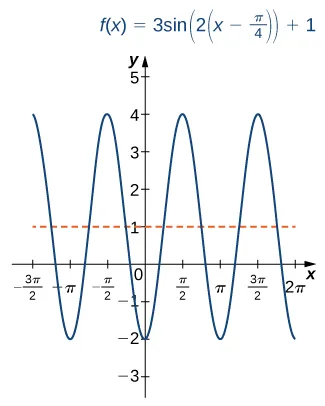
Sketch a graph of \(f(x) = 3\sin\!\left(2\!\left(x - \frac{\pi}{4}\right)\right) + 1.\)
Solution
Read off the parameters: \(A = 3\), \(B = 2\), \(\alpha = \frac{\pi}{4}\), \(C = 1\).
Step 1 — Period: \(\frac{2\pi}{|B|} = \frac{2\pi}{2} = \pi\).
Step 2 — Amplitude: \(|A| = 3\). The graph oscillates between \(1 - 3 = -2\) and \(1 + 3 = 4\) (after the vertical shift).
Step 3 — Phase shift: \(\alpha = \frac{\pi}{4}\) to the right.
Step 4 — Vertical shift: \(C = 1\) up; midline at \(y = 1\).
Step 5 — Sketch. Start with \(y = \sin x\), compress horizontally by factor 2, shift right \(\frac{\pi}{4}\), stretch vertically by 3, then shift up 1.
Problem Set 1.3
For the following exercises, convert each angle in degrees to radians. Write the answer as a multiple of \(\pi\).
Problem 1. \(240°\)
Problem 2. \(15°\)
Problem 3. \(-60°\)
Problem 4. \(-225°\)
Problem 5. \(330°\)
Solutions 1–5
Problem 1
Step 1 — Apply the conversion factor: Multiply by \(\frac{\pi}{180°}\).
$$240° \cdot \frac{\pi}{180°} = \frac{240\pi}{180} = \frac{4\pi}{3}.$$Answer: \(\dfrac{4\pi}{3}\) rad.
Problem 2
Step 1 — Apply the conversion factor:
$$15° \cdot \frac{\pi}{180°} = \frac{15\pi}{180} = \frac{\pi}{12}.$$Answer: \(\dfrac{\pi}{12}\) rad.
Problem 3
Step 1 — Apply the conversion factor:
$$-60° \cdot \frac{\pi}{180°} = \frac{-60\pi}{180} = -\frac{\pi}{3}.$$Answer: \(-\dfrac{\pi}{3}\) rad.
Problem 4
Step 1 — Apply the conversion factor:
$$-225° \cdot \frac{\pi}{180°} = \frac{-225\pi}{180} = -\frac{5\pi}{4}.$$Answer: \(-\dfrac{5\pi}{4}\) rad.
Problem 5
Step 1 — Apply the conversion factor:
$$330° \cdot \frac{\pi}{180°} = \frac{330\pi}{180} = \frac{11\pi}{6}.$$Answer: \(\dfrac{11\pi}{6}\) rad.
For the following exercises, convert each angle in radians to degrees.
Problem 6. \(\dfrac{\pi}{2}\) rad
Problem 7. \(\dfrac{7\pi}{6}\) rad
Problem 8. \(\dfrac{11\pi}{2}\) rad
Problem 9. \(-3\pi\) rad
Problem 10. \(\dfrac{5\pi}{12}\) rad
Evaluate the following functional values.
Problem 11. \(\cos\!\left(\dfrac{4\pi}{3}\right)\)
Problem 12. \(\tan\!\left(\dfrac{19\pi}{4}\right)\)
Problem 13. \(\sin\!\left(-\dfrac{3\pi}{4}\right)\)
Problem 14. \(\sec\!\left(\dfrac{\pi}{6}\right)\)
Problem 15. \(\sin\!\left(\dfrac{\pi}{12}\right)\)
Problem 16. \(\cos\!\left(\dfrac{5\pi}{12}\right)\)


Solutions 6–16
Problem 6
Step 1 — Apply the conversion factor: Multiply by \(\frac{180°}{\pi}\).
$$\frac{\pi}{2} \cdot \frac{180°}{\pi} = \frac{180°}{2} = 90°.$$Answer: \(90°\).
Problem 7
Step 1 — Multiply by \(\frac{180°}{\pi}\):
$$\frac{7\pi}{6} \cdot \frac{180°}{\pi} = \frac{7 \cdot 180°}{6} = \frac{1260°}{6} = 210°.$$Answer: \(210°\).
Problem 8
Step 1 — Multiply by \(\frac{180°}{\pi}\):
$$\frac{11\pi}{2} \cdot \frac{180°}{\pi} = \frac{11 \cdot 180°}{2} = \frac{1980°}{2} = 990°.$$Answer: \(990°\).
Problem 9
Step 1 — Multiply by \(\frac{180°}{\pi}\):
$$-3\pi \cdot \frac{180°}{\pi} = -3 \cdot 180° = -540°.$$Answer: \(-540°\).
Problem 10
Step 1 — Multiply by \(\frac{180°}{\pi}\):
$$\frac{5\pi}{12} \cdot \frac{180°}{\pi} = \frac{5 \cdot 180°}{12} = \frac{900°}{12} = 75°.$$Answer: \(75°\).
Problem 11
Step 1 — Locate the angle. \(\frac{4\pi}{3}\) is in the third quadrant. Reference angle: \(\frac{4\pi}{3} - \pi = \frac{\pi}{3}\). In QIII, cosine is negative.
Step 2 — Apply the reference angle: \(\cos\!\left(\frac{\pi}{3}\right) = \frac{1}{2}\), so \(\cos\!\left(\frac{4\pi}{3}\right) = -\frac{1}{2}\).
Answer: \(-\dfrac{1}{2}\).
Problem 12
Step 1 — Reduce the angle. \(\frac{19\pi}{4} = 4\pi + \frac{3\pi}{4}\), so the angle is coterminal with \(\frac{3\pi}{4}\) (QII). Reference angle: \(\pi - \frac{3\pi}{4} = \frac{\pi}{4}\). In QII, tangent is negative.
Step 2 — Compute: \(\tan\!\left(\frac{\pi}{4}\right) = 1\), so \(\tan\!\left(\frac{19\pi}{4}\right) = -1\).
Answer: \(-1\).
Problem 13
Step 1 — Locate the angle. \(-\frac{3\pi}{4}\) is in QIII (negative rotation). Reference angle: \(\frac{3\pi}{4} - \frac{\pi}{2} = \frac{\pi}{4}\)... more directly, the reference angle is \(\frac{\pi}{4}\). In QIII, sine is negative.
Step 2 — Compute: \(\sin\!\left(\frac{\pi}{4}\right) = \frac{\sqrt{2}}{2}\), so \(\sin\!\left(-\frac{3\pi}{4}\right) = -\frac{\sqrt{2}}{2}\).
Answer: \(-\dfrac{\sqrt{2}}{2}\).
Problem 14
Step 1 — Locate the angle. \(\frac{\pi}{6}\) is in QI. \(\cos\!\left(\frac{\pi}{6}\right) = \frac{\sqrt{3}}{2}\).
Step 2 — Apply the reciprocal identity: \(\sec\theta = \frac{1}{\cos\theta}\).
$$\sec\!\left(\frac{\pi}{6}\right) = \frac{1}{\cos(\pi/6)} = \frac{1}{\sqrt{3}/2} = \frac{2}{\sqrt{3}} = \frac{2\sqrt{3}}{3}.$$Answer: \(\dfrac{2\sqrt{3}}{3}\).
Problem 15
Step 1 — Use the half-angle or difference formula. Write \(\frac{\pi}{12} = \frac{\pi}{3} - \frac{\pi}{4}\).
$$\sin\!\left(\frac{\pi}{12}\right) = \sin\!\left(\frac{\pi}{3} - \frac{\pi}{4}\right) = \sin\frac{\pi}{3}\cos\frac{\pi}{4} - \cos\frac{\pi}{3}\sin\frac{\pi}{4}.$$Step 2 — Substitute known values:
$$= \frac{\sqrt{3}}{2}\cdot\frac{\sqrt{2}}{2} - \frac{1}{2}\cdot\frac{\sqrt{2}}{2} = \frac{\sqrt{6}}{4} - \frac{\sqrt{2}}{4} = \frac{\sqrt{6}-\sqrt{2}}{4}.$$Answer: \(\dfrac{\sqrt{6}-\sqrt{2}}{4}\).
Problem 16
Step 1 — Write \(\frac{5\pi}{12} = \frac{\pi}{3} + \frac{\pi}{12}\). More conveniently, use \(\frac{5\pi}{12} = \frac{\pi}{4} + \frac{\pi}{6}\).
$$\cos\!\left(\frac{5\pi}{12}\right) = \cos\!\left(\frac{\pi}{4} + \frac{\pi}{6}\right) = \cos\frac{\pi}{4}\cos\frac{\pi}{6} - \sin\frac{\pi}{4}\sin\frac{\pi}{6}.$$Step 2 — Substitute:
$$= \frac{\sqrt{2}}{2}\cdot\frac{\sqrt{3}}{2} - \frac{\sqrt{2}}{2}\cdot\frac{1}{2} = \frac{\sqrt{6}}{4} - \frac{\sqrt{2}}{4} = \frac{\sqrt{6}-\sqrt{2}}{4}.$$Answer: \(\dfrac{\sqrt{6}-\sqrt{2}}{4}\).
For the following exercises, consider triangle \(ABC\), a right triangle with a right angle at \(C\). a. Find the missing side of the triangle. b. Find the six trigonometric function values for the angle at \(A\). Where necessary, simplify to a fraction or round to three decimal places.
Problem 17. \(a = 4, c = 7\)
Problem 18. \(a = 21, c = 29\)
Problem 19. \(a = 85.3, b = 125.5\)
Problem 20. \(b = 40, c = 41\)
Problem 21. \(a = 84, b = 13\)
Problem 22. \(b = 28, c = 35\)
Solutions 17–22
Problem 17
Step 1 — Find the missing side. Given \(a = 4\) (side opposite \(A\)) and \(c = 7\) (hypotenuse). Use the Pythagorean theorem:
$$b = \sqrt{c^2 - a^2} = \sqrt{49 - 16} = \sqrt{33}.$$Step 2 — Find the six trig values for angle \(A\):
- \(\sin A = \dfrac{a}{c} = \dfrac{4}{7}\) - \(\cos A = \dfrac{b}{c} = \dfrac{\sqrt{33}}{7}\) - \(\tan A = \dfrac{a}{b} = \dfrac{4}{\sqrt{33}} = \dfrac{4\sqrt{33}}{33}\) - \(\csc A = \dfrac{7}{4}\) - \(\sec A = \dfrac{7}{\sqrt{33}} = \dfrac{7\sqrt{33}}{33}\) - \(\cot A = \dfrac{\sqrt{33}}{4}\)
Answer: \(b = \sqrt{33}\approx 5.745\); trig values as above.
Problem 18
Step 1 — Find the missing side. Given \(a = 21\), \(c = 29\) (hypotenuse).
$$b = \sqrt{29^2 - 21^2} = \sqrt{841 - 441} = \sqrt{400} = 20.$$Step 2 — Six trig values for angle \(A\):
- \(\sin A = \dfrac{21}{29}\) - \(\cos A = \dfrac{20}{29}\) - \(\tan A = \dfrac{21}{20}\) - \(\csc A = \dfrac{29}{21}\) - \(\sec A = \dfrac{29}{20}\) - \(\cot A = \dfrac{20}{21}\)
Answer: \(b = 20\); trig values as above.
Problem 19
Step 1 — Find the missing side. Given \(a = 85.3\) (opposite \(A\)) and \(b = 125.5\) (adjacent). The hypotenuse:
$$c = \sqrt{a^2 + b^2} = \sqrt{85.3^2 + 125.5^2} = \sqrt{7276.09 + 15750.25} = \sqrt{23026.34} \approx 151.745.$$Step 2 — Six trig values (rounded to three decimal places):
- \(\sin A = \dfrac{a}{c} \approx \dfrac{85.3}{151.745} \approx 0.562\) - \(\cos A = \dfrac{b}{c} \approx \dfrac{125.5}{151.745} \approx 0.827\) - \(\tan A = \dfrac{a}{b} = \dfrac{85.3}{125.5} \approx 0.680\) - \(\csc A \approx 1.780\) - \(\sec A \approx 1.209\) - \(\cot A \approx 1.471\)
Answer: \(c \approx 151.745\); trig values as above.
Problem 20
Step 1 — Find the missing side. Given \(b = 40\) (adjacent) and \(c = 41\) (hypotenuse).
$$a = \sqrt{41^2 - 40^2} = \sqrt{1681 - 1600} = \sqrt{81} = 9.$$Step 2 — Six trig values for angle \(A\):
- \(\sin A = \dfrac{9}{41}\) - \(\cos A = \dfrac{40}{41}\) - \(\tan A = \dfrac{9}{40}\) - \(\csc A = \dfrac{41}{9}\) - \(\sec A = \dfrac{41}{40}\) - \(\cot A = \dfrac{40}{9}\)
Answer: \(a = 9\); trig values as above.
Problem 21
Step 1 — Find the missing side. Given \(a = 84\) (opposite) and \(b = 13\) (adjacent).
$$c = \sqrt{84^2 + 13^2} = \sqrt{7056 + 169} = \sqrt{7225} = 85.$$Step 2 — Six trig values for angle \(A\):
- \(\sin A = \dfrac{84}{85}\) - \(\cos A = \dfrac{13}{85}\) - \(\tan A = \dfrac{84}{13}\) - \(\csc A = \dfrac{85}{84}\) - \(\sec A = \dfrac{85}{13}\) - \(\cot A = \dfrac{13}{84}\)
Answer: \(c = 85\); trig values as above.
Problem 22
Step 1 — Find the missing side. Given \(b = 28\) (adjacent) and \(c = 35\) (hypotenuse).
$$a = \sqrt{35^2 - 28^2} = \sqrt{1225 - 784} = \sqrt{441} = 21.$$Step 2 — Six trig values for angle \(A\):
- \(\sin A = \dfrac{21}{35} = \dfrac{3}{5}\) - \(\cos A = \dfrac{28}{35} = \dfrac{4}{5}\) - \(\tan A = \dfrac{21}{28} = \dfrac{3}{4}\) - \(\csc A = \dfrac{5}{3}\) - \(\sec A = \dfrac{5}{4}\) - \(\cot A = \dfrac{4}{3}\)
Answer: \(a = 21\); trig values as above.
For the following exercises, \(P\) is a point on the unit circle. a. Find the (exact) missing coordinate value of each point and b. find the values of the six trigonometric functions for the angle \(\theta\) with a terminal side that passes through point \(P\). Rationalize denominators.
Problem 23. \(P\!\left(\dfrac{7}{25}, y\right), y > 0\)
Problem 24. \(P\!\left(\dfrac{-15}{17}, y\right), y < 0\)
Problem 25. \(P\!\left(x, \dfrac{\sqrt{7}}{3}\right), x < 0\)
Problem 26. \(P\!\left(x, \dfrac{-\sqrt{15}}{4}\right), x > 0\)
Solutions 23–26
Problem 23
Step 1 — Find \(y\). Using \(x^2 + y^2 = 1\) (unit circle):
$$y = \sqrt{1 - \left(\frac{7}{25}\right)^2} = \sqrt{1 - \frac{49}{625}} = \sqrt{\frac{576}{625}} = \frac{24}{25} \quad (y > 0).$$Step 2 — Six trig values with \(x = \frac{7}{25}\), \(y = \frac{24}{25}\):
- \(\sin\theta = \dfrac{24}{25}\), \(\cos\theta = \dfrac{7}{25}\), \(\tan\theta = \dfrac{24}{7}\) - \(\csc\theta = \dfrac{25}{24}\), \(\sec\theta = \dfrac{25}{7}\), \(\cot\theta = \dfrac{7}{24}\)
Answer: \(y = \dfrac{24}{25}\); trig values as above.
Problem 24
Step 1 — Find \(y\). With \(x = -\frac{15}{17}\):
$$y = -\sqrt{1 - \frac{225}{289}} = -\sqrt{\frac{64}{289}} = -\frac{8}{17} \quad (y < 0).$$Step 2 — Six trig values (QIII):
- \(\sin\theta = -\dfrac{8}{17}\), \(\cos\theta = -\dfrac{15}{17}\), \(\tan\theta = \dfrac{8}{15}\) - \(\csc\theta = -\dfrac{17}{8}\), \(\sec\theta = -\dfrac{17}{15}\), \(\cot\theta = \dfrac{15}{8}\)
Answer: \(y = -\dfrac{8}{17}\); trig values as above.
Problem 25
Step 1 — Find \(x\). With \(y = \frac{\sqrt{7}}{3}\):
$$x = -\sqrt{1 - \frac{7}{9}} = -\sqrt{\frac{2}{9}} = -\frac{\sqrt{2}}{3} \quad (x < 0).$$Step 2 — Six trig values (QII):
- \(\sin\theta = \dfrac{\sqrt{7}}{3}\), \(\cos\theta = -\dfrac{\sqrt{2}}{3}\), \(\tan\theta = -\dfrac{\sqrt{7}}{\sqrt{2}} = -\dfrac{\sqrt{14}}{2}\) - \(\csc\theta = \dfrac{3}{\sqrt{7}} = \dfrac{3\sqrt{7}}{7}\), \(\sec\theta = -\dfrac{3}{\sqrt{2}} = -\dfrac{3\sqrt{2}}{2}\), \(\cot\theta = -\dfrac{\sqrt{2}}{\sqrt{7}} = -\dfrac{\sqrt{14}}{7}\)
Answer: \(x = -\dfrac{\sqrt{2}}{3}\); trig values as above.
Problem 26
Step 1 — Find \(x\). With \(y = -\frac{\sqrt{15}}{4}\):
$$x = \sqrt{1 - \frac{15}{16}} = \sqrt{\frac{1}{16}} = \frac{1}{4} \quad (x > 0).$$Step 2 — Six trig values (QIV):
- \(\sin\theta = -\dfrac{\sqrt{15}}{4}\), \(\cos\theta = \dfrac{1}{4}\), \(\tan\theta = -\sqrt{15}\) - \(\csc\theta = -\dfrac{4}{\sqrt{15}} = -\dfrac{4\sqrt{15}}{15}\), \(\sec\theta = 4\), \(\cot\theta = -\dfrac{1}{\sqrt{15}} = -\dfrac{\sqrt{15}}{15}\)
Answer: \(x = \dfrac{1}{4}\); trig values as above.
For the following exercises, simplify each expression by writing it in terms of sines and cosines, then simplify. The final answer does not have to be in terms of sine and cosine only.
Problem 27. \(\tan^2 x + \sin x \csc x\)
Problem 28. \(\sec x \sin x \cot x\)
Problem 29. \(\dfrac{\tan^2 x}{\sec^2 x}\)
Problem 30. \(\sec x - \cos x\)
Problem 31. \((1 + \tan\theta)^2 - 2\tan\theta\)
Problem 32. \(\sin x(\csc x - \sin x)\)
Problem 33. \(\dfrac{\cos t}{\sin t} + \dfrac{\sin t}{1 + \cos t}\)
Problem 34. \(\dfrac{1 + \tan^2\alpha}{1 + \cot^2\alpha}\)
Solutions 27–34
Problem 27
Step 1 — Write in terms of sin and cos:
$$\tan^2 x + \sin x\csc x = \frac{\sin^2 x}{\cos^2 x} + \sin x \cdot \frac{1}{\sin x} = \frac{\sin^2 x}{\cos^2 x} + 1.$$Step 2 — Combine using the Pythagorean identity \(\sin^2 x + \cos^2 x = 1\):
$$= \frac{\sin^2 x + \cos^2 x}{\cos^2 x} = \frac{1}{\cos^2 x} = \sec^2 x.$$Answer: \(\sec^2 x\).
Problem 28
Step 1 — Expand:
$$\sec x\sin x\cot x = \frac{1}{\cos x} \cdot \sin x \cdot \frac{\cos x}{\sin x}.$$Step 2 — Cancel:
$$= \frac{\sin x \cos x}{\cos x \sin x} = 1.$$Answer: \(1\).
Problem 29
Step 1 — Write in terms of sin and cos:
$$\frac{\tan^2 x}{\sec^2 x} = \frac{\sin^2 x/\cos^2 x}{1/\cos^2 x} = \frac{\sin^2 x}{\cos^2 x} \cdot \cos^2 x = \sin^2 x.$$Answer: \(\sin^2 x\).
Problem 30
Step 1 — Write in terms of cos:
$$\sec x - \cos x = \frac{1}{\cos x} - \cos x = \frac{1 - \cos^2 x}{\cos x} = \frac{\sin^2 x}{\cos x}.$$Step 2 — Simplify:
$$= \sin x \cdot \frac{\sin x}{\cos x} = \sin x\tan x.$$Answer: \(\sin x\tan x\).
Problem 31
Step 1 — Expand the square:
$$(1 + \tan\theta)^2 - 2\tan\theta = 1 + 2\tan\theta + \tan^2\theta - 2\tan\theta = 1 + \tan^2\theta.$$Step 2 — Apply the Pythagorean identity:
$$= \sec^2\theta.$$Answer: \(\sec^2\theta\).
Problem 32
Step 1 — Expand:
$$\sin x(\csc x - \sin x) = \sin x\csc x - \sin^2 x = 1 - \sin^2 x.$$Step 2 — Apply the Pythagorean identity:
$$= \cos^2 x.$$Answer: \(\cos^2 x\).
Problem 33
Step 1 — Combine fractions using the common denominator \(\sin t(1 + \cos t)\):
$$\frac{\cos t}{\sin t} + \frac{\sin t}{1 + \cos t} = \frac{\cos t(1 + \cos t) + \sin^2 t}{\sin t(1 + \cos t)}.$$Step 2 — Expand the numerator:
$$= \frac{\cos t + \cos^2 t + \sin^2 t}{\sin t(1 + \cos t)} = \frac{\cos t + 1}{\sin t(1 + \cos t)} = \frac{1}{\sin t} = \csc t.$$Answer: \(\csc t\).
Problem 34
Step 1 — Write using Pythagorean identities:
$$\frac{1 + \tan^2\alpha}{1 + \cot^2\alpha} = \frac{\sec^2\alpha}{\csc^2\alpha}.$$Step 2 — Convert to sin/cos:
$$= \frac{1/\cos^2\alpha}{1/\sin^2\alpha} = \frac{\sin^2\alpha}{\cos^2\alpha} = \tan^2\alpha.$$Answer: \(\tan^2\alpha\).
For the following exercises, verify that each equation is an identity.
Problem 35. \(\dfrac{\tan\theta\cot\theta}{\csc\theta} = \sin\theta\)
Problem 36. \(\dfrac{\sec^2\theta}{\tan\theta} = \sec\theta\csc\theta\)
Problem 37. \(\dfrac{\sin t}{\csc t} + \dfrac{\cos t}{\sec t} = 1\)
Problem 38. \(\dfrac{\sin x}{\cos x + 1} + \dfrac{\cos x - 1}{\sin x} = 0\)
Problem 39. \(\cot\gamma + \tan\gamma = \sec\gamma\csc\gamma\)
Problem 40. \(\sin^2\beta + \tan^2\beta + \cos^2\beta = \sec^2\beta\)
Problem 41. \(\dfrac{1}{1 - \sin\alpha} + \dfrac{1}{1 + \sin\alpha} = 2\sec^2\alpha\)
Problem 42. \(\dfrac{\tan\theta - \cot\theta}{\sin\theta\cos\theta} = \sec^2\theta - \csc^2\theta\)
Solutions 35–42
Problem 35
Step 1 — Simplify the left side:
$$\frac{\tan\theta\cot\theta}{\csc\theta} = \frac{(\tan\theta)(1/\tan\theta)}{1/\sin\theta} = \frac{1}{1/\sin\theta} = \sin\theta.$$Answer: Identity verified: both sides equal \(\sin\theta\).
Problem 36
Step 1 — Simplify:
$$\frac{\sec^2\theta}{\tan\theta} = \frac{1/\cos^2\theta}{\sin\theta/\cos\theta} = \frac{1}{\cos^2\theta}\cdot\frac{\cos\theta}{\sin\theta} = \frac{1}{\cos\theta\sin\theta} = \sec\theta\csc\theta.$$Answer: Identity verified.
Problem 37
Step 1 — Simplify each term:
$$\frac{\sin t}{\csc t} + \frac{\cos t}{\sec t} = \frac{\sin t}{1/\sin t} + \frac{\cos t}{1/\cos t} = \sin^2 t + \cos^2 t.$$Step 2 — Apply the Pythagorean identity:
$$= 1.$$Answer: Identity verified.
Problem 38
Step 1 — Combine fractions with common denominator \(\sin x(\cos x + 1)\):
$$\frac{\sin x}{\cos x+1} + \frac{\cos x-1}{\sin x} = \frac{\sin^2 x + (\cos x-1)(\cos x+1)}{\sin x(\cos x+1)}.$$Step 2 — Expand the numerator:
$$\sin^2 x + \cos^2 x - 1 = 1 - 1 = 0.$$Answer: The left side equals \(0\). Identity verified.
Problem 39
Step 1 — Write in terms of sin and cos:
$$\cot\gamma + \tan\gamma = \frac{\cos\gamma}{\sin\gamma} + \frac{\sin\gamma}{\cos\gamma} = \frac{\cos^2\gamma + \sin^2\gamma}{\sin\gamma\cos\gamma} = \frac{1}{\sin\gamma\cos\gamma}.$$Step 2 — Recognize the right side:
$$\sec\gamma\csc\gamma = \frac{1}{\cos\gamma}\cdot\frac{1}{\sin\gamma} = \frac{1}{\sin\gamma\cos\gamma}.$$Answer: Both sides equal \(\dfrac{1}{\sin\gamma\cos\gamma}\). Identity verified.
Problem 40
Step 1 — Group using the Pythagorean identity:
$$\sin^2\beta + \tan^2\beta + \cos^2\beta = (\sin^2\beta + \cos^2\beta) + \tan^2\beta = 1 + \tan^2\beta.$$Step 2 — Apply the second Pythagorean identity:
$$= \sec^2\beta.$$Answer: Identity verified.
Problem 41
Step 1 — Combine fractions:
$$\frac{1}{1-\sin\alpha} + \frac{1}{1+\sin\alpha} = \frac{(1+\sin\alpha)+(1-\sin\alpha)}{(1-\sin\alpha)(1+\sin\alpha)} = \frac{2}{1-\sin^2\alpha}.$$Step 2 — Apply the Pythagorean identity \(1 - \sin^2\alpha = \cos^2\alpha\):
$$= \frac{2}{\cos^2\alpha} = 2\sec^2\alpha.$$Answer: Identity verified.
Problem 42
Step 1 — Simplify the left side:
$$\frac{\tan\theta - \cot\theta}{\sin\theta\cos\theta} = \frac{\frac{\sin\theta}{\cos\theta} - \frac{\cos\theta}{\sin\theta}}{\sin\theta\cos\theta} = \frac{\frac{\sin^2\theta - \cos^2\theta}{\sin\theta\cos\theta}}{\sin\theta\cos\theta} = \frac{\sin^2\theta - \cos^2\theta}{\sin^2\theta\cos^2\theta}.$$Step 2 — Split the fraction:
$$= \frac{\sin^2\theta}{\sin^2\theta\cos^2\theta} - \frac{\cos^2\theta}{\sin^2\theta\cos^2\theta} = \frac{1}{\cos^2\theta} - \frac{1}{\sin^2\theta} = \sec^2\theta - \csc^2\theta.$$Answer: Identity verified.
For the following exercises, solve the trigonometric equations on the interval \(0 \le \theta < 2\pi\).
Problem 43. \(2\sin\theta - 1 = 0\)
Problem 44. \(1 + \cos\theta = \dfrac{1}{2}\)
Problem 45. \(2\tan^2\theta = 2\)
Problem 46. \(4\sin^2\theta - 2 = 0\)
Problem 47. \(\sqrt{3}\cot\theta + 1 = 0\)
Problem 48. \(3\sec\theta - 2\sqrt{3} = 0\)
Problem 49. \(2\cos\theta\sin\theta = \sin\theta\)
Problem 50. \(\csc^2\theta + 2\csc\theta + 1 = 0\)
Solutions 43–50
Problem 43
Step 1 — Solve: \(2\sin\theta = 1 \Rightarrow \sin\theta = \frac{1}{2}\).
Step 2 — Find all solutions on \([0, 2\pi)\). \(\sin\theta = \frac{1}{2}\) at \(\theta = \frac{\pi}{6}\) (QI) and \(\theta = \pi - \frac{\pi}{6} = \frac{5\pi}{6}\) (QII).
Answer: \(\theta = \dfrac{\pi}{6}, \dfrac{5\pi}{6}\).
Problem 44
Step 1 — Solve: \(\cos\theta = \frac{1}{2} - 1 = -\frac{1}{2}\).
Step 2 — Find solutions. \(\cos\theta = -\frac{1}{2}\) at \(\theta = \frac{2\pi}{3}\) (QII) and \(\theta = \frac{4\pi}{3}\) (QIII).
Answer: \(\theta = \dfrac{2\pi}{3}, \dfrac{4\pi}{3}\).
Problem 45
Step 1 — Solve: \(\tan^2\theta = 1 \Rightarrow \tan\theta = \pm 1\).
Step 2 — Find solutions. \(\tan\theta = 1\) at \(\theta = \frac{\pi}{4}, \frac{5\pi}{4}\); \(\tan\theta = -1\) at \(\theta = \frac{3\pi}{4}, \frac{7\pi}{4}\).
Answer: \(\theta = \dfrac{\pi}{4}, \dfrac{3\pi}{4}, \dfrac{5\pi}{4}, \dfrac{7\pi}{4}\).
Problem 46
Step 1 — Solve: \(\sin^2\theta = \frac{1}{2} \Rightarrow \sin\theta = \pm\frac{\sqrt{2}}{2}\).
Step 2 — Find solutions. \(\sin\theta = \frac{\sqrt{2}}{2}\) at \(\frac{\pi}{4}, \frac{3\pi}{4}\); \(\sin\theta = -\frac{\sqrt{2}}{2}\) at \(\frac{5\pi}{4}, \frac{7\pi}{4}\).
Answer: \(\theta = \dfrac{\pi}{4}, \dfrac{3\pi}{4}, \dfrac{5\pi}{4}, \dfrac{7\pi}{4}\).
Problem 47
Step 1 — Solve: \(\cot\theta = -\frac{1}{\sqrt{3}}\), which means \(\tan\theta = -\sqrt{3}\).
Step 2 — Find solutions. \(\tan\theta = -\sqrt{3}\) at \(\theta = \pi - \frac{\pi}{3} = \frac{2\pi}{3}\) (QII) and \(\theta = 2\pi - \frac{\pi}{3} = \frac{5\pi}{3}\) (QIV).
Answer: \(\theta = \dfrac{2\pi}{3}, \dfrac{5\pi}{3}\).
Problem 48
Step 1 — Solve: \(\sec\theta = \frac{2\sqrt{3}}{3}\), so \(\cos\theta = \frac{3}{2\sqrt{3}} = \frac{\sqrt{3}}{2}\).
Step 2 — Find solutions. \(\cos\theta = \frac{\sqrt{3}}{2}\) at \(\theta = \frac{\pi}{6}\) (QI) and \(\theta = \frac{11\pi}{6}\) (QIV).
Answer: \(\theta = \dfrac{\pi}{6}, \dfrac{11\pi}{6}\).
Problem 49
Step 1 — Rearrange and factor:
$$2\cos\theta\sin\theta - \sin\theta = 0 \Rightarrow \sin\theta(2\cos\theta - 1) = 0.$$Step 2 — Solve each factor.
- \(\sin\theta = 0\): \(\theta = 0, \pi\). - \(\cos\theta = \frac{1}{2}\): \(\theta = \frac{\pi}{3}, \frac{5\pi}{3}\).
Answer: \(\theta = 0, \dfrac{\pi}{3}, \pi, \dfrac{5\pi}{3}\).
Problem 50
Step 1 — Factor: Let \(u = \csc\theta\):
$$u^2 + 2u + 1 = (u+1)^2 = 0 \Rightarrow \csc\theta = -1.$$Step 2 — Solve: \(\csc\theta = -1 \Rightarrow \sin\theta = -1 \Rightarrow \theta = \frac{3\pi}{2}\).
Answer: \(\theta = \dfrac{3\pi}{2}\).
For the following exercises, each graph is of the form \(y = A\sin Bx\) or \(y = A\cos Bx,\) where \(B > 0\). Write the equation of the graph.
Problem 51. Write the equation of the graph shown below.


Problem 52. Write the equation of the graph shown below.


Problem 53. Write the equation of the graph shown below.


Problem 54. Write the equation of the graph shown below.


Solutions 51–54
Problem 51
Step 1 — Read off the parameters. The graph starts at \(y = 0\) at \(x = 0\), so it's a sine function. Identify amplitude \(|A|\) from the maximum/minimum values and period from the distance between peaks.
Note: The exact values of \(A\) and \(B\) for problems 1.3.51–1.3.54 depend on the specific graphs in the figures. The approach below applies to each.
Step 2 — General approach:
- Amplitude \(|A|\): Half the total vertical range (max minus min). - Period \(T\): Horizontal distance for one full cycle; then \(B = \frac{2\pi}{T}\). - Choose sine or cosine based on the function's value at \(x = 0\).
For a graph with amplitude 2 and period \(\pi\) starting at \(y = 0\): \(y = 2\sin(2x)\).
Answer: See the figure; apply the method above to read off the specific \(A\) and \(B\) values.
Problem 52
Step 1 — Identify the parameters from the graph. Determine whether the function starts at its maximum (cosine) or at zero (sine) at \(x = 0\).
Step 2 — Apply the amplitude–period formula. Amplitude \(= \frac{\text{max} - \text{min}}{2}\); period \(T\) from the graph gives \(B = \frac{2\pi}{T}\).
Answer: Read \(A\) and \(B\) from Figure 1.3.52 using the method above.
Problem 53
Step 1 — Identify the parameters from the graph. Determine whether the function starts at its maximum (cosine) or at zero (sine) at \(x = 0\).
Step 2 — Apply the amplitude–period formula. Amplitude \(= \frac{\text{max} - \text{min}}{2}\); period \(T\) from the graph gives \(B = \frac{2\pi}{T}\).
Answer: Read \(A\) and \(B\) from Figure 1.3.53 using the method above.
Problem 54
Step 1 — Identify the parameters from the graph. Determine whether the function starts at its maximum (cosine) or at zero (sine) at \(x = 0\).
Step 2 — Apply the amplitude–period formula. Amplitude \(= \frac{\text{max} - \text{min}}{2}\); period \(T\) from the graph gives \(B = \frac{2\pi}{T}\).
Answer: Read \(A\) and \(B\) from Figure 1.3.54 using the method above.
For the following exercises, find a. the amplitude, b. the period, and c. the phase shift with direction for each function.
Problem 55. \(y = \sin\!\left(x - \dfrac{\pi}{4}\right)\)
Problem 56. \(y = 3\cos(2x + 3)\)
Problem 57. \(y = \dfrac{-1}{2}\sin\!\left(\dfrac{1}{4}x\right)\)
Problem 58. \(y = 2\cos\!\left(x - \dfrac{\pi}{3}\right)\)
Problem 59. \(y = -3\sin(\pi x + 2)\)
Problem 60. \(y = 4\cos\!\left(2x - \dfrac{\pi}{2}\right)\)
Problem 61. [T] The diameter of a wheel rolling on the ground is 40 in. If the wheel rotates through an angle of \(120°,\) how many inches does it move? Approximate to the nearest whole inch.
Problem 62. [T] Find the length of the arc intercepted by central angle \(\theta\) in a circle of radius \(r\). Round to the nearest hundredth.
a) \(r = 12.8\) cm, \(\theta = \dfrac{5\pi}{6}\) rad
b) \(r = 4.378\) cm, \(\theta = \dfrac{7\pi}{6}\) rad
c) \(r = 0.964\) cm, \(\theta = 50°\)
d) \(r = 8.55\) cm, \(\theta = 325°\)
Problem 63. [T] As a point \(P\) moves around a circle, the measure of the angle changes. The measure of how fast the angle is changing is called angular speed, \(\omega,\) and is given by \(\omega = \theta/t,\) where \(\theta\) is in radians and \(t\) is time. Find the angular speed for the given data. Round to the nearest thousandth.
a) \(\theta = \dfrac{7\pi}{4}\) rad, \(t = 10\) sec
b) \(\theta = \dfrac{3\pi}{5}\) rad, \(t = 8\) sec
c) \(\theta = \dfrac{2\pi}{9}\) rad, \(t = 1\) min
d) \(\theta = 23.76\) rad, \(t = 14\) min
Problem 64. [T] A total of 250,000 m² of land is needed to build a nuclear power plant. Suppose it is decided that the area on which the power plant is to be built should be circular.
a) Find the radius of the circular land area.
b) If the land area is to form a \(45°\) sector of a circle instead of a whole circle, find the length of the curved side.
Problem 65. [T] The area of an isosceles triangle with equal sides of length \(x\) is \(\dfrac{1}{2}x^2\sin\theta,\) where \(\theta\) is the angle formed by the two sides. Find the area of an isosceles triangle with equal sides of length 8 in. and angle \(\theta = 5\pi/12\) rad.
Problem 66. [T] A particle travels in a circular path at a constant angular speed \(\omega.\) The angular speed is modeled by the function \(\omega = 9|\cos(\pi t - \pi/12)|.\) Determine the angular speed at \(t = 9\) sec.
Problem 67. [T] An alternating current for outlets in a home has voltage given by the function \(V(t) = 150\cos(368t),\) where \(V\) is the voltage in volts at time \(t\) in seconds.
a) Find the period of the function and interpret its meaning.
b) Determine the number of periods that occur when 1 sec has passed.
Problem 68. [T] The number of hours of daylight in a northeast city is modeled by the function
$$N(t) = 12 + 3\sin\!\left[\frac{2\pi}{365}(t - 79)\right],$$where \(t\) is the number of days after January 1.
a) Find the amplitude and period.
b) Determine the number of hours of daylight on the longest day of the year.
c) Determine the number of hours of daylight on the shortest day of the year.
d) Determine the number of hours of daylight 90 days after January 1.
e) Sketch the graph of the function for one period starting on January 1.
Problem 69. [T] Suppose that \(T = 50 + 10\sin\!\left[\dfrac{\pi}{12}(t - 8)\right]\) is a mathematical model of the temperature (in degrees Fahrenheit) at \(t\) hours after midnight on a certain day of the week.
a) Determine the amplitude and period.
b) Find the temperature 7 hours after midnight.
c) At what time does \(T = 60°\)?
d) Sketch the graph of \(T\) over \(0 \le t \le 24.\)
Problem 70. [T] The function \(H(t) = 8\sin\!\left(\dfrac{\pi}{6}t\right)\) models the height \(H\) (in feet) of the tide \(t\) hours after midnight. Assume that \(t = 0\) is midnight.
a) Find the amplitude and period.
b) Graph the function over one period.
c) What is the height of the tide at 4:30 a.m.?
Solutions 55–70
Problem 55
Step 1 — Identify parameters from \(y = \sin\!\left(x - \frac{\pi}{4}\right)\).
- \(A = 1\), \(B = 1\), phase shift \(\alpha = \frac{\pi}{4}\).
a) Amplitude: \(|A| = 1\).
b) Period: \(\dfrac{2\pi}{B} = \dfrac{2\pi}{1} = 2\pi\).
c) Phase shift: \(\frac{\pi}{4}\) to the right.
Answer: Amplitude = 1, Period = \(2\pi\), Phase shift = \(\dfrac{\pi}{4}\) right.
Problem 56
Step 1 — Rewrite in standard form. \(y = 3\cos(2x + 3) = 3\cos\!\left(2\!\left(x + \frac{3}{2}\right)\right)\).
a) Amplitude: \(|A| = 3\).
b) Period: \(\dfrac{2\pi}{2} = \pi\).
c) Phase shift: \(\frac{3}{2}\) units to the left (since \(\alpha = -\frac{3}{2}\)).
Answer: Amplitude = 3, Period = \(\pi\), Phase shift = \(\dfrac{3}{2}\) left.
Problem 57
Step 1 — Identify parameters from \(y = -\frac{1}{2}\sin\!\left(\frac{1}{4}x\right)\).
a) Amplitude: \(|A| = \frac{1}{2}\).
b) Period: \(\dfrac{2\pi}{1/4} = 8\pi\).
c) Phase shift: None (\(\alpha = 0\)).
Answer: Amplitude = \(\dfrac{1}{2}\), Period = \(8\pi\), No phase shift.
Problem 58
Step 1 — Identify parameters from \(y = 2\cos\!\left(x - \frac{\pi}{3}\right)\).
a) Amplitude: \(2\).
b) Period: \(2\pi\).
c) Phase shift: \(\dfrac{\pi}{3}\) to the right.
Answer: Amplitude = 2, Period = \(2\pi\), Phase shift = \(\dfrac{\pi}{3}\) right.
Problem 59
Step 1 — Rewrite in standard form. \(y = -3\sin(\pi x + 2) = -3\sin\!\left(\pi\!\left(x + \frac{2}{\pi}\right)\right)\).
a) Amplitude: \(|-3| = 3\).
b) Period: \(\dfrac{2\pi}{\pi} = 2\).
c) Phase shift: \(\dfrac{2}{\pi}\) to the left.
Answer: Amplitude = 3, Period = 2, Phase shift = \(\dfrac{2}{\pi}\) left.
Problem 60
Step 1 — Rewrite. \(y = 4\cos\!\left(2x - \frac{\pi}{2}\right) = 4\cos\!\left(2\!\left(x - \frac{\pi}{4}\right)\right)\).
a) Amplitude: \(4\).
b) Period: \(\dfrac{2\pi}{2} = \pi\).
c) Phase shift: \(\dfrac{\pi}{4}\) to the right.
Answer: Amplitude = 4, Period = \(\pi\), Phase shift = \(\dfrac{\pi}{4}\) right.
Problem 61
Step 1 — Convert the angle. \(120° = \frac{2\pi}{3}\) rad.
Step 2 — Find the arc length. The wheel has diameter 40 in, so radius \(r = 20\) in. Arc length \(s = r\theta\):
$$s = 20 \cdot \frac{2\pi}{3} = \frac{40\pi}{3} \approx 41.888 \approx 42 \text{ in.}$$Note on the calculator: compute \(40\pi/3\) and round to the nearest whole number.
Answer: The wheel moves approximately 42 inches.
Problem 62
Step 1 — Apply the arc length formula \(s = r\theta\). Convert degrees to radians where needed (\(\theta_{\text{rad}} = \theta_{\text{deg}} \cdot \pi/180\)).
a) \(s = 12.8 \cdot \frac{5\pi}{6} = \frac{64\pi}{6} \approx \frac{201.06}{6} \approx 33.51\) cm.
b) \(s = 4.378 \cdot \frac{7\pi}{6} \approx 4.378 \cdot 3.6652 \approx 16.05\) cm.
c) \(\theta = 50° \cdot \frac{\pi}{180} \approx 0.8727\) rad; \(s = 0.964 \cdot 0.8727 \approx 0.84\) cm.
d) \(\theta = 325° \cdot \frac{\pi}{180} \approx 5.6723\) rad; \(s = 8.55 \cdot 5.6723 \approx 48.50\) cm.
Answer: a) \(\approx 33.51\) cm, b) \(\approx 16.05\) cm, c) \(\approx 0.84\) cm, d) \(\approx 48.50\) cm.
Problem 63
Step 1 — Apply \(\omega = \theta/t\). Convert time units to match \(\theta\) (radians).
a) \(\omega = \frac{7\pi/4}{10} = \frac{7\pi}{40} \approx 0.550\) rad/sec.
b) \(\omega = \frac{3\pi/5}{8} = \frac{3\pi}{40} \approx 0.236\) rad/sec.
c) \(t = 1\) min = 60 sec; \(\omega = \frac{2\pi/9}{60} = \frac{2\pi}{540} = \frac{\pi}{270} \approx 0.012\) rad/sec.
d) \(t = 14\) min = 840 sec; \(\omega = \frac{23.76}{840} \approx 0.028\) rad/sec.
Answer: a) \(\approx 0.550\) rad/sec, b) \(\approx 0.236\) rad/sec, c) \(\approx 0.012\) rad/sec, d) \(\approx 0.028\) rad/sec.
Problem 64
Step 1 — Part a: Find the radius. Area of a full circle: \(\pi r^2 = 250{,}000\) m².
$$r = \sqrt{\frac{250000}{\pi}} \approx \sqrt{79577.5} \approx 282.1 \text{ m}.$$Step 2 — Part b: Sector arc length. A \(45°\) sector has central angle \(\theta = \frac{\pi}{4}\) rad. Arc length:
$$s = r\theta \approx 282.1 \cdot \frac{\pi}{4} \approx 282.1 \cdot 0.7854 \approx 221.6 \text{ m}.$$Answer: a) \(r \approx 282.1\) m; b) Arc length \(\approx 221.6\) m.
Problem 65
Step 1 — Apply the area formula. \(A = \frac{1}{2}x^2\sin\theta\) with \(x = 8\) in and \(\theta = \frac{5\pi}{12}\) rad.
$$A = \frac{1}{2}(8)^2\sin\!\left(\frac{5\pi}{12}\right) = 32\sin\!\left(\frac{5\pi}{12}\right).$$Step 2 — Evaluate. \(\frac{5\pi}{12} = 75°\), so \(\sin(75°) = \frac{\sqrt{6}+\sqrt{2}}{4} \approx 0.9659\).
$$A \approx 32 \cdot 0.9659 \approx 30.91 \text{ in}^2.$$Answer: \(A \approx 30.91\) in².
Problem 66
Step 1 — Plug in \(t = 9\). \(\omega = 9|\cos(\pi\cdot 9 - \pi/12)| = 9|\cos(9\pi - \pi/12)|\).
Step 2 — Simplify the angle. \(9\pi - \frac{\pi}{12} = \frac{108\pi - \pi}{12} = \frac{107\pi}{12}\). Since \(\cos\) has period \(2\pi\), reduce: \(\frac{107\pi}{12} = 8\pi + \frac{11\pi}{12}\). So \(\cos\!\left(\frac{107\pi}{12}\right) = \cos\!\left(\frac{11\pi}{12}\right)\).
\(\frac{11\pi}{12} = \pi - \frac{\pi}{12}\), so \(\cos\!\left(\frac{11\pi}{12}\right) = -\cos\!\left(\frac{\pi}{12}\right) \approx -0.9659\).
$$\omega = 9 \cdot |-0.9659| \approx 8.693 \text{ rad/sec.}$$Answer: \(\omega \approx 8.693\) rad/sec.
Problem 67
Step 1 — Identify the period. \(V(t) = 150\cos(368t)\) has \(B = 368\), so:
$$T = \frac{2\pi}{368} = \frac{\pi}{184} \approx 0.01707 \text{ sec.}$$Interpretation: The voltage completes one full oscillation (one AC cycle) approximately every 0.017 seconds.
Step 2 — Count cycles per second. Number of periods in 1 sec:
$$N = \frac{1}{T} = \frac{368}{2\pi} \approx 58.6 \text{ cycles/sec.}$$Note on the calculator: compute \(368/(2\pi)\) to get the frequency in Hertz.
Answer: Period \(\approx 0.01707\) sec (approximately 58.6 oscillations per second — close to 60 Hz AC current).
Problem 68
Step 1 — Read the parameters. \(N(t) = 12 + 3\sin\!\left[\frac{2\pi}{365}(t-79)\right]\).
a) Amplitude: \(3\) (daylight varies 3 hours above/below the 12-hour mean). Period: \(\frac{2\pi}{2\pi/365} = 365\) days (one year).
b) Longest day: Maximum occurs when \(\sin = 1\): \(N_{\max} = 12 + 3 = 15\) hours.
c) Shortest day: Minimum occurs when \(\sin = -1\): \(N_{\min} = 12 - 3 = 9\) hours.
d) Day 90: \(N(90) = 12 + 3\sin\!\left[\frac{2\pi}{365}(11)\right] = 12 + 3\sin(0.1893) \approx 12 + 3(0.1883) \approx 12.565\) hours.
e) Sketch: A sine curve centered at \(N = 12\), amplitude 3, period 365 days, shifted right 79 days (maximum near day 79 + 91 = day 170, approximately June 21).
Note on the calculator: Graph \(y = 12 + 3\sin(2\pi(x-79)/365)\) for \(0 \le x \le 365\).
Answer: a) Amplitude = 3, Period = 365 days; b) 15 hours; c) 9 hours; d) ≈ 12.56 hours.
Problem 69
Step 1 — Read the parameters. \(T = 50 + 10\sin\!\left[\frac{\pi}{12}(t-8)\right]\).
a) Amplitude: \(10\)°F. Period: \(\frac{2\pi}{\pi/12} = 24\) hours.
b) Temperature at \(t = 7\):
$$T(7) = 50 + 10\sin\!\left[\frac{\pi}{12}(7-8)\right] = 50 + 10\sin\!\left(-\frac{\pi}{12}\right) \approx 50 + 10(-0.2588) \approx 47.4°\text{F}.$$c) When does \(T = 60\)?
$$60 = 50 + 10\sin\!\left[\frac{\pi}{12}(t-8)\right] \Rightarrow \sin\!\left[\frac{\pi}{12}(t-8)\right] = 1 \Rightarrow \frac{\pi}{12}(t-8) = \frac{\pi}{2} \Rightarrow t = 14.$$So \(T = 60°\) at \(t = 14\) (2 p.m.).
d) Sketch: A sine curve centered at \(T = 50\), amplitude 10, period 24, shifted right by 8. Maximum at \(t = 14\) (2 p.m.), minimum at \(t = 2\) (2 a.m.).
Answer: a) Amplitude = 10°F, Period = 24 hours; b) ≈ 47.4°F; c) \(t = 14\) (2:00 p.m.).
Problem 70
Step 1 — Read the parameters. \(H(t) = 8\sin\!\left(\frac{\pi}{6}t\right)\).
a) Amplitude: \(8\) ft. Period: \(\frac{2\pi}{\pi/6} = 12\) hours.
b) Sketch: A sine curve on \([0, 12]\), starting at 0 (midnight), rising to a peak of 8 ft at \(t = 3\) (3:00 a.m.), back to 0 at \(t = 6\), down to \(-8\) ft at \(t = 9\), returning to 0 at \(t = 12\).
c) Height at 4:30 a.m.: Convert to decimal hours: \(t = 4.5\).
$$H(4.5) = 8\sin\!\left(\frac{\pi}{6} \cdot 4.5\right) = 8\sin\!\left(\frac{3\pi}{4}\right) = 8 \cdot \frac{\sqrt{2}}{2} = 4\sqrt{2} \approx 5.657 \text{ ft.}$$Answer: a) Amplitude = 8 ft, Period = 12 hours; c) \(H \approx 5.657\) ft (or exactly \(4\sqrt{2}\) ft).
Key Terms
radians — a unit of angle measure equal to the arc length on a unit circle; \(180° = \pi\) rad.
trigonometric functions — the six functions (sine, cosine, tangent, cosecant, secant, cotangent) defined via the unit circle and encoding ratios of side lengths in a right triangle.
trigonometric identity — an equation involving trigonometric functions that is true for all angles for which both sides are defined.
periodic functions — functions that repeat their values on a regular interval; the period is the length of the shortest such interval.