1.4 Inverse Functions
Learning Objectives
- Determine the conditions for when a function has an inverse.
- Use the horizontal line test to recognize when a function is one-to-one.
- Find the inverse of a given function.
- Draw the graph of an inverse function.
- Evaluate inverse trigonometric functions.
Think of a function as a machine: you drop in an input, and it produces exactly one output. An inverse function reverses that process — it takes the output and hands back the original input. But not every function can be reversed cleanly. In this section we figure out exactly when a function has an inverse, how to find it, how to draw it, and how to apply the idea to the six trigonometric functions — giving us a toolkit of six new inverse trig functions that are indispensable in calculus.
1.4.1 Existence of an Inverse Function
Given a function \(f\) with domain \(D\) and range \(R\), its inverse function (if it exists) is the function \(f^{-1}\) with domain \(R\) and range \(D\) such that \(f^{-1}(y) = x\) if \(f(x) = y\). In other words, for a function \(f\) and its inverse \(f^{-1}\),
$$ f^{-1}(f(x)) = x \quad \text{for all } x \text{ in } D, \quad \text{and} \quad f(f^{-1}(y)) = y \quad \text{for all } y \text{ in } R. $$Note that \(f^{-1}\) is read as "f inverse." The \(-1\) is NOT an exponent: \(f^{-1}(x) \ne \frac{1}{f(x)}\). Figure 1.37 shows the domain-and-range relationship between \(f\) and \(f^{-1}\).


Figure 1.37 — Given a function \(f\) and its inverse \(f^{-1}\), \(f^{-1}(y) = x\) if and only if \(f(x) = y\). The range of \(f\) becomes the domain of \(f^{-1}\) and the domain of \(f\) becomes the range of \(f^{-1}\).
We say \(f\) is a one-to-one function if \(f(x_1) \ne f(x_2)\) whenever \(x_1 \ne x_2\).
"One-to-one" means no two guests (inputs) get the same seat (output). If two people try to share a seat, we cannot reverse the seating chart and tell just from the seat which person was there. One-to-one functions are precisely the functions whose seating chart CAN be reversed uniquely.
A quick graphical check exists: the horizontal line test. If every horizontal line crosses the graph at most once, the function is one-to-one. (Compare this to the vertical line test, which checks whether a curve is a function at all. The horizontal line test checks whether that function is one-to-one.)
Rule: Horizontal Line Test
A function \(f\) is one-to-one if and only if every horizontal line intersects the graph of \(f\) no more than once.
Figure 1.38 — (a) The function \(f(x) = x^2\) is not one-to-one because it fails the horizontal line test. (b) The function \(f(x) = x^3\) is one-to-one because it passes the horizontal line test.
We start with a concrete example. Consider \(f(x) = x^3 + 4\). If we get an output \(y\), we can solve \(y = x^3 + 4\) for \(x\): subtract 4, then take the cube root to get \(x = \sqrt[3]{y - 4}\). That formula defines \(x\) as a function of \(y\), and it perfectly "undoes" whatever \(f\) did. We call this the inverse function and write \(f^{-1}(y) = \sqrt[3]{y - 4}\). Notice \(f^{-1}(f(x)) = \sqrt[3]{(x^3 + 4) - 4} = x\) — the composition brings us right back to where we started.
Not every function can be undone this cleanly. Try \(f(x) = x^2\): solving \(y = x^2\) gives \(x = \pm\sqrt{y}\). Two answers! For any positive \(y\) there are two inputs (\(\sqrt{y}\) and \(-\sqrt{y}\)) that produce it, so we cannot point to a single "original" input. The culprit is that \(f(x) = x^2\) sends two different inputs to the same output. Functions that avoid this problem — where each output came from exactly one input — are called one-to-one functions.
Is the function \(f\) graphed below one-to-one?


Solution
Apply the horizontal line test. The function \(f(x) = x^3 - x\) is a cubic with a local max and a local min, which means some horizontal lines cross it three times. Therefore, \(f\) is not one-to-one on its natural domain.
Answer: Not one-to-one.
For each of the following functions, use the horizontal line test to determine whether it is one-to-one.
- 
- 
Solution
- Since the horizontal line \(y = n\) for any integer \(n \ge 0\) intersects the graph more than once, this function is not one-to-one.


- Since every horizontal line intersects the graph at most once, this function is one-to-one.


1.4.2 Finding a Function's Inverse
Because a one-to-one function sends each input to a unique output, we can always work backwards: given any output \(y\) in the range, there is exactly one input \(x\) in the domain with \(f(x) = y\). To find that input algebraically:
Problem-Solving Strategy: Finding an Inverse Function
Step 1. Write the function as \(y = f(x)\).
Step 2. Solve the equation for \(x\) in terms of \(y\). The result is \(x = f^{-1}(y)\).
Step 3. Interchange \(x\) and \(y\) so the inverse is written as \(y = f^{-1}(x)\).
Step 4. State the domain and range of \(f^{-1}\): the domain of \(f^{-1}\) is the range of \(f\), and the range of \(f^{-1}\) is the domain of \(f\). Verify by checking \(f^{-1}(f(x)) = x\).
Find the inverse of \(f(x) = \dfrac{3x}{x - 2}\). State the domain and range of the inverse function.
Solution
Step 1. Set \(y = \dfrac{3x}{x - 2}\).
Step 2. Solve for \(x\): $$ y(x - 2) = 3x \implies yx - 2y = 3x \implies yx - 3x = 2y \implies x(y - 3) = 2y \implies x = \frac{2y}{y - 3}. $$
Step 3. Interchange \(x\) and \(y\): $$ f^{-1}(x) = \frac{2x}{x - 3}. $$
Step 4. The original function \(f\) has domain \(\{x \mid x \ne 2\}\) and range \(\{y \mid y \ne 3\}\). Therefore \(f^{-1}\) has domain \(\{x \mid x \ne 3\}\) and range \(\{y \mid y \ne 2\}\).
Answer: \(f^{-1}(x) = \dfrac{2x}{x - 3}\), domain \(x \ne 3\), range \(y \ne 2\).
Find the inverse for \(f(x) = 3x - 4\). State the domain and range of the inverse function. Verify that \(f^{-1}(f(x)) = x\).
Solution
Step 1. Write \(y = 3x - 4\).
Step 2. Solve for \(x\): $$ 3x = y + 4 \implies x = \tfrac{1}{3}y + \tfrac{4}{3}. $$
Step 3. Interchange \(x\) and \(y\): $$ f^{-1}(x) = \tfrac{1}{3}x + \tfrac{4}{3}. $$
Step 4. Since the domain of \(f\) is \((-\infty, \infty)\), the range of \(f^{-1}\) is \((-\infty, \infty)\). Since the range of \(f\) is \((-\infty, \infty)\), the domain of \(f^{-1}\) is \((-\infty, \infty)\).
Verification: $$ f^{-1}(f(x)) = f^{-1}(3x - 4) = \tfrac{1}{3}(3x - 4) + \tfrac{4}{3} = x - \tfrac{4}{3} + \tfrac{4}{3} = x. \checkmark $$
Answer: \(f^{-1}(x) = \dfrac{1}{3}x + \dfrac{4}{3}\), with domain and range both \((-\infty, \infty)\).
Graphing Inverse Functions
The graphs of \(f\) and \(f^{-1}\) are mirror images of each other across the line \(y = x\). Here is why: if the point \((a, b)\) is on the graph of \(f\) (meaning \(b = f(a)\)), then \(a = f^{-1}(b)\), so the point \((b, a)\) is on the graph of \(f^{-1}\). Swapping \(x\)- and \(y\)-coordinates is exactly the reflection over \(y = x\).
Figure 1.39 — (a) The graph of this function \(f\) shows point \((a, b)\) on the graph of \(f\). (b) Since \((a, b)\) is on the graph of \(f\), the point \((b, a)\) is on the graph of \(f^{-1}\). The graph of \(f^{-1}\) is a reflection of the graph of \(f\) about the line \(y = x\).
Sketch the graph of \(f(x) = 2x + 3\) and the graph of its inverse using the symmetry property of inverse functions.
Solution
First find \(f^{-1}\): solving \(y = 2x + 3\) for \(x\) gives \(x = \dfrac{y - 3}{2}\), so \(f^{-1}(x) = \dfrac{x - 3}{2}\).
The graph of \(f\) is a line with slope 2 and \(y\)-intercept 3. The graph of \(f^{-1}\) is a line with slope \(\dfrac{1}{2}\) and \(y\)-intercept \(-\dfrac{3}{2}\). Both graphs are reflections of each other across the line \(y = x\).
Answer: \(f^{-1}(x) = \dfrac{x - 3}{2}\); the two lines are mirror images across \(y = x\).
For the graph of \(f\) shown below, sketch a graph of \(f^{-1}\) by using symmetry about the line \(y = x\). Identify the domain and range of \(f^{-1}\).


Answer: Domain of \(f^{-1}\) is \([0, \infty)\); range of \(f^{-1}\) is \([-2, \infty)\).
Restricting Domains
Since \(f(x) = x^2\) fails the horizontal line test, it has no inverse on all of \((-\infty, \infty)\). But we can salvage the situation by shrinking the domain. If we restrict to \([0, \infty)\), then \(g(x) = x^2\) on that subdomain is one-to-one, and its inverse is \(g^{-1}(x) = \sqrt{x}\). Alternatively, restricting to \((-\infty, 0]\) gives \(h(x) = x^2\) which is also one-to-one, with inverse \(h^{-1}(x) = -\sqrt{x}\).
A restricted domain is a subset of the natural domain chosen specifically to make a function one-to-one so that an inverse exists.
![Figure 1.40 — (a) For g(x) = x^2 restricted to [0, ∞), g^-1(x) = sqrt(x). (b) For h(x) = x^2 restricted to (-∞, 0], h^-1(x) = -sqrt(x).](../images/figure_1.40_light.png?v=20260528b)

Figure 1.40 — (a) For \(g(x) = x^2\) restricted to \([0, \infty)\), \(g^{-1}(x) = \sqrt{x}\). (b) For \(h(x) = x^2\) restricted to \((-\infty, 0]\), \(h^{-1}(x) = -\sqrt{x}\).
Consider \(f(x) = \dfrac{1}{x^2}\) restricted to the domain \((-\infty, 0)\). Verify that \(f\) is one-to-one on this domain. Determine the domain and range of the inverse of \(f\) and find a formula for \(f^{-1}\).
Solution
One-to-one check: On \((-\infty, 0)\), as \(x\) decreases from 0 to \(-\infty\), \(f(x) = 1/x^2\) strictly decreases from \(+\infty\) to 0. A strictly monotone function is always one-to-one.
Range of \(f\): \(f(x) = 1/x^2 > 0\) for all \(x \ne 0\), and the range on \((-\infty, 0)\) is \((0, \infty)\).
Inverse formula: Solve \(y = 1/x^2\) for \(x\) (with \(x < 0\)): $$ x^2 = \frac{1}{y} \implies x = \pm\frac{1}{\sqrt{y}}. $$ Since \(x < 0\), we take \(x = -\dfrac{1}{\sqrt{y}}\). Swapping \(x\) and \(y\): $$ f^{-1}(x) = -\frac{1}{\sqrt{x}}. $$
- Domain of \(f^{-1}\): \((0, \infty)\) - Range of \(f^{-1}\): \((-\infty, 0)\)
Answer: \(f^{-1}(x) = -\dfrac{1}{\sqrt{x}}\), domain \((0, \infty)\), range \((-\infty, 0)\).
Consider \(f(x) = (x + 1)^2\).
- Sketch the graph of \(f\) and use the horizontal line test to show that \(f\) is not one-to-one.
- Show that \(f\) is one-to-one on the restricted domain \([-1, \infty)\). Determine the domain and range for the inverse of \(f\) on this restricted domain and find a formula for \(f^{-1}\).
Solution
Part 1. The graph of \(f(x) = (x+1)^2\) is the parabola \(y = x^2\) shifted left by 1. Since horizontal lines above the vertex cross it twice, \(f\) is not one-to-one.


Part 2. On \([-1, \infty)\), the parabola only extends to the right of its vertex at \((-1, 0)\). Every horizontal line above 0 hits this half-parabola exactly once — it passes the horizontal line test, so \(f\) is one-to-one on this restricted domain.


The domain and range of \(f^{-1}\) are the range and domain of \(f\), respectively. On \([-1, \infty)\), the range of \(f\) is \([0, \infty)\). Therefore: - Domain of \(f^{-1}\): \([0, \infty)\) - Range of \(f^{-1}\): \([-1, \infty)\)
To find the formula, solve \(y = (x+1)^2\) for \(x\): $$ x + 1 = \pm\sqrt{y} \implies x = -1 \pm \sqrt{y}. $$ Since we restricted to \(x \ge -1\), we need the \(+\) sign: \(x = -1 + \sqrt{y}\). Swapping \(x\) and \(y\): $$ f^{-1}(x) = -1 + \sqrt{x}. $$
Answer: \(f^{-1}(x) = -1 + \sqrt{x}\), with domain \([0, \infty)\) and range \([-1, \infty)\).
1.4.3 Inverse Trigonometric Functions
The inverse sine function, denoted \(\sin^{-1}\) or \(\arcsin\), and the inverse cosine function, denoted \(\cos^{-1}\) or \(\arccos\), are defined on the domain \(D = \{x \mid -1 \le x \le 1\}\) as follows:
$$ \begin{array}{l} \sin^{-1}(x) = y \quad \text{if and only if} \quad \sin(y) = x \quad \text{and} \quad -\dfrac{\pi}{2} \le y \le \dfrac{\pi}{2}; \\[6pt] \cos^{-1}(x) = y \quad \text{if and only if} \quad \cos(y) = x \quad \text{and} \quad 0 \le y \le \pi. \end{array} $$The inverse tangent function, denoted \(\tan^{-1}\) or \(\arctan\), and the inverse cotangent function, denoted \(\cot^{-1}\) or \(\text{arccot}\), are defined on the domain \(D = \{x \mid -\infty < x < \infty\}\) as follows:
$$ \begin{array}{l} \tan^{-1}(x) = y \quad \text{if and only if} \quad \tan(y) = x \quad \text{and} \quad -\dfrac{\pi}{2} < y < \dfrac{\pi}{2}; \\[6pt] \cot^{-1}(x) = y \quad \text{if and only if} \quad \cot(y) = x \quad \text{and} \quad 0 < y < \pi. \end{array} $$The inverse cosecant function, denoted \(\csc^{-1}\) or \(\text{arccsc}\), and the inverse secant function, denoted \(\sec^{-1}\) or \(\text{arcsec}\), are defined on the domain \(D = \{x \mid |x| \ge 1\}\) as follows:
$$ \begin{array}{l} \csc^{-1}(x) = y \quad \text{if and only if} \quad \csc(y) = x \quad \text{and} \quad -\dfrac{\pi}{2} \le y \le \dfrac{\pi}{2}, \; y \ne 0; \\[6pt] \sec^{-1}(x) = y \quad \text{if and only if} \quad \sec(y) = x \quad \text{and} \quad 0 \le y \le \pi, \; y \ne \dfrac{\pi}{2}. \end{array} $$The graphs of all six inverse trigonometric functions are reflections of the corresponding restricted trig functions across the line \(y = x\) (Figure 1.41).
Figure 1.41 — The graph of each of the inverse trigonometric functions is a reflection about the line \(y = x\) of the corresponding restricted trigonometric function.
When you evaluate an inverse trig function, the output is always an angle (in radians, unless stated otherwise), and that angle must lie within the specified restricted domain. Two common pitfalls to remember:
- \(\sin^{-1}(\sin(\pi)) \ne \pi\). Here, \(\sin(\pi) = 0\) and \(\sin^{-1}(0) = 0 \ne \pi\), because \(\pi\) is outside the range \(\left[-\dfrac{\pi}{2}, \dfrac{\pi}{2}\right]\) of \(\sin^{-1}\).
- \(\sin(\sin^{-1}(y)) = y\) for all \(y \in [-1, 1]\). This one works cleanly because the output of \(\sin^{-1}\) is automatically in the domain of \(\sin\).
In summary:
$$ \sin(\sin^{-1} y) = y \quad \text{if } -1 \le y \le 1, $$ $$ \sin^{-1}(\sin x) = x \quad \text{if } -\frac{\pi}{2} \le x \le \frac{\pi}{2}, $$ $$ \cos(\cos^{-1} y) = y \quad \text{if } -1 \le y \le 1, $$ $$ \cos^{-1}(\cos x) = x \quad \text{if } 0 \le x \le \pi. $$Why does choosing the "right" restricted domain matter? Different choices of restricted domain give different inverse functions, even though the values agree on the overlap. The conventions below — \(\left[-\frac{\pi}{2}, \frac{\pi}{2}\right]\) for sine and arctangent, \([0, \pi]\) for cosine and arccotangent — are universal across textbooks, calculators, and computer algebra systems. Learning them once means your answers will always match everyone else's.
Similar identities hold for the other four pairs. The key rule: the outer-undoes-inner identity holds only when the input is in the range of the inner inverse function.
The six trigonometric functions are periodic — they repeat the same output values over and over — so each one is decidedly not one-to-one on its full domain. The solution is to restrict each trig function to a carefully chosen interval where it is one-to-one, and then define its inverse on that piece.
Consider the sine function (see Figure 1.34 below). On the interval \(\left[-\dfrac{\pi}{2}, \dfrac{\pi}{2}\right]\), sine sweeps through every value in \([-1, 1]\) exactly once — it passes the horizontal line test. We restrict to this interval by convention, and that gives us the inverse sine function.
Evaluate \(\cos^{-1}\!\left(-\dfrac{\sqrt{3}}{2}\right)\).
Solution
We need \(\theta \in [0, \pi]\) such that \(\cos\theta = -\dfrac{\sqrt{3}}{2}\). That angle is \(\theta = \dfrac{5\pi}{6}\) (in the second quadrant, where cosine is negative).
$$\cos^{-1}\!\left(-\frac{\sqrt{3}}{2}\right) = \frac{5\pi}{6}.$$Evaluate each of the following.
- \(\sin^{-1}\!\left(-\dfrac{\sqrt{3}}{2}\right)\)
- \(\tan\!\left(\tan^{-1}\!\left(-\dfrac{1}{\sqrt{3}}\right)\right)\)
- \(\cos^{-1}\!\left(\cos\!\left(\dfrac{5\pi}{4}\right)\right)\)
- \(\sin^{-1}\!\left(\cos\!\left(\dfrac{2\pi}{3}\right)\right)\)
Solution
Part 1. We need \(\theta \in \left[-\dfrac{\pi}{2}, \dfrac{\pi}{2}\right]\) with \(\sin\theta = -\dfrac{\sqrt{3}}{2}\). That angle is \(\theta = -\dfrac{\pi}{3}\).
$$\sin^{-1}\!\left(-\frac{\sqrt{3}}{2}\right) = -\frac{\pi}{3}.$$Part 2. Since \(\tan^{-1}(-1/\sqrt{3}) = -\pi/6\), we evaluate \(\tan(-\pi/6) = -1/\sqrt{3}\). So:
$$\tan\!\left(\tan^{-1}\!\left(-\frac{1}{\sqrt{3}}\right)\right) = -\frac{1}{\sqrt{3}}.$$This is just the outer-undoes-inner identity at work: \(-1/\sqrt{3}\) is in the domain of \(\tan^{-1}\), so the composition returns the original value.
Part 3. First, \(\cos(5\pi/4) = -\sqrt{2}/2\). Now we need \(\theta \in [0, \pi]\) with \(\cos\theta = -\sqrt{2}/2\). That is \(\theta = 3\pi/4\).
$$\cos^{-1}\!\left(\cos\!\left(\frac{5\pi}{4}\right)\right) = \frac{3\pi}{4}.$$Note: \(5\pi/4\) is NOT in \([0, \pi]\), so the answer is not \(5\pi/4\) — the inverse cosine returns the angle within its restricted range.
Part 4. First, \(\cos(2\pi/3) = -1/2\). So we need \(\sin^{-1}(-1/2)\): the angle \(\theta \in \left[-\dfrac{\pi}{2}, \dfrac{\pi}{2}\right]\) with \(\sin\theta = -1/2\) is \(\theta = -\pi/6\).
$$\sin^{-1}\!\left(\cos\!\left(\frac{2\pi}{3}\right)\right) = -\frac{\pi}{6}.$$Student Project: Maximum Values and Inverse Trigonometric Functions
In many areas of science, engineering, and mathematics, it is useful to know the maximum value a function can attain, even if we do not know its exact value at every instant. If a function describes the strength of a roof beam, we need the maximum weight the beam can support. If a function describes a train's speed, we need its maximum before it jumps the tracks. Safe design depends on knowing maximum values.
This project explores a simple function whose maximum value depends on two parameters.
- Consider the graph (Figure 1.42) of \(y = \sin x + \cos x\). Describe its overall shape. Is it periodic? How do you know?


Figure 1.42 — The graph of \(y = \sin x + \cos x\).
Using a graphing calculator or other graphing device, estimate the \(x\)- and \(y\)-values of the maximum point for the graph (the first such point where \(x > 0\)). It may be helpful to express the \(x\)-value as a multiple of \(\pi\).
- Now consider other graphs of the form \(y = A\sin x + B\cos x\) for various values of \(A\) and \(B\). Sketch the graph when \(A = 2\) and \(B = 1\), and find the \(x\)- and \(y\)-values for the maximum point. (Remember to express the \(x\)-value as a multiple of \(\pi\), if possible.) Has it moved?
- Repeat for \(A = 1\), \(B = 2\). Is there any relationship to what you found in part (2)?
- Complete the following table, adding a few choices of your own for \(A\) and \(B\):
| \(A\) | \(B\) | \(x\) | \(y\) | \(A\) | \(B\) | \(x\) | \(y\) |
|---|---|---|---|---|---|---|---|
| 0 | 1 | \(\sqrt{3}\) | 1 | ||||
| 1 | 0 | 1 | \(\sqrt{3}\) | ||||
| 1 | 1 | 12 | 5 | ||||
| 1 | 2 | 5 | 12 | ||||
| 2 | 1 | 2 | 2 | ||||
| 3 | 4 | 4 | 3 |
- Try to figure out the formula for the \(y\)-values.
- The formula for the \(x\)-values is a little harder. The most helpful points from the table are \((A, B) = (1, 1),\, (1, \sqrt{3}),\, (\sqrt{3}, 1)\). (Hint: Consider inverse trigonometric functions.)
- If you found formulas for parts (5) and (6), show that they work together. That is, substitute the \(x\)-value formula you found into \(y = A\sin x + B\cos x\) and simplify it to arrive at the \(y\)-value formula you found.
Problem Set 1.4
For the following exercises, use the horizontal line test to determine whether each of the given graphs is one-to-one.
Problem 1. Is the function graphed below one-to-one?


Problem 2. Is the function graphed below one-to-one?
![Problem 1.4.184 — a strictly increasing curve on x ∈ [0, 7] for the horizontal-line-test exercise.](../images/figure_ex_1.4.184_light.png?v=20260528b)

Problem 3. Is the function graphed below one-to-one?


Problem 4. Is the function graphed below one-to-one?


Problem 5. Is the function graphed below one-to-one?


Problem 6. Is the function graphed below one-to-one?


Solutions 1–6
Problem 1
Step 1 — Apply the horizontal line test: A decreasing straight line passes the horizontal line test because every horizontal line can intersect a strictly decreasing line at most once.
Answer: Yes, this function is one-to-one.
Problem 2
Step 1 — Apply the horizontal line test: The graph shows a function that is always increasing. A strictly increasing function passes the horizontal line test because every horizontal line intersects it at most once.
Answer: Yes, this function is one-to-one.
Problem 3
Step 1 — Apply the horizontal line test: A semicircle (upper or lower half) has a turning point — horizontal lines near the top of the arc intersect the graph at two points.
Answer: No, this function is not one-to-one (fails the horizontal line test).
Problem 4
Step 1 — Apply the horizontal line test: The graph shows a curved function that increases and then turns. Based on the description (resembling a curve that is not strictly monotone), horizontal lines in some range will intersect it more than once.
Answer: No, this function is not one-to-one (fails the horizontal line test).
Problem 5
Step 1 — Apply the horizontal line test: The graph is described as a curved function that is always increasing. A strictly increasing function passes the horizontal line test.
Answer: Yes, this function is one-to-one.
Problem 6
Step 1 — Apply the horizontal line test: The graph increases in a straight line from one region and then levels off or changes — this suggests it is not strictly monotone everywhere.
Step 2 — Note the shape: A function that increases on part of its domain and is constant or decreasing elsewhere is not one-to-one if any horizontal line crosses it more than once.
Answer: No, this function is not one-to-one (fails the horizontal line test).
For the following exercises, a. find the inverse function, and b. find the domain and range of the inverse function.
Problem 7. \(f(x) = x^2 - 4,\; x \ge 0\)
Problem 8. \(f(x) = \sqrt[3]{x - 4}\)
Problem 9. \(f(x) = x^3 + 1\)
Problem 10. \(f(x) = (x - 1)^2,\; x \le 1\)
Problem 11. \(f(x) = \sqrt{x - 1}\)
Problem 12. \(f(x) = \dfrac{1}{x + 2}\)
Solutions 7–12
Problem 7
Step 1 — Find the inverse: Write \(y = x^2 - 4\) with \(x \ge 0\). Solve for \(x\): $$y + 4 = x^2 \implies x = \sqrt{y + 4}$$ (taking the positive root since \(x \ge 0\)). Swap \(x\) and \(y\): $$f^{-1}(x) = \sqrt{x + 4}.$$
Step 2 — Domain and range of \(f^{-1}\): - Domain of \(f\) is \([0, \infty)\); range of \(f\) is \([-4, \infty)\) (since \(f(0) = -4\) and \(f\) increases without bound). - Therefore domain of \(f^{-1}\) is \([-4, \infty)\) and range of \(f^{-1}\) is \([0, \infty)\).
Answer: \(f^{-1}(x) = \sqrt{x + 4}\), domain \([-4, \infty)\), range \([0, \infty)\).
Problem 8
Step 1 — Find the inverse: Write \(y = \sqrt[3]{x - 4}\). Cube both sides: $$y^3 = x - 4 \implies x = y^3 + 4.$$ Swap \(x\) and \(y\): $$f^{-1}(x) = x^3 + 4.$$
Step 2 — Domain and range of \(f^{-1}\): The original function \(f\) has domain \((-\infty, \infty)\) and range \((-\infty, \infty)\). So \(f^{-1}\) has domain \((-\infty, \infty)\) and range \((-\infty, \infty)\).
Answer: \(f^{-1}(x) = x^3 + 4\), domain \((-\infty, \infty)\), range \((-\infty, \infty)\).
Problem 9
Step 1 — Find the inverse: Write \(y = x^3 + 1\). Solve for \(x\): $$x^3 = y - 1 \implies x = (y - 1)^{1/3}.$$ Swap: $$f^{-1}(x) = (x - 1)^{1/3}.$$
Step 2 — Domain and range: Both \(f\) and \(f^{-1}\) have domain and range \((-\infty, \infty)\).
Answer: \(f^{-1}(x) = (x-1)^{1/3}\), domain \((-\infty, \infty)\), range \((-\infty, \infty)\).
Problem 10
Step 1 — Find the inverse: Write \(y = (x-1)^2\) with \(x \le 1\). Take the square root: $$\sqrt{y} = |x - 1| = 1 - x \quad (\text{since } x \le 1 \text{ means } x - 1 \le 0).$$ So \(x = 1 - \sqrt{y}\). Swap: $$f^{-1}(x) = 1 - \sqrt{x}.$$
Step 2 — Domain and range: On \((-\infty, 1]\), \(f(x) = (x-1)^2\) ranges over \([0, \infty)\). So: - Domain of \(f^{-1}\): \([0, \infty)\) - Range of \(f^{-1}\): \((-\infty, 1]\)
Answer: \(f^{-1}(x) = 1 - \sqrt{x}\), domain \([0, \infty)\), range \((-\infty, 1]\).
Problem 11
Step 1 — Find the inverse: Write \(y = \sqrt{x - 1}\). Square both sides: $$y^2 = x - 1 \implies x = y^2 + 1.$$ Swap: $$f^{-1}(x) = x^2 + 1.$$
Step 2 — Domain and range: - Domain of \(f\) is \([1, \infty)\); range of \(f\) is \([0, \infty)\). - Domain of \(f^{-1}\): \([0, \infty)\); range of \(f^{-1}\): \([1, \infty)\).
Answer: \(f^{-1}(x) = x^2 + 1\), domain \([0, \infty)\), range \([1, \infty)\).
Problem 12
Step 1 — Find the inverse: Write \(y = \dfrac{1}{x + 2}\). Solve for \(x\): $$y(x + 2) = 1 \implies x + 2 = \frac{1}{y} \implies x = \frac{1}{y} - 2.$$ Swap: $$f^{-1}(x) = \frac{1}{x} - 2 = \frac{1 - 2x}{x}.$$
Step 2 — Domain and range: - Domain of \(f\) is \(\{x \mid x \ne -2\}\); range of \(f\) is \(\{y \mid y \ne 0\}\). - Domain of \(f^{-1}\): \(\{x \mid x \ne 0\}\); range of \(f^{-1}\): \(\{y \mid y \ne -2\}\).
Answer: \(f^{-1}(x) = \dfrac{1}{x} - 2\), domain \(x \ne 0\), range \(y \ne -2\).
For the following exercises, use the graph of \(f\) to sketch the graph of its inverse function.
Problem 13. Sketch the graph of \(f^{-1}\) for the function graphed below.


Problem 14. Sketch the graph of \(f^{-1}\) for the function graphed below.


Problem 15. Sketch the graph of \(f^{-1}\) for the function graphed below.


Problem 16. Sketch the graph of \(f^{-1}\) for the function graphed below.


Solutions 13–16
Problem 13
Step 1 — Sketch and reflect: The graph of \(f\) (an increasing straight line) passes through the origin along a positive slope. To sketch \(f^{-1}\), reflect the graph over the line \(y = x\).
Step 2 — Identify domain/range of \(f^{-1}\): Read these from the graph of \(f\) — the range of \(f\) becomes the domain of \(f^{-1}\), and vice versa.
Answer: Sketch the reflection of the straight-line graph over \(y = x\). The result is also a straight line; the roles of domain and range are swapped.
Problem 14
Step 1 — Sketch and reflect: The graph of \(f\) is a decreasing curved function. Reflect each point \((a, b)\) to \((b, a)\) across \(y = x\).
Answer: Sketch the mirror image of the decreasing curve over the line \(y = x\). The reflected graph is an increasing curve with domain equal to the range of \(f\) and range equal to the domain of \(f\).
Problem 15
Step 1 — Sketch and reflect: The graph is an increasing straight line with a steeper slope. Reflect over \(y = x\) to obtain \(f^{-1}\).
Answer: The inverse is also a straight line with slope equal to the reciprocal of \(f\)'s slope; domain and range are swapped.
Problem 16
Step 1 — Sketch and reflect: The graph is a decreasing curved function. Reflecting over \(y = x\) gives an increasing curve.
Answer: The reflection of the decreasing curve over \(y = x\) is an increasing curve. The domain and range of \(f^{-1}\) are the range and domain of \(f\), respectively.
For the following exercises, use composition to determine which pairs of functions are inverses.
Problem 17. \(f(x) = 8x,\quad g(x) = \dfrac{x}{8}\)
Problem 18. \(f(x) = 8x + 3,\quad g(x) = \dfrac{x - 3}{8}\)
Problem 19. \(f(x) = 5x - 7,\quad g(x) = \dfrac{x + 5}{7}\)
Problem 20. \(f(x) = \dfrac{2}{3}x + 2,\quad g(x) = \dfrac{3}{2}x + 3\)
Problem 21. \(f(x) = \dfrac{1}{x - 1},\; x \ne 1,\quad g(x) = \dfrac{1}{x} + 1,\; x \ne 0\)
Problem 22. \(f(x) = x^3 + 1,\quad g(x) = (x - 1)^{1/3}\)
Problem 23. \(f(x) = x^2 + 2x + 1,\; x \ge -1,\quad g(x) = -1 + \sqrt{x},\; x \ge 0\)
Problem 24. \(f(x) = \sqrt{4 - x^2},\; 0 \le x \le 2,\quad g(x) = \sqrt{4 - x^2},\; 0 \le x \le 2\)
Solutions 17–24
Problem 17
Step 1 — Check via composition: Compute \(f(g(x))\): $$f(g(x)) = f!\left(\frac{x}{8}\right) = 8 \cdot \frac{x}{8} = x.$$
Step 2 — Verify the other direction: $$g(f(x)) = g(8x) = \frac{8x}{8} = x.$$
Both compositions equal \(x\), so \(f\) and \(g\) are inverses.
Answer: Yes, \(f\) and \(g\) are inverses of each other.
Problem 18
Step 1 — Compute \(f(g(x))\): $$f(g(x)) = 8!\left(\frac{x-3}{8}\right) + 3 = (x - 3) + 3 = x.$$
Step 2 — Compute \(g(f(x))\): $$g(f(x)) = \frac{(8x+3)-3}{8} = \frac{8x}{8} = x.$$
Answer: Yes, \(f\) and \(g\) are inverses.
Problem 19
Step 1 — Compute \(f(g(x))\): $$f(g(x)) = 5!\left(\frac{x+5}{7}\right) - 7 = \frac{5x + 25}{7} - 7 = \frac{5x + 25 - 49}{7} = \frac{5x - 24}{7}.$$
This does NOT equal \(x\) in general, so \(f\) and \(g\) are NOT inverses.
Answer: No, \(f(x) = 5x - 7\) and \(g(x) = \dfrac{x+5}{7}\) are not inverses. (The correct inverse of \(f\) would be \(f^{-1}(x) = \dfrac{x+7}{5}\).)
Problem 20
Step 1 — Compute \(f(g(x))\): $$f(g(x)) = \frac{2}{3}!\left(\frac{3}{2}x + 3\right) + 2 = x + 2 + 2 = x + 4.$$
This is not \(x\), so \(f\) and \(g\) are NOT inverses.
Answer: No, they are not inverses. (The correct inverse of \(f\) would have \(f^{-1}(x) = \dfrac{3}{2}(x-2) = \dfrac{3x}{2} - 3\).)
Problem 21
Step 1 — Compute \(f(g(x))\): $$f(g(x)) = f!\left(\frac{1}{x} + 1\right) = \frac{1}{\left(\frac{1}{x}+1\right) - 1} = \frac{1}{\frac{1}{x}} = x.$$
Step 2 — Compute \(g(f(x))\): $$g(f(x)) = g!\left(\frac{1}{x-1}\right) = \frac{1}{\frac{1}{x-1}} + 1 = (x-1) + 1 = x.$$
Answer: Yes, \(f\) and \(g\) are inverses (on their respective domains \(x \ne 1\) and \(x \ne 0\)).
Problem 22
Step 1 — Compute \(f(g(x))\): $$f(g(x)) = \left((x-1)^{1/3}\right)^3 + 1 = (x-1) + 1 = x.$$
Step 2 — Compute \(g(f(x))\): $$g(f(x)) = \left((x^3+1) - 1\right)^{1/3} = \left(x^3\right)^{1/3} = x.$$
Answer: Yes, \(f\) and \(g\) are inverses.
Problem 23
Step 1 — Compute \(f(g(x))\): $$f(g(x)) = \left(-1 + \sqrt{x}\right)^2 + 2!\left(-1 + \sqrt{x}\right) + 1 = \left(\sqrt{x}\right)^2 = x.$$ (Using the fact that \((-1+\sqrt{x})^2 + 2(-1+\sqrt{x}) + 1 = ((-1+\sqrt{x})+1)^2 = (\sqrt{x})^2 = x\).)
Step 2 — Compute \(g(f(x))\) for \(x \ge -1\): $$g(f(x)) = -1 + \sqrt{x^2+2x+1} = -1 + \sqrt{(x+1)^2} = -1 + (x+1) = x.$$ (Since \(x \ge -1\), \(|x+1| = x+1\).)
Answer: Yes, \(f\) and \(g\) are inverses on their respective domains.
Problem 24
Step 1 — Compute \(f(g(x))\): $$f(g(x)) = \sqrt{4 - \left(\sqrt{4-x^2}\right)^2} = \sqrt{4 - (4 - x^2)} = \sqrt{x^2} = x$$ (since \(0 \le x \le 2\)).
Step 2 — Compute \(g(f(x))\): By symmetry, same calculation gives \(x\).
Answer: Yes, \(f = g\) and each is its own inverse on \([0, 2]\).
For the following exercises, evaluate the functions. Give the exact value.
Problem 25. \(\tan^{-1}\!\left(\dfrac{\sqrt{3}}{3}\right)\)
Problem 26. \(\cos^{-1}\!\left(-\dfrac{\sqrt{2}}{2}\right)\)
Problem 27. \(\cot^{-1}(1)\)
Problem 28. \(\sin^{-1}(-1)\)
Problem 29. \(\cos^{-1}\!\left(\dfrac{\sqrt{3}}{2}\right)\)
Problem 30. \(\cos\!\left(\tan^{-1}(\sqrt{3})\right)\)
Problem 31. \(\sin\!\left(\cos^{-1}\!\left(\dfrac{\sqrt{2}}{2}\right)\right)\)
Problem 32. \(\sin^{-1}\!\left(\sin\!\left(\dfrac{\pi}{3}\right)\right)\)
Problem 33. \(\tan^{-1}\!\left(\tan\!\left(-\dfrac{\pi}{6}\right)\right)\)
Problem 34. The function \(C = T(F) = \dfrac{5}{9}(F - 32)\) converts degrees Fahrenheit to degrees Celsius.
a) Find the inverse function \(F = T^{-1}(C)\).
b) What is the inverse function used for?
Problem 35. [T] The velocity \(V\) (in centimeters per second) of blood in an artery at a distance \(x\) cm from the center of the artery can be modeled by the function \(V = f(x) = 500(0.04 - x^2)\) for \(0 \le x \le 0.2\).
a) Find \(x = f^{-1}(V)\).
b) Interpret what the inverse function is used for.
c) Find the distance from the center of an artery with a velocity of 15 cm/sec, 10 cm/sec, and 5 cm/sec.
Problem 36. A function that converts dress sizes in the United States to those in Europe is given by \(D(x) = 2x + 24\).
a) Find the European dress sizes that correspond to sizes 6, 8, 10, and 12 in the United States.
b) Find the function that converts European dress sizes to U.S. dress sizes.
c) Use part b. to find the dress sizes in the United States that correspond to 46, 52, 62, and 70.
Problem 37. [T] The cost to remove a toxin from a lake is modeled by the function \(C(p) = 75p/(85 - p)\), where \(C\) is the cost (in thousands of dollars) and \(p\) is the amount of toxin in a small lake (measured in parts per billion [ppb]). This model is valid only when the amount of toxin is less than 85 ppb.
a) Find the cost to remove 25 ppb, 40 ppb, and 50 ppb of the toxin from the lake.
b) Find the inverse function.
c) Use part b. to determine how much of the toxin is removed for $50,000.
Problem 38. [T] A race car is accelerating at a velocity given by \(v(t) = \dfrac{25}{4}t + 54\), where \(v\) is the velocity (in feet per second) at time \(t\).
a) Find the velocity of the car at 10 sec.
b) Find the inverse function.
c) Use part b. to determine how long it takes for the car to reach a speed of 150 ft/sec.
Problem 39. [T] An airplane's Mach number \(M\) is the ratio of its speed to the speed of sound. When a plane is flying at a constant altitude, its Mach angle is given by \(\mu = 2\sin^{-1}\!\left(\dfrac{1}{M}\right)\). Find the Mach angle (to the nearest degree) for the following Mach numbers.
a) \(M = 1.4\)
b) \(M = 2.8\)
c) \(M = 4.3\)
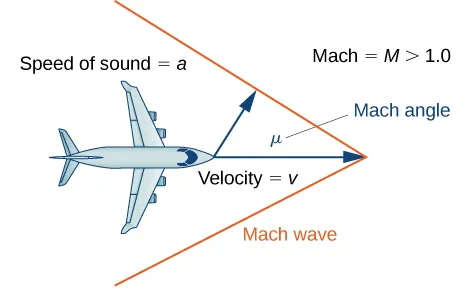
Problem 40. [T] Using \(\mu = 2\sin^{-1}\!\left(\dfrac{1}{M}\right)\), find the Mach number \(M\) for the following angles.
a) \(\mu = \dfrac{\pi}{6}\)
b) \(\mu = \dfrac{2\pi}{7}\)
c) \(\mu = \dfrac{3\pi}{8}\)
Problem 41. [T] The average temperature (in degrees Celsius) of a city in the northern United States can be modeled by \(T(x) = 5 + 18\sin\!\left[\dfrac{\pi}{6}(x - 4.6)\right]\), where \(x\) is time in months and \(x = 1.00\) corresponds to January 1. Determine the day(s) (month and day) when the average temperature is \(21°\text{C}\). Use the integer portion of your answer(s) as the month and calculate the day of the month from the decimal portion.
Problem 42. [T] The depth (in feet) of water at a dock changes with the rise and fall of tides. It is modeled by \(D(t) = 5\sin\!\left(\dfrac{\pi}{6}t - \dfrac{7\pi}{6}\right) + 8\), where \(t\) is the number of hours after midnight. Determine the first time after midnight when the depth is 11.75 ft.
Problem 43. [T] An object moving in simple harmonic motion is modeled by \(s(t) = -6\cos\!\left(\dfrac{\pi t}{2}\right)\), where \(s\) is measured in inches and \(t\) is measured in seconds. Determine the first time when the distance moved is 4.5 in.
Problem 44. [T] A local art gallery has a portrait 3 ft in height that is hung 2.5 ft above the eye level of an average person. The viewing angle \(\theta\) can be modeled by \(\theta = \tan^{-1}\!\dfrac{5.5}{x} - \tan^{-1}\!\dfrac{2.5}{x}\), where \(x\) is the distance (in feet) from the portrait. Find the viewing angle when a person is 4 ft from the portrait.
Problem 45. [T] Use a calculator to evaluate \(\tan^{-1}(\tan(2.1))\) and \(\cos^{-1}(\cos(2.1))\). Explain the results of each.
Problem 46. [T] Use a calculator to evaluate \(\sin(\sin^{-1}(-2))\) and \(\tan(\tan^{-1}(-2))\). Explain the results of each.
Solutions 25–46
Problem 25
Step 1 — Identify the angle: We need \(\theta \in \left(-\dfrac{\pi}{2}, \dfrac{\pi}{2}\right)\) such that \(\tan\theta = \dfrac{\sqrt{3}}{3} = \dfrac{1}{\sqrt{3}}\). That angle is \(\theta = \dfrac{\pi}{6}\).
Answer: \(\tan^{-1}\!\left(\dfrac{\sqrt{3}}{3}\right) = \dfrac{\pi}{6}\).
Problem 26
Step 1 — Identify the angle: We need \(\theta \in [0, \pi]\) such that \(\cos\theta = -\dfrac{\sqrt{2}}{2}\). That is \(\theta = \dfrac{3\pi}{4}\) (second quadrant, where cosine is negative).
Answer: \(\cos^{-1}\!\left(-\dfrac{\sqrt{2}}{2}\right) = \dfrac{3\pi}{4}\).
Problem 27
Step 1 — Identify the angle: We need \(\theta \in (0, \pi)\) such that \(\cot\theta = 1\), meaning \(\tan\theta = 1\). That is \(\theta = \dfrac{\pi}{4}\).
Answer: \(\cot^{-1}(1) = \dfrac{\pi}{4}\).
Problem 28
Step 1 — Identify the angle: We need \(\theta \in \left[-\dfrac{\pi}{2}, \dfrac{\pi}{2}\right]\) such that \(\sin\theta = -1\). That is \(\theta = -\dfrac{\pi}{2}\).
Answer: \(\sin^{-1}(-1) = -\dfrac{\pi}{2}\).
Problem 29
Step 1 — Identify the angle: We need \(\theta \in [0, \pi]\) such that \(\cos\theta = \dfrac{\sqrt{3}}{2}\). That is \(\theta = \dfrac{\pi}{6}\) (first quadrant).
Answer: \(\cos^{-1}\!\left(\dfrac{\sqrt{3}}{2}\right) = \dfrac{\pi}{6}\).
Problem 30
Step 1 — Find \(\tan^{-1}(\sqrt{3})\): We need \(\theta \in \left(-\dfrac{\pi}{2}, \dfrac{\pi}{2}\right)\) with \(\tan\theta = \sqrt{3}\). That is \(\theta = \dfrac{\pi}{3}\).
Step 2 — Evaluate \(\cos(\pi/3)\): $$\cos!\left(\frac{\pi}{3}\right) = \frac{1}{2}.$$
Answer: \(\cos\!\left(\tan^{-1}(\sqrt{3})\right) = \dfrac{1}{2}\).
Problem 31
Step 1 — Find \(\cos^{-1}\!\left(\dfrac{\sqrt{2}}{2}\right)\): We need \(\theta \in [0, \pi]\) with \(\cos\theta = \dfrac{\sqrt{2}}{2}\). That is \(\theta = \dfrac{\pi}{4}\).
Step 2 — Evaluate \(\sin(\pi/4)\): $$\sin!\left(\frac{\pi}{4}\right) = \frac{\sqrt{2}}{2}.$$
Answer: \(\sin\!\left(\cos^{-1}\!\left(\dfrac{\sqrt{2}}{2}\right)\right) = \dfrac{\sqrt{2}}{2}\).
Problem 32
Step 1 — Check domain: \(\dfrac{\pi}{3} \in \left[-\dfrac{\pi}{2}, \dfrac{\pi}{2}\right]\), so the outer-undoes-inner identity applies directly.
$$\sin^{-1}\!\left(\sin\!\left(\frac{\pi}{3}\right)\right) = \frac{\pi}{3}.$$Answer: \(\dfrac{\pi}{3}\).
Problem 33
Step 1 — Check domain: \(-\dfrac{\pi}{6} \in \left(-\dfrac{\pi}{2}, \dfrac{\pi}{2}\right)\), so the outer-undoes-inner identity applies.
$$\tan^{-1}\!\left(\tan\!\left(-\frac{\pi}{6}\right)\right) = -\frac{\pi}{6}.$$Answer: \(-\dfrac{\pi}{6}\).
Problem 34
Part a — Find the inverse function:
Step 1: Write \(C = \dfrac{5}{9}(F - 32)\). Solve for \(F\): $$\frac{9C}{5} = F - 32 \implies F = \frac{9C}{5} + 32.$$
So \(T^{-1}(C) = \dfrac{9C}{5} + 32\).
Part b — Interpret:
The inverse function converts Celsius back to Fahrenheit. For example, a weather forecast in degrees Celsius can be converted to degrees Fahrenheit using this formula.
Answer: \(F = T^{-1}(C) = \dfrac{9C}{5} + 32\); it converts Celsius temperatures to Fahrenheit.
Problem 35
Part a — Find \(x = f^{-1}(V)\):
Step 1: Write \(V = 500(0.04 - x^2)\). Solve for \(x\) (with \(0 \le x \le 0.2\)): $$\frac{V}{500} = 0.04 - x^2 \implies x^2 = 0.04 - \frac{V}{500} \implies x = \sqrt{0.04 - \frac{V}{500}}.$$
(Taking the positive root since \(x \ge 0\).)
$$f^{-1}(V) = \sqrt{0.04 - \frac{V}{500}}.$$Part b — Interpret:
The inverse function gives the distance from the center of the artery at which blood is flowing at velocity \(V\) cm/sec. Doctors can use this to locate where blood is moving at a specified speed.
Part c — Find distances:
- \(V = 15\): \(x = \sqrt{0.04 - 15/500} = \sqrt{0.04 - 0.03} = \sqrt{0.01} = 0.1\) cm. - \(V = 10\): \(x = \sqrt{0.04 - 10/500} = \sqrt{0.04 - 0.02} = \sqrt{0.02} \approx 0.1414\) cm. - \(V = 5\): \(x = \sqrt{0.04 - 5/500} = \sqrt{0.04 - 0.01} = \sqrt{0.03} \approx 0.1732\) cm.
Answer: \(f^{-1}(V) = \sqrt{0.04 - V/500}\); distances are 0.1 cm, ≈ 0.1414 cm, ≈ 0.1732 cm.
Problem 36
Part a — European sizes for U.S. sizes 6, 8, 10, 12:
$$D(6) = 2(6)+24 = 36, \quad D(8) = 40, \quad D(10) = 44, \quad D(12) = 48.$$Part b — Inverse function (European → U.S.):
Solve \(y = 2x + 24\) for \(x\): \(x = \dfrac{y - 24}{2}\). So \(D^{-1}(y) = \dfrac{y - 24}{2}\).
Part c — U.S. sizes for European 46, 52, 62, 70:
$$D^{-1}(46) = 11, \quad D^{-1}(52) = 14, \quad D^{-1}(62) = 19, \quad D^{-1}(70) = 23.$$Answer: a) 36, 40, 44, 48. b) \(D^{-1}(x) = \dfrac{x - 24}{2}\). c) 11, 14, 19, 23.
Problem 37
Part a — Cost to remove 25, 40, 50 ppb:
$$C(25) = \frac{75(25)}{85-25} = \frac{1875}{60} = 31.25 \text{ (thousand dollars)}.$$ $$C(40) = \frac{75(40)}{85-40} = \frac{3000}{45} \approx 66.67 \text{ (thousand dollars)}.$$ $$C(50) = \frac{75(50)}{85-50} = \frac{3750}{35} \approx 107.14 \text{ (thousand dollars)}.$$Part b — Inverse function:
Write \(C = \dfrac{75p}{85 - p}\). Solve for \(p\): $$C(85 - p) = 75p \implies 85C - Cp = 75p \implies 85C = 75p + Cp = p(75 + C) \implies p = \frac{85C}{75 + C}.$$
So \(C^{-1}(C) = \dfrac{85C}{75 + C}\).
Part c — Toxin removed for $50,000:
$50,000 = 50 thousand dollars, so \(C = 50\): $$p = \frac{85(50)}{75 + 50} = \frac{4250}{125} = 34 \text{ ppb}.$$
Answer: a) ≈ $31,250; ≈ $66,667; ≈ $107,143. b) \(p = \dfrac{85C}{75 + C}\). c) 34 ppb.
Problem 38
Part a — Velocity at \(t = 10\) sec:
$$v(10) = \frac{25}{4}(10) + 54 = 62.5 + 54 = 116.5 \text{ ft/sec}.$$Part b — Inverse function:
Write \(v = \dfrac{25}{4}t + 54\). Solve for \(t\): $$v - 54 = \frac{25}{4}t \implies t = \frac{4(v - 54)}{25}.$$
So \(v^{-1}(v) = \dfrac{4(v-54)}{25}\).
Part c — Time to reach 150 ft/sec:
$$t = \frac{4(150 - 54)}{25} = \frac{4(96)}{25} = \frac{384}{25} = 15.36 \text{ sec}.$$Answer: a) 116.5 ft/sec. b) \(t = \dfrac{4(v-54)}{25}\). c) 15.36 seconds.
Problem 39
Note on the calculator: Use the formula \(\mu = 2\sin^{-1}(1/M)\) with a calculator in radian mode, then convert to degrees by multiplying by \(180/\pi\).
Part a — \(M = 1.4\): $$\mu = 2\sin^{-1}!\left(\frac{1}{1.4}\right) = 2\sin^{-1}(0.7143) \approx 2(0.7754) \approx 1.5508 \text{ rad} \approx 89°.$$
Part b — \(M = 2.8\): $$\mu = 2\sin^{-1}!\left(\frac{1}{2.8}\right) \approx 2\sin^{-1}(0.3571) \approx 2(0.3652) \approx 0.7303 \text{ rad} \approx 42°.$$
Part c — \(M = 4.3\): $$\mu = 2\sin^{-1}!\left(\frac{1}{4.3}\right) \approx 2\sin^{-1}(0.2326) \approx 2(0.2341) \approx 0.4682 \text{ rad} \approx 27°.$$
Answer: Approximately 89°, 42°, and 27°.
Problem 40
Solve \(\mu = 2\sin^{-1}(1/M)\) for \(M\): Rearranging: \(\sin(\mu/2) = 1/M\), so \(M = \dfrac{1}{\sin(\mu/2)}\).
Part a — \(\mu = \pi/6\): $$M = \frac{1}{\sin(\pi/12)} = \frac{1}{\sin(15°)} \approx \frac{1}{0.2588} \approx 3.86.$$
Part b — \(\mu = 2\pi/7\): $$M = \frac{1}{\sin(\pi/7)} \approx \frac{1}{\sin(25.71°)} \approx \frac{1}{0.4339} \approx 2.30.$$
Part c — \(\mu = 3\pi/8\): $$M = \frac{1}{\sin(3\pi/16)} \approx \frac{1}{\sin(33.75°)} \approx \frac{1}{0.5556} \approx 1.80.$$
Answer: Approximately \(M \approx 3.86\), \(M \approx 2.30\), \(M \approx 1.80\).
Problem 41
Step 1 — Set up the equation: We want \(T(x) = 21\): $$5 + 18\sin!\left[\frac{\pi}{6}(x - 4.6)\right] = 21.$$
Step 2 — Isolate the sine: $$18\sin!\left[\frac{\pi}{6}(x - 4.6)\right] = 16 \implies \sin!\left[\frac{\pi}{6}(x - 4.6)\right] = \frac{8}{9}.$$
Step 3 — Solve for \(x\): Let \(u = \dfrac{\pi}{6}(x - 4.6)\). Then \(\sin u = 8/9\), so: $$u = \sin^{-1}(8/9) \approx 1.0956 \quad \text{or} \quad u = \pi - 1.0956 \approx 2.0460.$$
For \(u_1 \approx 1.0956\): $$\frac{\pi}{6}(x - 4.6) = 1.0956 \implies x - 4.6 = \frac{6(1.0956)}{\pi} \approx 2.091 \implies x \approx 6.691.$$
Month 6, day: \(0.691 \times 30 \approx 21\) → approximately June 21.
For \(u_2 \approx 2.0460\): $$x - 4.6 = \frac{6(2.0460)}{\pi} \approx 3.909 \implies x \approx 8.509.$$
Month 8, day: \(0.509 \times 31 \approx 16\) → approximately August 16.
Answer: The average temperature is 21°C on approximately June 21 and August 16.
Problem 42
Step 1 — Set up the equation: We want \(D(t) = 11.75\): $$5\sin!\left(\frac{\pi}{6}t - \frac{7\pi}{6}\right) + 8 = 11.75.$$
Step 2 — Isolate the sine: $$5\sin!\left(\frac{\pi}{6}t - \frac{7\pi}{6}\right) = 3.75 \implies \sin!\left(\frac{\pi}{6}t - \frac{7\pi}{6}\right) = 0.75.$$
Step 3 — Solve: Let \(u = \dfrac{\pi}{6}t - \dfrac{7\pi}{6}\). Then \(\sin u = 0.75\): $$u = \sin^{-1}(0.75) \approx 0.8481 \quad \text{or} \quad u = \pi - 0.8481 \approx 2.2935.$$
For \(u \approx 0.8481\): $$\frac{\pi}{6}t = \frac{7\pi}{6} + 0.8481 \implies t = \frac{6}{\pi}!\left(\frac{7\pi}{6} + 0.8481\right) = 7 + \frac{6(0.8481)}{\pi} \approx 7 + 1.620 = 8.620 \text{ hours.}$$
So the first time after midnight is approximately 8 hours 37 minutes, or about 8:37 AM.
Answer: The depth is 11.75 ft for the first time at approximately \(t \approx 8.62\) hours after midnight (about 8:37 AM).
Problem 43
Step 1 — Set up the equation: We want the first \(t > 0\) when \(|s(t)| = 4.5\). Since \(s(t) = -6\cos(\pi t/2)\), we solve: $$\left|-6\cos!\left(\frac{\pi t}{2}\right)\right| = 4.5 \implies \left|\cos!\left(\frac{\pi t}{2}\right)\right| = 0.75.$$
Step 2 — Solve: \(\cos(\pi t/2) = \pm 0.75\).
For \(\cos(\pi t/2) = 0.75\): $$\frac{\pi t}{2} = \cos^{-1}(0.75) \approx 0.7227 \implies t \approx \frac{2(0.7227)}{\pi} \approx 0.460 \text{ sec.}$$
For \(\cos(\pi t/2) = -0.75\): $$\frac{\pi t}{2} = \cos^{-1}(-0.75) \approx 2.4189 \implies t \approx \frac{2(2.4189)}{\pi} \approx 1.540 \text{ sec.}$$
The first positive solution is \(t \approx 0.460\) sec.
Answer: The distance first reaches 4.5 inches at \(t \approx 0.46\) seconds.
Problem 44
Step 1 — Plug in \(x = 4\): $$\theta = \tan^{-1}!\left(\frac{5.5}{4}\right) - \tan^{-1}!\left(\frac{2.5}{4}\right) = \tan^{-1}(1.375) - \tan^{-1}(0.625).$$
Step 2 — Evaluate: $$\tan^{-1}(1.375) \approx 0.9420 \text{ rad}, \quad \tan^{-1}(0.625) \approx 0.5586 \text{ rad}.$$
$$\theta \approx 0.9420 - 0.5586 \approx 0.3834 \text{ rad} \approx 21.96°.$$Answer: The viewing angle is approximately 0.383 radians (about 22°) when the person stands 4 ft from the portrait.
Problem 45
Part 1 — \(\tan^{-1}(\tan(2.1))\):
\(2.1\) radians is NOT in \((-\pi/2, \pi/2) \approx (-1.571, 1.571)\). Because \(\tan\) has period \(\pi\), we find the equivalent angle in the range: \(2.1 - \pi \approx 2.1 - 3.1416 \approx -1.042\).
$$\tan^{-1}(\tan(2.1)) \approx -1.042 \approx 2.1 - \pi.$$Part 2 — \(\cos^{-1}(\cos(2.1))\):
\(2.1 \in [0, \pi] \approx [0, 3.14]\), so the outer-undoes-inner identity applies directly:
$$\cos^{-1}(\cos(2.1)) = 2.1.$$Explanation: For \(\cos^{-1}\), any input in \([0, \pi]\) passes through unchanged. For \(\tan^{-1}\), the identity only holds when the argument is in \((-\pi/2, \pi/2)\); otherwise the result is the angle in that range with the same tangent value.
Answer: \(\tan^{-1}(\tan(2.1)) \approx 2.1 - \pi \approx -1.042\); \(\cos^{-1}(\cos(2.1)) = 2.1\).
Problem 46
Part 1 — \(\sin(\sin^{-1}(-2))\):
The domain of \(\sin^{-1}\) is \([-1, 1]\). Since \(-2 \notin [-1, 1]\), \(\sin^{-1}(-2)\) is undefined. Therefore \(\sin(\sin^{-1}(-2))\) is also undefined.
Note on calculator: Most calculators return an error (domain error) for \(\sin^{-1}(-2)\).
Part 2 — \(\tan(\tan^{-1}(-2))\):
The domain of \(\tan^{-1}\) is all real numbers, so \(\tan^{-1}(-2)\) is defined. By the outer-undoes-inner identity (since \(-2\) is in the domain of \(\tan^{-1}\)): $$\tan(\tan^{-1}(-2)) = -2.$$
Explanation: The sine function only takes values in \([-1, 1]\), so its inverse is only defined for inputs in that interval. The tangent function takes all real values, so its inverse is defined everywhere.
Answer: \(\sin(\sin^{-1}(-2))\) is undefined; \(\tan(\tan^{-1}(-2)) = -2\).
Key Terms
inverse function — a function \(f^{-1}\) that reverses the operation of \(f\); \(f^{-1}(f(x)) = x\) for all \(x\) in the domain of \(f\).
one-to-one function — a function in which no two distinct inputs produce the same output; required for an inverse to exist.
horizontal line test — a graphical test: a function is one-to-one if and only if every horizontal line intersects its graph at most once.
restricted domain — a subset of a function's natural domain chosen to make the function one-to-one so that an inverse exists.
inverse trigonometric functions — the six functions \(\sin^{-1}\), \(\cos^{-1}\), \(\tan^{-1}\), \(\cot^{-1}\), \(\sec^{-1}\), \(\csc^{-1}\) defined by restricting the corresponding trig functions to standard intervals where they are one-to-one.