1.5 Exponential and Logarithmic Functions
Learning Objectives
- Identify the form of an exponential function.
- Explain the difference between the graphs of \(x^b\) and \(b^x\).
- Recognize the significance of the number \(e\).
- Identify the form of a logarithmic function.
- Explain the relationship between exponential and logarithmic functions.
- Describe how to calculate a logarithm to a different base.
- Identify the hyperbolic functions, their graphs, and basic identities.
In this section we examine exponential and logarithmic functions. We use the properties of these functions to solve equations involving exponential or logarithmic terms, and we study the meaning and importance of the number \(e\). We also define hyperbolic and inverse hyperbolic functions, which involve combinations of exponential and logarithmic functions. (Note that we present alternative definitions of exponential and logarithmic functions in the chapter on Applications of Integration, and prove that the functions have the same properties with either definition.)
1.5.1 Exponential Functions
Exponential functions arise in many applications. One common example is population growth.
For example, if a population starts with \(P_0\) individuals and then grows at an annual rate of \(2\%,\) its population after 1 year is
$$ P(1) = P_0 + 0.02P_0 = P_0(1 + 0.02) = P_0(1.02). $$Its population after 2 years is
$$ P(2) = P(1) + 0.02P(1) = P(1)(1.02) = P_0(1.02)^2. $$In general, its population after \(t\) years is
$$ P(t) = P_0(1.02)^t, $$which is an exponential function. More generally, any function of the form \(f(x) = b^x,\) where \(b > 0, b \neq 1,\) is an exponential function with base \(b\) and exponent \(x\). Exponential functions have constant bases and variable exponents. Note that a function of the form \(f(x) = x^b\) for some constant \(b\) is not an exponential function but a power function.
Here is a simple way to keep the two straight: if the variable is in the exponent, it's exponential (\(2^x\) grows explosively as \(x\) grows). If the variable is in the base and the exponent is a fixed number, it's a power function (\(x^2\) is just a parabola). Both can get large, but exponentials eventually lap power functions by an enormous margin — that gap is one of the big themes of calculus.
To see the difference between an exponential function and a power function, we compare \(y = x^2\) and \(y = 2^x\). In the table below, we see that both \(2^x\) and \(x^2\) approach infinity as \(x \to \infty\). Eventually, however, \(2^x\) becomes larger than \(x^2\) and grows more rapidly as \(x \to \infty\). In the opposite direction, as \(x \to -\infty\), \(x^2 \to \infty\), whereas \(2^x \to 0\). The line \(y = 0\) is a horizontal asymptote for \(y = 2^x\).
| \(x\) | \(x^2\) | \(2^x\) |
|---|---|---|
| \(-3\) | \(9\) | \(1/8\) |
| \(-2\) | \(4\) | \(1/4\) |
| \(-1\) | \(1\) | \(1/2\) |
| \(0\) | \(0\) | \(1\) |
| \(1\) | \(1\) | \(2\) |
| \(2\) | \(4\) | \(4\) |
| \(3\) | \(9\) | \(8\) |
| \(4\) | \(16\) | \(16\) |
| \(5\) | \(25\) | \(32\) |
In Figure 1.43, we graph both \(y = x^2\) and \(y = 2^x\) to show how the graphs differ.
Figure 1.43 — Both \(2^x\) and \(x^2\) approach infinity as \(x\to\infty,\) but \(2^x\) grows more rapidly than \(x^2.\) As \(x\to-\infty,\) \(x^2\to\infty,\) whereas \(2^x\to0.\)
Evaluating Exponential Functions
Recall the properties of exponents. If \(x\) is a positive integer, then we define \(b^x = b \cdot b \cdots b\) (with \(x\) factors of \(b\)). If \(x\) is a negative integer, then \(x = -y\) for some positive integer \(y,\) and we define \(b^x = b^{-y} = 1/b^y\). Also, \(b^0\) is defined to be \(1\). If \(x\) is a rational number, then \(x = p/q,\) where \(p\) and \(q\) are integers and \(b^x = b^{p/q} = \sqrt[q]{b^p}\). For example, \(9^{3/2} = \sqrt{9^3} = 27\).
How is \(b^x\) defined if \(x\) is an irrational number — for example, \(2^{\sqrt{2}}\)? This is too complex a question for us to answer fully right now; however, we can make an approximation. In Table 1.5.2, we list some rational numbers approaching \(\sqrt{2},\) and the values of \(2^x\) for each rational number \(x\). If we choose rational numbers \(x\) getting closer and closer to \(\sqrt{2},\) the values of \(2^x\) get closer and closer to some number \(L\). We define that number \(L\) to be \(2^{\sqrt{2}}\).
| \(x\) | \(2^x\) |
|---|---|
| \(1.4\) | \(2.639\) |
| \(1.41\) | \(2.657\) |
| \(1.414\) | \(2.664\) |
| \(1.4142\) | \(2.665\) |
| \(1.41421\) | \(2.6651\) |
| \(1.414213\) | \(2.66514\) |
Given the exponential function \(f(x) = 100 \cdot 3^{x/2},\) evaluate \(f(4)\) and \(f(10)\).
Solution
For \(f(4)\):
$$ f(4) = 100 \cdot 3^{4/2} = 100 \cdot 3^2 = 100 \cdot 9 = 900. $$For \(f(10)\):
$$ f(10) = 100 \cdot 3^{10/2} = 100 \cdot 3^5 = 100 \cdot 243 = 24300. $$Answer: \(f(4) = 900\) and \(f(10) = 24300.\)
Suppose a particular population of bacteria is known to double in size every \(4\) hours. If a culture starts with \(1000\) bacteria, the number of bacteria after \(4\) hours is \(n(4) = 1000 \cdot 2\). The number of bacteria after \(8\) hours is \(n(8) = n(4) \cdot 2 = 1000 \cdot 2^2\). In general, the number of bacteria after \(4m\) hours is \(n(4m) = 1000 \cdot 2^m\). Letting \(t = 4m,\) we see that the number of bacteria after \(t\) hours is
$$ n(t) = 1000 \cdot 2^{t/4}. $$Find the number of bacteria after \(6\) hours, \(10\) hours, and \(24\) hours.
Solution
Step 1 — Plug in \(t = 6\):
$$ n(6) = 1000 \cdot 2^{6/4} = 1000 \cdot 2^{3/2} = 1000 \cdot 2\sqrt{2} \approx 2828 \text{ bacteria.} $$Step 2 — Plug in \(t = 10\):
$$ n(10) = 1000 \cdot 2^{10/4} = 1000 \cdot 2^{5/2} = 1000 \cdot 4\sqrt{2} \approx 5657 \text{ bacteria.} $$Step 3 — Plug in \(t = 24\):
$$ n(24) = 1000 \cdot 2^{24/4} = 1000 \cdot 2^6 = 64000 \text{ bacteria.} $$Answer: After 6 hours: approximately \(2828\) bacteria; after 10 hours: approximately \(5657\) bacteria; after 24 hours: \(64,000\) bacteria.
Graphing Exponential Functions
For any base \(b > 0, b \neq 1,\) the exponential function \(f(x) = b^x\) is defined for all real numbers \(x\) and satisfies \(b^x > 0\). Therefore, the domain of \(f(x) = b^x\) is \((-\infty, \infty)\) and the range is \((0, \infty)\). To graph \(b^x,\) we note:
- If \(b > 1\): \(b^x\) is increasing on \((-\infty, \infty)\). It approaches \(\infty\) as \(x \to \infty\) and approaches \(0\) as \(x \to -\infty\).
- If \(0 < b < 1\): \(f(x) = b^x\) is decreasing on \((-\infty, \infty)\). It approaches \(0\) as \(x \to \infty\) and approaches \(\infty\) as \(x \to -\infty\).
Figure 1.44 — If \(b>1,\) then \(b^x\) is increasing on \((-\infty,\infty).\) If \(0<b<1,\) then \(b^x\) is decreasing on \((-\infty,\infty).\)
Note that exponential functions satisfy the general laws of exponents. We state them here as a rule for reference.
Rule: Laws of Exponents
For any constants \(a > 0, b > 0,\) and for all \(x\) and \(y\):
1. \(b^x \cdot b^y = b^{x+y}\)
2. \(\dfrac{b^x}{b^y} = b^{x-y}\)
3. \((b^x)^y = b^{xy}\)
4. \((ab)^x = a^x b^x\)
5. \(\dfrac{a^x}{b^x} = \left(\dfrac{a}{b}\right)^x\)
Use the laws of exponents to simplify \(\dfrac{6x^{-3}y^2}{12x^{-4}y^5}\).
Solution
Answer: \(\dfrac{x}{2y^3}\).
Use the laws of exponents to simplify each of the following expressions.
- \(\dfrac{(2x^{2/3})^3}{(4x^{-1/3})^2}\)
- \(\dfrac{(x^3 y^{-1})^2}{(xy^2)^{-2}}\)
Solution
Part 1:
$$ \frac{(2x^{2/3})^3}{(4x^{-1/3})^2} = \frac{2^3(x^{2/3})^3}{4^2(x^{-1/3})^2} = \frac{8x^2}{16x^{-2/3}} = \frac{x^2 \cdot x^{2/3}}{2} = \frac{x^{8/3}}{2}. $$Part 2:
$$ \frac{(x^3 y^{-1})^2}{(xy^2)^{-2}} = \frac{(x^3)^2 (y^{-1})^2}{x^{-2}(y^2)^{-2}} = \frac{x^6 y^{-2}}{x^{-2} y^{-4}} = x^6 x^2 y^{-2} y^4 = x^8 y^2. $$Answer: Part 1: \(\dfrac{x^{8/3}}{2}\). Part 2: \(x^8 y^2\).
1.5.2 The Number \(e\)
A special type of exponential function appears frequently in real-world applications. To describe it, consider the following example of exponential growth, which arises from compounding interest in a savings account. Suppose a person invests \(P\) dollars in a savings account with an annual interest rate \(r,\) compounded annually. The amount of money after 1 year is
$$ A(1) = P + rP = P(1 + r). $$The amount of money after \(2\) years is
$$ A(2) = A(1) + rA(1) = P(1+r) + rP(1+r) = P(1+r)^2. $$More generally, the amount after \(t\) years is
$$ A(t) = P(1+r)^t. $$If the money is compounded \(2\) times per year, the amount of money after half a year is
$$ A\!\left(\tfrac{1}{2}\right) = P + \tfrac{r}{2} P = P\!\left(1 + \tfrac{r}{2}\right). $$After \(t\) years, compounding \(n\) times per year gives
$$ A(t) = P\!\left(1 + \frac{r}{n}\right)^{nt}. $$What happens as \(n \to \infty\) (continuous compounding)? To answer this, let \(m = n/r\) and write
$$ \left(1 + \frac{r}{n}\right)^{nt} = \left(1 + \frac{1}{m}\right)^{mrt}, $$and examine the behavior of \(\left(1 + 1/m\right)^m\) as \(m \to \infty\).
| \(m\) | \(\left(1+\tfrac{1}{m}\right)^m\) |
|---|---|
| \(10\) | \(2.5937\) |
| \(100\) | \(2.7048\) |
| \(1000\) | \(2.7169\) |
| \(10000\) | \(2.71815\) |
| \(100000\) | \(2.71827\) |
Looking at this table, it appears that \((1+1/m)^m\) is approaching a number between \(2.7\) and \(2.8\) as \(m \to \infty\). In fact, \((1+1/m)^m\) does approach some number as \(m \to \infty\). We call this number \(e\). To six decimal places of accuracy,
$$ e \approx 2.718282. $$The letter \(e\) was first used to represent this number by the Swiss mathematician Leonhard Euler during the 1720s. Although Euler did not discover the number, he showed many important connections between \(e\) and logarithmic functions. We still use the notation \(e\) today to honor Euler's work.
Returning to our savings account example, if a person puts \(P\) dollars in an account at an annual interest rate \(r,\) compounded continuously, then
$$ A(t) = Pe^{rt}. $$Since functions involving base \(e\) arise often in applications, we call the function \(f(x) = e^x\) the natural exponential function.
Since \(e > 1,\) we know \(e^x\) is increasing on \((-\infty, \infty)\). In Figure 1.45, we show a graph of \(f(x) = e^x\) along with a tangent line to the graph at \(x = 0\). (We give a precise definition of tangent line in the next chapter; informally, a tangent line to the graph of \(f\) at \(x = a\) is a line that passes through the point \((a, f(a))\) and has the same "slope" as \(f\) at that point.) The function \(f(x) = e^x\) is the only exponential function \(b^x\) with a tangent line at \(x = 0\) that has a slope of 1. This property makes \(e^x\) the most natural and convenient exponential function for calculus.


Figure 1.45 — The graph of \(f(x)=e^x\) has a tangent line with slope \(1\) at \(x=0.\)
If \(\$750\) is invested in an account at an annual interest rate of \(4\%,\) compounded continuously, find a formula for the amount of money in the account after \(t\) years. Find the amount of money after \(30\) years.
Solution
Formula: Using \(P = 750\) and \(r = 0.04\):
$$ A(t) = 750e^{0.04t}. $$After 30 years:
$$ A(30) = 750e^{0.04 \cdot 30} = 750e^{1.2} \approx \$2{,}490.59. $$Answer: \(A(t) = 750e^{0.04t}\). After 30 years, approximately \(\$2{,}490.59\).
Suppose \(\$500\) is invested in an account at an annual interest rate of \(r = 5.5\%,\) compounded continuously.
- Let \(t\) denote the number of years after the initial investment and \(A(t)\) denote the amount of money in the account at time \(t\). Find a formula for \(A(t)\).
- Find the amount of money in the account after \(10\) years and after \(20\) years.
Solution
Part 1 — Build the formula:
The formula for continuous compounding is \(A(t) = Pe^{rt}.\) Here \(P = 500\) and \(r = 0.055\) (5.5% written as a decimal). Therefore,
$$ A(t) = 500e^{0.055t}. $$Part 2 — Evaluate at \(t = 10\) and \(t = 20\):
$$ A(10) = 500e^{0.055 \cdot 10} = 500e^{0.55} \approx \$866.63. $$ $$ A(20) = 500e^{0.055 \cdot 20} = 500e^{1.1} \approx \$1{,}502.08. $$Answer: After 10 years, approximately \(\$866.63\); after 20 years, approximately \(\$1{,}502.08\).
1.5.3 Logarithmic Functions
Using our understanding of exponential functions, we can discuss their inverses, which are the logarithmic functions. These come in handy when we need to consider any phenomenon that varies over a wide range of values, such as pH in chemistry or decibels in sound levels.
The exponential function \(f(x) = b^x\) is one-to-one, with domain \((-\infty, \infty)\) and range \((0, \infty).\) Therefore, it has an inverse function, called the logarithmic function with base \(b\). For any \(b > 0, b \neq 1,\) the logarithmic function with base \(b,\) denoted \(\log_b,\) has domain \((0, \infty)\) and range \((-\infty, \infty),\) and satisfies
$$ \log_b(x) = y \quad \text{if and only if} \quad b^y = x. $$For example,
$$ \begin{array}{lll} \log_2(8) = 3 & & \text{since } 2^3 = 8, \\[4pt] \log_{10}\!\left(\tfrac{1}{100}\right) = -2 & & \text{since } 10^{-2} = \tfrac{1}{100}, \\[4pt] \log_b(1) = 0 & & \text{since } b^0 = 1 \text{ for any base } b > 0. \end{array} $$Furthermore, since \(y = \log_b(x)\) and \(y = b^x\) are inverse functions,
$$ \log_b(b^x) = x \quad \text{and} \quad b^{\log_b(x)} = x. $$A logarithm answers the question: "What power do I raise \(b\) to in order to get \(x\)?" If someone tells you \(\log_2(32) = 5,\) they are saying: raise 2 to the power 5 and you get 32. Anytime you see a logarithm, translate it into an exponent question — that habit makes log algebra feel mechanical rather than mysterious.
The most commonly used logarithmic function is \(\log_e.\) Since this function uses the natural base \(e,\) it is called the natural logarithm. We use the notation \(\ln(x)\) or \(\ln x\) to mean \(\log_e(x).\) For example,
$$ \ln(e) = \log_e(e) = 1, \quad \ln(e^3) = \log_e(e^3) = 3, \quad \ln(1) = \log_e(1) = 0. $$Since \(f(x) = e^x\) and \(g(x) = \ln(x)\) are inverses of each other,
$$ \ln(e^x) = x \quad \text{and} \quad e^{\ln x} = x, $$and their graphs are symmetric about the line \(y = x\) (Figure 1.46).


Figure 1.46 — The functions \(y=e^x\) and \(y=\ln(x)\) are inverses of each other, so their graphs are symmetric about the line \(y=x.\)
In general, for any base \(b > 0, b \neq 1,\) the function \(g(x) = \log_b(x)\) is symmetric about the line \(y = x\) with the function \(f(x) = b^x\). Using this fact and the graphs of the exponential functions, we graph functions \(\log_b\) for several values of \(b > 1\) (Figure 1.47).
Figure 1.47 — Graphs of \(y=\log_b(x)\) are depicted for \(b=2,e,10.\)
Before solving equations, let's review the basic properties of logarithms.
Rule: Properties of Logarithms
If \(a, b, c > 0, b \neq 1,\) and \(r\) is any real number, then
| Property | Formula |
|---|---|
| Product rule | \(\log_b(ac) = \log_b a + \log_b c\) |
| Quotient rule | \(\log_b\!\left(\dfrac{a}{c}\right) = \log_b a - \log_b c\) |
| Power rule | \(\log_b(a^r) = r \log_b a\) |
| Change of base | \(\log_b a = \dfrac{\log_c a}{\log_c b}\) |
Solve \(\dfrac{e^{2x}}{3 + e^{2x}} = \dfrac{1}{2}\).
Solution
Cross-multiply: \(2e^{2x} = 3 + e^{2x},\) so \(e^{2x} = 3.\) Taking natural logs:
$$ 2x = \ln 3, \quad \text{so} \quad x = \frac{\ln 3}{2}. $$Answer: \(x = \dfrac{\ln 3}{2}\).
Solve each of the following equations for \(x.\)
- \(5^x = 2\)
- \(e^x + 6e^{-x} = 5\)
Solution
Part 1 — Apply the natural logarithm to both sides:
$$ \ln 5^x = \ln 2. $$Using the power property of logarithms:
$$ x \ln 5 = \ln 2, $$so
$$ x = \frac{\ln 2}{\ln 5}. $$Part 2 — Multiply both sides by \(e^x\):
$$ e^{2x} + 6 = 5e^x. $$Rewrite as
$$ e^{2x} - 5e^x + 6 = 0. $$This is a quadratic in \(e^x\):
$$ (e^x)^2 - 5(e^x) + 6 = 0. $$Factor:
$$ (e^x - 3)(e^x - 2) = 0. $$So \(e^x = 3\) or \(e^x = 2\). Taking natural logs:
$$ x = \ln 3 \quad \text{or} \quad x = \ln 2. $$Answer: Part 1: \(x = \dfrac{\ln 2}{\ln 5}\). Part 2: \(x = \ln 3\) and \(x = \ln 2\).
Solve \(\ln(x^3) - 4\ln(x) = 1\).
Solution
Apply the power property: \(\ln(x^3) = 3\ln x,\) so \(3\ln x - 4\ln x = 1,\) giving \(-\ln x = 1,\) and thus
$$ \ln x = -1, \quad x = e^{-1} = \frac{1}{e}. $$Check: \(x = 1/e > 0\): valid.
Answer: \(x = \dfrac{1}{e}\).
When evaluating a logarithmic function with a calculator, you may have noticed that the only options are \(\log_{10}\) (the common logarithm) or \(\ln\) (the natural logarithm). However, exponential functions and logarithm functions can be expressed in terms of any desired base \(b.\) If you need to use a calculator to evaluate an expression with a different base, you can apply the change-of-base formulas first. Using this change of base, we typically write a given exponential or logarithmic function in terms of the natural exponential and natural logarithmic functions.
Rule: Change-of-Base Formulas
Let \(a > 0, b > 0,\) and \(a \neq 1, b \neq 1.\) Then:
1. \(a^x = b^{x \log_b a}\)
2. \(\log_a x = \dfrac{\log_b x}{\log_b a}\)
Solve each of the following equations for \(x.\)
- \(\ln\!\left(\dfrac{1}{x}\right) = 4\)
- \(\log_{10}\!\sqrt{x} + \log_{10} x = 2\)
- \(\ln(2x) - 3\ln(x^2) = 0\)
Solution
Part 1 — Use the definition of the natural log:
$$ \ln\!\left(\frac{1}{x}\right) = 4 \quad \Leftrightarrow \quad e^4 = \frac{1}{x}, \quad \text{so} \quad x = \frac{1}{e^4} = e^{-4}. $$Part 2 — Use product and power properties:
$$ \log_{10}\!\sqrt{x} + \log_{10} x = \log_{10}\!\left(x\sqrt{x}\right) = \log_{10} x^{3/2} = \frac{3}{2}\log_{10} x. $$So \(\dfrac{3}{2}\log_{10} x = 2,\) meaning \(\log_{10} x = \dfrac{4}{3},\) and
$$ x = 10^{4/3} = 10\sqrt[3]{10}. $$Part 3 — Apply the power property first:
$$ \ln(2x) - \ln(x^6) = 0. $$Using the quotient property:
$$ \ln\!\left(\frac{2}{x^5}\right) = 0 \quad \Rightarrow \quad \frac{2}{x^5} = 1 \quad \Rightarrow \quad x = \sqrt[5]{2}. $$Check that \(x = \sqrt[5]{2} > 0\): valid.
Answer: Part 1: \(x = e^{-4}\). Part 2: \(x = 10^{4/3}\). Part 3: \(x = \sqrt[5]{2}\).
Proof
For the first formula, we use the power property: \(\log_b(a^x) = x \log_b a,\) so
$$ b^{\log_b(a^x)} = b^{x \log_b a}. $$Since \(b^x\) and \(\log_b(x)\) are inverse functions, \(b^{\log_b(a^x)} = a^x,\) and combining:
$$ a^x = b^{x \log_b a}. $$For the second formula, let \(u = \log_b a,\) \(v = \log_a x,\) \(w = \log_b x.\) Then \(b^u = a,\) \(a^v = x,\) \(b^w = x.\) We want to show \(u \cdot v = w\):
$$ b^{uv} = (b^u)^v = a^v = x = b^w. $$Since exponential functions are one-to-one, \(uv = w.\) \(\square\)
Use the change-of-base formula and a calculating utility to evaluate \(\log_4 6\).
Solution
Answer: \(\log_4 6 \approx 1.2925\).
Use a calculating utility to evaluate \(\log_3 7\) with the change-of-base formula.
Solution
Using the second change-of-base formula with \(b = e\):
$$ \log_3 7 = \frac{\ln 7}{\ln 3} \approx \frac{1.9459}{1.0986} \approx 1.7712. $$Answer: \(\log_3 7 \approx 1.7712\).
Compare the relative severity of a magnitude \(8.4\) earthquake with a magnitude \(7.4\) earthquake.
Solution
Answer: A magnitude \(8.4\) earthquake is exactly \(10\) times more intense than a magnitude \(7.4\) earthquake.

Figure 1.48 — (credit: modification of work by Robb Hannawacker, NPS)
In 1935, Charles Richter developed a scale (now known as the Richter scale) to measure the magnitude of an earthquake. The scale is a base-10 logarithmic scale. Consider two earthquakes with magnitudes \(R_1\) and \(R_2\) (where \(R_1 > R_2\)) and corresponding wave amplitudes \(A_1\) and \(A_2\). The magnitudes and amplitudes satisfy
$$ R_1 - R_2 = \log_{10}\!\left(\frac{A_1}{A_2}\right). $$Consider an earthquake that measures \(8\) on the Richter scale and one that measures \(7\):
$$ 8 - 7 = \log_{10}\!\left(\frac{A_1}{A_2}\right) = 1, \quad \text{so} \quad \frac{A_1}{A_2} = 10. $$The first earthquake is \(10\) times as intense as the second. If one earthquake measures \(8\) and another measures \(6\):
$$ \log_{10}\!\left(\frac{A_1}{A_2}\right) = 2, \quad \text{so} \quad A_1 = 100 A_2. $$How can we use logarithmic functions to compare the magnitude \(9\) earthquake in Japan in 2011 with the magnitude \(7.3\) earthquake in Haiti in 2010?
Solution
Using the Richter scale equation:
$$ 9 - 7.3 = \log_{10}\!\left(\frac{A_1}{A_2}\right) = 1.7. $$Therefore,
$$ \frac{A_1}{A_2} = 10^{1.7} \approx 50. $$Answer: The earthquake in Japan was approximately \(50\) times more intense than the earthquake in Haiti.
1.5.4 Hyperbolic Functions
The name cosh rhymes with "gosh," whereas sinh is pronounced "cinch." Tanh, sech, csch, and coth are pronounced "tanch," "seech," "coseech," and "cotanch," respectively.
Using the definition of \(\cosh(x)\) and principles of physics, it can be shown that the height of a hanging chain, such as the one in Figure 1.49, can be described by the function \(h(x) = a\cosh(x/a) + c\) for certain constants \(a\) and \(c.\)
But why are these functions called hyperbolic? Consider the quantity \(\cosh^2 t - \sinh^2 t:\)
$$ \cosh^2 t - \sinh^2 t = \frac{e^{2t} + 2 + e^{-2t}}{4} - \frac{e^{2t} - 2 + e^{-2t}}{4} = 1. $$This identity is the analog of the trigonometric identity \(\cos^2 t + \sin^2 t = 1.\) Given a value \(t,\) the point \((x, y) = (\cosh t, \sinh t)\) lies on the unit hyperbola \(x^2 - y^2 = 1\) (Figure 1.50).


Figure 1.50 — The unit hyperbola \(\cosh^2 t - \sinh^2 t = 1.\)
Let's derive the formula for \(\sinh^{-1} x\). Suppose \(y = \sinh^{-1} x,\) so \(x = \sinh y = \dfrac{e^y - e^{-y}}{2}.\) Then
$$ e^y - 2x - e^{-y} = 0. $$Multiplying by \(e^y\):
$$ e^{2y} - 2xe^y - 1 = 0. $$This is quadratic in \(e^y,\) with solution
$$ e^y = \frac{2x \pm \sqrt{4x^2 + 4}}{2} = x \pm \sqrt{x^2 + 1}. $$Since \(e^y > 0,\) we take the positive sign, giving
$$ y = \ln\!\left(x + \sqrt{x^2 + 1}\right). $$Hyperbolic functions look exotic, but they are simply specific combinations of \(e^x\) and \(e^{-x}\) that show up repeatedly in real-world curved shapes and physics. The reason they resemble trigonometric functions is no accident: just as \(\cos\) and \(\sin\) parametrize the unit circle \(x^2 + y^2 = 1,\) the functions \(\cosh\) and \(\sinh\) parametrize the unit hyperbola \(x^2 - y^2 = 1.\) That structural parallel carries through to their identities and calculus properties.
The hyperbolic functions are defined in terms of certain combinations of \(e^x\) and \(e^{-x}\). These functions arise naturally in various engineering and physics applications, including the study of water waves and vibrations of elastic membranes. Another common use for a hyperbolic function is the representation of a hanging chain or cable, also known as a catenary (Figure 1.49). If we introduce a coordinate system so that the low point of the chain lies along the \(y\)-axis, we can describe the height of the chain in terms of a hyperbolic function.
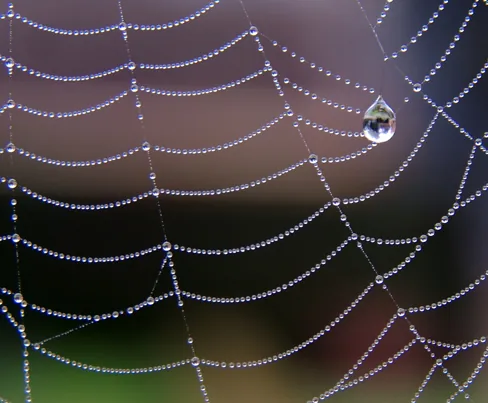
Figure 1.49 — The shape of a strand of silk in a spider's web can be described in terms of a hyperbolic function. The same shape applies to a chain or cable hanging from two supports with only its own weight. (credit: "Mtpaley", Wikimedia Commons)
Verify that the point \((\cosh t, \sinh t)\) satisfies the equation \(x^2 - y^2 = 1\).
Solution
We substitute \(x = \cosh t\) and \(y = \sinh t\):
$$ x^2 - y^2 = \cosh^2 t - \sinh^2 t = \frac{e^{2t}+2+e^{-2t}}{4} - \frac{e^{2t}-2+e^{-2t}}{4} = \frac{4}{4} = 1. \checkmark $$Answer: The point \((\cosh t, \sinh t)\) always satisfies \(x^2 - y^2 = 1\) for every real \(t\).
Graphs of Hyperbolic Functions
To graph \(\cosh x\) and \(\sinh x,\) we make use of the fact that both functions approach \(\tfrac{1}{2}e^x\) as \(x \to \infty,\) since \(e^{-x} \to 0\) as \(x \to \infty\). As \(x \to -\infty,\) \(\cosh x\) approaches \(\tfrac{1}{2}e^{-x},\) whereas \(\sinh x\) approaches \(-\tfrac{1}{2}e^{-x}.\) Using the graphs of \(\tfrac{1}{2}e^x, \tfrac{1}{2}e^{-x},\) and \(-\tfrac{1}{2}e^{-x}\) as guides, we graph \(\cosh x\) and \(\sinh x.\) To graph \(\tanh x,\) we use the facts that \(\tanh(0) = 0,\) \(-1 < \tanh(x) < 1\) for all \(x,\) \(\tanh x \to 1\) as \(x \to \infty,\) and \(\tanh x \to -1\) as \(x \to -\infty.\) The graphs of the other three hyperbolic functions can be sketched using the graphs of \(\cosh x, \sinh x,\) and \(\tanh x\) (Figure 1.51).


Figure 1.51 — The hyperbolic functions involve combinations of \(e^x\) and \(e^{-x}.\)
Identities Involving Hyperbolic Functions
The identity \(\cosh^2 t - \sinh^2 t = 1\) is one of several identities involving the hyperbolic functions. The first four properties below follow easily from the definitions of hyperbolic sine and hyperbolic cosine. Except for some differences in signs, most of these properties are analogous to trigonometric identities.
Rule: Identities Involving Hyperbolic Functions
1. \(\cosh(-x) = \cosh x\)
2. \(\sinh(-x) = -\sinh x\)
3. \(\cosh x + \sinh x = e^x\)
4. \(\cosh x - \sinh x = e^{-x}\)
5. \(\cosh^2 x - \sinh^2 x = 1\)
6. \(1 - \tanh^2 x = \text{sech}^2 x\)
7. \(\coth^2 x - 1 = \text{csch}^2 x\)
8. \(\sinh(x \pm y) = \sinh x \cosh y \pm \cosh x \sinh y\)
9. \(\cosh(x \pm y) = \cosh x \cosh y \pm \sinh x \sinh y\)
- Simplify \(\sinh(5\ln x).\)
- If \(\sinh x = 3/4,\) find the values of the remaining five hyperbolic functions.
Solution
Part 1 — Use the definition of \(\sinh\):
$$ \sinh(5\ln x) = \frac{e^{5\ln x} - e^{-5\ln x}}{2} = \frac{e^{\ln(x^5)} - e^{\ln(x^{-5})}}{2} = \frac{x^5 - x^{-5}}{2}. $$Part 2 — Use the Pythagorean identity:
$$ \cosh^2 x = 1 + \sinh^2 x = 1 + \left(\frac{3}{4}\right)^2 = 1 + \frac{9}{16} = \frac{25}{16}. $$Since \(\cosh x \geq 1\) for all \(x,\) we must have \(\cosh x = 5/4.\) Then:
$$ \tanh x = \frac{\sinh x}{\cosh x} = \frac{3/4}{5/4} = \frac{3}{5}. $$ $$ \text{csch}\, x = \frac{1}{\sinh x} = \frac{4}{3}, \quad \text{sech}\, x = \frac{1}{\cosh x} = \frac{4}{5}, \quad \coth x = \frac{\cosh x}{\sinh x} = \frac{5}{3}. $$Answer: Part 1: \(\dfrac{x^5 - x^{-5}}{2}\). Part 2: \(\cosh x = 5/4,\) \(\tanh x = 3/5,\) \(\text{csch}\, x = 4/3,\) \(\text{sech}\, x = 4/5,\) \(\coth x = 5/3.\)
Simplify \(\cosh(2\ln x).\)
Solution
Answer: \(\dfrac{x^2 + x^{-2}}{2}\).
Inverse Hyperbolic Functions
From the graphs of the hyperbolic functions, we see that all of them are one-to-one except \(\cosh x\) and \(\text{sech}\, x.\) If we restrict the domains of these two functions to the interval \([0, \infty),\) then all the hyperbolic functions are one-to-one, and we can define the inverse hyperbolic functions. Since the hyperbolic functions themselves involve exponential functions, the inverse hyperbolic functions involve logarithmic functions.
Evaluate each of the following expressions.
- \(\sinh^{-1}(2)\)
- \(\tanh^{-1}(1/4)\)
Solution
Part 1:
$$ \sinh^{-1}(2) = \ln\!\left(2 + \sqrt{4+1}\right) = \ln\!\left(2 + \sqrt{5}\right) \approx 1.4436. $$Part 2:
$$ \tanh^{-1}\!\left(\frac{1}{4}\right) = \frac{1}{2}\ln\!\left(\frac{1 + \frac{1}{4}}{1 - \frac{1}{4}}\right) = \frac{1}{2}\ln\!\left(\frac{\frac{5}{4}}{\frac{3}{4}}\right) = \frac{1}{2}\ln\!\left(\frac{5}{3}\right) \approx 0.2554. $$Answer: Part 1: \(\approx 1.4436\). Part 2: \(\approx 0.2554\).
Evaluate \(\tanh^{-1}(1/2).\)
Solution
Answer: \(\dfrac{1}{2}\ln 3 \approx 0.5493\).
Problem Set 1.5
For the following exercises, evaluate the given exponential functions as indicated, accurate to two significant digits after the decimal.
Problem 1. \(f(x) = 5^x\)
a) \(x = 3\)
b) \(x = \dfrac{1}{2}\)
c) \(x = \sqrt{2}\)
Problem 2. \(f(x) = (0.3)^x\)
a) \(x = -1\)
b) \(x = 4\)
c) \(x = -1.5\)
Problem 3. \(f(x) = 10^x\)
a) \(x = -2\)
b) \(x = 4\)
c) \(x = \dfrac{5}{3}\)
Problem 4. \(f(x) = e^x\)
a) \(x = 2\)
b) \(x = -3.2\)
c) \(x = \pi\)
a) \(y = 4^{-x}\)
b) \(y = 3^{x-1}\)
c) \(y = 2^{x+1}\)
d) \(y = \left(\dfrac{1}{2}\right)^x + 2\)
e) \(y = -3^{-x}\)
f) \(y = 1 - 5^x\)
Solutions 1–4
Problem 1
Step 1 — Evaluate at each given \(x\):
$$ f(3) = 5^3 = 125.00 $$ $$ f\!\left(\tfrac{1}{2}\right) = 5^{1/2} = \sqrt{5} \approx 2.24. $$ $$ f(\sqrt{2}) = 5^{\sqrt{2}} \approx 5^{1.41421} \approx 9.74. $$Answer: a) \(125.00\), b) \(\approx 2.24\), c) \(\approx 9.74\).
Problem 2
Step 1 — Evaluate at each given \(x\):
$$ f(-1) = (0.3)^{-1} = \frac{1}{0.3} \approx 3.33. $$ $$ f(4) = (0.3)^4 = 0.0081 \approx 0.01. $$ $$ f(-1.5) = (0.3)^{-1.5} = \frac{1}{(0.3)^{1.5}} = \frac{1}{0.3\sqrt{0.3}} \approx \frac{1}{0.1643} \approx 6.09. $$Answer: a) \(\approx 3.33\), b) \(\approx 0.01\), c) \(\approx 6.09\).
Problem 3
Step 1 — Evaluate at each given \(x\):
$$ f(-2) = 10^{-2} = 0.01. $$ $$ f(4) = 10^4 = 10000.00. $$ $$ f\!\left(\tfrac{5}{3}\right) = 10^{5/3} = 10^{1.6\overline{6}} \approx 46.42. $$Answer: a) \(0.01\), b) \(10000.00\), c) \(\approx 46.42\).
Problem 4
Step 1 — Evaluate at each given \(x\):
$$ f(2) = e^2 \approx 7.39. $$ $$ f(-3.2) = e^{-3.2} \approx 0.04. $$ $$ f(\pi) = e^{\pi} \approx 23.14. $$Answer: a) \(\approx 7.39\), b) \(\approx 0.04\), c) \(\approx 23.14\).
For the following exercises, match the exponential equation to the correct graph.
Problem 5. (Match graph)


Problem 6. (Match graph)


Problem 7. (Match graph)


Problem 8. (Match graph)


Problem 9. (Match graph)


Problem 10. (Match graph)


Solutions 5–10
Problem 5
Step 1 — Identify the graph's characteristics:
The graph shows a decreasing curve (as \(x\) increases the function decreases), positive \(y\)-values only, passing near \((0, 1)\). A decreasing exponential with base \(> 1\) is of the form \(y = b^{-x}\) or \(y = (1/b)^x\).
Step 2 — Match to the list:
The function \(y = 4^{-x}\) is decreasing and positive for all \(x\), which matches this graph.
Answer: a) \(y = 4^{-x}\).
Problem 6
Step 1 — Identify the graph's characteristics:
The graph starts below the \(x\)-axis (negative values), approaches \(0\) from below as \(x \to -\infty\), and decreases to large negative values as \(x \to \infty\).
Step 2 — Match to the list:
\(y = -3^{-x}\) is always negative and approaches \(0^-\) as \(x \to \infty\), matching this shape.
Answer: e) \(y = -3^{-x}\).
Problem 7
Step 1 — Identify the graph's characteristics:
The graph shows an increasing curve that stays above a horizontal asymptote at \(y = 0,\) passes through a small positive value near \(x = -4,\) and increases steeply for positive \(x\).
Step 2 — Match to the list:
\(y = 2^{x+1}\) is an increasing exponential shifted left by 1. At \(x = 0\), \(y = 2\); at \(x = -1\), \(y = 1\). This matches an increasing curve passing through \((-1, 1)\) and \((0, 2)\).
Answer: c) \(y = 2^{x+1}\).
Problem 8
Step 1 — Identify the graph's characteristics:
The graph is decreasing, stays above a horizontal asymptote at \(y = 0,\) but is positive and decreasing — consistent with a base \(> 1\) raised to \(-x\), or with a vertical shift.
Step 2 — Match to the list:
\(y = 3^{x-1}\) is an increasing exponential shifted right by 1; however the description says "decreasing." Reconsidering: the graph shows positive values that decrease, consistent with \(y = (1/2)^x + 2\) — wait, that has asymptote at \(y = 2\). The graph described has asymptote near \(y = 0\) and decreases. \(y = 4^{-x}\) was already used. The remaining decreasing option is \(y = 3^{x-1}\) only if \(x < 0\) range dominates.
Actually, reviewing the alt text: "decreasing curved function" in range \(-5\) to \(5\) on \(x\), \(-5\) to \(5\) on \(y\). This matches \(y = 1 - 5^x\): at \(x = 0\), \(y = 0\); for \(x > 0\) it decreases rapidly; has horizontal asymptote \(y = 1\) as \(x \to -\infty\).
Answer: f) \(y = 1 - 5^x\).
Problem 9
Step 1 — Identify the graph's characteristics:
The graph shows an increasing curve that starts near \(-5\) on the \(y\)-axis as \(x\) is very negative and increases. Alt text: "curved increasing function that increa[ses]" in range \(x: -5\) to \(5\), \(y: -5\) to \(5\).
Step 2 — Match to the list:
\(y = 3^{x-1}\): increasing, passes through \((1, 1)\) and \((0, 1/3)\). Rises from near zero to high values.
Answer: b) \(y = 3^{x-1}\).
Problem 10
Step 1 — Identify the graph's characteristics:
The alt text says: "curved increasing function that starts" in range \(y: -2\) to \(8\), \(x: -5\) to \(5\). A function that starts above 2 when \(x \to -\infty\) and increases suggests a vertical shift.
Step 2 — Match to the list:
\(y = (1/2)^x + 2\): as \(x \to \infty\), \((1/2)^x \to 0\), so \(y \to 2\) (horizontal asymptote at \(y=2\)), and as \(x \to -\infty\), \((1/2)^x \to \infty\), so \(y\) increases. This gives a decreasing function, not increasing. Re-reading: the graph is "of a curved increasing function that starts" — this combined with the \(y\)-range \(-2\) to \(8\) suggests a function that starts around 2 and increases. The function \(y = 3^{x-1}\) was already used. The remaining is \(y = (1/2)^x + 2\).
Answer: d) \(y = \left(\dfrac{1}{2}\right)^x + 2\).
For the following exercises, sketch the graph of the exponential function. Determine the domain, range, and horizontal asymptote.
Problem 11. \(f(x) = e^x + 2\)
Problem 12. \(f(x) = -2^x\)
Problem 13. \(f(x) = 3^{x+1}\)
Problem 14. \(f(x) = 4^x - 1\)
Problem 15. \(f(x) = 1 - 2^{-x}\)
Problem 16. \(f(x) = 5^{x+1} + 2\)
Problem 17. \(f(x) = e^{-x} - 1\)
Solutions 11–17
Problem 11
Step 1 — Analyze the function \(f(x) = e^x + 2\):
This is the natural exponential shifted up by 2.
- Domain: \((-\infty, \infty)\) — exponentials are defined for all real \(x\). - Range: \((2, \infty)\) — since \(e^x > 0\), we have \(e^x + 2 > 2\). - Horizontal asymptote: \(y = 2\) (as \(x \to -\infty\), \(e^x \to 0\)).
Sketch: Standard rising exponential curve, but lifted up by 2 units.
Answer: Domain: \((-\infty, \infty)\); Range: \((2, \infty)\); Horizontal asymptote: \(y = 2\).
Problem 12
Step 1 — Analyze \(f(x) = -2^x\):
This reflects \(2^x\) across the \(x\)-axis.
- Domain: \((-\infty, \infty)\). - Range: \((-\infty, 0)\) — since \(2^x > 0\), \(-2^x < 0\). - Horizontal asymptote: \(y = 0\) (as \(x \to -\infty\), \(-2^x \to 0^-\)).
Answer: Domain: \((-\infty, \infty)\); Range: \((-\infty, 0)\); Horizontal asymptote: \(y = 0\).
Problem 13
Step 1 — Analyze \(f(x) = 3^{x+1}\):
This is \(3^x\) shifted left by 1.
- Domain: \((-\infty, \infty)\). - Range: \((0, \infty)\). - Horizontal asymptote: \(y = 0\).
At \(x = 0\): \(f(0) = 3^1 = 3\).
Answer: Domain: \((-\infty, \infty)\); Range: \((0, \infty)\); Horizontal asymptote: \(y = 0\).
Problem 14
Step 1 — Analyze \(f(x) = 4^x - 1\):
This is \(4^x\) shifted down by 1.
- Domain: \((-\infty, \infty)\). - Range: \((-1, \infty)\) — since \(4^x > 0\), \(4^x - 1 > -1\). - Horizontal asymptote: \(y = -1\).
Answer: Domain: \((-\infty, \infty)\); Range: \((-1, \infty)\); Horizontal asymptote: \(y = -1\).
Problem 15
Step 1 — Analyze \(f(x) = 1 - 2^{-x}\):
As \(x \to \infty\): \(2^{-x} \to 0\), so \(f(x) \to 1\). As \(x \to -\infty\): \(2^{-x} \to \infty\), so \(f(x) \to -\infty\).
- Domain: \((-\infty, \infty)\). - Range: \((-\infty, 1)\). - Horizontal asymptote: \(y = 1\).
Answer: Domain: \((-\infty, \infty)\); Range: \((-\infty, 1)\); Horizontal asymptote: \(y = 1\).
Problem 16
Step 1 — Analyze \(f(x) = 5^{x+1} + 2\):
Shift \(5^x\) left 1 unit and up 2 units.
- Domain: \((-\infty, \infty)\). - Range: \((2, \infty)\). - Horizontal asymptote: \(y = 2\).
Answer: Domain: \((-\infty, \infty)\); Range: \((2, \infty)\); Horizontal asymptote: \(y = 2\).
Problem 17
Step 1 — Analyze \(f(x) = e^{-x} - 1\):
This is the natural exponential reflected across the \(y\)-axis, then shifted down 1.
- Domain: \((-\infty, \infty)\). - Range: \((-1, \infty)\) — since \(e^{-x} > 0\), \(e^{-x} - 1 > -1\). - Horizontal asymptote: \(y = -1\) (as \(x \to \infty\), \(e^{-x} \to 0\)).
Answer: Domain: \((-\infty, \infty)\); Range: \((-1, \infty)\); Horizontal asymptote: \(y = -1\).
For the following exercises, write the equation in equivalent exponential form.
Problem 18. \(\log_3 81 = 4\)
Problem 19. \(\log_8 2 = \dfrac{1}{3}\)
Problem 20. \(\log_5 1 = 0\)
Problem 21. \(\log_5 25 = 2\)
Problem 22. \(\log 0.1 = -1\)
Problem 23. \(\ln\!\left(\dfrac{1}{e^3}\right) = -3\)
Problem 24. \(\log_9 3 = 0.5\)
Problem 25. \(\ln 1 = 0\)
Solutions 18–25
Problem 18
Step 1 — Convert \(\log_3 81 = 4\) to exponential form:
By definition, \(\log_b x = y \Leftrightarrow b^y = x\). So \(\log_3 81 = 4\) becomes:
$$ 3^4 = 81. $$Answer: \(3^4 = 81\).
Problem 19
Step 1 — Convert \(\log_8 2 = \frac{1}{3}\):
$$ 8^{1/3} = 2. $$Answer: \(8^{1/3} = 2\).
Problem 20
Step 1 — Convert \(\log_5 1 = 0\):
$$ 5^0 = 1. $$Answer: \(5^0 = 1\).
Problem 21
Step 1 — Convert \(\log_5 25 = 2\):
$$ 5^2 = 25. $$Answer: \(5^2 = 25\).
Problem 22
Step 1 — Convert \(\log 0.1 = -1\) (base 10):
$$ 10^{-1} = 0.1. $$Answer: \(10^{-1} = 0.1\).
Problem 23
Step 1 — Convert \(\ln(1/e^3) = -3\):
$$ e^{-3} = \frac{1}{e^3}. $$Answer: \(e^{-3} = \dfrac{1}{e^3}\).
Problem 24
Step 1 — Convert \(\log_9 3 = 0.5\):
$$ 9^{0.5} = 3. $$Answer: \(9^{0.5} = 3\).
Problem 25
Step 1 — Convert \(\ln 1 = 0\):
$$ e^0 = 1. $$Answer: \(e^0 = 1\).
For the following exercises, write the equation in equivalent logarithmic form.
Problem 26. \(2^3 = 8\)
Problem 27. \(4^{-2} = \dfrac{1}{16}\)
Problem 28. \(10^2 = 100\)
Problem 29. \(9^0 = 1\)
Problem 30. \(\left(\dfrac{1}{3}\right)^3 = \dfrac{1}{27}\)
Problem 31. \(\sqrt[3]{64} = 4\)
Problem 32. \(e^x = y\)
Problem 33. \(9^y = 150\)
Problem 34. \(b^3 = 45\)
Problem 35. \(4^{-3/2} = 0.125\)
Solutions 26–35
Problem 26
Step 1 — Convert \(2^3 = 8\) to logarithmic form:
By definition, \(b^y = x \Leftrightarrow \log_b x = y\). So:
$$ \log_2 8 = 3. $$Answer: \(\log_2 8 = 3\).
Problem 27
Step 1 — Convert \(4^{-2} = \frac{1}{16}\):
$$ \log_4\!\left(\frac{1}{16}\right) = -2. $$Answer: \(\log_4\!\left(\dfrac{1}{16}\right) = -2\).
Problem 28
Step 1 — Convert \(10^2 = 100\):
$$ \log_{10}(100) = 2, \quad \text{i.e.,} \quad \log(100) = 2. $$Answer: \(\log 100 = 2\).
Problem 29
Step 1 — Convert \(9^0 = 1\):
$$ \log_9(1) = 0. $$Answer: \(\log_9 1 = 0\).
Problem 30
Step 1 — Convert \(\left(\frac{1}{3}\right)^3 = \frac{1}{27}\):
$$ \log_{1/3}\!\left(\frac{1}{27}\right) = 3. $$Answer: \(\log_{1/3}\!\left(\dfrac{1}{27}\right) = 3\).
Problem 31
Step 1 — Convert \(\sqrt[3]{64} = 4\):
Write \(\sqrt[3]{64} = 64^{1/3} = 4,\) so the base is \(64\) and the exponent is \(1/3\):
$$ \log_{64}(4) = \frac{1}{3}. $$Answer: \(\log_{64} 4 = \dfrac{1}{3}\).
Problem 32
Step 1 — Convert \(e^x = y\):
$$ \ln(y) = x. $$Answer: \(\ln y = x\).
Problem 33
Step 1 — Convert \(9^y = 150\):
$$ \log_9(150) = y. $$Answer: \(\log_9 150 = y\).
Problem 34
Step 1 — Convert \(b^3 = 45\):
$$ \log_b(45) = 3. $$Answer: \(\log_b 45 = 3\).
Problem 35
Step 1 — Convert \(4^{-3/2} = 0.125\):
$$ \log_4(0.125) = -\frac{3}{2}. $$Answer: \(\log_4(0.125) = -\dfrac{3}{2}\).
For the following exercises, sketch the graph of the logarithmic function. Determine the domain, range, and vertical asymptote.
Problem 36. \(f(x) = 3 + \ln x\)
Problem 37. \(f(x) = \ln(x-1)\)
Problem 38. \(f(x) = \ln(-x)\)
Problem 39. \(f(x) = 1 - \ln x\)
Problem 40. \(f(x) = \log x - 1\)
Problem 41. \(f(x) = \ln(x+1)\)
Solutions 36–41
Problem 36
Step 1 — Analyze \(f(x) = 3 + \ln x\):
This is \(\ln x\) shifted up by 3.
- Domain: \((0, \infty)\) — logarithm requires positive argument. - Range: \((-\infty, \infty)\). - Vertical asymptote: \(x = 0\).
At \(x = 1\): \(f(1) = 3 + 0 = 3\). The graph crosses the \(x\)-axis where \(\ln x = -3\), i.e., \(x = e^{-3} \approx 0.05\).
Answer: Domain: \((0, \infty)\); Range: \((-\infty, \infty)\); Vertical asymptote: \(x = 0\).
Problem 37
Step 1 — Analyze \(f(x) = \ln(x-1)\):
- Domain: \(x - 1 > 0\), so \(x > 1\), i.e., \((1, \infty)\). - Range: \((-\infty, \infty)\). - Vertical asymptote: \(x = 1\).
Answer: Domain: \((1, \infty)\); Range: \((-\infty, \infty)\); Vertical asymptote: \(x = 1\).
Problem 38
Step 1 — Analyze \(f(x) = \ln(-x)\):
- Domain: \(-x > 0\), so \(x < 0\), i.e., \((-\infty, 0)\). - Range: \((-\infty, \infty)\). - Vertical asymptote: \(x = 0\).
Answer: Domain: \((-\infty, 0)\); Range: \((-\infty, \infty)\); Vertical asymptote: \(x = 0\).
Problem 39
Step 1 — Analyze \(f(x) = 1 - \ln x\):
- Domain: \((0, \infty)\). - Range: \((-\infty, \infty)\) — as \(x \to \infty\), \(\ln x \to \infty\) so \(f \to -\infty\); as \(x \to 0^+\), \(\ln x \to -\infty\) so \(f \to \infty\). - Vertical asymptote: \(x = 0\).
Answer: Domain: \((0, \infty)\); Range: \((-\infty, \infty)\); Vertical asymptote: \(x = 0\).
Problem 40
Step 1 — Analyze \(f(x) = \log x - 1\):
This is \(\log_{10} x\) shifted down by 1.
- Domain: \((0, \infty)\). - Range: \((-\infty, \infty)\). - Vertical asymptote: \(x = 0\).
Answer: Domain: \((0, \infty)\); Range: \((-\infty, \infty)\); Vertical asymptote: \(x = 0\).
Problem 41
Step 1 — Analyze \(f(x) = \ln(x+1)\):
- Domain: \(x + 1 > 0\), so \(x > -1\), i.e., \((-1, \infty)\). - Range: \((-\infty, \infty)\). - Vertical asymptote: \(x = -1\).
Answer: Domain: \((-1, \infty)\); Range: \((-\infty, \infty)\); Vertical asymptote: \(x = -1\).
For the following exercises, use properties of logarithms to write the expressions as a sum, difference, and/or product of logarithms.
Problem 42. \(\log x^4 y\)
Problem 43. \(\log_3 \dfrac{9a^3}{b}\)
Problem 44. \(\ln a\sqrt[3]{b}\)
Problem 45. \(\log_5 \sqrt{125xy^3}\)
Problem 46. \(\log_4 \dfrac{\sqrt[3]{xy}}{64}\)
Problem 47. \(\ln\!\left(\dfrac{6}{\sqrt{e^3}}\right)\)
Solutions 42–47
Problem 42
Step 1 — Apply product and power rules:
$$ \log x^4 y = \log x^4 + \log y = 4\log x + \log y. $$Answer: \(4\log x + \log y\).
Problem 43
Step 1 — Expand using quotient and power rules:
$$ \log_3 \frac{9a^3}{b} = \log_3 9 + \log_3 a^3 - \log_3 b = 2 + 3\log_3 a - \log_3 b. $$(Since \(\log_3 9 = \log_3 3^2 = 2\).)
Answer: \(2 + 3\log_3 a - \log_3 b\).
Problem 44
Step 1 — Rewrite and apply product and power rules:
$$ \ln a\sqrt[3]{b} = \ln a + \ln b^{1/3} = \ln a + \frac{1}{3}\ln b. $$Answer: \(\ln a + \dfrac{1}{3}\ln b\).
Problem 45
Step 1 — Simplify inside the radical:
$$ \sqrt{125xy^3} = (125xy^3)^{1/2}, \quad \text{so} $$ $$ \log_5\sqrt{125xy^3} = \frac{1}{2}\log_5(125xy^3) = \frac{1}{2}\!\left(\log_5 125 + \log_5 x + \log_5 y^3\right). $$Step 2 — Evaluate \(\log_5 125 = 3\) and apply power rule:
$$ = \frac{1}{2}(3 + \log_5 x + 3\log_5 y) = \frac{3}{2} + \frac{1}{2}\log_5 x + \frac{3}{2}\log_5 y. $$Answer: \(\dfrac{3}{2} + \dfrac{1}{2}\log_5 x + \dfrac{3}{2}\log_5 y\).
Problem 46
Step 1 — Apply quotient, product, and power rules:
$$ \log_4\frac{\sqrt[3]{xy}}{64} = \log_4(xy)^{1/3} - \log_4 64 = \frac{1}{3}(\log_4 x + \log_4 y) - 3. $$(Since \(\log_4 64 = \log_4 4^3 = 3\).)
Answer: \(\dfrac{1}{3}\log_4 x + \dfrac{1}{3}\log_4 y - 3\).
Problem 47
Step 1 — Rewrite the denominator and apply quotient and power rules:
$$ \ln\!\left(\frac{6}{\sqrt{e^3}}\right) = \ln 6 - \ln e^{3/2} = \ln 6 - \frac{3}{2}. $$Answer: \(\ln 6 - \dfrac{3}{2}\).
For the following exercises, solve the exponential equation exactly.
Problem 48. \(5^x = 125\)
Problem 49. \(e^{3x} - 15 = 0\)
Problem 50. \(8^x = 4\)
Problem 51. \(4^{x+1} - 32 = 0\)
Problem 52. \(3^{x/14} = \dfrac{1}{10}\)
Problem 53. \(10^x = 7.21\)
Problem 54. \(4 \cdot 2^{3x} - 20 = 0\)
Problem 55. \(7^{3x-2} = 11\)
Solutions 48–55
Problem 48
Step 1 — Rewrite 125 as a power of 5:
\(125 = 5^3\), so \(5^x = 5^3\), giving \(x = 3\).
Answer: \(x = 3\).
Problem 49
Step 1 — Isolate the exponential:
\(e^{3x} = 15\).
Step 2 — Take the natural log:
\(3x = \ln 15\), so \(x = \dfrac{\ln 15}{3}\).
Answer: \(x = \dfrac{\ln 15}{3}\).
Problem 50
Step 1 — Express both sides with a common base:
\(8 = 2^3\) and \(4 = 2^2\), so \(8^x = 2^{3x}\) and \(4 = 2^2\).
Thus \(2^{3x} = 2^2\), giving \(3x = 2\), so \(x = \dfrac{2}{3}\).
Answer: \(x = \dfrac{2}{3}\).
Problem 51
Step 1 — Rewrite \(32 = 2^5\) and \(4 = 2^2\):
\(4^{x+1} = 32 \Rightarrow (2^2)^{x+1} = 2^5 \Rightarrow 2^{2(x+1)} = 2^5\).
Step 2 — Equate exponents:
\(2(x+1) = 5 \Rightarrow x + 1 = \dfrac{5}{2} \Rightarrow x = \dfrac{3}{2}\).
Answer: \(x = \dfrac{3}{2}\).
Problem 52
Step 1 — Take \(\log_{10}\) of both sides:
$$ \frac{x}{14}\log 3 = \log\frac{1}{10} = -1. $$Step 2 — Solve for \(x\):
$$ x = \frac{-14}{\log 3} = \frac{-14}{\ln 3 / \ln 10} = \frac{-14\ln 10}{\ln 3} \approx \frac{-14 \times 2.3026}{1.0986} \approx -29.37. $$Answer: \(x = \dfrac{-14\ln 10}{\ln 3} \approx -29.37\).
Problem 53
Step 1 — Take \(\log_{10}\) of both sides:
$$ x = \log_{10}(7.21) \approx 0.8579. $$Answer: \(x = \log(7.21) \approx 0.8579\).
Problem 54
Step 1 — Isolate the exponential:
\(4 \cdot 2^{3x} = 20 \Rightarrow 2^{3x} = 5\).
Step 2 — Take \(\ln\):
\(3x = \ln 5 \Rightarrow x = \dfrac{\ln 5}{3}\).
Answer: \(x = \dfrac{\ln 5}{3}\).
Problem 55
Step 1 — Take \(\ln\) of both sides:
\((3x-2)\ln 7 = \ln 11\).
Step 2 — Solve for \(x\):
$$ 3x - 2 = \frac{\ln 11}{\ln 7}, \quad 3x = 2 + \frac{\ln 11}{\ln 7}, \quad x = \frac{1}{3}\!\left(2 + \frac{\ln 11}{\ln 7}\right) \approx \frac{1}{3}(2 + 1.2323) \approx 1.0774. $$Answer: \(x = \dfrac{1}{3}\!\left(2 + \dfrac{\ln 11}{\ln 7}\right) \approx 1.0774\).
For the following exercises, solve the logarithmic equation exactly, if possible.
Problem 56. \(\log_3 x = 0\)
Problem 57. \(\log_5 x = -2\)
Problem 58. \(\log_4(x+5) = 0\)
Problem 59. \(\log(2x-7) = 0\)
Problem 60. \(\ln\sqrt{x+3} = 2\)
Problem 61. \(\log_6(x+9) + \log_6 x = 2\)
Problem 62. \(\log_4(x+2) - \log_4(x-1) = 0\)
Problem 63. \(\ln x + \ln(x-2) = \ln 4\)
Solutions 56–63
Problem 56
Step 1 — Rewrite using the definition of logarithm:
\(\log_3 x = 0 \Rightarrow x = 3^0 = 1\).
Answer: \(x = 1\).
Problem 57
Step 1 — Rewrite using the definition:
\(\log_5 x = -2 \Rightarrow x = 5^{-2} = \dfrac{1}{25}\).
Answer: \(x = \dfrac{1}{25}\).
Problem 58
Step 1 — Rewrite:
\(\log_4(x+5) = 0 \Rightarrow x + 5 = 4^0 = 1 \Rightarrow x = -4\).
Step 2 — Check domain: \(x + 5 = 1 > 0\). Valid.
Answer: \(x = -4\).
Problem 59
Step 1 — Rewrite (base 10):
\(\log(2x-7) = 0 \Rightarrow 2x - 7 = 10^0 = 1 \Rightarrow 2x = 8 \Rightarrow x = 4\).
Step 2 — Check: \(2(4) - 7 = 1 > 0\). Valid.
Answer: \(x = 4\).
Problem 60
Step 1 — Exponentiate both sides:
\(\ln\sqrt{x+3} = 2 \Rightarrow \sqrt{x+3} = e^2 \Rightarrow x + 3 = e^4 \Rightarrow x = e^4 - 3\).
Step 2 — Check domain: \(e^4 - 3 > 0\). Valid.
Answer: \(x = e^4 - 3 \approx 51.60\).
Problem 61
Step 1 — Combine logs using product rule:
\(\log_6(x+9) + \log_6 x = \log_6[x(x+9)] = 2 \Rightarrow x(x+9) = 6^2 = 36\).
Step 2 — Solve the quadratic:
\(x^2 + 9x - 36 = 0 \Rightarrow (x+12)(x-3) = 0\).
So \(x = 3\) or \(x = -12\).
Step 3 — Check domain: Both arguments must be positive. For \(x = 3\): \(x + 9 = 12 > 0\) and \(x = 3 > 0\). Valid. For \(x = -12\): \(\log_6(-12)\) is undefined.
Answer: \(x = 3\).
Problem 62
Step 1 — Combine logs:
\(\log_4(x+2) - \log_4(x-1) = \log_4\!\left(\dfrac{x+2}{x-1}\right) = 0\).
Step 2 — Exponentiate:
\(\dfrac{x+2}{x-1} = 4^0 = 1 \Rightarrow x + 2 = x - 1\).
This gives \(2 = -1\), which is a contradiction. No solution.
Answer: No solution.
Problem 63
Step 1 — Combine left-hand logs:
\(\ln[x(x-2)] = \ln 4 \Rightarrow x(x-2) = 4\).
Step 2 — Solve the quadratic:
\(x^2 - 2x - 4 = 0 \Rightarrow x = \dfrac{2 \pm \sqrt{4+16}}{2} = 1 \pm \sqrt{5}\).
Step 3 — Check domain: Both \(x > 0\) and \(x - 2 > 0\) (i.e., \(x > 2\)) must hold. \(1 + \sqrt{5} \approx 3.24 > 2\). Valid. \(1 - \sqrt{5} < 0\). Invalid.
Answer: \(x = 1 + \sqrt{5}\).
For the following exercises, use the change-of-base formula and either base 10 or base \(e\) to evaluate the given expressions. Answer in exact form and in approximate form, rounding to four decimal places.
Problem 64. \(\log_5 47\)
Problem 65. \(\log_7 82\)
Problem 66. \(\log_6 103\)
Problem 67. \(\log_{0.5} 211\)
Problem 68. \(\log_2 \pi\)
Problem 69. \(\log_{0.2} 0.452\)
Problem 70. Rewrite the following expressions in terms of exponentials and simplify.
a) \(2\cosh(\ln x)\)
b) \(\cosh 4x + \sinh 4x\)
c) \(\cosh 2x - \sinh 2x\)
d) \(\ln(\cosh x + \sinh x) + \ln(\cosh x - \sinh x)\)
Problem 71. [T] The number of bacteria \(N\) in a culture after \(t\) days can be modeled by the function \(N(t) = 1300 \cdot 2^{t/4}.\) Find the number of bacteria present after 15 days.
Problem 72. [T] The demand \(D\) (in millions of barrels) for oil in an oil-rich country is given by the function \(D(p) = 150 \cdot (2.7)^{-0.25p},\) where \(p\) is the price (in dollars) of a barrel of oil. Find the amount of oil demanded (to the nearest million barrels) when the price is between \(\$15\) and \(\$20\).
Problem 73. [T] The amount \(A\) of a \(\$100,000\) investment paying continuously and compounded for \(t\) years is given by \(A(t) = 100000 \cdot e^{0.055t}.\) Find the amount \(A\) accumulated in 5 years.
Problem 74. [T] An investment is compounded monthly, quarterly, or yearly and is given by the function \(A = P\!\left(1 + \dfrac{j}{n}\right)^{nt},\) where \(A\) is the value of the investment at time \(t,\) \(P\) is the initial principal, \(j\) is the annual interest rate, and \(n\) is the number of times the interest is compounded per year. Given a yearly interest rate of \(3.5\%\) and an initial principal of \(\$100,000,\) find the amount \(A\) accumulated in 5 years for interest that is compounded:
a) daily
b) monthly
c) quarterly
d) yearly
Problem 75. [T] The concentration of hydrogen ions in a substance is denoted by \([\text{H}^+],\) measured in moles per liter. The pH of a substance is defined by the logarithmic function \(\text{pH} = -\log[\text{H}^+].\) This function is used to measure the acidity of a substance. The pH of water is 7. A substance with a pH less than 7 is an acid, whereas one with a pH greater than 7 is a base.
Find the pH of the following substances. Round answers to one digit. Determine whether the substance is an acid or a base.
a) Eggs: \([\text{H}^+] = 1.6 \times 10^{-8}\) mol/L
b) Beer: \([\text{H}^+] = 3.16 \times 10^{-3}\) mol/L
c) Tomato Juice: \([\text{H}^+] = 7.94 \times 10^{-5}\) mol/L
Problem 76. [T] Iodine-131 is a radioactive substance that decays according to the function \(Q(t) = Q_0 \cdot e^{-0.08664t},\) where \(Q_0\) is the initial quantity and \(t\) is in days. Determine how long it takes (to the nearest day) for 95% of a quantity to decay.
Problem 77. [T] According to the World Bank, at the end of 2013 (\(t = 0\)) the U.S. population was 316 million and was increasing according to the model
$$ P(t) = 316e^{0.0074t}, $$where \(P\) is measured in millions of people and \(t\) is measured in years after 2013.
a) Based on this model, what will be the population of the United States in 2020?
b) Determine when the U.S. population will be twice what it is in 2013.
Problem 78. [T] The amount \(A\) accumulated after \(\$1000\) is invested for \(t\) years at an interest rate of 4% is modeled by \(A(t) = 1000(1.04)^t.\)
a) Find the amount accumulated after 5 years and 10 years.
b) Determine how long it takes for the original investment to triple.
Problem 79. [T] A bacterial colony grown in a lab is known to double in number in 12 hours. Suppose, initially, there are 1000 bacteria present.
a) Use the exponential function \(Q = Q_0 e^{kt}\) to determine the value \(k,\) which is the growth rate of the bacteria. Round to four decimal places.
b) Determine approximately how long it takes for 200,000 bacteria to grow.
Problem 80. [T] The rabbit population on a game reserve doubles every 6 months. Suppose there were 120 rabbits initially.
a) Use the exponential function \(P = P_0 a^t\) to determine the growth rate constant \(a.\) Round to four decimal places.
b) Use the function in part a to determine approximately how long it takes for the rabbit population to reach 3500.
Problem 81. [T] The 1906 earthquake in San Francisco had a magnitude of 8.3 on the Richter scale. At the same time, in Japan, an earthquake with magnitude 4.9 caused only minor damage. Approximately how much more intense was the San Francisco earthquake than the Japanese earthquake?
Solutions 64–81
Problem 64
Step 1 — Apply change-of-base formula:
$$ \log_5 47 = \frac{\ln 47}{\ln 5} = \frac{3.8501}{1.6094} \approx 2.3921. $$Answer: \(\log_5 47 = \dfrac{\ln 47}{\ln 5} \approx 2.3921\).
Problem 65
Step 1 — Apply change-of-base formula:
$$ \log_7 82 = \frac{\ln 82}{\ln 7} = \frac{4.4067}{1.9459} \approx 2.2646. $$Answer: \(\log_7 82 = \dfrac{\ln 82}{\ln 7} \approx 2.2646\).
Problem 66
Step 1 — Apply change-of-base formula:
$$ \log_6 103 = \frac{\ln 103}{\ln 6} = \frac{4.6347}{1.7918} \approx 2.5872. $$Answer: \(\log_6 103 = \dfrac{\ln 103}{\ln 6} \approx 2.5872\).
Problem 67
Step 1 — Apply change-of-base formula:
$$ \log_{0.5} 211 = \frac{\ln 211}{\ln 0.5} = \frac{5.3510}{-0.6931} \approx -7.7206. $$Answer: \(\log_{0.5} 211 = \dfrac{\ln 211}{\ln 0.5} \approx -7.7206\).
Problem 68
Step 1 — Apply change-of-base formula:
$$ \log_2 \pi = \frac{\ln \pi}{\ln 2} = \frac{1.1447}{0.6931} \approx 1.6514. $$Answer: \(\log_2 \pi = \dfrac{\ln\pi}{\ln 2} \approx 1.6514\).
Problem 69
Step 1 — Apply change-of-base formula:
$$ \log_{0.2} 0.452 = \frac{\ln 0.452}{\ln 0.2} = \frac{-0.7930}{-1.6094} \approx 0.4927. $$Answer: \(\log_{0.2} 0.452 = \dfrac{\ln 0.452}{\ln 0.2} \approx 0.4927\).
Problem 70
Step 1 — Part a: Simplify \(2\cosh(\ln x)\).
$$ 2\cosh(\ln x) = 2 \cdot \frac{e^{\ln x} + e^{-\ln x}}{2} = e^{\ln x} + e^{-\ln x} = x + \frac{1}{x}. $$Step 2 — Part b: Simplify \(\cosh 4x + \sinh 4x\).
Using the identity \(\cosh u + \sinh u = e^u\):
$$ \cosh 4x + \sinh 4x = e^{4x}. $$Step 3 — Part c: Simplify \(\cosh 2x - \sinh 2x\).
Using the identity \(\cosh u - \sinh u = e^{-u}\):
$$ \cosh 2x - \sinh 2x = e^{-2x}. $$Step 4 — Part d: Simplify \(\ln(\cosh x + \sinh x) + \ln(\cosh x - \sinh x)\).
$$ = \ln[(\cosh x + \sinh x)(\cosh x - \sinh x)] = \ln[\cosh^2 x - \sinh^2 x] = \ln 1 = 0. $$Answer: a) \(x + \dfrac{1}{x}\), b) \(e^{4x}\), c) \(e^{-2x}\), d) \(0\).
Problem 71
Step 1 — Set up the model and plug in \(t = 15\):
$$ N(15) = 1300 \cdot 2^{15/4} = 1300 \cdot 2^{3.75}. $$Step 2 — Evaluate \(2^{3.75}\):
$$ 2^{3.75} = 2^3 \cdot 2^{0.75} = 8 \cdot 2^{3/4} \approx 8 \times 1.6818 = 13.454. $$ $$ N(15) \approx 1300 \times 13.454 \approx 17490 \text{ bacteria.} $$Answer: Approximately \(17490\) bacteria are present after 15 days.
Problem 72
Step 1 — Evaluate \(D(15)\):
$$ D(15) = 150 \cdot (2.7)^{-0.25 \times 15} = 150 \cdot (2.7)^{-3.75} \approx 150 \cdot 0.01878 \approx 2.8 \approx 3 \text{ million barrels.} $$Step 2 — Evaluate \(D(20)\):
$$ D(20) = 150 \cdot (2.7)^{-5} \approx 150 \cdot 0.004049 \approx 0.607 \approx 1 \text{ million barrel.} $$Answer: At \(p = \$15\): approximately \(3\) million barrels; at \(p = \$20\): approximately \(1\) million barrel.
Problem 73
Step 1 — Plug in \(t = 5\):
$$ A(5) = 100000 \cdot e^{0.055 \times 5} = 100000 \cdot e^{0.275} \approx 100000 \times 1.3165 \approx \$131650. $$Answer: After 5 years, approximately \(\$131,650\).
Problem 74
Step 1 — Set \(P = 100000,\) \(j = 0.035,\) \(t = 5\):
a) Daily (\(n = 365\)):
$$ A = 100000\!\left(1 + \frac{0.035}{365}\right)^{365 \times 5} \approx 100000 \times 1.19096 \approx \$119,096. $$b) Monthly (\(n = 12\)):
$$ A = 100000\!\left(1 + \frac{0.035}{12}\right)^{60} \approx 100000 \times 1.19064 \approx \$119,064. $$c) Quarterly (\(n = 4\)):
$$ A = 100000\!\left(1 + \frac{0.035}{4}\right)^{20} \approx 100000 \times 1.18985 \approx \$118,985. $$d) Yearly (\(n = 1\)):
$$ A = 100000(1.035)^5 \approx 100000 \times 1.18769 \approx \$118,769. $$Answer: a) \(\approx \$119,096\); b) \(\approx \$119,064\); c) \(\approx \$118,985\); d) \(\approx \$118,769\).
Problem 75
Step 1 — Recall the pH formula: \(\text{pH} = -\log[\text{H}^+]\).
a) Eggs: \([\text{H}^+] = 1.6 \times 10^{-8}\):
$$ \text{pH} = -\log(1.6 \times 10^{-8}) = -({\log 1.6 + \log 10^{-8}}) = -(0.204 - 8) \approx 7.8 \approx 8. $$Since pH \(> 7\): base.
b) Beer: \([\text{H}^+] = 3.16 \times 10^{-3}\):
$$ \text{pH} = -\log(3.16 \times 10^{-3}) = -(0.500 - 3) = 2.5 \approx 3. $$Since pH \(< 7\): acid.
c) Tomato Juice: \([\text{H}^+] = 7.94 \times 10^{-5}\):
$$ \text{pH} = -\log(7.94 \times 10^{-5}) = -(0.900 - 5) = 4.1 \approx 4. $$Since pH \(< 7\): acid.
Answer: a) pH \(\approx 8\) (base); b) pH \(\approx 3\) (acid); c) pH \(\approx 4\) (acid).
Problem 76
Step 1 — Set up the equation for 95% decay:
We want \(Q(t) = 0.05 Q_0\) (only 5% remains):
$$ 0.05 Q_0 = Q_0 e^{-0.08664t} \Rightarrow e^{-0.08664t} = 0.05. $$Step 2 — Solve for \(t\):
$$ -0.08664t = \ln(0.05) = -2.9957, \quad t = \frac{2.9957}{0.08664} \approx 34.58 \approx 35 \text{ days.} $$Answer: It takes approximately \(35\) days for 95% of the iodine-131 to decay.
Problem 77
Step 1 — Part a: Population in 2020 (\(t = 7\)):
$$ P(7) = 316 e^{0.0074 \times 7} = 316 e^{0.0518} \approx 316 \times 1.0532 \approx 332.8 \text{ million.} $$Step 2 — Part b: When does \(P(t) = 2 \times 316 = 632\)?
$$ 632 = 316 e^{0.0074t} \Rightarrow e^{0.0074t} = 2 \Rightarrow 0.0074t = \ln 2 \approx 0.6931 \Rightarrow t \approx 93.7 \text{ years.} $$So approximately in the year \(2013 + 94 = 2107\).
Answer: a) \(\approx 332.8\) million; b) \(\approx 94\) years after 2013 (year 2107).
Problem 78
Step 1 — Part a: Evaluate at \(t = 5\) and \(t = 10\):
$$ A(5) = 1000(1.04)^5 \approx 1000 \times 1.21665 = \$1216.65. $$ $$ A(10) = 1000(1.04)^{10} \approx 1000 \times 1.48024 = \$1480.24. $$Step 2 — Part b: Find \(t\) such that \(A(t) = 3000\):
$$ 3 = (1.04)^t \Rightarrow t = \frac{\ln 3}{\ln 1.04} = \frac{1.0986}{0.03922} \approx 28.01 \text{ years.} $$Answer: a) After 5 years: \(\$1216.65\); after 10 years: \(\$1480.24\). b) Approximately \(28\) years.
Problem 79
Step 1 — Part a: Find \(k\) using the doubling time of 12 hours:
At \(t = 12\), \(Q = 2Q_0\):
$$ 2Q_0 = Q_0 e^{12k} \Rightarrow e^{12k} = 2 \Rightarrow k = \frac{\ln 2}{12} = \frac{0.6931}{12} \approx 0.0578. $$Step 2 — Part b: Find \(t\) when \(Q = 200000\):
$$ 200000 = 1000 e^{0.0578t} \Rightarrow e^{0.0578t} = 200 \Rightarrow t = \frac{\ln 200}{0.0578} = \frac{5.2983}{0.0578} \approx 91.7 \text{ hours.} $$Answer: a) \(k \approx 0.0578\); b) approximately \(91.7\) hours.
Problem 80
Step 1 — Part a: Find \(a\) using doubling time of 6 months (\(t = 0.5\) years):
At \(t = 0.5\), \(P = 2 \times 120 = 240\):
$$ 240 = 120 a^{0.5} \Rightarrow a^{0.5} = 2 \Rightarrow a = 4. $$So \(a = 4.0000\).
Step 2 — Part b: Find \(t\) when \(P = 3500\):
$$ 3500 = 120 \cdot 4^t \Rightarrow 4^t = \frac{3500}{120} = 29.167 \Rightarrow t = \frac{\ln(29.167)}{\ln 4} = \frac{3.3730}{1.3863} \approx 2.43 \text{ years.} $$Answer: a) \(a = 4.0000\); b) approximately \(2.43\) years.
Problem 81
Step 1 — Apply the Richter scale formula:
$$ R_1 - R_2 = \log_{10}\!\left(\frac{A_1}{A_2}\right), \quad 8.3 - 4.9 = 3.4. $$Step 2 — Compute the intensity ratio:
$$ \frac{A_1}{A_2} = 10^{3.4} \approx 2512. $$Answer: The San Francisco earthquake was approximately \(2512\) times more intense than the Japanese earthquake.
Key Terms
population growth — The exponential increase of a population modeled by \(P(t) = P_0 b^t\).
base — In an exponential function \(b^x,\) the constant \(b > 0, b \neq 1\).
exponent — The variable or power to which the base is raised.
compounding interest — A process of earning interest on interest, leading to exponential account growth.
number \(e\) — The irrational constant \(e \approx 2.718282,\) defined as \(\displaystyle\lim_{m\to\infty}\left(1+\tfrac{1}{m}\right)^m\).
natural exponential function — The function \(f(x) = e^x\).
natural logarithm — The function \(\ln x = \log_e x,\) the inverse of \(e^x\).
common logarithm — The function \(\log_{10} x,\) often written \(\log x\).
Richter scale — A base-10 logarithmic scale measuring earthquake intensity via \(R_1 - R_2 = \log_{10}(A_1/A_2)\).
hyperbolic functions — Functions \(\cosh x, \sinh x, \tanh x,\) etc., defined using \(e^x\) and \(e^{-x}\); analogous to trigonometric functions but for the unit hyperbola.