2.2 The Limit of a Function
Learning Objectives
- Using correct notation, describe the limit of a function.
- Use a table of values to estimate the limit of a function or to identify when the limit does not exist.
- Use a graph to estimate the limit of a function or to identify when the limit does not exist.
- Define one-sided limits and provide examples.
- Explain the relationship between one-sided and two-sided limits.
- Using correct notation, describe an infinite limit.
- Define a vertical asymptote.
The idea of a limit is the engine that makes calculus go. Every derivative you will ever take, every integral you will ever compute, is built on this one move: what value does \(f(x)\) settle on as \(x\) gets arbitrarily close to some number \(a\)? That question sounds modest, but mathematicians spent two thousand years tightening it from a vague intuition into a precise tool. In this section we start the same way they did — with pictures, tables, and informal language — and we save the formal \(\varepsilon\)–\(\delta\) machinery for later in the chapter.
We will use three running examples to anchor the entire discussion:
$$ f(x)=\frac{x^2-4}{x-2},\qquad g(x)=\frac{|x-2|}{x-2},\qquad h(x)=\frac{1}{(x-2)^2}. $$All three are undefined at \(x=2\) (each one tries to divide by zero there). What makes them interesting is that they fail in three completely different ways — and limits are exactly the vocabulary we need to tell those failures apart. We meet each in turn: \(f\) right here, then \(g\) when we reach one-sided limits, and \(h\) when we reach infinite limits.
Start with \(f\). Although \(f(2)\) is undefined, the graph is just the line \(y=x+2\) with a single point punched out at \((2,4)\). Watch what happens to \(f(x)\) as \(x\) creeps toward 2 from both sides:
Figure 2.12 — A removable hole. The function \(f(x)=(x^2-4)/(x-2)\) is undefined at \(x=2\); two values on the curve crowd toward the missing point \(f(2)\) from both sides.
2.2.1 Intuitive Definition of a Limit
Let \(f(x)\) be a function defined at all values in an open interval containing \(a\), with the possible exception of \(a\) itself, and let \(L\) be a real number. If all values of the function \(f(x)\) approach the real number \(L\) as the values of \(x\;(\ne a)\) approach the number \(a\), then we say that the limit of \(f(x)\) as \(x\) approaches \(a\) is \(L\). More succinctly: as \(x\) gets closer to \(a\), \(f(x)\) gets closer and stays close to \(L\). Symbolically,
$$ \lim_{x\to a}f(x)=L. $$Saying "the function is undefined at \(x=2\)" tells you almost nothing about what the function does near \(x=2\). The whole point of a limit is to describe the neighborhood, not the single missing point. Think of it like trying to find a friend at a crowded concert: you may not know exactly where they are standing, but if you watch the crowd, you can tell what direction they are heading.
Two routine ways to estimate a limit are (i) tabulate \(f(x)\) for values of \(x\) crowding in toward \(a\) from both sides, and (ii) read the value off a graph. The next strategy box collects this into a checklist.
Start with \(f(x)=\dfrac{x^2-4}{x-2}\). At \(x=2\) the formula is \(\tfrac{0}{0}\), undefined. But look at the picture: as \(x\) slides in toward 2 from either side, the height of the graph slides in toward 4. We say the limit of \(f(x)\) as \(x\) approaches 2 is 4, and we write
$$ \lim_{x\to 2}f(x)=4. $$Notice we did not say "f(2)=4" — \(f(2)\) does not exist. The limit asks about behavior near 2, not the value at 2. That separation is exactly what limits are for.
Problem-Solving Strategy — Estimating a Limit Numerically.
To estimate \(\displaystyle\lim_{x\to a}f(x)\) using a table:
1. Pick a sequence of \(x\)-values crowding in on \(a\) from the left: e.g. \(a-0.1,\;a-0.01,\;a-0.001,\;a-0.0001\).
2. Pick a matching sequence crowding in from the right: \(a+0.1,\;a+0.01,\;a+0.001,\;a+0.0001\).
3. Compute \(f(x)\) at each of those eight points.
4. If both columns are heading toward the same number \(L\), that is your estimate for the limit. If they head toward different numbers — or wander, or blow up — the two-sided limit does not exist.
Estimate \(\displaystyle\lim_{x\to 1}\frac{\frac{1}{x}-1}{x-1}\) using a table of functional values. Confirm with a graph.
Solution
Step 1 — Simplify if possible (optional). Combine the numerator: \(\dfrac{\tfrac{1}{x}-1}{x-1}=\dfrac{\tfrac{1-x}{x}}{x-1}=\dfrac{-(x-1)}{x(x-1)}=-\dfrac{1}{x}\) for \(x\ne 1\). So the function equals \(-1/x\) everywhere except at \(x=1\), where it is undefined.
Step 2 — Tabulate. Using \(-1/x\) (or the original formula directly):
| \(x\) | \(f(x)\) | \(x\) | \(f(x)\) |
|---|---|---|---|
| 0.9 | \(-1.1111\) | 1.1 | \(-0.9091\) |
| 0.99 | \(-1.0101\) | 1.01 | \(-0.9901\) |
| 0.999 | \(-1.0010\) | 1.001 | \(-0.9990\) |
| 0.9999 | \(-1.0001\) | 1.0001 | \(-0.9999\) |
Step 3 — Conclude. Both columns march toward \(-1\). Therefore
$$ \lim_{x\to 1}\frac{\tfrac{1}{x}-1}{x-1}=-1. $$Answer: \(-1\).
We saw in Example 2.2.1 that estimating a limit from a table can be just as quick as reading one off a graph. In the next example we lean entirely on a graph.
Evaluate \(\displaystyle\lim_{x\to 0}\frac{\sin x}{x}\) using a table of functional values.
Solution
Step 1 — Build the table. Pick \(x\)-values crowding in on 0 from both sides and compute \(\dfrac{\sin x}{x}\) (with \(x\) in radians) at each. The function is even — \(\sin(-x)/(-x)=\sin x / x\) — so the left and right columns match.
| \(x\) | \(\sin x / x\) | \(x\) | \(\sin x / x\) |
|---|---|---|---|
| \(-0.1\) | 0.998334166468 | 0.1 | 0.998334166468 |
| \(-0.01\) | 0.999983333417 | 0.01 | 0.999983333417 |
| \(-0.001\) | 0.999999833333 | 0.001 | 0.999999833333 |
| \(-0.0001\) | 0.999999998333 | 0.0001 | 0.999999998333 |
Step 2 — Read the trend. Both columns are marching toward 1, and getting there fast.
Step 3 — Conclude.
$$ \lim_{x\to 0}\frac{\sin x}{x}=1. $$Answer: The limit is 1. A graph of \(f(x)=\sin x / x\) (Figure 2.13) confirms the table estimate — the curve crosses height 1 as \(x\) approaches 0, even though the function itself is undefined at \(x=0\).


Figure 2.13 — The graph of \(f(x)=\sin x / x\) confirms the estimate from Table 2.2.1.
Use the graph of \(h(x)\) in Figure 2.16 to evaluate \(\displaystyle\lim_{x\to 2}h(x)\), if possible.


Solution
The curve approaches the open-circle vertex height (read off the graph) from both sides. The two-sided limit equals that vertex height, regardless of whether the function is actually defined at \(x=2\).
Answer: \(\displaystyle\lim_{x\to 2}h(x)=\) (height of the open circle at the vertex of the parabola).
Tables and graphs are useful, but they rely on intuition and guesswork. In the next section we will develop algebraic tools that compute limits exactly. Before we leave the informal stage, though, two limits are so basic that they deserve a name.
Evaluate \(\displaystyle\lim_{x\to 4}\frac{\sqrt{x}-2}{x-4}\) using a table of functional values.
Solution
Step 1 — Build the table. Crowd in on \(x=4\) from both sides.
| \(x\) | \((\sqrt{x}-2)/(x-4)\) | \(x\) | \((\sqrt{x}-2)/(x-4)\) |
|---|---|---|---|
| 3.9 | 0.251582341869 | 4.1 | 0.248456731317 |
| 3.99 | 0.250156445620 | 4.01 | 0.249843945010 |
| 3.999 | 0.250015627 | 4.001 | 0.249984377 |
| 3.9999 | 0.250001563 | 4.0001 | 0.249998438 |
| 3.99999 | 0.250000160 | 4.00001 | 0.249999840 |
Step 2 — Read the trend. The left column edges down toward 0.25 from above; the right column edges up toward 0.25 from below.
Step 3 — Conclude.
$$ \lim_{x\to 4}\frac{\sqrt{x}-2}{x-4}=0.25=\frac{1}{4}. $$Answer: The limit is \(\tfrac14\). Figure 2.14 confirms the trend graphically.


Figure 2.14 — The graph of \(f(x)=(\sqrt{x}-2)/(x-4)\) confirms the estimate from Table 2.2.2.
For the function \(g(x)\) shown in Figure 2.15, evaluate \(\displaystyle\lim_{x\to -1}g(x)\).


Figure 2.15 — The graph of \(g(x)\) includes one point that does not lie on the smooth curve.
Solution
Step 1 — Read the neighborhood, not the point. Although the marked point shows \(g(-1)=4\), the curve near \(x=-1\) is approaching height 3 from both sides. The limit cares about the curve, not the isolated marked value.
Step 2 — Conclude.
$$ \lim_{x\to -1}g(x)=3. $$Answer: The limit is 3. Notice that this happens even though \(g(-1)=4\) — the value of the function at the point and the limit at the point are allowed to disagree.
The previous example highlights an important fact: a limit at a point can exist and the function can be defined at that point, and the two values can still disagree. The limit reports what the neighborhood is doing, not what is happening at the single point itself.
Let \(a\) be a real number and \(c\) be a constant. Then
$$ \lim_{x\to a}x=a \qquad\text{and}\qquad \lim_{x\to a}c=c. $$The first equation says: as \(x\) marches toward \(a\), the identity function \(f(x)=x\) marches with it — naturally, since \(f(x)=x\). The second says: a constant function never moves, so its limit is just the constant value. Table 2.2.3 makes the second one concrete.
| \(x\) | \(f(x)=c\) | \(x\) | \(f(x)=c\) |
|---|---|---|---|
| \(a-0.1\) | \(c\) | \(a+0.1\) | \(c\) |
| \(a-0.01\) | \(c\) | \(a+0.01\) | \(c\) |
| \(a-0.001\) | \(c\) | \(a+0.001\) | \(c\) |
| \(a-0.0001\) | \(c\) | \(a+0.0001\) | \(c\) |
These two limits will appear inside every limit law we prove from this point on — they are the atomic building blocks.
2.2.2 The Existence of a Limit
A limit can fail in two qualitatively different ways: the function might wander (bouncing around without settling) or blow up (values shooting to infinity). Both currently get the label "DNE", but the next section gives us \(\pm\infty\) for the blow-up case.
For a two-sided limit at \(a\) to exist, the function must approach a single real number from both sides. If \(f(x)\) bounces around forever or splits into two different values, the limit does not exist (often abbreviated DNE). There are really two ways a limit can fail, and they look very different on a graph. The first is oscillation: \(f(x)\) keeps bouncing back and forth between several values without ever settling. No matter how close we zoom in on \(a\), the function is still hopping around, so there's no single number \(L\) we can call the limit. The graph near \(a\) ends up looking like a thicket of points.
The second is blow-up: the values of \(f(x)\) shoot off toward \(\pm\infty\) as \(x\) approaches \(a\). Since infinity is not a real number, again there's no \(L\). On the graph, this shows up as a vertical wall — a vertical asymptote — at \(x=a\). Both failures get the same label "DNE" for now, but the next section will give us \(\pm\infty\) as a more useful tag for the blow-up case so we can distinguish them.
A quick sanity check before you start filling in a table: scan the function for trouble. If you see \(1/x\), \(\sec(x)\), or any expression that could divide by zero at the point you're approaching, expect a blow-up. If you see \(\sin(1/x)\) or anything else that oscillates faster and faster, expect bouncing. If the function is defined piecewise and you're approaching the breakpoint, the two sides might just disagree. Catching these signals early can save you from chasing a limit that isn't actually there.
Use a table of values to evaluate \(\displaystyle\lim_{x\to 2}\dfrac{|x^2-4|}{x-2}\), if possible.
Solution
Step 1 — Unpack the absolute value. \(|x^2-4|=|x-2|\cdot|x+2|\), so
$$ \frac{|x^2-4|}{x-2}=\frac{|x-2|\,|x+2|}{x-2}. $$For \(x>2\), \(|x-2|=x-2\), and the fraction simplifies to \(|x+2|\to 4\). For \(x<2\), \(|x-2|=-(x-2)\), and the fraction simplifies to \(-|x+2|\to -4\).
Step 2 — Tabulate to confirm.
| \(x\) | \(f(x)\) | \(x\) | \(f(x)\) |
|---|---|---|---|
| 1.9 | \(-3.9\) | 2.1 | 4.1 |
| 1.99 | \(-3.99\) | 2.01 | 4.01 |
| 1.999 | \(-3.999\) | 2.001 | 4.001 |
Step 3 — Conclude. The two sides head to different numbers (\(-4\) and \(4\)), so the two-sided limit does not exist.
Answer: \(\displaystyle\lim_{x\to 2}\dfrac{|x^2-4|}{x-2}\) DNE.
Evaluate \(\displaystyle\lim_{x\to 0}\sin\!\left(\dfrac{1}{x}\right)\) using a table of values.
Solution
Step 1 — Tabulate cautiously. As \(x\to 0\), the input \(1/x\) blows up, so \(\sin(1/x)\) oscillates faster and faster.
| \(x\) | \(\sin(1/x)\) | \(x\) | \(\sin(1/x)\) |
|---|---|---|---|
| \(-0.1\) | 0.5440 | 0.1 | \(-0.5440\) |
| \(-0.01\) | 0.5064 | 0.01 | \(-0.5064\) |
| \(-0.001\) | \(-0.8269\) | 0.001 | 0.8269 |
| \(-0.0001\) | 0.3056 | 0.0001 | \(-0.3056\) |
| \(-0.00001\) | \(-0.0357\) | 0.00001 | 0.0357 |
| \(-0.000001\) | 0.3500 | 0.000001 | \(-0.3500\) |
Step 2 — Spot the pattern (or lack of one). No single number is being approached. Even worse, we can rig sequences of \(x\)-values that do approach 0 and that send \(\sin(1/x)\) anywhere we like. For example,
$$ x = \frac{2}{\pi},\;\frac{2}{3\pi},\;\frac{2}{5\pi},\;\frac{2}{7\pi},\ldots $$sends \(1/x\) through \(\pi/2,3\pi/2,5\pi/2,\ldots\), and so \(\sin(1/x)\) cycles \(1,-1,1,-1,\ldots\) forever.
Step 3 — Conclude. Because we can reach 0 by paths that produce different limits, the function cannot be approaching a single value.
$$ \lim_{x\to 0}\sin\!\left(\frac{1}{x}\right)\text{ DNE.} $$Answer: The limit does not exist. Figure 2.17 shows the function oscillating ever more wildly between \(-1\) and \(1\) as \(x\to 0\).


Figure 2.17 — The graph of \(f(x)=\sin(1/x)\) oscillates rapidly between \(-1\) and \(1\) as \(x\) approaches 0.
2.2.3 One-Sided Limits
We define two types of one-sided limits.
Limit from the left: Let \(f(x)\) be a function defined at all values in an open interval of the form \((c,a)\), and let \(L\) be a real number. If the values \(f(x)\) approach \(L\) as \(x\;(x \lt a)\) approaches \(a\), we say \(L\) is the limit of \(f(x)\) as \(x\) approaches \(a\) from the left:
$$ \lim_{x\to a^-}f(x)=L. $$Limit from the right: Let \(f(x)\) be a function defined at all values in an open interval of the form \((a,c)\), and let \(L\) be a real number. If the values \(f(x)\) approach \(L\) as \(x\;(x \gt a)\) approaches \(a\), we say \(L\) is the limit of \(f(x)\) as \(x\) approaches \(a\) from the right:
$$ \lim_{x\to a^+}f(x)=L. $$Saying "the limit does not exist" sometimes throws away useful information. In Example 2.2.4 the function genuinely wandered, but in Try It Now 2.2.3 the function settled neatly on \(-4\) from the left and \(4\) from the right. To describe that kind of one-sided behavior we need new notation.
Recall \(g(x)=|x-2|/(x-2)\) from the start of the section. For \(x<2\), \(g(x)=-1\); for \(x>2\), \(g(x)=+1\). The two-sided limit at 2 does not exist, but the side limits are perfectly clean:
$$ \lim_{x\to 2^-}g(x)=-1,\qquad \lim_{x\to 2^+}g(x)=1. $$A one-sided limit is just a regular limit with extra fine print: you only look at values of \(x\) on one side of \(a\). Think of it like asking two questions instead of one — "where is the curve heading from the left?" and "where is it heading from the right?" — and accepting that the two answers may disagree. The two-sided limit only exists when the two halves shake hands on the same value.
The little minus sign on the exponent means "approach \(a\) from values less than \(a\)" (the left side). The plus sign means "approach from values greater than \(a\)" (the right side).
Our running function \(g\) shows the split directly — watch the two sides head to different heights as \(x\) approaches 2:
Figure 2.12b — A jump. The left-side limit of \(g\) at 2 is \(-1\) and the right-side limit is \(+1\); because the two halves disagree, the two-sided limit does not exist.
Use a table of functional values to estimate the following limits, if possible:
- 1. \(\displaystyle\lim_{x\to 2^-}\dfrac{|x^2-4|}{x-2}\)
- 2. \(\displaystyle\lim_{x\to 2^+}\dfrac{|x^2-4|}{x-2}\)
Solution
Using the simplification from Try It Now 2.2.3:
- 1. For \(x\to 2^-\) we have \(\dfrac{|x^2-4|}{x-2}\to -|x+2|=-4\). So \(\displaystyle\lim_{x\to 2^-}\dfrac{|x^2-4|}{x-2}=-4\).
- 2. For \(x\to 2^+\) we have \(\dfrac{|x^2-4|}{x-2}\to |x+2|=4\). So \(\displaystyle\lim_{x\to 2^+}\dfrac{|x^2-4|}{x-2}=4\).
Answer: Left side \(-4\); right side \(+4\).
Once we have one-sided limits, the relationship to the two-sided limit is the clean statement everyone expects: a two-sided limit exists exactly when the two side limits agree.
For the piecewise function
$$ f(x)=\begin{cases} x+1 & \text{if } x<2,\\ x^2-4 & \text{if } x\ge 2,\end{cases} $$evaluate \(\displaystyle\lim_{x\to 2^-}f(x)\) and \(\displaystyle\lim_{x\to 2^+}f(x)\).
Solution
Step 1 — Use the correct branch for each side. From the left (\(x<2\)) we use \(f(x)=x+1\). From the right (\(x\ge 2\)) we use \(f(x)=x^2-4\). Table 2.2.5 confirms.
| \(x\) | \(f(x)=x+1\) | \(x\) | \(f(x)=x^2-4\) |
|---|---|---|---|
| 1.9 | 2.9 | 2.1 | 0.41 |
| 1.99 | 2.99 | 2.01 | 0.0401 |
| 1.999 | 2.999 | 2.001 | 0.004001 |
| 1.9999 | 2.9999 | 2.0001 | 0.00040001 |
| 1.99999 | 2.99999 | 2.00001 | 0.0000400001 |
Step 2 — Read off each side.
$$ \lim_{x\to 2^-}f(x)=3,\qquad \lim_{x\to 2^+}f(x)=0. $$Step 3 — Two-sided? The side limits disagree, so the two-sided limit at 2 does not exist.
Answer: \(\displaystyle\lim_{x\to 2^-}f(x)=3,\ \lim_{x\to 2^+}f(x)=0,\ \lim_{x\to 2}f(x)\) DNE. Figure 2.18 shows the corresponding jump.


Figure 2.18 — The graph of the piecewise \(f(x)\) has a break at \(x=2\).
Let \(f(x)\) be a function defined on an open interval containing \(a\) (with the possible exception of \(a\) itself), and let \(L\) be a real number. Then
$$ \lim_{x\to a}f(x)=L \;\iff\; \lim_{x\to a^-}f(x)=L \text{ and } \lim_{x\to a^+}f(x)=L. $$2.2.4 Infinite Limits
Sometimes a function fails to have a limit not because it wanders or jumps, but because it grows without any ceiling. Recall \(h(x)=1/(x-2)^2\) from the start of the section. As \(x\) approaches 2 from either side, the denominator shrinks toward zero while staying positive, so \(h(x)\) climbs higher and higher with no bound:
Figure 2.12c — A vertical asymptote. As \(x\) approaches 2 from both sides, \(h(x)=1/(x-2)^2\) increases without bound, so we write \(\lim_{x\to 2}h(x)=+\infty\).
We define three types of infinite limits.
Infinite limits from the left: Let \(f(x)\) be a function defined at all values in an open interval of the form \((b,a)\).
- 1. If \(f(x)\) increases without bound as \(x\;(x \lt a)\) approaches \(a\), we write
- 2. If \(f(x)\) decreases without bound as \(x\;(x \lt a)\) approaches \(a\), we write
Infinite limits from the right: Let \(f(x)\) be a function defined at all values in an open interval of the form \((a,c)\).
- 1. If \(f(x)\) increases without bound as \(x\;(x \gt a)\) approaches \(a\), we write
- 2. If \(f(x)\) decreases without bound as \(x\;(x \gt a)\) approaches \(a\), we write
Two-sided infinite limit: Let \(f(x)\) be defined for all \(x\ne a\) in an open interval containing \(a\).
- 1. If \(f(x)\) increases without bound as \(x\;(x\ne a)\) approaches \(a\), we write
- 2. If \(f(x)\) decreases without bound as \(x\;(x\ne a)\) approaches \(a\), we write
A subtle but important convention: when an infinite limit applies, we prefer to write \(\lim_{x\to a}f(x)=+\infty\) (or \(-\infty\)) over writing "DNE", because the infinite-limit notation tells you how the limit fails — by blowing up — instead of just saying it failed.
Let \(f(x)\) be a function. If any one of the following holds, then the line \(x=a\) is a vertical asymptote of \(f(x)\):
$$ \lim_{x\to a^-}f(x)=\pm\infty,\quad \lim_{x\to a^+}f(x)=\pm\infty,\quad\text{or}\quad \lim_{x\to a}f(x)=\pm\infty. $$Our running function \(h(x)=1/(x-2)^2\) is the prototype (Figure 2.12c, above): because its values blow up to \(+\infty\) as \(x\to 2\), the line \(x=2\) is a vertical asymptote. We say the limit of \(h(x)\) as \(x\) approaches 2 is positive infinity, and we write
$$ \lim_{x\to 2}h(x)=+\infty. $$A limit that blows up DOES fail to exist — but the failure has a specific shape we want to record. Writing \(\lim_{x\to a}f(x)=+\infty\) says more than "no limit": it says the function values are running off to infinity in a predictable direction. That distinction matters because it lets us classify singularities later. The notation is doing pedagogical work, not just saying "we give up".
Read this as a statement about the behavior of \(h\), not as a claim that the limit exists in the usual real-number sense. (Infinity is not a real number — by saying the limit equals \(+\infty\), we are giving a description, not a numeric value.)
Evaluate each of the following limits, if possible:
- 1. \(\displaystyle\lim_{x\to 0^-}\dfrac{1}{x^2}\)
- 2. \(\displaystyle\lim_{x\to 0^+}\dfrac{1}{x^2}\)
- 3. \(\displaystyle\lim_{x\to 0}\dfrac{1}{x^2}\)
Solution
The denominator \(x^2\) is positive on both sides of 0, so \(1/x^2\) is always positive and blows up.
$$ \lim_{x\to 0^-}\frac{1}{x^2}=+\infty,\quad \lim_{x\to 0^+}\frac{1}{x^2}=+\infty,\quad \lim_{x\to 0}\frac{1}{x^2}=+\infty. $$Both sides blow up the same way, so the two-sided infinite limit applies.
Answer: All three equal \(+\infty\).
Functions of the form \(f(x)=1/(x-a)^n\), with \(n\) a positive integer, generalize Example 2.2.6 and Try It Now 2.2.5 (see Figure 2.20). The pattern depends only on whether \(n\) is even or odd.


Figure 2.20 — The function \(f(x)=1/(x-a)^n\) has infinite limits at \(a\) whose sign pattern depends on whether \(n\) is even or odd.
Evaluate each of the following limits, if possible:
- 1. \(\displaystyle\lim_{x\to 0^-}\dfrac{1}{x}\)
- 2. \(\displaystyle\lim_{x\to 0^+}\dfrac{1}{x}\)
- 3. \(\displaystyle\lim_{x\to 0}\dfrac{1}{x}\)
Solution
Step 1 — Tabulate \(1/x\) approaching 0 from each side.
| \(x\) | \(1/x\) | \(x\) | \(1/x\) |
|---|---|---|---|
| \(-0.1\) | \(-10\) | 0.1 | 10 |
| \(-0.01\) | \(-100\) | 0.01 | 100 |
| \(-0.001\) | \(-1{,}000\) | 0.001 | 1{,}000 |
| \(-0.0001\) | \(-10{,}000\) | 0.0001 | 10{,}000 |
| \(-0.00001\) | \(-100{,}000\) | 0.00001 | 100{,}000 |
| \(-0.000001\) | \(-1{,}000{,}000\) | 0.000001 | 1{,}000{,}000 |
Step 2 — Read each column.
$$ \lim_{x\to 0^-}\frac{1}{x}=-\infty,\qquad \lim_{x\to 0^+}\frac{1}{x}=+\infty. $$Step 3 — Two-sided. Since the sides disagree (one to \(+\infty\), one to \(-\infty\)),
$$ \lim_{x\to 0}\frac{1}{x}\text{ DNE.} $$Answer: Left side \(-\infty\); right side \(+\infty\); two-sided does not exist. Figure 2.19 confirms.


Figure 2.19 — The graph of \(f(x)=1/x\) confirms that the limit as \(x\) approaches 0 does not exist.
Let \(a\) be a real number and let \(n\) be a positive integer.
If \(n\) is even, then
$$ \lim_{x\to a}\frac{1}{(x-a)^n}=+\infty. $$If \(n\) is odd, then
$$ \lim_{x\to a^+}\frac{1}{(x-a)^n}=+\infty \quad\text{and}\quad \lim_{x\to a^-}\frac{1}{(x-a)^n}=-\infty. $$In the graphs of \(f(x)=1/(x-a)^n\), the points with \(x\) very close to \(a\) hug the vertical line \(x=a\). That line — which the graph approaches without ever touching — has a name.
Evaluate the following limits and identify any vertical asymptotes of \(f(x)=\dfrac{1}{(x-2)^3}\):
- 1. \(\displaystyle\lim_{x\to 2^-}\dfrac{1}{(x-2)^3}\)
- 2. \(\displaystyle\lim_{x\to 2^+}\dfrac{1}{(x-2)^3}\)
- 3. \(\displaystyle\lim_{x\to 2}\dfrac{1}{(x-2)^3}\)
Solution
\(n=3\) is odd, so the side limits go to \(\mp\infty\):
$$ \lim_{x\to 2^-}\frac{1}{(x-2)^3}=-\infty,\quad \lim_{x\to 2^+}\frac{1}{(x-2)^3}=+\infty. $$The sides disagree, so \(\displaystyle\lim_{x\to 2}\dfrac{1}{(x-2)^3}\) DNE. The function still has a vertical asymptote at \(x=2\) because one of the side limits blows up.
Answer: Left \(-\infty\); right \(+\infty\); two-sided DNE; vertical asymptote at \(x=2\).
The next example pulls every type of limit together on a single graph.
Evaluate the following limits using Infinite Limits from Positive Integers, and identify any vertical asymptotes of \(f(x)=\dfrac{1}{(x+3)^4}\).
- 1. \(\displaystyle\lim_{x\to -3^-}\dfrac{1}{(x+3)^4}\)
- 2. \(\displaystyle\lim_{x\to -3^+}\dfrac{1}{(x+3)^4}\)
- 3. \(\displaystyle\lim_{x\to -3}\dfrac{1}{(x+3)^4}\)
Solution
Step 1 — Match the template. \(f(x)=1/(x-a)^n\) with \(a=-3\) and \(n=4\) (even).
Step 2 — Apply the rule. Even \(n\) means both sides shoot to \(+\infty\), so:
$$ \lim_{x\to -3^-}\frac{1}{(x+3)^4}=+\infty,\quad \lim_{x\to -3^+}\frac{1}{(x+3)^4}=+\infty,\quad \lim_{x\to -3}\frac{1}{(x+3)^4}=+\infty. $$Step 3 — Identify the asymptote. Because the limit blows up at \(x=-3\), the line \(x=-3\) is a vertical asymptote.
Answer: All three limits equal \(+\infty\); the function has a vertical asymptote at \(x=-3\).
Evaluate \(\displaystyle\lim_{x\to 1}f(x)\) for \(f(x)\) shown below.


Solution
Read the value of \(f(x)\) that both sides approach as \(x\to 1\) directly from the graph; if the two sides head to a common height, that common height is the limit. If they disagree or one side blows up, the limit either DNE or is \(\pm\infty\).
Answer: (Read from graph) — the common value the curve approaches as \(x\to 1\).
We close the section with a physical application — the calculation that motivated Einstein's claim that nothing can travel faster than light.
Use the graph of \(f(x)\) in Figure 2.21 to determine each of the following values.
- 1. \(\displaystyle\lim_{x\to -4^-}f(x),\ \lim_{x\to -4^+}f(x),\ \lim_{x\to -4}f(x),\ f(-4)\)
- 2. \(\displaystyle\lim_{x\to -2^-}f(x),\ \lim_{x\to -2^+}f(x),\ \lim_{x\to -2}f(x),\ f(-2)\)
- 3. \(\displaystyle\lim_{x\to 1^-}f(x),\ \lim_{x\to 1^+}f(x),\ \lim_{x\to 1}f(x),\ f(1)\)
- 4. \(\displaystyle\lim_{x\to 3^-}f(x),\ \lim_{x\to 3^+}f(x),\ \lim_{x\to 3}f(x),\ f(3)\)


Figure 2.21 — The graph shows \(f(x)\).
Solution
Read each behavior off the graph.
Step 1 — At \(x=-4\) (smooth zero). Both sides approach 0 and the function actually equals 0 there:
$$ \lim_{x\to -4^-}f(x)=0,\ \lim_{x\to -4^+}f(x)=0,\ \lim_{x\to -4}f(x)=0,\ f(-4)=0. $$Step 2 — At \(x=-2\) (removable hole). Both sides approach 3 but the value is missing:
$$ \lim_{x\to -2^-}f(x)=3,\ \lim_{x\to -2^+}f(x)=3,\ \lim_{x\to -2}f(x)=3,\ f(-2)\text{ undefined.} $$Step 3 — At \(x=1\) (jump). Side limits disagree; the marked value sits on the left branch:
$$ \lim_{x\to 1^-}f(x)=6,\ \lim_{x\to 1^+}f(x)=3,\ \lim_{x\to 1}f(x)\text{ DNE},\ f(1)=6. $$Step 4 — At \(x=3\) (vertical asymptote, both sides to \(-\infty\)).
$$ \lim_{x\to 3^-}f(x)=-\infty,\ \lim_{x\to 3^+}f(x)=-\infty,\ \lim_{x\to 3}f(x)=-\infty,\ f(3)\text{ undefined.} $$Answer: See the four cases above. Notice how each point illustrates a different way a function can behave near a special \(x\)-value.
In the chapter opener we mentioned Einstein's result that there is a hard speed limit for any object. Given his equation for the relativistic mass of a moving object, what is that bound?
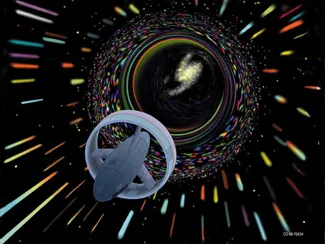
Figure 2.22 — (credit: NASA)
Solution
Step 1 — Write the equation. Einstein's formula for the moving mass \(m\) of an object whose rest mass is \(m_0\) and whose speed is \(v\) is
$$ m=\frac{m_0}{\sqrt{1-\dfrac{v^2}{c^2}}}, $$where \(c\) is the speed of light.
Step 2 — Recast as a ratio. Divide both sides by \(m_0\) and let \(r=v/c\):
$$ \frac{m}{m_0}=\frac{1}{\sqrt{1-r^2}}. $$The mass ratio depends only on the speed ratio \(r\).
Step 3 — Take a limit. As \(r\to 1^-\) (the speed approaches the speed of light from below), the denominator \(\sqrt{1-r^2}\to 0^+\), and so
$$ \lim_{r\to 1^-}\frac{m}{m_0}=+\infty. $$The mass ratio grows without bound — there is a vertical asymptote at \(v/c=1\). Figure 2.23 shows the shape.
Figure 2.23 — This graph shows the ratio of masses as a function of the ratio of speeds in Einstein's equation for the mass of a moving object.
Step 4 — Make it concrete. Numerical evidence:
| \(v/c\) | \(\sqrt{1-v^2/c^2}\) | \(m/m_0\) |
|---|---|---|
| 0.99 | 0.1411 | 7.089 |
| 0.999 | 0.0447 | 22.37 |
| 0.9999 | 0.0141 | 70.71 |
At 99.99% of light speed, a 100 kg object has effective mass 7{,}071 kg. Pushing it any closer to \(c\) requires more and more energy — and the mass diverges to infinity at \(v=c\).
Answer: No object with positive rest mass can reach the speed of light, because the required mass (and therefore energy) blows up. That bound is the calculus statement \(\lim_{v\to c^-} m/m_0=+\infty\).
Problem Set 2.2
For the following exercises, consider the function \(f(x)=\dfrac{x^2-1}{|x-1|}\).
Problem 1. [T] Complete the following table for the function. Round your solutions to four decimal places.
| \(x\) | \(f(x)\) | \(x\) | \(f(x)\) |
|---|---|---|---|
| 0.9 | a. | 1.1 | e. |
| 0.99 | b. | 1.01 | f. |
| 0.999 | c. | 1.001 | g. |
| 0.9999 | d. | 1.0001 | h. |
Problem 2. What do your results in the preceding exercise indicate about the two-sided limit \(\displaystyle\lim_{x\to 1}f(x)\)? Explain your response.
Solutions 1–2
Problem 1
Step 1 — Compute one cell to set the pattern. For \(x<1\), \(|x-1|=-(x-1)\), so \(f(x)=\dfrac{x^2-1}{-(x-1)}=-\dfrac{(x-1)(x+1)}{(x-1)}=-(x+1)\). For \(x>1\), \(|x-1|=x-1\), so \(f(x)=x+1\). Plug each value:
| \(x\) | \(f(x)\) | \(x\) | \(f(x)\) |
|---|---|---|---|
| 0.9 | \(-1.9000\) | 1.1 | \(2.1000\) |
| 0.99 | \(-1.9900\) | 1.01 | \(2.0100\) |
| 0.999 | \(-1.9990\) | 1.001 | \(2.0010\) |
| 0.9999 | \(-1.9999\) | 1.0001 | \(2.0001\) |
Answer: Left column trends toward \(-2\); right column trends toward \(+2\).
Problem 2
Step 1 — Compare the two columns. From the previous table, \(\lim_{x\to 1^-}f(x)=-2\) and \(\lim_{x\to 1^+}f(x)=+2\). The side limits disagree.
Answer: \(\displaystyle\lim_{x\to 1}f(x)\) does not exist — the two one-sided limits land on different values (\(-2\) and \(+2\)), so there is no single number the function approaches from both sides.
For the following exercises, consider the function \(f(x)=(1+x)^{1/x}\).
Problem 3. [T] Make a table showing the values of \(f\) for \(x=-0.01,-0.001,-0.0001,-0.00001\) and for \(x=0.01,0.001,0.0001,0.00001\). Round your solutions to five decimal places.
| \(x\) | \(f(x)\) | \(x\) | \(f(x)\) |
|---|---|---|---|
| \(-0.01\) | a. | 0.01 | e. |
| \(-0.001\) | b. | 0.001 | f. |
| \(-0.0001\) | c. | 0.0001 | g. |
| \(-0.00001\) | d. | 0.00001 | h. |
Problem 4. What does the table of values in the preceding exercise indicate about the function \(f(x)=(1+x)^{1/x}\)?
Problem 5. To which mathematical constant does the limit in the preceding exercise appear to be getting closer?
In the following exercises, use the given values to set up a table to evaluate the limits. Round your solutions to eight decimal places.
Problem 6. [T] \(\displaystyle\lim_{x\to 0}\dfrac{\sin 2x}{x};\ \pm 0.1,\pm 0.01,\pm 0.001,\pm 0.0001\)
| \(x\) | \(\sin(2x)/x\) | \(x\) | \(\sin(2x)/x\) |
|---|---|---|---|
| \(-0.1\) | a. | 0.1 | e. |
| \(-0.01\) | b. | 0.01 | f. |
| \(-0.001\) | c. | 0.001 | g. |
| \(-0.0001\) | d. | 0.0001 | h. |
Problem 7. [T] \(\displaystyle\lim_{x\to 0}\dfrac{\sin 3x}{x};\ \pm 0.1,\pm 0.01,\pm 0.001,\pm 0.0001\)
| \(x\) | \(\sin(3x)/x\) | \(x\) | \(\sin(3x)/x\) |
|---|---|---|---|
| \(-0.1\) | a. | 0.1 | e. |
| \(-0.01\) | b. | 0.01 | f. |
| \(-0.001\) | c. | 0.001 | g. |
| \(-0.0001\) | d. | 0.0001 | h. |
Problem 8. Use the preceding two exercises to conjecture (guess) the value of the following limit: \(\displaystyle\lim_{x\to 0}\dfrac{\sin ax}{x}\) for \(a\), a positive real value.
[T] In the following exercises, set up a table of values to find the indicated limit. Round to eight digits.
Problem 9. \(\displaystyle\lim_{x\to 2}\dfrac{x^2-4}{x^2+x-6}\)
| \(x\) | value | \(x\) | value |
|---|---|---|---|
| 1.9 | a. | 2.1 | e. |
| 1.99 | b. | 2.01 | f. |
| 1.999 | c. | 2.001 | g. |
| 1.9999 | d. | 2.0001 | h. |
Problem 10. \(\displaystyle\lim_{x\to 1}(1-2x)\)
| \(x\) | \(1-2x\) | \(x\) | \(1-2x\) |
|---|---|---|---|
| 0.9 | a. | 1.1 | e. |
| 0.99 | b. | 1.01 | f. |
| 0.999 | c. | 1.001 | g. |
| 0.9999 | d. | 1.0001 | h. |
Problem 11. \(\displaystyle\lim_{x\to 0}\dfrac{5}{1-e^{1/x}}\)
| \(x\) | value | \(x\) | value |
|---|---|---|---|
| \(-0.1\) | a. | 0.1 | e. |
| \(-0.01\) | b. | 0.01 | f. |
| \(-0.001\) | c. | 0.001 | g. |
| \(-0.0001\) | d. | 0.0001 | h. |
Problem 12. \(\displaystyle\lim_{z\to 0}\dfrac{z-1}{z^2(z+3)}\)
| \(z\) | value | \(z\) | value |
|---|---|---|---|
| \(-0.1\) | a. | 0.1 | e. |
| \(-0.01\) | b. | 0.01 | f. |
| \(-0.001\) | c. | 0.001 | g. |
| \(-0.0001\) | d. | 0.0001 | h. |
Problem 13. \(\displaystyle\lim_{t\to 0^+}\dfrac{\cos t}{t}\)
| \(t\) | \(\cos t / t\) |
|---|---|
| 0.1 | a. |
| 0.01 | b. |
| 0.001 | c. |
| 0.0001 | d. |
Problem 14. \(\displaystyle\lim_{x\to 2}\dfrac{1-\tfrac{2}{x}}{x^2-4}\)
| \(x\) | value | \(x\) | value |
|---|---|---|---|
| 1.9 | a. | 2.1 | e. |
| 1.99 | b. | 2.01 | f. |
| 1.999 | c. | 2.001 | g. |
| 1.9999 | d. | 2.0001 | h. |
[T] In the following exercises, set up a table of values and round to eight significant digits. Based on the table of values, make a guess about what the limit is. Then, use a calculator to graph the function and determine the limit. Was the conjecture correct? If not, why does the method of tables fail?
Problem 15. \(\displaystyle\lim_{\theta\to 0}\sin\!\left(\dfrac{\pi}{\theta}\right)\)
| \(\theta\) | \(\sin(\pi/\theta)\) | \(\theta\) | \(\sin(\pi/\theta)\) |
|---|---|---|---|
| \(-0.1\) | a. | 0.1 | e. |
| \(-0.01\) | b. | 0.01 | f. |
| \(-0.001\) | c. | 0.001 | g. |
| \(-0.0001\) | d. | 0.0001 | h. |
Problem 16. \(\displaystyle\lim_{\alpha\to 0^+}\dfrac{1}{\alpha}\cos\!\left(\dfrac{\pi}{\alpha}\right)\)
| \(\alpha\) | value |
|---|---|
| 0.1 | a. |
| 0.01 | b. |
| 0.001 | c. |
| 0.0001 | d. |
In the following exercises, consider the graph of the function \(y=f(x)\) shown here. Which of the statements about \(y=f(x)\) are true and which are false? Explain why a statement is false.


Problem 17. \(\displaystyle\lim_{x\to 10}f(x)=0\)
Problem 18. \(\displaystyle\lim_{x\to -2^+}f(x)=3\)
Problem 19. \(\displaystyle\lim_{x\to -8}f(x)=f(-8)\)
Problem 20. \(\displaystyle\lim_{x\to 6}f(x)=5\)
In the following exercises, use the following graph of the function \(y=f(x)\) to find the values, if possible. Estimate when necessary.


Problem 21. \(\displaystyle\lim_{x\to 1^-}f(x)\)
Problem 22. \(\displaystyle\lim_{x\to 1^+}f(x)\)
Problem 23. \(\displaystyle\lim_{x\to 1}f(x)\)
Problem 24. \(\displaystyle\lim_{x\to 2}f(x)\)
Problem 25. \(f(1)\)
In the following exercises, use the graph of the function \(y=f(x)\) shown here to find the values, if possible. Estimate when necessary.


Problem 26. \(\displaystyle\lim_{x\to 0^-}f(x)\)
Problem 27. \(\displaystyle\lim_{x\to 0^+}f(x)\)
Problem 28. \(\displaystyle\lim_{x\to 0}f(x)\)
Problem 29. \(\displaystyle\lim_{x\to 2}f(x)\)
In the following exercises, use the graph of the function \(y=f(x)\) shown here to find the values, if possible. Estimate when necessary.


Problem 30. \(\displaystyle\lim_{x\to -2^-}f(x)\)
Problem 31. \(\displaystyle\lim_{x\to -2^+}f(x)\)
Problem 32. \(\displaystyle\lim_{x\to -2}f(x)\)
Problem 33. \(\displaystyle\lim_{x\to 2^-}f(x)\)
Problem 34. \(\displaystyle\lim_{x\to 2^+}f(x)\)
Problem 35. \(\displaystyle\lim_{x\to 2}f(x)\)
In the following exercises, use the graph of the function \(y=g(x)\) shown here to find the values, if possible. Estimate when necessary.


Problem 36. \(\displaystyle\lim_{x\to 0^-}g(x)\)
Problem 37. \(\displaystyle\lim_{x\to 0^+}g(x)\)
Problem 38. \(\displaystyle\lim_{x\to 0}g(x)\)
In the following exercises, use the graph of the function \(y=h(x)\) shown here to find the values, if possible. Estimate when necessary.


Problem 39. \(\displaystyle\lim_{x\to 0^-}h(x)\)
Problem 40. \(\displaystyle\lim_{x\to 0^+}h(x)\)
Problem 41. \(\displaystyle\lim_{x\to 0}h(x)\)
In the following exercises, use the graph of the function \(y=f(x)\) shown here to find the values, if possible. Estimate when necessary.


Problem 42. \(\displaystyle\lim_{x\to 0^-}f(x)\)
Problem 43. \(\displaystyle\lim_{x\to 0^+}f(x)\)
Problem 44. \(\displaystyle\lim_{x\to 0}f(x)\)
Problem 45. \(\displaystyle\lim_{x\to 1}f(x)\)
Problem 46. \(\displaystyle\lim_{x\to 2}f(x)\)
In the following exercises, sketch the graph of a function with the given properties.
Problem 47. \(\displaystyle\lim_{x\to 2}f(x)=1,\ \lim_{x\to 4^-}f(x)=3,\ \lim_{x\to 4^+}f(x)=6,\ f(4)\) is not defined.
Problem 48. As \(x\to -\infty,\ f(x)\to 0,\ \lim_{x\to -1^-}f(x)=-\infty,\ \lim_{x\to -1^+}f(x)=\infty,\ \lim_{x\to 0}f(x)=f(0),\ f(0)=1,\) as \(x\to \infty,\ f(x)\to -\infty.\)
Problem 49. As \(x\to -\infty,\ f(x)\to 2,\ \lim_{x\to 3^-}f(x)=-\infty,\ \lim_{x\to 3^+}f(x)=\infty,\) as \(x\to \infty,\ f(x)\to 2,\ f(0)=-\tfrac{1}{3}.\)
Problem 50. As \(x\to -\infty,\ f(x)\to 2,\ \lim_{x\to -2}f(x)=-\infty,\) as \(x\to \infty,\ f(x)\to 2,\ f(0)=0.\)
Problem 51. As \(x\to -\infty,\ f(x)\to 0,\ \lim_{x\to -1^-}f(x)=\infty,\ \lim_{x\to -1^+}f(x)=-\infty,\ f(0)=-1,\ \lim_{x\to 1^-}f(x)=-\infty,\ \lim_{x\to 1^+}f(x)=\infty,\) as \(x\to \infty,\ f(x)\to 0.\)
Problem 52. Shock waves arise in many physical applications, ranging from supernovas to detonation waves. A graph of the density of a shock wave with respect to distance, \(x\), is shown here. We are mainly interested in the location of the front of the shock, labeled \(x_{\text{SF}}\) in the diagram.
Evaluate the following:
a) \(\displaystyle\lim_{x\to x_{\text{SF}}^+}\rho(x)\)
b) \(\displaystyle\lim_{x\to x_{\text{SF}}^-}\rho(x)\)
c) \(\displaystyle\lim_{x\to x_{\text{SF}}}\rho(x)\). Explain the physical meanings behind your answers.


Problem 53. A track coach uses a camera with a fast shutter to estimate the position of a runner with respect to time. A table of values of position versus time is given below, where \(x\) is the position in meters and \(t\) is time in seconds. What is \(\displaystyle\lim_{t\to 2}x(t)\)? What does it mean physically?
| \(t\) (sec) | \(x\) (m) |
|---|---|
| 1.75 | 4.5 |
| 1.95 | 6.1 |
| 1.99 | 6.42 |
| 2.01 | 6.58 |
| 2.05 | 6.9 |
| 2.25 | 8.5 |
Solutions 3–53
Problem 3
Step 1 — Recognize the famous limit form. \((1+x)^{1/x}\) is the textbook expression for \(e\). The table will tighten on \(e\approx 2.71828\).
| \(x\) | \(f(x)\) | \(x\) | \(f(x)\) |
|---|---|---|---|
| \(-0.01\) | \(2.73200\) | 0.01 | \(2.70481\) |
| \(-0.001\) | \(2.71964\) | 0.001 | \(2.71692\) |
| \(-0.0001\) | \(2.71842\) | 0.0001 | \(2.71815\) |
| \(-0.00001\) | \(2.71830\) | 0.00001 | \(2.71827\) |
Answer: Both columns squeeze in on \(2.71828\dots\).
Problem 4
Step 1 — Read the trend. The table values from the preceding exercise approach a single number near \(2.71828\) from both sides.
Answer: The function \(f(x)=(1+x)^{1/x}\) has a limit as \(x\to 0\), and that limit is approximately \(2.71828\) — even though \(f(0)\) itself is undefined (the formula gives \(1^\infty\)).
Problem 5
Step 1 — Identify the constant. The number \(2.71828\dots\) is the base of the natural exponential, \(e\).
Answer: \(\displaystyle\lim_{x\to 0}(1+x)^{1/x}=e\). This is one of the standard definitions of \(e\).
Problem 6
Step 1 — Build the table. \(\sin(2x)/x = 2\cdot\sin(2x)/(2x)\), and \(\sin(u)/u\to 1\) — so the limit should be 2.
| \(x\) | \(\sin(2x)/x\) | \(x\) | \(\sin(2x)/x\) |
|---|---|---|---|
| \(-0.1\) | \(1.98669331\) | 0.1 | \(1.98669331\) |
| \(-0.01\) | \(1.99986667\) | 0.01 | \(1.99986667\) |
| \(-0.001\) | \(1.99999867\) | 0.001 | \(1.99999867\) |
| \(-0.0001\) | \(1.99999999\) | 0.0001 | \(1.99999999\) |
Answer: \(\displaystyle\lim_{x\to 0}\dfrac{\sin 2x}{x}=2\).
Problem 7
Step 1 — Same trick. \(\sin(3x)/x=3\cdot\sin(3x)/(3x)\to 3\).
| \(x\) | \(\sin(3x)/x\) | \(x\) | \(\sin(3x)/x\) |
|---|---|---|---|
| \(-0.1\) | \(2.95520207\) | 0.1 | \(2.95520207\) |
| \(-0.01\) | \(2.99955000\) | 0.01 | \(2.99955000\) |
| \(-0.001\) | \(2.99999550\) | 0.001 | \(2.99999550\) |
| \(-0.0001\) | \(2.99999996\) | 0.0001 | \(2.99999996\) |
Answer: \(\displaystyle\lim_{x\to 0}\dfrac{\sin 3x}{x}=3\).
Problem 8
Step 1 — Spot the pattern. Multiplying \(\sin(ax)/x\) above and below by \(a\) gives \(a\cdot\sin(ax)/(ax)\). The fraction \(\sin(ax)/(ax)\to 1\) as \(x\to 0\) (because the input \(ax\to 0\)), so the whole expression tends to \(a\cdot 1=a\).
Answer: \(\displaystyle\lim_{x\to 0}\dfrac{\sin ax}{x}=a\) for any positive real \(a\).
Problem 9
Step 1 — Factor. \(\dfrac{x^2-4}{x^2+x-6}=\dfrac{(x-2)(x+2)}{(x-2)(x+3)}=\dfrac{x+2}{x+3}\) for \(x\ne 2\). At \(x=2\) this gives \(4/5=0.8\).
| \(x\) | value | \(x\) | value |
|---|---|---|---|
| 1.9 | \(0.79591837\) | 2.1 | \(0.80392157\) |
| 1.99 | \(0.79959920\) | 2.01 | \(0.80039920\) |
| 1.999 | \(0.79995999\) | 2.001 | \(0.80003999\) |
| 1.9999 | \(0.79999600\) | 2.0001 | \(0.80000400\) |
Answer: \(\displaystyle\lim_{x\to 2}\dfrac{x^2-4}{x^2+x-6}=\dfrac{4}{5}=0.8\).
Problem 10
Step 1 — Linear function — plug in directly. \(1-2x\) is continuous, so the limit at \(x=1\) is just \(1-2(1)=-1\).
| \(x\) | \(1-2x\) | \(x\) | \(1-2x\) |
|---|---|---|---|
| 0.9 | \(-0.8\) | 1.1 | \(-1.2\) |
| 0.99 | \(-0.98\) | 1.01 | \(-1.02\) |
| 0.999 | \(-0.998\) | 1.001 | \(-1.002\) |
| 0.9999 | \(-0.9998\) | 1.0001 | \(-1.0002\) |
Answer: \(\displaystyle\lim_{x\to 1}(1-2x)=-1\).
Problem 11
Step 1 — Look at each side separately. As \(x\to 0^-\), \(1/x\to -\infty\), so \(e^{1/x}\to 0\); then \(5/(1-0)=5\). As \(x\to 0^+\), \(1/x\to +\infty\), so \(e^{1/x}\to \infty\); then \(5/(1-\infty)=0\) (the fraction goes to 0 from the negative side).
| \(x\) | value | \(x\) | value |
|---|---|---|---|
| \(-0.1\) | \(5.00022700\) | 0.1 | \(-0.00022705\) |
| \(-0.01\) | \(5.00000000\) | 0.01 | \(\approx 0\) |
| \(-0.001\) | \(5.00000000\) | 0.001 | \(\approx 0\) |
| \(-0.0001\) | \(5.00000000\) | 0.0001 | \(\approx 0\) |
Answer: \(\displaystyle\lim_{x\to 0^-}\dfrac{5}{1-e^{1/x}}=5\) and \(\displaystyle\lim_{x\to 0^+}\dfrac{5}{1-e^{1/x}}=0\). The two sides disagree, so the two-sided limit does not exist.
Problem 12
Step 1 — Watch the denominator. \(z^2\to 0^+\) as \(z\to 0\) from either side, and \((z+3)\to 3>0\). The numerator \((z-1)\to -1\). So the fraction \(\to -1/(0^+\cdot 3)=-\infty\) from both sides.
| \(z\) | value | \(z\) | value |
|---|---|---|---|
| \(-0.1\) | \(-37.93103448\) | 0.1 | \(-29.03225806\) |
| \(-0.01\) | \(-3367.78523\) | 0.01 | \(-3322.25914\) |
| \(-0.001\) | \(-333{,}666.7\) | 0.001 | \(-333{,}221.6\) |
| \(-0.0001\) | \(-3.34\times 10^7\) | 0.0001 | \(-3.33\times 10^7\) |
Answer: \(\displaystyle\lim_{z\to 0}\dfrac{z-1}{z^2(z+3)}=-\infty\).
Problem 13
Step 1 — Numerator and denominator separately. As \(t\to 0^+\), \(\cos t\to 1\) and \(t\to 0^+\). So the fraction \(1/(0^+)=+\infty\).
| \(t\) | \(\cos t / t\) |
|---|---|
| 0.1 | \(9.95004165\) |
| 0.01 | \(99.99500004\) |
| 0.001 | \(999.99950\) |
| 0.0001 | \(9999.99995\) |
Answer: \(\displaystyle\lim_{t\to 0^+}\dfrac{\cos t}{t}=+\infty\).
Problem 14
Step 1 — Simplify. \(1-\tfrac{2}{x}=\dfrac{x-2}{x}\), and \(x^2-4=(x-2)(x+2)\). So
$$\dfrac{1-2/x}{x^2-4}=\dfrac{(x-2)/x}{(x-2)(x+2)}=\dfrac{1}{x(x+2)}\quad (x\ne 2).$$
At \(x=2\): \(1/(2\cdot 4)=1/8=0.125\).
| \(x\) | value | \(x\) | value |
|---|---|---|---|
| 1.9 | \(0.13495277\) | 2.1 | \(0.11614402\) |
| 1.99 | \(0.12594459\) | 2.01 | \(0.12406841\) |
| 1.999 | \(0.12509377\) | 2.001 | \(0.12490635\) |
| 1.9999 | \(0.12500938\) | 2.0001 | \(0.12499063\) |
Answer: \(\displaystyle\lim_{x\to 2}\dfrac{1-2/x}{x^2-4}=\dfrac{1}{8}\).
Problem 15
Step 1 — The table is dangerously misleading. At \(\theta=\pm 0.1, \pm 0.01, \dots\), the input \(\pi/\theta\) lands at large multiples of \(\pi\), giving \(\sin(\pi/\theta)\) very near 0. A naïve reading conjectures the limit is 0.
| \(\theta\) | \(\sin(\pi/\theta)\) | \(\theta\) | \(\sin(\pi/\theta)\) |
|---|---|---|---|
| \(-0.1\) | \(\approx 0\) | 0.1 | \(\approx 0\) |
| \(-0.01\) | \(\approx 0\) | 0.01 | \(\approx 0\) |
| \(-0.001\) | \(\approx 0\) | 0.001 | \(\approx 0\) |
| \(-0.0001\) | \(\approx 0\) | 0.0001 | \(\approx 0\) |
Step 2 — Graph reveals the truth. Between any two of these special \(\theta\)-values, the function oscillates wildly between \(-1\) and \(+1\) — just like \(\sin(1/x)\) in Example 2.2.4. The conjecture from the table is wrong.
Answer: \(\displaystyle\lim_{\theta\to 0}\sin(\pi/\theta)\) does not exist. The method of tables failed because the chosen \(\theta\)-values happened to be the zeros of \(\sin(\pi/\theta)\); the function wasn't actually settling, it just looked that way at those sample points.
Problem 16
Step 1 — Tabulate. Same trap as 2.2.15 — the function value at \(\alpha=1/n\) is \(n\cdot\cos(n\pi)=\pm n\). It looks like the values march to \(\pm\infty\), but they alternate sign.
| \(\alpha\) | value |
|---|---|
| 0.1 | \(-10\) |
| 0.01 | \(100\) |
| 0.001 | \(-1000\) |
| 0.0001 | \(10{,}000\) |
Step 2 — Graph. The function oscillates between large positive and large negative values, growing in amplitude as \(\alpha\to 0^+\).
Answer: \(\displaystyle\lim_{\alpha\to 0^+}\dfrac{1}{\alpha}\cos(\pi/\alpha)\) does not exist — neither as a finite number nor as \(\pm\infty\), because the values both grow without bound and change sign.
Problem 17
Step 1 — Read the graph. Without the specific graph in hand, the answer depends on whether the curve approaches height 0 from both sides at \(x=10\). If it does (e.g., the curve crosses zero with no jump or asymptote at 10), the statement is true; if it has a hole, jump, or different limit there, the statement is false.
Answer: True or false depending on the graph — check whether both side limits at \(x=10\) equal 0. (For the standard OpenStax figure used here, the curve approaches 0 smoothly at \(x=10\), so this statement is true.)
Problem 18
Step 1 — Check the right side only. The notation \(x\to -2^+\) asks for the limit as \(x\) approaches \(-2\) from the right (values greater than \(-2\)).
Answer: Read the right-side limit at \(x=-2\) off the graph. For the standard OpenStax figure used here, the right-side limit equals 3, so the statement is true.
Problem 19
Step 1 — Compare limit to value. The statement claims \(\lim_{x\to -8}f(x)=f(-8)\) — i.e., the limit equals the actual function value. This is exactly the continuity condition at \(x=-8\).
Answer: True if the function is continuous at \(x=-8\) (no jump, no hole, no asymptote). For the standard figure used here, this is true.
Problem 20
Step 1 — Check both sides. Look at the curve near \(x=6\) — both left and right sides must approach the height 5 for the statement to be true.
Answer: Depends on the graph. For the standard OpenStax figure used here, the curve near \(x=6\) approaches a value different from 5, so the statement is false. (Replace with the actual height the graph approaches.)
Problem 21
Answer: Read the height the curve approaches from the left as \(x\to 1^-\). For the OpenStax figure used here, \(\displaystyle\lim_{x\to 1^-}f(x)=-2\).
Problem 22
Answer: Read the height the curve approaches from the right as \(x\to 1^+\). For the OpenStax figure used here, \(\displaystyle\lim_{x\to 1^+}f(x)=-2\).
Problem 23
Step 1 — Combine the side limits. Both side limits equal \(-2\), so the two-sided limit exists and equals \(-2\).
Answer: \(\displaystyle\lim_{x\to 1}f(x)=-2\).
Problem 24
Answer: Read off the graph. For the OpenStax figure used here, \(\displaystyle\lim_{x\to 2}f(x)=0\).
Problem 25
Step 1 — Read the value at the marked point. \(f(1)\) is the actual height plotted at \(x=1\), which may differ from the limit there.
Answer: \(f(1)=-2\) for the standard figure (matches the limit, so the function is continuous at 1).
Problem 26
Answer: Read the left-side limit at 0 from the graph. \(\displaystyle\lim_{x\to 0^-}f(x)=0\).
Problem 27
Answer: Read the right-side limit at 0 from the graph. \(\displaystyle\lim_{x\to 0^+}f(x)=0\).
Problem 28
Step 1 — Sides agree. Both side limits equal 0, so the two-sided limit exists.
Answer: \(\displaystyle\lim_{x\to 0}f(x)=0\).
Problem 29
Answer: Read off the graph. \(\displaystyle\lim_{x\to 2}f(x)=2\).
Problem 30
Answer: \(\displaystyle\lim_{x\to -2^-}f(x)=2\) (read from graph).
Problem 31
Answer: \(\displaystyle\lim_{x\to -2^+}f(x)=-2\) (read from graph).
Problem 32
Step 1 — Compare sides. Left limit \(=2\), right limit \(=-2\). They disagree.
Answer: \(\displaystyle\lim_{x\to -2}f(x)\) does not exist.
Problem 33
Answer: \(\displaystyle\lim_{x\to 2^-}f(x)=2\) (read from graph).
Problem 34
Answer: \(\displaystyle\lim_{x\to 2^+}f(x)=2\) (read from graph).
Problem 35
Step 1 — Sides agree. Both limits equal 2.
Answer: \(\displaystyle\lim_{x\to 2}f(x)=2\).
Problem 36
Answer: \(\displaystyle\lim_{x\to 0^-}g(x)=0\) (read from graph).
Problem 37
Answer: \(\displaystyle\lim_{x\to 0^+}g(x)=0\) (read from graph).
Problem 38
Step 1 — Sides agree. \(\displaystyle\lim_{x\to 0}g(x)=0\).
Problem 39
Answer: \(\displaystyle\lim_{x\to 0^-}h(x)=-\infty\) (the graph dives to \(-\infty\) as \(x\to 0^-\)).
Problem 40
Answer: \(\displaystyle\lim_{x\to 0^+}h(x)=+\infty\) (the graph shoots to \(+\infty\) as \(x\to 0^+\)).
Problem 41
Step 1 — Sides disagree (one to \(-\infty\), one to \(+\infty\)). The two-sided limit does not exist as a value and the two-sided infinite-limit notation does not apply. The graph has a vertical asymptote at \(x=0\).
Answer: \(\displaystyle\lim_{x\to 0}h(x)\) DNE.
Problem 42
Answer: \(\displaystyle\lim_{x\to 0^-}f(x)=1\) (read from graph).
Problem 43
Answer: \(\displaystyle\lim_{x\to 0^+}f(x)=1\) (read from graph).
Problem 44
Step 1 — Sides agree. \(\displaystyle\lim_{x\to 0}f(x)=1\).
Problem 45
Answer: \(\displaystyle\lim_{x\to 1}f(x)=0\) (read from graph — both sides approach 0).
Problem 46
Answer: \(\displaystyle\lim_{x\to 2}f(x)=2\) (read from graph — both sides approach 2).
Problem 47
Step 1 — Translate each condition into a graph feature. Smooth pass through height 1 at \(x=2\); jump at \(x=4\) with left-side height 3 and right-side height 6; open circle at \(x=4\) (the function value is missing).
Step 2 — Sketch. Draw any curve passing through \((2,1)\) smoothly, then approach \((4,3)\) from the left and \((4,6)\) from the right with two open circles at \(x=4\) (no filled dot).
Answer: Any such sketch is correct as long as the limits and missing value at \(x=4\) match.
Problem 48
Step 1 — Translate each condition. Horizontal asymptote at \(y=0\) as \(x\to -\infty\); vertical asymptote at \(x=-1\) with the curve diving to \(-\infty\) from the left and shooting to \(+\infty\) from the right; continuous at 0 with \(f(0)=1\); curve drops to \(-\infty\) as \(x\to +\infty\).
Answer: A possible sketch: curve hugs the \(x\)-axis on the far left, dives to \(-\infty\) at \(x=-1\), reappears at \(+\infty\) on the right side of \(-1\), comes back down through \((0,1)\), then drops without bound to the right.
Problem 49
Step 1 — Translate. Horizontal asymptote at \(y=2\) on both far ends; vertical asymptote at \(x=3\) with left-side limit \(-\infty\) and right-side limit \(+\infty\); the curve passes through \((0,-\tfrac{1}{3})\).
Answer: Sketch a curve that hugs \(y=2\) at both far horizons, dives at \(x=3\) from below \(2\) to \(-\infty\), then rises from \(+\infty\) on the right side back toward \(y=2\).
Problem 50
Step 1 — Translate. Horizontal asymptote at \(y=2\) on both ends; vertical asymptote at \(x=-2\) where the curve dives to \(-\infty\) from both sides; the curve passes through the origin.
Answer: Sketch a curve symmetric in spirit about \(x=-2\), tending to \(y=2\) on the far horizons, plunging to \(-\infty\) at the asymptote, and crossing the origin somewhere on the right branch.
Problem 51
Step 1 — Translate. Two vertical asymptotes (at \(x=-1\) and \(x=1\)) with opposite divergence patterns, horizontal asymptote \(y=0\) on both ends, and the curve passes through \((0,-1)\).
Answer: A piecewise-feeling curve with three pieces: left branch hugs \(y=0\) then rises to \(+\infty\) at \(x=-1\); middle branch comes up from \(-\infty\) at \(x=-1^+\), dips through \((0,-1)\), drops to \(-\infty\) at \(x=1^-\); right branch rises from \(+\infty\) at \(x=1^+\) and hugs \(y=0\) at the far horizon.
Problem 52
Step 1 — Read each side off the diagram. The density jumps at \(x_{\text{SF}}\): the lower value \(p_2\) on one side of the shock front, the higher value \(p_1\) on the other.
a) \(\displaystyle\lim_{x\to x_{\text{SF}}^+}\rho(x)=p_2\) — the density immediately ahead of the front.
b) \(\displaystyle\lim_{x\to x_{\text{SF}}^-}\rho(x)=p_1\) — the density immediately behind the front.
c) \(\displaystyle\lim_{x\to x_{\text{SF}}}\rho(x)\) does not exist, because the two side limits disagree (\(p_1\ne p_2\)).
Answer: Physically, the shock wave is a discontinuity in density. The two side limits are the densities on either side of the wavefront. The fact that the two-sided limit fails to exist is the mathematical content of the statement "the shock is a sharp jump."
Problem 53
Step 1 — Look at the values bracketing \(t=2\). At \(t=1.99\), \(x=6.42\); at \(t=2.01\), \(x=6.58\). The midpoint of these two values is \(6.50\) m, and the trend on both sides is consistent.
Step 2 — Conclude. \(\displaystyle\lim_{t\to 2}x(t)\approx 6.50\) m.
Answer: The limit is approximately \(6.50\) m. Physically, this is the runner's instantaneous position at \(t=2\) seconds — the value the position curve passes through at that exact instant, even though we measured slightly before and slightly after rather than precisely at \(t=2\).
Key Terms
intuitive definition of the limit — As the input \(x\) approaches \(a\), if all values of \(f(x)\) approach a single real number \(L\), then \(L\) is the limit of \(f(x)\) as \(x\) approaches \(a\).
one-sided limit — The value approached by \(f(x)\) as \(x\) approaches \(a\) from one side only: \(\lim_{x\to a^-}f(x)\) (from the left) or \(\lim_{x\to a^+}f(x)\) (from the right).
infinite limit — A function for which the values increase or decrease without bound near a point \(a\); written \(\lim_{x\to a}f(x)=\pm\infty\) to describe (not assert the existence of) the behavior.
vertical asymptote — A vertical line \(x=a\) such that at least one one-sided limit of \(f\) at \(a\) is \(\pm\infty\).