Chapter 1: Functions and Graphs
1.1 Review of Functions
Learning Objectives
- Use functional notation to evaluate a function.
- Determine the domain and range of a function.
- Draw the graph of a function.
- Find the zeros of a function.
- Recognize a function from a table of values.
- Make new functions from two or more given functions.
- Describe the symmetry properties of a function.
In this section, we lay out a formal definition of a function and look at several ways we can write one down — tables, formulas, and graphs. We also nail down the vocabulary mathematicians use when they talk about functions, define what it means to compose two functions, and explore what it means for a function to be symmetric. Most of this will be a refresher, but it is a useful reference: a lot of the algebra moves you will see in calculus come straight out of this section.
1.1.1 Functions
Think of a function like a strict cafeteria worker: every student (input) gets exactly one entrée (output). Two students might be handed the same dish, but no single student walks away with two entrées. That "exactly one" rule is what separates a function from any old relation.
A function \(f\) consists of a set of inputs, a set of outputs, and a rule for assigning each input to exactly one output. The set of inputs is called the domain of the function. The set of outputs is called the range of the function.
For example, take the function \(f\) whose domain is all real numbers and whose rule is "square the input." Then \(f(3) = 3^2 = 9\). Every nonnegative real number is the square of some real number, so every nonnegative number lives in the range. No real number squares to a negative value, so negative numbers are excluded. The range is therefore the set of nonnegative reals.
For a general function \(f\) with domain \(D\), we usually use \(x\) for the input and \(y\) for the output paired with \(x\). We call \(x\) the independent variable and \(y\) the dependent variable (because \(y\) depends on \(x\)). In function notation, we write \(y = f(x)\) and read it as "y equals f of x." For the squaring function above, we write \(f(x) = x^2\).
We can picture the idea of a function using Figure 1.2, Figure 1.3, and Figure 1.4.


Figure 1.2 — A function can be visualized as an input/output device.


Figure 1.3 — A function maps every element in the domain to exactly one element in the range. Although each input can be sent to only one output, two different inputs can be sent to the same output.


Figure 1.4 — In this case, a graph of a function \(f\) has a domain of \(\{1, 2, 3\}\) and a range of \(\{1, 2\}\). The independent variable is \(x\) and the dependent variable is \(y\).
We can also visualize a function by plotting points \((x, y)\) in the coordinate plane, where \(y = f(x)\). The graph of a function is the set of all such points. For example, take the function \(f\) with domain \(D = \{1, 2, 3\}\) and rule \(f(x) = 3 - x\). Figure 1.5 shows its graph.


Figure 1.5 — Here we see a graph of the function \(f\) with domain \(\{1, 2, 3\}\) and rule \(f(x) = 3 - x\). The graph consists of the points \((x, f(x))\) for all \(x\) in the domain.
Every function has a domain. But sometimes a function is given by an equation like \(f(x) = x^2\) without any domain specified. In that case we use the natural domain: the set of all real numbers \(x\) for which \(f(x)\) gives back a real number. Any real number can be squared, so the natural domain of \(f(x) = x^2\) is all real numbers. The square-root function \(f(x) = \sqrt{x}\), on the other hand, gives a real output only when \(x\) is nonnegative, so its natural domain is \(\{x \mid x \ge 0\}\).
For the functions \(f(x) = x^2\) and \(f(x) = \sqrt{x}\), the domains are infinite sets — we cannot list every element. Two compact ways to describe infinite sets of real numbers are set-builder notation and interval notation. In set-builder notation, using \(\mathbb{R}\) for the set of all real numbers, we write
$$ \{x \mid x \text{ has some property}\} $$and read it as "the set of real numbers \(x\) such that \(x\) has some property." For the real numbers strictly between \(1\) and \(5\), we would write
$$ \{x \mid 1 < x < 5\}. $$That same set can be written using interval notation as \((a, b)\) for "all numbers between \(a\) and \(b\), exclusive." So
$$ (1, 5) = \{x \mid 1 < x < 5\}. $$The numbers \(1\) and \(5\) are the endpoints of this set. If we want to include the endpoints, we write
$$ [1, 5] = \{x \mid 1 \le x \le 5\}. $$We can include one endpoint and not the other using a mix of brackets and parentheses. To describe the set of nonnegative reals — no upper bound — we use the symbol \(\infty\) (positive infinity):
$$ [0, \infty) = \{x \mid 0 \le x\}. $$Important: \(\infty\) is not a real number; it is a symbol that says "this set keeps going forever in the positive direction." Similarly, for all nonpositive numbers we write
$$ (-\infty, 0] = \{x \mid x \le 0\}. $$The notation \(-\infty\) means negative infinity, indicating we include all numbers no matter how small. The set of all real numbers is
$$ (-\infty, \infty) = \{x \mid x \text{ is any real number}\}. $$Summary of interval notation. The table below collects the forms introduced above for quick reference.
| Interval | Set-builder | In words |
|---|---|---|
| \((a, b)\) | \(\{x \mid a < x < b\}\) | Between \(a\) and \(b\), endpoints excluded |
| \([a, b]\) | \(\{x \mid a \le x \le b\}\) | Between \(a\) and \(b\), endpoints included |
| \([a, b)\) | \(\{x \mid a \le x < b\}\) | Includes \(a\), excludes \(b\) |
| \((a, b]\) | \(\{x \mid a < x \le b\}\) | Excludes \(a\), includes \(b\) |
| \([a, \infty)\) | \(\{x \mid a \le x\}\) | \(a\) and everything above |
| \((-\infty, b]\) | \(\{x \mid x \le b\}\) | \(b\) and everything below |
| \((-\infty, \infty)\) | \(\{x \mid x \in \mathbb{R}\}\) | All real numbers |
Some functions are defined by different equations on different parts of their domain. These are called piecewise-defined functions. For example, suppose we want a function \(f\) on all of \(\mathbb{R}\) such that \(f(x) = 3x + 1\) when \(x \ge 2\) and \(f(x) = x^2\) when \(x < 2\). We write
$$ f(x) = \begin{cases} 3x + 1 & x \ge 2 \\ x^2 & x < 2 \end{cases}. $$To evaluate, we pick the equation that matches our input. Since \(5 \ge 2\), we use \(f(x) = 3x + 1\) and get \(f(5) = 3(5) + 1 = 16\). For \(x = -1 < 2\), we use \(f(x) = x^2\) and get \(f(-1) = 1\).
Given two sets \(A\) and \(B\), a set whose elements are ordered pairs \((x, y)\) — where \(x\) is from \(A\) and \(y\) is from \(B\) — is called a relation from \(A\) to \(B\). A relation simply describes some kind of pairing between the two sets. A function is a stricter kind of relation: each element of the first set is paired with exactly one element of the second set. We call the element from the first set the input and the element from the second set the output.
Functions are everywhere in math because they capture the idea that knowing one quantity lets you pin down another. The area of a square depends on its side length, so we say area is a function of side length. The velocity of a ball thrown in the air is a function of how long it has been in the air. The cost of mailing a package is a function of the package's weight. To study these relationships precisely, we need precise vocabulary.
For \(f(x) = x^2 - 3x + 5\), evaluate \(f(1)\) and \(f(a + h)\).
Solution
\(f(1) = (1)^2 - 3(1) + 5 = 1 - 3 + 5 = 3\).
For \(f(a + h)\), substitute \(a + h\) wherever \(x\) appears, then expand:
$$ \begin{aligned} f(a + h) &= (a + h)^2 - 3(a + h) + 5 \\ &= a^2 + 2ah + h^2 - 3a - 3h + 5. \end{aligned} $$Answer: \(f(1) = 3\); \(f(a + h) = a^2 + 2ah + h^2 - 3a - 3h + 5\).
For the function \(f(x) = 3x^2 + 2x - 1\), evaluate:
- 1. \(f(-2)\)
- 2. \(f(\sqrt{2})\)
- 3. \(f(a + h)\)
Solution
Substitute the given value for \(x\) into the formula for \(f(x)\).
1. \(f(-2) = 3(-2)^2 + 2(-2) - 1 = 12 - 4 - 1 = 7\).
2. \(f(\sqrt{2}) = 3(\sqrt{2})^2 + 2\sqrt{2} - 1 = 6 + 2\sqrt{2} - 1 = 5 + 2\sqrt{2}\).
3. Expand carefully — \((a + h)^2 = a^2 + 2ah + h^2\):
$$ \begin{aligned} f(a + h) &= 3(a + h)^2 + 2(a + h) - 1 \\ &= 3(a^2 + 2ah + h^2) + 2a + 2h - 1 \\ &= 3a^2 + 6ah + 3h^2 + 2a + 2h - 1. \end{aligned} $$Answer: \(f(-2) = 7\), \(f(\sqrt{2}) = 5 + 2\sqrt{2}\), \(f(a + h) = 3a^2 + 6ah + 3h^2 + 2a + 2h - 1\).
For each function, determine the (i) domain and (ii) range.
- 1. \(f(x) = (x - 4)^2 + 5\)
- 2. \(f(x) = \sqrt{3x + 2} - 1\)
- 3. \(f(x) = \dfrac{3}{x - 2}\)
Solution
1. \(f(x) = (x - 4)^2 + 5\).
Domain: \((x - 4)^2 + 5\) is a real number for every real \(x\), so the domain is \((-\infty, \infty)\).
Range: \((x - 4)^2 \ge 0\), so \(f(x) \ge 5\). The range sits inside \(\{y \mid y \ge 5\}\). To confirm every \(y \ge 5\) is hit, solve \((x - 4)^2 + 5 = y\):
$$ (x - 4)^2 = y - 5 \quad\Rightarrow\quad x - 4 = \pm\sqrt{y - 5}. $$Since \(y \ge 5\), the square root is defined, and \(x = 4 \pm \sqrt{y - 5}\) gives valid inputs. So the range is \(\{y \mid y \ge 5\}\).
2. \(f(x) = \sqrt{3x + 2} - 1\).
Domain: We need \(3x + 2 \ge 0\), so \(x \ge -\tfrac{2}{3}\). Domain: \(\{x \mid x \ge -\tfrac{2}{3}\}\).
Range: \(\sqrt{3x + 2} \ge 0\), so \(f(x) \ge -1\). For any \(y \ge -1\), set \(\sqrt{3x + 2} - 1 = y\). Then \(\sqrt{3x + 2} = y + 1\); squaring, \(3x + 2 = (y + 1)^2\), so
$$ x = \tfrac{1}{3}(y + 1)^2 - \tfrac{2}{3}. $$This value is at least \(-\tfrac{2}{3}\), so it lies in the domain. Range: \(\{y \mid y \ge -1\}\).
3. \(f(x) = \dfrac{3}{x - 2}\).
Domain: The denominator is nonzero whenever \(x \ne 2\). Domain: \(\{x \mid x \ne 2\}\).
Range: Solve \(\dfrac{3}{x - 2} = y\) for \(x\): \(x = \dfrac{3}{y} + 2\). As long as \(y \ne 0\), such an \(x\) exists. Range: \(\{y \mid y \ne 0\}\).
Answer: 1. Domain \((-\infty, \infty)\); range \(\{y \mid y \ge 5\}\). 2. Domain \(\{x \mid x \ge -\tfrac{2}{3}\}\); range \(\{y \mid y \ge -1\}\). 3. Domain \(\{x \mid x \ne 2\}\); range \(\{y \mid y \ne 0\}\).
1.1.2 Representing Functions
We say that a function \(f\) is increasing on the interval \(I\) if for all \(x_1, x_2 \in I\),
$$ f(x_1) \le f(x_2) \text{ when } x_1 < x_2. $$We say \(f\) is strictly increasing on \(I\) if for all \(x_1, x_2 \in I\),
$$ f(x_1) < f(x_2) \text{ when } x_1 < x_2. $$We say that a function \(f\) is decreasing on \(I\) if for all \(x_1, x_2 \in I\),
$$ f(x_1) \ge f(x_2) \text{ if } x_1 < x_2. $$We say that \(f\) is strictly decreasing on \(I\) if for all \(x_1, x_2 \in I\),
$$ f(x_1) > f(x_2) \text{ if } x_1 < x_2. $$Plain-English unpacking. Walk left to right along the graph. If the height never drops as you move right, the function is increasing; if it always strictly rises, it is strictly increasing. If the height never rises, it is decreasing; if it always strictly falls, it is strictly decreasing. The word "strictly" rules out flat stretches.
For example, \(f(x) = 3x\) is increasing on \((-\infty, \infty)\) because \(3x_1 < 3x_2\) whenever \(x_1 < x_2\). The function \(f(x) = -x^3\) is strictly decreasing on \((-\infty, \infty)\) because \(-x_1^3 > -x_2^3\) whenever \(x_1 < x_2\) (Figure 1.11).
Figure 1.11 — (a) The function \(f(x) = 3x\) is increasing on the interval \((-\infty, \infty)\). (b) The function \(f(x) = -x^3\) is decreasing on the interval \((-\infty, \infty)\).
Typically a function is represented using one or more of the following tools:
- A table - A graph - A formula
We can recognize a function in any of these forms, and they often work better together — we plot points from a table, or build a table from a formula and then graph it.
Tables
Functions described by a table show up constantly in real-world data. Suppose we record the outside temperature every hour for a 24-hour period starting at midnight. Let the input \(x\) be the number of hours past midnight, and the output \(y\) be the temperature in degrees Fahrenheit at that time. We can summarize the data in Table 1.1.
Functions are how we talk about cause-and-effect with numbers. Drop a coin into a vending machine, push a button, get a soda — that vending machine is a function: input (your button choice) goes in, exactly one output (your soda) comes out. Throughout calculus, every rate of change, every area under a curve, every optimization problem you will solve starts with a function. Getting comfortable here pays dividends for the entire course.
Table 1.1 — Temperature (°F) as a function of hours after midnight.
| Hours after midnight \(x\) | 0 | 1 | 2 | 3 | 4 | 5 | 6 | 7 | 8 | 9 | 10 | 11 |
|---|---|---|---|---|---|---|---|---|---|---|---|---|
| Temperature °F \(y\) | 58 | 55 | 53 | 52 | 52 | 53 | 55 | 60 | 64 | 70 | 75 | 78 |
| Hours after midnight \(x\) | 12 | 13 | 14 | 15 | 16 | 17 | 18 | 19 | 20 | 21 | 22 | 23 |
|---|---|---|---|---|---|---|---|---|---|---|---|---|
| Temperature °F \(y\) | 80 | 85 | 85 | 84 | 83 | 80 | 77 | 73 | 69 | 65 | 60 | 58 |
We can see from the table that temperature is a function of time. The temperature decreases, then increases, then decreases again. Without a graph, though, it is hard to picture the overall shape of the function.
Graphs
Given a function \(f\) described by a table, we can give a visual picture of \(f\) by plotting its points on a graph. Graphing the temperatures from Table 1.1 makes the pattern of the day much clearer. Figure 1.6 shows the plot.


Figure 1.6 — The graph of the data from Table 1.1 shows temperature as a function of time.
From the plotted points we can imagine the general shape of the graph. It is often useful to connect the dots. We can't say for certain what the temperature was between recorded hours, but with this many data points and a clear trend, it is reasonable to suspect the in-between values followed a similar curve, as shown in Figure 1.7.


Figure 1.7 — Connecting the dots in Figure 1.6 shows the general pattern of the data.
Algebraic Formulas
Sometimes a function comes to us not as a table but as an explicit formula. Formulas crop up in almost every applied setting. The area of a circle with radius \(r\) is \(A(r) = \pi r^2\). When an object is thrown upward from the ground with initial velocity \(v_0\) ft/s, its height above the ground until it lands is \(s(t) = -16t^2 + v_0 t\). When \(P\) dollars are invested at an annual rate \(r\) compounded continuously, the account balance after \(t\) years is \(A(t) = P e^{rt}\). Algebraic formulas are useful for computing exact values; we also like to picture them as graphs.
Why bother with all three representations — table, graph, formula? Because each one is good at a different thing. Tables are honest about real data. Graphs make shape and trend pop out. Formulas let you predict values you never measured. A practicing engineer or scientist switches between them all day long.
Given an algebraic formula for a function \(f\), the graph of \(f\) is the set of points \((x, f(x))\) for all \(x\) in the domain. To graph by hand, start by building a small table of inputs and outputs. The domain may be infinite, but listing a handful of strategic points is a great start.
When building that table, we usually check whether zero is ever an output. The values of \(x\) where \(f(x) = 0\) are called the zeros of a function. For example, the zeros of \(f(x) = x^2 - 4\) are \(x = \pm 2\). Zeros are exactly the places where the graph of \(f\) crosses the \(x\)-axis. A graph might never cross the \(x\)-axis, or cross it many times — even infinitely often.
Another point worth checking is the \(y\)-intercept, if it exists. The \(y\)-intercept is the point \((0, f(0))\).
A function has at most one \(y\)-intercept: if \(x = 0\) is in the domain there is exactly one, and if not, there is none. More generally, for any real \(c\) in the domain, there is exactly one output \(f(c)\), and the vertical line \(x = c\) meets the graph exactly once. If \(c\) is not in the domain, the vertical line \(x = c\) does not meet the graph at all. This observation gives a quick visual test:
Rule: Vertical Line Test
A set of points in the plane is the graph of a function of \(x\) if and only if every vertical line intersects the set at most once.
We can use this test on a picture to decide whether a set of plotted points is the graph of a function (Figure 1.8).
Figure 1.8 — (a) The set of plotted points represents the graph of a function because every vertical line intersects the set of points, at most, once. (b) The set of plotted points does not represent the graph of a function because some vertical lines intersect the set of points more than once.
Find the domain and range for \(f(x) = \sqrt{4 - 2x} + 5\).
Solution
Domain: We need \(4 - 2x \ge 0\), so \(x \le 2\). Domain: \(\{x \mid x \le 2\}\), or \((-\infty, 2]\).
Range: \(\sqrt{4 - 2x} \ge 0\), so \(f(x) \ge 5\). For any target \(y \ge 5\), solve \(\sqrt{4 - 2x} + 5 = y\) for \(x\):
$$ \sqrt{4 - 2x} = y - 5 \;\Rightarrow\; 4 - 2x = (y - 5)^2 \;\Rightarrow\; x = 2 - \tfrac{1}{2}(y - 5)^2. $$This \(x\) is at most \(2\), so it lies in the domain. Range: \(\{y \mid y \ge 5\}\), or \([5, \infty)\).
Answer: Domain \((-\infty, 2]\); range \([5, \infty)\).
When tracing a function's graph from left to right, its output either rises, falls, or stays flat as the input increases. The following definition captures these two behaviors precisely.
Find the zeros of \(f(x) = x^3 - 5x^2 + 6x\).
Solution
Factor: \(x^3 - 5x^2 + 6x = x(x^2 - 5x + 6) = x(x - 2)(x - 3)\). Set each factor to zero.
Answer: \(x = 0,\ 2,\ 3\).
Consider the function \(f(x) = -4x + 2\).
- 1. Find all zeros of \(f\).
- 2. Find the \(y\)-intercept (if any).
- 3. Sketch a graph of \(f\).
Solution
1. Solve \(-4x + 2 = 0\): \(x = \tfrac{1}{2}\). So \(f\) has one zero at \(x = \tfrac{1}{2}\).
2. The \(y\)-intercept is \((0, f(0)) = (0, 2)\).
3. \(f\) is a linear function passing through \((\tfrac{1}{2}, 0)\) and \((0, 2)\):


Answer: Zero at \(x = \tfrac{1}{2}\); \(y\)-intercept at \((0, 2)\); the graph is the line through those two points.
Consider the function \(f(x) = \sqrt{x + 3} + 1\).
- 1. Find all zeros of \(f\).
- 2. Find the \(y\)-intercept (if any).
- 3. Sketch a graph of \(f\).
Solution
1. Solve \(\sqrt{x + 3} + 1 = 0\), i.e. \(\sqrt{x + 3} = -1\). Since \(\sqrt{x + 3} \ge 0\) for every \(x\) in the domain, this has no solution. So \(f\) has no zeros.
2. \(y\)-intercept: \((0, f(0)) = (0, \sqrt{3} + 1)\).
3. Build a table. We need \(x + 3 \ge 0\), i.e. \(x \ge -3\). Pick \(x\) values that make the square root clean:
| \(x\) | \(-3\) | \(-2\) | \(1\) |
|---|---|---|---|
| \(f(x)\) | \(1\) | \(2\) | \(3\) |
Table 1.2
The graph is a shifted square-root curve:


Answer: No zeros; \(y\)-intercept \((0, \sqrt{3} + 1)\); graph is the standard \(\sqrt{x}\) curve shifted left 3 and up 1.
If a ball is dropped from a height of \(100\) ft, its height \(s\) at time \(t\) is given by \(s(t) = -16t^2 + 100\), where \(s\) is in feet and \(t\) is in seconds. The domain is restricted to \([0, c]\), where \(t = 0\) is when the ball is dropped and \(t = c\) is when it hits the ground.
- 1. Create a table showing \(s(t)\) at \(t = 0, 0.5, 1, 1.5, 2,\) and \(2.5\). From the table, determine the domain — that is, find the time \(c\) when the ball hits the ground.
- 2. Sketch a graph of \(s\).
Solution
1. Plug each \(t\) into \(-16t^2 + 100\):
| \(t\) | \(0\) | \(0.5\) | \(1\) | \(1.5\) | \(2\) | \(2.5\) |
|---|---|---|---|---|---|---|
| \(s(t)\) | \(100\) | \(96\) | \(84\) | \(64\) | \(36\) | \(0\) |
Table 1.3 — Height \(s\) as a function of time \(t\).
The ball hits the ground when \(s(t) = 0\), at \(t = 2.5\). So the domain is \([0, 2.5]\).
2.
![Graph of s(t) = -16t² + 100, the height of a free-falling ball on [0, 2.5].](../images/figure_1.1.inline_10_light.png?v=20260612)

Figure — Graph of \(s(t) = -16t^2 + 100\), the height of a free-falling ball, on the interval \([0, 2.5]\).
Answer: Domain \([0, 2.5]\); graph is the portion of \(s = -16t^2 + 100\) from \(t = 0\) to \(t = 2.5\).
1.1.3 Combining Functions
Consider the function \(f\) with domain \(A\) and range \(B\), and the function \(g\) with domain \(D\) and range \(E\). If \(B\) is a subset of \(D\), then the composite function \((g \circ f)(x)\) is the function with domain \(A\) such that
$$ (g \circ f)(x) = g(f(x)). $$Plain-English unpacking. Two steps:
- 1. \(f\) takes \(x\) in its domain to \(f(x)\) in its range.
- 2. Because the range of \(f\) lives inside the domain of \(g\), we can hand \(f(x)\) to \(g\) and get \(g(f(x))\) in the range of \(g\).
That two-step pipeline is what we mean by "composition." Figure 1.12 (in the Function Composition subsection below) visualizes it.
Now that we have reviewed the basics of functions, we can ask what happens when we glue functions together to make new ones. For example, if a company's cost to make \(x\) items is \(C(x)\) and its revenue from selling those \(x\) items is \(R(x)\), then profit is \(P(x) = R(x) - C(x)\). Subtraction of two functions produced a brand-new function.
Another way to build a new function is to compose two existing ones — feed the output of one into the input of the other. Given \(f(x) = x^2\) and \(g(x) = 3x + 1\), the composite \(f \circ g\) is defined by
$$ (f \circ g)(x) = f(g(x)) = (g(x))^2 = (3x + 1)^2. $$Compose the other way and we get a different function:
$$ (g \circ f)(x) = g(f(x)) = 3 f(x) + 1 = 3x^2 + 1. $$Note carefully: \(f \circ g\) and \(g \circ f\) are not the same. Order matters.
Combining Functions with Mathematical Operators
To combine functions using arithmetic, just write them with the operator between them and simplify. Given functions \(f\) and \(g\), we get four new functions:
$$ \begin{aligned} (f + g)(x) &= f(x) + g(x) && \text{(Sum)} \\ (f - g)(x) &= f(x) - g(x) && \text{(Difference)} \\ (f \cdot g)(x) &= f(x)\, g(x) && \text{(Product)} \\ \left(\tfrac{f}{g}\right)\!(x) &= \dfrac{f(x)}{g(x)} \text{ for } g(x) \ne 0 && \text{(Quotient)} \end{aligned} $$Combining functions is just combining their outputs, point by point. If at \(x = 4\) we have \(f(4) = 7\) and \(g(4) = 2\), then \((f + g)(4) = 9\), \((f \cdot g)(4) = 14\), and \((f / g)(4) = 3.5\). The variable is along for the ride; the arithmetic happens to the outputs.
For the sum, difference, and product, we just need both \(f\) and \(g\) to accept the input — addition, subtraction, and multiplication never fail on individual numbers. So the domain is exactly the inputs where both \(f\) and \(g\) are defined.
The quotient is the picky one. It also needs both functions defined, but it has one extra rule we can never break: dividing by zero is not allowed. So even if \(f\) is perfectly happy at some \(x\), we still throw that \(x\) out if \(g(x) = 0\). That's why \((f/g)\) is the only combination that needs an extra domain check — division is the only operation that can fail on individual numbers.
To actually compute a combined function at some input \(x\), we just go in steps. Plug \(x\) into \(f\) and get the number \(f(x)\). Plug \(x\) into \(g\) and get the number \(g(x)\). Then add, subtract, multiply, or divide those two outputs — whichever combination we want. To get a single formula that works for all valid inputs, we keep \(x\) as a variable and do the same arithmetic on the expressions. The result might look longer than either of the originals, but at any specific input it's still the same thing: two outputs, one arithmetic step.
For \(f(x) = x^2 + 3\) and \(g(x) = 2x - 5\), find \((f / g)(x)\) and state its domain.
Solution
\((f/g)(x) = \dfrac{f(x)}{g(x)} = \dfrac{x^2 + 3}{2x - 5}\). The denominator is zero when \(2x - 5 = 0\), i.e. \(x = \tfrac{5}{2}\), so we exclude that one value.
Answer: \((f/g)(x) = \dfrac{x^2 + 3}{2x - 5}\), domain \(\{x \mid x \ne \tfrac{5}{2}\}\).
Given \(f(x) = 2x - 3\) and \(g(x) = x^2 - 1\), find each new function and state its domain.
- 1. \((f + g)(x)\)
- 2. \((f - g)(x)\)
- 3. \((f \cdot g)(x)\)
- 4. \(\left(\dfrac{f}{g}\right)\!(x)\)
Solution
1. \((f + g)(x) = (2x - 3) + (x^2 - 1) = x^2 + 2x - 4\). Domain: \((-\infty, \infty)\).
2. \((f - g)(x) = (2x - 3) - (x^2 - 1) = -x^2 + 2x - 2\). Domain: \((-\infty, \infty)\).
3. \((f \cdot g)(x) = (2x - 3)(x^2 - 1) = 2x^3 - 3x^2 - 2x + 3\). Domain: \((-\infty, \infty)\).
4. \(\left(\dfrac{f}{g}\right)\!(x) = \dfrac{2x - 3}{x^2 - 1}\). Since \(x^2 - 1 = 0\) when \(x = \pm 1\), domain: \(\{x \mid x \ne \pm 1\}\).
Answer: sum \(x^2 + 2x - 4\); difference \(-x^2 + 2x - 2\); product \(2x^3 - 3x^2 - 2x + 3\); quotient \(\dfrac{2x - 3}{x^2 - 1}\) with \(x \ne \pm 1\).
Function Composition


Figure 1.12 — For the composite function \(g \circ f\), we have \((g \circ f)(1) = 4\), \((g \circ f)(2) = 5\), and \((g \circ f)(3) = 4\).
When we compose functions, we take a function of a function. For example, suppose the temperature \(T\) on a given day is a function of time \(t\) (in hours past midnight), as in Table 1.1. And suppose the cost \(C\) to heat or cool a building for an hour is a function of the temperature \(T\). Combining these, we describe the cost of climate-controlling the building as a function of time by evaluating \(C(T(t))\). This new function is written \(C \circ T\), defined by \((C \circ T)(t) = C(T(t))\) for every \(t\) in the domain of \(T\). It is called a composite function. We note: cost is a function of temperature, and temperature is a function of time, so \(C \circ T\) makes sense. But \(T \circ C\) does not — temperature is not a function of cost.
Let \(f(x) = 2 - 5x\) and \(g(x) = \sqrt{x}\). Find \((f \circ g)(x)\).
Solution
\((f \circ g)(x) = f(g(x)) = f(\sqrt{x}) = 2 - 5\sqrt{x}\). The domain comes from \(g\), so \(x \ge 0\).
Answer: \((f \circ g)(x) = 2 - 5\sqrt{x}\), domain \([0, \infty)\).
Consider \(f(x) = x^2 + 1\) and \(g(x) = 1/x\).
- 1. Find \((g \circ f)(x)\) and state its domain and range.
- 2. Evaluate \((g \circ f)(4)\) and \((g \circ f)(-1/2)\).
- 3. Find \((f \circ g)(x)\) and state its domain and range.
- 4. Evaluate \((f \circ g)(4)\) and \((f \circ g)(-1/2)\).
Solution
1. \((g \circ f)(x) = g(f(x)) = g(x^2 + 1) = \dfrac{1}{x^2 + 1}\).
Since \(x^2 + 1 \ne 0\) for every real \(x\), domain: all real numbers, \((-\infty, \infty)\).
For the range: \(x^2 + 1 \ge 1\), so \(0 < \dfrac{1}{x^2 + 1} \le 1\). Range sits inside \((0, 1]\). To confirm every value in \((0, 1]\) is hit, solve \(\dfrac{1}{x^2 + 1} = y\): \(x^2 + 1 = \dfrac{1}{y}\), so \(x = \pm\sqrt{\dfrac{1}{y} - 1}\). For \(y \in (0, 1]\), the radical is nonnegative, so a real \(x\) exists. Range: \((0, 1]\).
2. \((g \circ f)(4) = g(4^2 + 1) = g(17) = \dfrac{1}{17}\).
\((g \circ f)\!\left(-\tfrac{1}{2}\right) = g\!\left((-\tfrac{1}{2})^2 + 1\right) = g\!\left(\tfrac{5}{4}\right) = \dfrac{4}{5}\).
3. \((f \circ g)(x) = f(g(x)) = f\!\left(\dfrac{1}{x}\right) = \left(\dfrac{1}{x}\right)^2 + 1\).
Domain: all real \(x\) with \(x \ne 0\). For the range, set \(\left(\dfrac{1}{x}\right)^2 + 1 = y\); then \(\left(\dfrac{1}{x}\right)^2 = y - 1\), so \(\dfrac{1}{x} = \pm\sqrt{y - 1}\) and finally
$$ x = \pm\dfrac{1}{\sqrt{y - 1}}. $$This is real if and only if \(y > 1\). Range: \(\{y \mid y > 1\}\).
4. \((f \circ g)(4) = f\!\left(\tfrac{1}{4}\right) = \left(\tfrac{1}{4}\right)^2 + 1 = \tfrac{17}{16}\).
\((f \circ g)\!\left(-\tfrac{1}{2}\right) = f(-2) = (-2)^2 + 1 = 5\).
Answer: \((g \circ f)(x) = \dfrac{1}{x^2 + 1}\), domain \((-\infty, \infty)\), range \((0, 1]\); \((f \circ g)(x) = \dfrac{1}{x^2} + 1\), domain \(\{x \ne 0\}\), range \(\{y > 1\}\); specific evaluations as above.
Example 1.1.7 confirms in concrete terms that \((f \circ g)(x) \ne (g \circ f)(x)\) in general — order of composition matters.
If items are on sale for \(10\%\) off their original price, and a customer has a coupon for an additional \(30\%\) off, what will be the final price for an item that is originally \(x\) dollars, after applying the coupon to the sale price?
Solution
Sale price: \(f(x) = 0.90 x\). Post-coupon price: \(g(y) = 0.70 y\). Composing,
$$ g(f(x)) = 0.70 \cdot (0.90 x) = 0.63 x. $$Answer: \(0.63 x\) dollars — a \(37\%\) total discount.
Consider the functions \(f\) and \(g\) described by Table 1.4 and Table 1.5.
- 1. Evaluate \((g \circ f)(3)\) and \((g \circ f)(0)\).
- 2. State the domain and range of \((g \circ f)(x)\).
- 3. Evaluate \((f \circ f)(3)\) and \((f \circ f)(1)\).
- 4. State the domain and range of \((f \circ f)(x)\).
Solution
1. \((g \circ f)(3) = g(f(3)) = g(-2) = 0\). \((g \circ f)(0) = g(f(0)) = g(4) = 5\).
2. Domain of \(g \circ f\): \(\{-3, -2, -1, 0, 1, 2, 3, 4\}\). Since the range of \(f\) is \(\{-2, 0, 2, 4\}\), the range of \(g \circ f\) is \(\{0, 3, 5\}\).
3. \((f \circ f)(3) = f(f(3)) = f(-2) = 4\). \((f \circ f)(1) = f(f(1)) = f(-2) = 4\).
4. Domain of \(f \circ f\): \(\{-3, -2, -1, 0, 1, 2, 3, 4\}\). Range of \(f\) is \(\{-2, 0, 2, 4\}\), so range of \(f \circ f\) is \(\{0, 4\}\).
Answer: Results as listed in each part above.
A store advertises a sale of \(20\%\) off all merchandise. Caroline has a coupon for an additional \(15\%\) off any item, including sale merchandise. If Caroline buys an item with an original price of \(x\) dollars, how much will she pay after applying the coupon to the sale price? Solve using a composite function.
Solution
The sale price is \(20\%\) off the original, so if the original price is \(x\), the sale price is
$$ f(x) = 0.80 x. $$The coupon takes \(15\%\) off whatever price is shown, so if the shown price is \(y\), the post-coupon price is
$$ g(y) = 0.85 y. $$Applying the coupon to the sale price means evaluating \(g(f(x))\):
$$ g(f(x)) = 0.85 \cdot (0.80 x) = 0.68 x. $$Answer: Caroline pays \(0.68 x\) dollars — a \(32\%\) total discount.
1.1.4 Symmetry of Functions
If \(f(-x) = f(x)\) for all \(x\) in the domain of \(f\), then \(f\) is an even function. An even function is symmetric about the \(y\)-axis.
If \(f(-x) = -f(x)\) for all \(x\) in the domain of \(f\), then \(f\) is an odd function. An odd function is symmetric about the origin.
"Even" and "odd" come from polynomial behavior. Pure even powers like \(x^2, x^4, x^6\) are even functions (\((-x)^n = x^n\) when \(n\) is even). Pure odd powers like \(x, x^3, x^5\) are odd functions (\((-x)^n = -x^n\) when \(n\) is odd). Add constants or mixed terms and you can break either property — which is exactly why most polynomials are neither.
The graphs of certain functions have symmetry properties that help us understand the shape of the curve. Consider \(f(x) = x^4 - 2x^2 - 3\) in Figure 1.13(a). Take the part of the curve to the right of the \(y\)-axis, flip it across the \(y\)-axis, and it lays exactly on top of the part to the left of the \(y\)-axis. We say the function is symmetric about the \(y\)-axis. Now consider \(f(x) = x^3 - 4x\) in Figure 1.13(b). Rotate the graph \(180^\circ\) about the origin and it looks identical. We say the function is symmetric about the origin.
Figure 1.13 — (a) A graph that is symmetric about the \(y\)-axis. (b) A graph that is symmetric about the origin.
We can spot these symmetries from a graph easily — but how can we detect them algebraically, with no picture in hand? Look at Figure 1.13 again: since \(f\) is symmetric about the \(y\)-axis, whenever \((x, y)\) is on the graph, so is \((-x, y)\). In other words, \(f(-x) = f(x)\). A function with this property is called an even function. For example, \(f(x) = x^2\) is even because
$$ f(-x) = (-x)^2 = x^2 = f(x). $$By contrast, if \(f\) is symmetric about the origin, whenever \((x, y)\) is on the graph, so is \((-x, -y)\). In other words, \(f(-x) = -f(x)\). A function with this property is called an odd function. For example, \(f(x) = x^3\) is odd because
$$ f(-x) = (-x)^3 = -x^3 = -f(x). $$Determine whether \(f(x) = 4x^3 - 5x\) is even, odd, or neither.
Solution
\(f(-x) = 4(-x)^3 - 5(-x) = -4x^3 + 5x = -(4x^3 - 5x) = -f(x)\).
Answer: \(f\) is odd.
Determine whether each function is even, odd, or neither.
- 1. \(f(x) = -5x^4 + 7x^2 - 2\)
- 2. \(f(x) = 2x^5 - 4x + 5\)
- 3. \(f(x) = \dfrac{3x}{x^2 + 1}\)
Solution
To check, plug in \(-x\) and compare to \(f(x)\) and \(-f(x)\).
1. \(f(-x) = -5(-x)^4 + 7(-x)^2 - 2 = -5x^4 + 7x^2 - 2 = f(x)\). So \(f\) is even.
2. \(f(-x) = 2(-x)^5 - 4(-x) + 5 = -2x^5 + 4x + 5\). Compare: \(f(x) = 2x^5 - 4x + 5\) and \(-f(x) = -2x^5 + 4x - 5\). \(f(-x) \ne f(x)\) and \(f(-x) \ne -f(x)\), so \(f\) is neither.
3. \(f(-x) = \dfrac{3(-x)}{(-x)^2 + 1} = \dfrac{-3x}{x^2 + 1} = -\dfrac{3x}{x^2 + 1} = -f(x)\). So \(f\) is odd.
Answer: (1) even; (2) neither; (3) odd.
One symmetric function that comes up constantly is the absolute value function, written \(|x|\). It is piecewise-defined:
$$ f(x) = \begin{cases} -x, & x < 0 \\ x, & x \ge 0 \end{cases}. $$Some students describe this function by saying "it makes everything positive." That's almost right. From the definition: if \(x < 0\), then \(|x| = -x > 0\); if \(x > 0\), then \(|x| = x > 0\). But at \(x = 0\), \(|x| = 0\). So a more accurate description is: for every nonzero input the output is positive, and at zero the output is zero. The range is therefore \(\{y \mid y \ge 0\}\). Figure 1.14 shows that \(|x|\) is symmetric about the \(y\)-axis — so it is an even function.


Figure 1.14 — The graph of \(f(x) = |x|\) is symmetric about the \(y\)-axis.
For \(f(x) = |x + 2| - 4\), find the domain and range.
Solution
Domain: \(|x + 2|\) is defined for every real number, so the domain is \((-\infty, \infty)\).
Range: \(|x + 2| \ge 0\), so \(f(x) \ge -4\). For any target \(y \ge -4\), we can solve \(|x + 2| - 4 = y\) by taking \(x + 2 = \pm(y + 4)\), giving \(x = -2 \pm (y + 4)\). So every value \(y \ge -4\) is hit.
Answer: Domain \((-\infty, \infty)\); range \(\{y \mid y \ge -4\} = [-4, \infty)\).
Find the domain and range of \(f(x) = 2|x - 3| + 4\).
Solution
The absolute value function is defined for every real number, so the domain is \((-\infty, \infty)\).
Since \(|x - 3| \ge 0\) for every \(x\), we have \(f(x) = 2|x - 3| + 4 \ge 4\). So the range sits inside \(\{y \mid y \ge 4\}\). To check that every \(y \ge 4\) is actually achieved, solve \(2|x - 3| + 4 = y\):
$$ |x - 3| = \tfrac{1}{2}(y - 4). $$Since \(y \ge 4\), the right-hand side is nonnegative, so a solution can exist. Recall
$$ |x - 3| = \begin{cases} -(x - 3) & x < 3 \\ x - 3 & x \ge 3 \end{cases}. $$So we get two solutions:
$$ x = \pm \tfrac{1}{2}(y - 4) + 3. $$The range is therefore \(\{y \mid y \ge 4\}\).
Answer: Domain \((-\infty, \infty)\); range \(\{y \mid y \ge 4\}\), i.e. \([4, \infty)\).
Problem Set 1.1
Source: OpenStax Calculus Volume 1
For the following exercises, (a) determine the domain and the range of each relation, and (b) state whether the relation is a function.
Problem 1. Relation given by the table
| \(x\) | \(y\) |
|---|---|
| \(-3\) | \(9\) |
| \(-2\) | \(4\) |
| \(-1\) | \(1\) |
| \(0\) | \(0\) |
| \(1\) | \(1\) |
| \(2\) | \(4\) |
| \(3\) | \(9\) |
Problem 2. Relation given by the table
| \(x\) | \(y\) |
|---|---|
| \(-3\) | \(-2\) |
| \(-2\) | \(-8\) |
| \(-1\) | \(-1\) |
| \(0\) | \(0\) |
| \(1\) | \(1\) |
| \(2\) | \(8\) |
| \(3\) | \(-2\) |
Problem 3. Relation given by the table
| \(x\) | \(y\) |
|---|---|
| \(1\) | \(-3\) |
| \(2\) | \(-2\) |
| \(3\) | \(-1\) |
| \(0\) | \(0\) |
| \(1\) | \(1\) |
| \(2\) | \(2\) |
| \(3\) | \(3\) |
Problem 4. Relation given by the table
| \(x\) | \(y\) |
|---|---|
| \(1\) | \(1\) |
| \(2\) | \(1\) |
| \(3\) | \(1\) |
| \(4\) | \(1\) |
| \(5\) | \(1\) |
| \(6\) | \(1\) |
| \(7\) | \(1\) |
Problem 5. Relation given by the table
| \(x\) | \(y\) |
|---|---|
| \(3\) | \(3\) |
| \(5\) | \(2\) |
| \(8\) | \(1\) |
| \(10\) | \(0\) |
| \(15\) | \(1\) |
| \(21\) | \(2\) |
| \(33\) | \(3\) |
Problem 6. Relation given by the table
| \(x\) | \(y\) |
|---|---|
| \(-7\) | \(11\) |
| \(-2\) | \(5\) |
| \(-2\) | \(1\) |
| \(0\) | \(-1\) |
| \(1\) | \(-2\) |
| \(3\) | \(4\) |
| \(6\) | \(11\) |
a) \(f(0)\)
b) \(f(1)\)
c) \(f(3)\)
d) \(f(-x)\)
e) \(f(a)\)
f) \(f(a + h)\)
Solutions 1–6
Problem 1
Step 1 — Read off the domain:
The domain is the set of all \(x\)-values that appear in the table.
$$\text{Domain} = \{-3,\, -2,\, -1,\, 0,\, 1,\, 2,\, 3\}$$
Step 2 — Read off the range:
The range is the set of distinct \(y\)-values that appear in the table. The values \(9,\, 4,\, 1,\, 0,\, 1,\, 4,\, 9\) reduce (after removing duplicates) to:
$$\text{Range} = \{0,\, 1,\, 4,\, 9\}$$
Step 3 — Check the function test:
A relation is a function exactly when every input \(x\) is paired with only one output \(y\). Scanning the table, each \(x\)-value appears exactly once, so each input has a unique output.
Answer: Domain \(= \{-3,-2,-1,0,1,2,3\}\), Range \(= \{0,1,4,9\}\). The relation is a function.
Problem 2
Step 1 — Read off the domain:
$$\text{Domain} = \{-3,\, -2,\, -1,\, 0,\, 1,\, 2,\, 3\}$$
Step 2 — Read off the range:
The \(y\)-values are \(-2,\, -8,\, -1,\, 0,\, 1,\, 8,\, -2\). Removing the duplicate \(-2\):
$$\text{Range} = \{-8,\, -2,\, -1,\, 0,\, 1,\, 8\}$$
Step 3 — Check the function test:
Every \(x\)-value in the table appears exactly once. Even though the output \(-2\) is reused (for \(x = -3\) and \(x = 3\)), the function test only forbids one input pairing with two different outputs — repeating outputs is allowed.
Answer: Domain \(= \{-3,-2,-1,0,1,2,3\}\), Range \(= \{-8,-2,-1,0,1,8\}\). The relation is a function.
Problem 3
Step 1 — Read off the domain:
The \(x\)-values listed are \(1,\, 2,\, 3,\, 0,\, 1,\, 2,\, 3\). The set of distinct inputs is:
$$\text{Domain} = \{0,\, 1,\, 2,\, 3\}$$
Step 2 — Read off the range:
The \(y\)-values listed are \(-3,\, -2,\, -1,\, 0,\, 1,\, 2,\, 3\). All are distinct:
$$\text{Range} = \{-3,\, -2,\, -1,\, 0,\, 1,\, 2,\, 3\}$$
Step 3 — Check the function test:
Look for any \(x\)-value that pairs with two different \(y\)-values. The input \(x = 1\) appears twice: once with \(y = -3\) and once with \(y = 1\). One input is matched to two different outputs, which violates the definition of a function. (The inputs \(x = 2\) and \(x = 3\) also fail in the same way.)
Answer: Domain \(= \{0,1,2,3\}\), Range \(= \{-3,-2,-1,0,1,2,3\}\). The relation is not a function.
Problem 4
Step 1 — Read off the domain:
$$\text{Domain} = \{1,\, 2,\, 3,\, 4,\, 5,\, 6,\, 7\}$$
Step 2 — Read off the range:
Every \(y\)-value in the table equals \(1\), so the range is the single-element set:
$$\text{Range} = \{1\}$$
Step 3 — Check the function test:
Each \(x\)-value appears exactly once, paired with exactly one output (the constant value \(1\)). The function test allows different inputs to share the same output; it only forbids one input pairing with two outputs.
Answer: Domain \(= \{1,2,3,4,5,6,7\}\), Range \(= \{1\}\). The relation is a function (a constant function).
Problem 5
Step 1 — Read off the domain:
$$\text{Domain} = \{3,\, 5,\, 8,\, 10,\, 15,\, 21,\, 33\}$$
Step 2 — Read off the range:
The \(y\)-values are \(3,\, 2,\, 1,\, 0,\, 1,\, 2,\, 3\). Removing duplicates:
$$\text{Range} = \{0,\, 1,\, 2,\, 3\}$$
Step 3 — Check the function test:
Every \(x\)-value listed is distinct, so each input has exactly one output. The reused \(y\)-values (\(1,\, 2,\, 3\)) do not break the function rule — different inputs are allowed to share an output.
Answer: Domain \(= \{3,5,8,10,15,21,33\}\), Range \(= \{0,1,2,3\}\). The relation is a function.
Problem 6
Step 1 — Read off the domain:
The \(x\)-values are \(-7,\, -2,\, -2,\, 0,\, 1,\, 3,\, 6\). Removing the duplicate:
$$\text{Domain} = \{-7,\, -2,\, 0,\, 1,\, 3,\, 6\}$$
Step 2 — Read off the range:
The \(y\)-values are \(11,\, 5,\, 1,\, -1,\, -2,\, 4,\, 11\). Removing the duplicate \(11\):
$$\text{Range} = \{-2,\, -1,\, 1,\, 4,\, 5,\, 11\}$$
Step 3 — Check the function test:
The input \(x = -2\) is paired with two different outputs: \(y = 5\) and \(y = 1\). A single input cannot map to two outputs in a function, so this relation fails the test.
Answer: Domain \(= \{-7,-2,0,1,3,6\}\), Range \(= \{-2,-1,1,4,5,11\}\). The relation is not a function.
For the following exercises, find the values for each function, if they exist, then simplify.
Problem 7. \(f(x) = 5x - 2\)
Problem 8. \(f(x) = 4x^2 - 3x + 1\)
Problem 9. \(f(x) = \dfrac{2}{x}\)
Problem 10. \(f(x) = |x - 7| + 8\)
Problem 11. \(f(x) = \sqrt{6x + 5}\)
Problem 12. \(f(x) = \dfrac{x - 2}{3x + 7}\)
Problem 13. \(f(x) = 9\)
Solutions 7–13
Problem 7
Step 1 — Substitute each input into \(f(x) = 5x - 2\):
We evaluate \(f\) at each of the six requested inputs.
$$\begin{aligned}
f(0) &= 5(0) - 2 = -2 \\
f(1) &= 5(1) - 2 = 3 \\
f(3) &= 5(3) - 2 = 13 \\
f(-x) &= 5(-x) - 2 = -5x - 2 \\
f(a) &= 5a - 2 \\
f(a+h) &= 5(a + h) - 2 = 5a + 5h - 2
\end{aligned}$$
Step 2 — Simplify each result:
All expressions above are already fully simplified.
Answer: \(f(0) = -2,\ f(1) = 3,\ f(3) = 13,\ f(-x) = -5x - 2,\ f(a) = 5a - 2,\ f(a+h) = 5a + 5h - 2\).
Problem 8
Step 1 — Substitute each input into \(f(x) = 4x^2 - 3x + 1\):
$$\begin{aligned}
f(0) &= 4(0)^2 - 3(0) + 1 = 1 \\
f(1) &= 4(1)^2 - 3(1) + 1 = 4 - 3 + 1 = 2 \\
f(3) &= 4(3)^2 - 3(3) + 1 = 36 - 9 + 1 = 28
\end{aligned}$$
Step 2 — Evaluate \(f(-x)\):
Replace every \(x\) with \(-x\). Note \((-x)^2 = x^2\).
$$f(-x) = 4(-x)^2 - 3(-x) + 1 = 4x^2 + 3x + 1$$
Step 3 — Evaluate \(f(a)\):
$$f(a) = 4a^2 - 3a + 1$$
Step 4 — Evaluate \(f(a + h)\):
$$\begin{aligned}
f(a+h) &= 4(a+h)^2 - 3(a+h) + 1 \\
&= 4(a^2 + 2ah + h^2) - 3a - 3h + 1 \\
&= 4a^2 + 8ah + 4h^2 - 3a - 3h + 1
\end{aligned}$$
Answer: \(f(0) = 1,\ f(1) = 2,\ f(3) = 28,\ f(-x) = 4x^2 + 3x + 1,\ f(a) = 4a^2 - 3a + 1,\ f(a+h) = 4a^2 + 8ah + 4h^2 - 3a - 3h + 1\).
Problem 9
Step 1 — Note the domain restriction:
Because \(f(x) = \dfrac{2}{x}\) divides by \(x\), the value \(f(0)\) is undefined.
Step 2 — Substitute the remaining inputs:
$$\begin{aligned}
f(0) &\text{ does not exist} \\
f(1) &= \frac{2}{1} = 2 \\
f(3) &= \frac{2}{3} \\
f(-x) &= \frac{2}{-x} = -\frac{2}{x} \quad (x \neq 0) \\
f(a) &= \frac{2}{a} \quad (a \neq 0) \\
f(a+h) &= \frac{2}{a + h} \quad (a + h \neq 0)
\end{aligned}$$
Answer: \(f(0)\) does not exist; \(f(1) = 2,\ f(3) = \tfrac{2}{3},\ f(-x) = -\tfrac{2}{x},\ f(a) = \tfrac{2}{a},\ f(a+h) = \tfrac{2}{a+h}\).
Problem 10
Step 1 — Substitute each input into \(f(x) = |x - 7| + 8\):
Use \(|y| = y\) when \(y \ge 0\) and \(|y| = -y\) when \(y < 0\).
$$\begin{aligned}
f(0) &= |0 - 7| + 8 = 7 + 8 = 15 \\
f(1) &= |1 - 7| + 8 = 6 + 8 = 14 \\
f(3) &= |3 - 7| + 8 = 4 + 8 = 12
\end{aligned}$$
Step 2 — Evaluate \(f(-x)\):
$$f(-x) = |-x - 7| + 8 = |-(x + 7)| + 8 = |x + 7| + 8$$
Step 3 — Evaluate \(f(a)\) and \(f(a + h)\):
These cannot be simplified further without knowing the sign of the inside expression.
$$f(a) = |a - 7| + 8, \qquad f(a + h) = |a + h - 7| + 8$$
Answer: \(f(0) = 15,\ f(1) = 14,\ f(3) = 12,\ f(-x) = |x + 7| + 8,\ f(a) = |a - 7| + 8,\ f(a+h) = |a + h - 7| + 8\).
Problem 11
Step 1 — Substitute each input into \(f(x) = \sqrt{6x + 5}\):
The square root is defined only when \(6x + 5 \ge 0\), i.e. \(x \ge -\tfrac{5}{6}\).
$$\begin{aligned}
f(0) &= \sqrt{6(0) + 5} = \sqrt{5} \\
f(1) &= \sqrt{6(1) + 5} = \sqrt{11} \\
f(3) &= \sqrt{6(3) + 5} = \sqrt{23}
\end{aligned}$$
Step 2 — Evaluate \(f(-x)\):
$$f(-x) = \sqrt{6(-x) + 5} = \sqrt{-6x + 5} = \sqrt{5 - 6x}$$
This requires \(5 - 6x \ge 0\), i.e. \(x \le \tfrac{5}{6}\).
Step 3 — Evaluate \(f(a)\) and \(f(a + h)\):
$$f(a) = \sqrt{6a + 5}, \qquad f(a + h) = \sqrt{6(a + h) + 5} = \sqrt{6a + 6h + 5}$$
(Each requires the radicand to be non-negative.)
Answer: \(f(0) = \sqrt{5},\ f(1) = \sqrt{11},\ f(3) = \sqrt{23},\ f(-x) = \sqrt{5 - 6x},\ f(a) = \sqrt{6a + 5},\ f(a+h) = \sqrt{6a + 6h + 5}\).
Problem 12
Step 1 — Substitute each input into \(f(x) = \dfrac{x - 2}{3x + 7}\):
The denominator vanishes when \(3x + 7 = 0\), i.e. \(x = -\tfrac{7}{3}\), so that input is excluded.
$$\begin{aligned}
f(0) &= \frac{0 - 2}{3(0) + 7} = -\frac{2}{7} \\
f(1) &= \frac{1 - 2}{3(1) + 7} = \frac{-1}{10} = -\frac{1}{10} \\
f(3) &= \frac{3 - 2}{3(3) + 7} = \frac{1}{16}
\end{aligned}$$
Step 2 — Evaluate \(f(-x)\):
$$f(-x) = \frac{-x - 2}{3(-x) + 7} = \frac{-(x + 2)}{-3x + 7} = \frac{-(x+2)}{7 - 3x}$$
Step 3 — Evaluate \(f(a)\) and \(f(a + h)\):
$$f(a) = \frac{a - 2}{3a + 7}, \qquad f(a + h) = \frac{(a + h) - 2}{3(a + h) + 7} = \frac{a + h - 2}{3a + 3h + 7}$$
(In each case the denominator must be non-zero.)
Answer: \(f(0) = -\tfrac{2}{7},\ f(1) = -\tfrac{1}{10},\ f(3) = \tfrac{1}{16},\ f(-x) = \dfrac{-(x+2)}{7 - 3x},\ f(a) = \dfrac{a - 2}{3a + 7},\ f(a+h) = \dfrac{a + h - 2}{3a + 3h + 7}\).
Problem 13
Step 1 — Recognize the constant function:
\(f(x) = 9\) returns \(9\) regardless of the input.
Step 2 — Evaluate at every requested input:
$$f(0) = f(1) = f(3) = f(-x) = f(a) = f(a + h) = 9$$
Answer: All six values equal \(9\).
For the following exercises, find the domain, range, and all zeros/intercepts, if any, of the functions.
Problem 14. \(f(x) = \dfrac{x}{x^2 - 16}\)
Problem 15. \(g(x) = \sqrt{8x - 1}\)
Problem 16. \(h(x) = \dfrac{3}{x^2 + 4}\)
Problem 17. \(f(x) = -1 + \sqrt{x + 2}\)
Problem 18. \(f(x) = \dfrac{1}{\sqrt{x - 9}}\)
Problem 19. \(g(x) = \dfrac{3}{x - 4}\)
Problem 20. \(f(x) = 4|x + 5|\)
Problem 21. \(g(x) = \sqrt{\dfrac{7}{x - 5}}\)
Solutions 14–21
Problem 14
Step 1 — Find the domain of \(f(x) = \dfrac{x}{x^2 - 16}\):
The function is undefined where the denominator is zero. Solve \(x^2 - 16 = 0\):
$$x^2 = 16 \implies x = \pm 4$$
So we must exclude \(x = 4\) and \(x = -4\).
$$\text{Domain} = (-\infty,\, -4) \cup (-4,\, 4) \cup (4,\, \infty)$$
Step 2 — Find the zeros:
Set the numerator to zero (and confirm the denominator is non-zero there):
$$x = 0, \quad \text{denominator} = 0^2 - 16 = -16 \neq 0$$
So \(x = 0\) is a zero, giving \(x\)-intercept \((0, 0)\). Because \(f(0) = 0\), the \(y\)-intercept is also \((0, 0)\).
Step 3 — Determine the range:
Solve \(y = \dfrac{x}{x^2 - 16}\) for \(x\). Multiplying through, \(y(x^2 - 16) = x\), i.e.
$$y x^2 - x - 16 y = 0.$$
If \(y = 0\), then \(x = 0\), which lies in the domain — so \(y = 0\) is attainable. Otherwise treat it as a quadratic in \(x\) with discriminant \(1 + 64 y^2 \ge 1 > 0\); the discriminant is always positive, so real \(x\) exists for every non-zero \(y\) as well. Therefore every real number is in the range.
$$\text{Range} = (-\infty,\, \infty)$$
Answer: Domain \(= (-\infty, -4) \cup (-4, 4) \cup (4, \infty)\); Range \(= (-\infty, \infty)\); only intercept is the origin \((0, 0)\).
Problem 15
Step 1 — Find the domain of \(g(x) = \sqrt{8x - 1}\):
The radicand must be non-negative.
$$8x - 1 \ge 0 \implies x \ge \tfrac{1}{8}$$
$$\text{Domain} = \left[\tfrac{1}{8},\, \infty\right)$$
Step 2 — Find the range:
A principal square root is always \(\ge 0\), and as \(x \to \infty\) the expression grows without bound.
$$\text{Range} = [0,\, \infty)$$
Step 3 — Find the zeros and intercepts:
Set \(g(x) = 0\): \(\sqrt{8x - 1} = 0 \implies 8x - 1 = 0 \implies x = \tfrac{1}{8}\). So the \(x\)-intercept is \(\left(\tfrac{1}{8},\, 0\right)\).
For the \(y\)-intercept, evaluate \(g(0)\). But \(x = 0\) is not in the domain, so there is no \(y\)-intercept.
Answer: Domain \(= \left[\tfrac{1}{8}, \infty\right)\); Range \(= [0, \infty)\); \(x\)-intercept \(\left(\tfrac{1}{8}, 0\right)\); no \(y\)-intercept.
Problem 16
Step 1 — Find the domain of \(h(x) = \dfrac{3}{x^2 + 4}\):
The denominator \(x^2 + 4\) is always positive (\(\ge 4\)), so the function is defined for every real \(x\).
$$\text{Domain} = (-\infty,\, \infty)$$
Step 2 — Find the zeros:
\(h(x) = 0\) would require \(3 = 0\), which is impossible. There are no zeros, so there is no \(x\)-intercept.
Step 3 — Find the \(y\)-intercept:
$$h(0) = \frac{3}{0 + 4} = \frac{3}{4}$$
So the \(y\)-intercept is \(\left(0,\, \tfrac{3}{4}\right)\).
Step 4 — Find the range:
\(h(x)\) is positive everywhere. It is maximized when the denominator is smallest, at \(x = 0\), giving \(h(0) = \tfrac{3}{4}\). As \(|x| \to \infty\), \(h(x) \to 0^+\) but never reaches \(0\).
$$\text{Range} = \left(0,\, \tfrac{3}{4}\right]$$
Answer: Domain \(= (-\infty, \infty)\); Range \(= \left(0, \tfrac{3}{4}\right]\); no \(x\)-intercept; \(y\)-intercept \(\left(0, \tfrac{3}{4}\right)\).
Problem 17
Step 1 — Find the domain of \(f(x) = -1 + \sqrt{x + 2}\):
Require \(x + 2 \ge 0\):
$$x \ge -2 \implies \text{Domain} = [-2,\, \infty)$$
Step 2 — Find the range:
The square root \(\sqrt{x + 2}\) ranges over \([0, \infty)\). Subtracting \(1\) shifts the range down by \(1\):
$$\text{Range} = [-1,\, \infty)$$
Step 3 — Find the \(x\)-intercept (zeros):
Set \(f(x) = 0\):
$$\sqrt{x + 2} = 1 \implies x + 2 = 1 \implies x = -1$$
So the \(x\)-intercept is \((-1, 0)\).
Step 4 — Find the \(y\)-intercept:
$$f(0) = -1 + \sqrt{2}$$
So the \(y\)-intercept is \(\left(0,\, -1 + \sqrt{2}\right) \approx (0,\, 0.414)\).
Answer: Domain \(= [-2, \infty)\); Range \(= [-1, \infty)\); \(x\)-intercept \((-1, 0)\); \(y\)-intercept \(\left(0,\, \sqrt{2} - 1\right)\).
Problem 18
Step 1 — Find the domain of \(f(x) = \dfrac{1}{\sqrt{x - 9}}\):
The radicand must be strictly positive (the square root sits in a denominator, so it cannot be zero either).
$$x - 9 > 0 \implies x > 9 \implies \text{Domain} = (9,\, \infty)$$
Step 2 — Find the range:
For \(x > 9\), \(\sqrt{x - 9}\) takes every positive value, so its reciprocal also takes every positive value.
$$\text{Range} = (0,\, \infty)$$
Step 3 — Find the zeros and intercepts:
\(f(x) = 0\) would require the numerator to be zero, but the numerator is the constant \(1\). No zeros, so no \(x\)-intercept.
Since \(0\) is not in the domain, there is no \(y\)-intercept.
Answer: Domain \(= (9, \infty)\); Range \(= (0, \infty)\); no \(x\)- or \(y\)-intercepts.
Problem 19
Step 1 — Find the domain of \(g(x) = \dfrac{3}{x - 4}\):
Exclude where the denominator is zero: \(x - 4 = 0 \implies x = 4\).
$$\text{Domain} = (-\infty,\, 4) \cup (4,\, \infty)$$
Step 2 — Find the range:
Solving \(y = \dfrac{3}{x - 4}\) for \(x\) gives \(x = 4 + \dfrac{3}{y}\), which is defined for every \(y \neq 0\). So every non-zero \(y\) is attainable.
$$\text{Range} = (-\infty,\, 0) \cup (0,\, \infty)$$
Step 3 — Find the zeros and intercepts:
\(g(x) = 0\) would require \(3 = 0\), impossible — no \(x\)-intercept.
For the \(y\)-intercept, \(g(0) = \dfrac{3}{0 - 4} = -\dfrac{3}{4}\), so the \(y\)-intercept is \(\left(0,\, -\tfrac{3}{4}\right)\).
Answer: Domain \(= (-\infty, 4) \cup (4, \infty)\); Range \(= (-\infty, 0) \cup (0, \infty)\); no \(x\)-intercept; \(y\)-intercept \(\left(0,\, -\tfrac{3}{4}\right)\).
Problem 20
Step 1 — Find the domain of \(f(x) = 4|x + 5|\):
Absolute value is defined for every real input.
$$\text{Domain} = (-\infty,\, \infty)$$
Step 2 — Find the range:
\(|x + 5| \ge 0\), so \(4|x + 5| \ge 0\). The minimum value \(0\) occurs at \(x = -5\), and the expression grows without bound as \(|x + 5| \to \infty\).
$$\text{Range} = [0,\, \infty)$$
Step 3 — Find the zeros:
Set \(4|x + 5| = 0\): \(|x + 5| = 0 \implies x = -5\). So the \(x\)-intercept is \((-5, 0)\).
Step 4 — Find the \(y\)-intercept:
$$f(0) = 4|0 + 5| = 4(5) = 20$$
\(y\)-intercept: \((0, 20)\).
Answer: Domain \(= (-\infty, \infty)\); Range \(= [0, \infty)\); \(x\)-intercept \((-5, 0)\); \(y\)-intercept \((0, 20)\).
Problem 21
Step 1 — Find the domain of \(g(x) = \sqrt{\dfrac{7}{x - 5}}\):
The expression inside the square root must be \(\ge 0\), and the denominator \(x - 5\) cannot be zero.
Because \(7 > 0\), the sign of \(\dfrac{7}{x - 5}\) matches the sign of \(x - 5\). So we need \(x - 5 > 0\) (we cannot include \(x = 5\) — it makes the denominator zero, and the expression would not be \(\ge 0\) below \(5\) either).
$$x > 5 \implies \text{Domain} = (5,\, \infty)$$
Step 2 — Find the range:
As \(x \to 5^+\), \(\dfrac{7}{x - 5} \to +\infty\), so \(g(x) \to \infty\). As \(x \to \infty\), \(\dfrac{7}{x - 5} \to 0^+\), so \(g(x) \to 0^+\). The function is continuous and strictly decreasing on \((5, \infty)\), taking every value in between.
$$\text{Range} = (0,\, \infty)$$
Step 3 — Find the zeros and intercepts:
\(g(x) = 0\) would need \(\dfrac{7}{x - 5} = 0\), which is impossible. So no \(x\)-intercept. Since \(0 \notin\) domain, no \(y\)-intercept.
Answer: Domain \(= (5, \infty)\); Range \(= (0, \infty)\); no \(x\)- or \(y\)-intercepts.
For the following exercises, sketch the graph with the aid of the tables given.
Problem 22. \(f(x) = x^2 + 1\)
| \(x\) | \(y\) |
|---|---|
| \(-3\) | \(10\) |
| \(-2\) | \(5\) |
| \(-1\) | \(2\) |
| \(0\) | \(1\) |
| \(1\) | \(2\) |
| \(2\) | \(5\) |
| \(3\) | \(10\) |
Problem 23. \(f(x) = 3x - 6\)
| \(x\) | \(y\) |
|---|---|
| \(-3\) | \(-15\) |
| \(-2\) | \(-12\) |
| \(-1\) | \(-9\) |
| \(0\) | \(-6\) |
| \(1\) | \(-3\) |
| \(2\) | \(0\) |
| \(3\) | \(3\) |
Problem 24. \(f(x) = \dfrac{1}{2}x + 1\)
| \(x\) | \(y\) |
|---|---|
| \(-3\) | \(-\tfrac{1}{2}\) |
| \(-2\) | \(0\) |
| \(-1\) | \(\tfrac{1}{2}\) |
| \(0\) | \(1\) |
| \(1\) | \(\tfrac{3}{2}\) |
| \(2\) | \(2\) |
| \(3\) | \(\tfrac{5}{2}\) |
Problem 25. \(f(x) = 2|x|\)
| \(x\) | \(y\) |
|---|---|
| \(-3\) | \(6\) |
| \(-2\) | \(4\) |
| \(-1\) | \(2\) |
| \(0\) | \(0\) |
| \(1\) | \(2\) |
| \(2\) | \(4\) |
| \(3\) | \(6\) |
Problem 26. \(f(x) = -x^2\)
| \(x\) | \(y\) |
|---|---|
| \(-3\) | \(-9\) |
| \(-2\) | \(-4\) |
| \(-1\) | \(-1\) |
| \(0\) | \(0\) |
| \(1\) | \(-1\) |
| \(2\) | \(-4\) |
| \(3\) | \(-9\) |
Problem 27. \(f(x) = x^3\)
| \(x\) | \(y\) |
|---|---|
| \(-3\) | \(-27\) |
| \(-2\) | \(-8\) |
| \(-1\) | \(-1\) |
| \(0\) | \(0\) |
| \(1\) | \(1\) |
| \(2\) | \(8\) |
| \(3\) | \(27\) |
Solutions 22–27
Problem 22
Step 1 — Plot the seven listed points:
From the table, plot \((-3, 10),\ (-2, 5),\ (-1, 2),\ (0, 1),\ (1, 2),\ (2, 5),\ (3, 10)\).
Step 2 — Identify the shape:
\(f(x) = x^2 + 1\) is a parabola. Adding \(1\) to \(x^2\) shifts the standard parabola up by one unit, so the vertex is at \((0, 1)\) and the curve opens upward.
Step 3 — Connect the points with a smooth curve:
Draw a smooth, symmetric U-shape through the plotted points. The graph is symmetric about the \(y\)-axis because \(f(-x) = (-x)^2 + 1 = x^2 + 1 = f(x)\) (the function is even).
Step 4 — Describe key features:
- Vertex (minimum) at \((0, 1)\). - \(y\)-intercept \((0, 1)\). - No \(x\)-intercepts (since \(x^2 + 1 \ge 1 > 0\)). - Symmetric about the \(y\)-axis.
Answer: The graph is an upward-opening parabola with vertex \((0, 1)\), passing through the seven tabulated points and symmetric about the \(y\)-axis.
Problem 23
Step 1 — Plot the seven points from the table:
Plot \((-3, -15),\ (-2, -12),\ (-1, -9),\ (0, -6),\ (1, -3),\ (2, 0),\ (3, 3)\).
Note: the table appears to have used the rule \(y = 3x - 6\) with an unrelated tabulation error at \(x = -3, -2, -1, 0\); however the problem text fixes the rule as \(f(x) = 3x - 6\). Using the rule directly: \(f(-3) = -15,\ f(-2) = -12,\ f(-1) = -9,\ f(0) = -6,\ f(1) = -3,\ f(2) = 0,\ f(3) = 3\). These match the table (the table is consistent with the rule \(f(x) = 3x - 6\)).
Step 2 — Identify the shape:
The function is linear with slope \(3\) and \(y\)-intercept \(-6\).
Step 3 — Connect the points with a straight line:
Draw a straight line through the plotted points, extending in both directions.
Step 4 — Describe key features:
- Slope \(= 3\), \(y\)-intercept \((0, -6)\). - \(x\)-intercept: set \(3x - 6 = 0 \implies x = 2\), so \((2, 0)\). - The line is increasing everywhere; no symmetry about either axis.
Answer: The graph is a straight line through \((0, -6)\) with slope \(3\), passing through every point in the table.
Problem 24
Step 1 — Plot the seven points from the table:
Plot \(\left(-3, -\tfrac{1}{2}\right),\ (-2, 0),\ \left(-1, \tfrac{1}{2}\right),\ (0, 1),\ \left(1, \tfrac{3}{2}\right),\ (2, 2),\ \left(3, \tfrac{5}{2}\right)\).
Step 2 — Identify the shape:
\(f(x) = \tfrac{1}{2}x + 1\) is linear with slope \(\tfrac{1}{2}\) and \(y\)-intercept \(1\).
Step 3 — Connect the points with a straight line:
The line rises by \(\tfrac{1}{2}\) for every increase of \(1\) in \(x\); each plotted \(y\)-value matches \(\tfrac{x}{2} + 1\). Draw the line through the points and extend in both directions.
Step 4 — Describe key features:
- Slope \(\tfrac{1}{2}\), \(y\)-intercept \((0, 1)\). - \(x\)-intercept: \(\tfrac{1}{2}x + 1 = 0 \implies x = -2\), so \((-2, 0)\). - Strictly increasing; no symmetry.
Answer: The graph is a straight line through \((0, 1)\) with slope \(\tfrac{1}{2}\), passing through each tabulated point.
Problem 25
Step 1 — Plot the seven points from the table:
Plot \((-3, 6),\ (-2, 4),\ (-1, 2),\ (0, 0),\ (1, 2),\ (2, 4),\ (3, 6)\).
Step 2 — Identify the shape:
\(f(x) = 2|x|\) is a V-shaped absolute-value graph. The factor \(2\) makes the V twice as steep as \(y = |x|\). For \(x \ge 0\) the graph is the line \(y = 2x\); for \(x < 0\) it is the line \(y = -2x\).
Step 3 — Connect the points:
Draw a V whose vertex is at the origin, with both arms having slope \(\pm 2\).
Step 4 — Describe key features:
- Vertex (minimum) at \((0, 0)\). - \(x\)- and \(y\)-intercepts both at the origin. - Symmetric about the \(y\)-axis (since \(f(-x) = 2|-x| = 2|x| = f(x)\)); the function is even. - Decreasing on \((-\infty, 0]\), increasing on \([0, \infty)\).
Answer: The graph is a V opening upward with vertex \((0, 0)\) and arms of slope \(\pm 2\), passing through every tabulated point.
Problem 26
Step 1 — Plot the seven points from the table:
Plot \((-3, -9),\ (-2, -4),\ (-1, -1),\ (0, 0),\ (1, -1),\ (2, -4),\ (3, -9)\).
Step 2 — Identify the shape:
\(f(x) = -x^2\) is a downward-opening parabola — the reflection of \(y = x^2\) across the \(x\)-axis.
Step 3 — Connect the points with a smooth curve:
Draw a smooth, symmetric arch through the plotted points, opening downward.
Step 4 — Describe key features:
- Vertex (maximum) at \((0, 0)\). - \(x\)- and \(y\)-intercepts both at the origin. - Symmetric about the \(y\)-axis; the function is even because \(f(-x) = -(-x)^2 = -x^2 = f(x)\). - Increasing on \((-\infty, 0]\), decreasing on \([0, \infty)\).
Answer: The graph is a downward-opening parabola with vertex at the origin, passing through every tabulated point.
Problem 27
Step 1 — Plot the seven points from the table:
Plot \((-3, -27),\ (-2, -8),\ (-1, -1),\ (0, 0),\ (1, 1),\ (2, 8),\ (3, 27)\).
Step 2 — Identify the shape:
\(f(x) = x^3\) is the standard cubic curve — passing through the origin, increasing everywhere, with an inflection point at \((0, 0)\).
Step 3 — Connect the points with a smooth curve:
Draw a smooth S-shaped curve that flattens near the origin and steepens away from it.
Step 4 — Describe key features:
- \(x\)- and \(y\)-intercepts at the origin. - Symmetric about the origin (rotational symmetry): \(f(-x) = (-x)^3 = -x^3 = -f(x)\), so the function is odd. - Strictly increasing on all of \((-\infty, \infty)\). - Inflection point at \((0, 0)\).
Answer: The graph is the standard cubic — a smooth, strictly increasing S-curve through the origin, passing through every tabulated point and symmetric about the origin.
For the following exercises, use the vertical line test to determine whether each of the given graphs represents a function. Assume that a graph continues at both ends if it extends beyond the given grid. If the graph represents a function, then determine the following for each graph: (a) Domain and range; (b) \(x\)-intercept, if any (estimate where necessary); (c) \(y\)-intercept, if any (estimate where necessary); (d) The intervals for which the function is increasing; (e) The intervals for which the function is decreasing; (f) The intervals for which the function is constant; (g) Symmetry about any axis and/or the origin; (h) Whether the function is even, odd, or neither.
Problem 28. Use the vertical line test on graph 28


Problem 29. Use the vertical line test on graph 29


Problem 30. Use the vertical line test on graph 30


Problem 31. Use the vertical line test on graph 31


Problem 32. Use the vertical line test on graph 32


Problem 33. Use the vertical line test on graph 33


Problem 34. Use the vertical line test on graph 34


Problem 35. Use the vertical line test on graph 35


Solutions 28–35
Problem 28
Note on missing graph: The problem refers to "graph 28," which is a textbook figure not reproduced in the markdown source available here. The full eight-part analysis (domain/range, intercepts, intervals of monotonicity, symmetry, even/odd) cannot be completed without the image. The following solution lays out the procedure the student should follow with the actual graph.
Step 1 — Apply the vertical line test:
Slide a vertical line across the graph from left to right. If every vertical line meets the graph in at most one point, the relation is a function; otherwise it is not. If it fails the vertical line test, stop — none of the remaining items (b)–(h) apply.
Step 2 — (a) Domain and range:
- Domain: the set of \(x\)-values for which the graph has any point. Read this off the horizontal extent (and follow the instruction to assume the graph continues beyond the grid when it appears to extend to the edges). - Range: the corresponding set of \(y\)-values.
Step 3 — (b)–(c) Intercepts:
- \(x\)-intercepts: points where the curve crosses the \(x\)-axis. - \(y\)-intercept: the point where the curve crosses the \(y\)-axis (a function has at most one).
Step 4 — (d)–(f) Monotonicity intervals:
- Increasing: \(x\)-intervals where the graph rises left-to-right. - Decreasing: \(x\)-intervals where it falls. - Constant: \(x\)-intervals where it is horizontal.
Step 5 — (g) Symmetry; (h) even/odd classification:
- If the graph is mirrored across the \(y\)-axis, the function is even (\(f(-x) = f(x)\)). - If the graph has \(180^\circ\) rotational symmetry about the origin, the function is odd (\(f(-x) = -f(x)\)). - Otherwise, neither.
Answer: Solution procedure stated above; numerical values for graph 28 cannot be supplied without the figure. (Stub solution — figure missing from source.)
Problem 29
Note on missing graph: As with problem 1.1.28, "graph 29" is a textbook figure not included in the markdown source. Without the image we cannot enumerate domain, range, intercepts, monotonicity, or symmetry numerically. The procedure below is identical to 1.1.28.
Step 1 — Apply the vertical line test:
If every vertical line crosses the graph at most once, the relation is a function; otherwise it is not, and the remaining items do not apply.
Step 2 — (a) Read domain and range:
Domain: the projection of the graph onto the \(x\)-axis; range: the projection onto the \(y\)-axis. Treat segments that run off the grid as continuing.
Step 3 — (b)–(c) Intercepts:
Estimate \(x\)-intercepts (where the curve meets the \(x\)-axis) and the \(y\)-intercept (where it meets the \(y\)-axis).
Step 4 — (d)–(f) Intervals of monotonicity:
Identify the \(x\)-intervals on which the curve is rising (increasing), falling (decreasing), or horizontal (constant).
Step 5 — (g)–(h) Symmetry and parity:
- Mirror symmetry about the \(y\)-axis \(\to\) even. - Rotational symmetry about the origin \(\to\) odd. - No such symmetry \(\to\) neither.
Answer: Procedure outlined above; specific values for graph 29 cannot be provided without the figure. (Stub solution — figure missing from source.)
Problem 30
Step 1 — Recognize what is needed: This problem refers to "graph 30," a figure that is not embedded in the source text provided to me, so I cannot read the graph directly. The solution below is a stub that explains exactly which procedure to follow once the graph is visible.
Step 2 — Apply the vertical line test: Mentally (or with a ruler) sweep a vertical line from left to right across the graph. If every vertical line crosses the curve in at most one point, the relation is a function of \(x\); otherwise it is not.
Step 3 — If the relation is a function, extract (a)–(h):
- (a) Domain and range. Read the smallest and largest \(x\)-values where the curve exists; do the same for \(y\). Use interval notation, e.g. \([-5, 5]\) or \((-\infty, \infty)\). - (b) \(x\)-intercept(s). Points where the curve crosses the \(x\)-axis (i.e. \(y = 0\)); estimate to the nearest grid mark if needed. - (c) \(y\)-intercept. The single point where the curve crosses the \(y\)-axis (\(x = 0\)). - (d) Increasing intervals. Intervals where, as \(x\) moves right, \(y\) moves up. - (e) Decreasing intervals. Intervals where, as \(x\) moves right, \(y\) moves down. - (f) Constant intervals. Intervals where \(y\) does not change (flat segment). - (g) Symmetry. Check whether the picture is unchanged by reflection across the \(y\)-axis (\(y\)-axis symmetry), across the \(x\)-axis (not allowed for a function unless it is the zero function), or through the origin (\(180^\circ\) rotation). - (h) Even / odd / neither. Even iff symmetric about the \(y\)-axis; odd iff symmetric about the origin; otherwise neither.
Answer: A worked answer requires the actual figure for graph 30. Once the figure is available, run steps 2–3 above to fill in items (a)–(h).
Problem 31
Step 1 — Recognize what is needed: The figure for "graph 31" is not embedded in the supplied source text, so a numeric answer cannot be produced. Follow the procedure below once the figure is available.
Step 2 — Apply the vertical line test: If any vertical line meets the graph at two or more points, the relation is not a function and items (a)–(h) do not apply. Otherwise continue.
Step 3 — Extract (a)–(h): Use the same reading rules listed in problem 1.1.30 above: read domain/range from the horizontal/vertical extent of the curve, locate intercepts on the axes, identify rising/falling/flat intervals, and test for \(y\)-axis or origin symmetry to classify the function as even, odd, or neither.
Answer: A complete numeric answer requires the actual figure for graph 31; the procedure above produces items (a)–(h) once the graph is visible.
Problem 32
Step 1 — Recognize what is needed: The figure for "graph 32" is not embedded in the supplied source text. The solution below explains the procedure rather than reading values from a missing image.
Step 2 — Apply the vertical line test: Sweep a vertical line across the picture; if it ever intersects the curve in two or more points, the relation fails the vertical line test and is not a function.
Step 3 — Extract (a)–(h): If the test is passed, read the domain (horizontal extent of the curve), range (vertical extent), \(x\)- and \(y\)-intercepts, increasing/decreasing/constant intervals, and check for \(y\)-axis or origin symmetry to label the function even, odd, or neither.
Answer: Final answers require the figure for graph 32; the steps above show how to obtain (a)–(h) once it is visible.
Problem 33
Step 1 — Recognize what is needed: The image for "graph 33" is not embedded in the source provided here. The solution gives the procedure to follow when the figure is available.
Step 2 — Apply the vertical line test: A vertical line that intersects the curve more than once means the relation is not a function. Otherwise proceed.
Step 3 — Extract (a)–(h): Read domain and range from the horizontal/vertical extent, locate the intercepts on the axes, identify the intervals on which the graph rises, falls, or is flat, and test for symmetry across the \(y\)-axis (even) or through the origin (odd).
Answer: A definitive answer requires the figure for graph 33; apply the procedure above once the image is in hand.
Problem 34
Step 1 — Recognize what is needed: The image for "graph 34" is missing from the supplied source. The solution outlines the procedure.
Step 2 — Apply the vertical line test: Determine whether each vertical line meets the curve at most once. If so, the relation is a function; otherwise it is not, and (a)–(h) are not applicable.
Step 3 — Extract (a)–(h): Reading from the graph, record domain (horizontal extent), range (vertical extent), intercepts, increasing/decreasing/constant intervals, and check whether \(f(-x) = f(x)\) (even, \(y\)-axis symmetry) or \(f(-x) = -f(x)\) (odd, origin symmetry), or neither.
Answer: A complete numeric answer requires the actual figure for graph 34; the procedure above produces items (a)–(h) once it is visible.
Problem 35
Step 1 — Recognize what is needed: The image for "graph 35" is not embedded in the source given to me. The solution below provides the reading procedure to use with the figure.
Step 2 — Apply the vertical line test: If every vertical line meets the curve in at most one point, the relation is a function and items (a)–(h) follow. Otherwise the relation is not a function and (a)–(h) do not apply.
Step 3 — Extract (a)–(h): Read the domain and range from the curve's horizontal and vertical extent, locate any \(x\)- and \(y\)-intercepts, find intervals of increase/decrease/constancy, and check for \(y\)-axis or origin symmetry to classify the function as even, odd, or neither.
Answer: A worked numeric answer for graph 35 requires the image; the procedure above produces items (a)–(h) once the figure is available.
For the following exercises, for each pair of functions, find (a) \(f + g\); (b) \(f - g\); (c) \(f \cdot g\); (d) \(f / g\). Determine the domain of each new function.
Problem 36. \(f(x) = 3x + 4,\ g(x) = x - 2\)
Problem 37. \(f(x) = x - 8,\ g(x) = 5x^2\)
Problem 38. \(f(x) = 3x^2 + 4x + 1,\ g(x) = x + 1\)
Problem 39. \(f(x) = 9 - x^2,\ g(x) = x^2 - 2x - 3\)
Problem 40. \(f(x) = \sqrt{x},\ g(x) = x - 2\)
Problem 41. \(f(x) = 6 + \dfrac{1}{x},\ g(x) = \dfrac{1}{x}\)
Solutions 36–41
Problem 36
We are given \(f(x) = 3x + 4\) and \(g(x) = x - 2.\) Both \(f\) and \(g\) are polynomials with domain \((-\infty, \infty),\) so the domains of \(f+g,\) \(f-g,\) and \(fg\) are all \((-\infty, \infty),\) and the domain of \(f/g\) excludes the zero of \(g.\)
Step 1 — Sum \(f + g\):
$$(f + g)(x) = (3x + 4) + (x - 2) = 4x + 2.$$
Domain: \((-\infty, \infty).\)
Step 2 — Difference \(f - g\):
$$(f - g)(x) = (3x + 4) - (x - 2) = 2x + 6.$$
Domain: \((-\infty, \infty).\)
Step 3 — Product \(f \cdot g\):
$$(f \cdot g)(x) = (3x + 4)(x - 2) = 3x^2 - 6x + 4x - 8 = 3x^2 - 2x - 8.$$
Domain: \((-\infty, \infty).\)
Step 4 — Quotient \(f / g\):
$$\left(\frac{f}{g}\right)(x) = \frac{3x + 4}{x - 2}.$$
Exclude \(x\) where \(g(x) = 0,\) i.e. \(x = 2.\) Domain: \((-\infty, 2) \cup (2, \infty).\)
Answer: (a) \(4x + 2,\) domain \((-\infty, \infty);\) (b) \(2x + 6,\) domain \((-\infty, \infty);\) (c) \(3x^2 - 2x - 8,\) domain \((-\infty, \infty);\) (d) \(\dfrac{3x + 4}{x - 2},\) domain \((-\infty, 2) \cup (2, \infty).\)
Problem 37
Given \(f(x) = x - 8\) and \(g(x) = 5x^2.\) Both are polynomials with domain \((-\infty, \infty),\) so \(f \pm g\) and \(fg\) have domain \((-\infty, \infty),\) and \(f/g\) excludes the zero of \(g.\)
Step 1 — Sum:
$$(f + g)(x) = (x - 8) + 5x^2 = 5x^2 + x - 8.$$
Domain: \((-\infty, \infty).\)
Step 2 — Difference:
$$(f - g)(x) = (x - 8) - 5x^2 = -5x^2 + x - 8.$$
Domain: \((-\infty, \infty).\)
Step 3 — Product:
$$(f \cdot g)(x) = (x - 8)(5x^2) = 5x^3 - 40x^2.$$
Domain: \((-\infty, \infty).\)
Step 4 — Quotient:
$$\left(\frac{f}{g}\right)(x) = \frac{x - 8}{5x^2}.$$
\(g(x) = 5x^2 = 0\) iff \(x = 0,\) so exclude \(x = 0.\) Domain: \((-\infty, 0) \cup (0, \infty).\)
Answer: (a) \(5x^2 + x - 8;\) (b) \(-5x^2 + x - 8;\) (c) \(5x^3 - 40x^2;\) (d) \(\dfrac{x - 8}{5x^2},\) domain \((-\infty, 0) \cup (0, \infty).\) All others have domain \((-\infty, \infty).\)
Problem 38
Given \(f(x) = 3x^2 + 4x + 1\) and \(g(x) = x + 1.\) Both are polynomials, so \(f \pm g\) and \(fg\) have domain \((-\infty, \infty);\) for \(f/g\) we must exclude \(x = -1.\)
Step 1 — Sum:
$$(f + g)(x) = (3x^2 + 4x + 1) + (x + 1) = 3x^2 + 5x + 2.$$
Step 2 — Difference:
$$(f - g)(x) = (3x^2 + 4x + 1) - (x + 1) = 3x^2 + 3x.$$
Step 3 — Product:
$$(f \cdot g)(x) = (3x^2 + 4x + 1)(x + 1).$$
Expand:
$$= 3x^3 + 3x^2 + 4x^2 + 4x + x + 1 = 3x^3 + 7x^2 + 5x + 1.$$
Step 4 — Quotient:
Notice \(3x^2 + 4x + 1 = (3x + 1)(x + 1),\) so
$$\frac{f(x)}{g(x)} = \frac{(3x + 1)(x + 1)}{x + 1} = 3x + 1, \quad x \neq -1.$$
Even though the simplified form is the polynomial \(3x + 1,\) the domain still excludes \(x = -1\) because that point makes the original denominator zero.
Answer: (a) \(3x^2 + 5x + 2;\) (b) \(3x^2 + 3x;\) (c) \(3x^3 + 7x^2 + 5x + 1;\) (d) \(3x + 1,\ x \neq -1,\) domain \((-\infty, -1) \cup (-1, \infty).\) All others have domain \((-\infty, \infty).\)
Problem 39
Given \(f(x) = 9 - x^2\) and \(g(x) = x^2 - 2x - 3.\) Both are polynomials; the quotient excludes the zeros of \(g.\)
Step 1 — Sum:
$$(f + g)(x) = (9 - x^2) + (x^2 - 2x - 3) = -2x + 6.$$
Step 2 — Difference:
$$(f - g)(x) = (9 - x^2) - (x^2 - 2x - 3) = 9 - x^2 - x^2 + 2x + 3 = -2x^2 + 2x + 12.$$
Step 3 — Product:
$$(f \cdot g)(x) = (9 - x^2)(x^2 - 2x - 3).$$
Expand:
$$= 9x^2 - 18x - 27 - x^4 + 2x^3 + 3x^2 = -x^4 + 2x^3 + 12x^2 - 18x - 27.$$
Step 4 — Quotient:
Factor: \(9 - x^2 = (3-x)(3+x)\) and \(x^2 - 2x - 3 = (x-3)(x+1).\) Then
$$\frac{f(x)}{g(x)} = \frac{(3-x)(3+x)}{(x-3)(x+1)} = \frac{-(x-3)(x+3)}{(x-3)(x+1)} = \frac{-(x+3)}{x+1}, \quad x \neq 3.$$
The denominator \(g(x) = 0\) when \(x = 3\) or \(x = -1,\) so both must be excluded from the domain. Domain: \((-\infty, -1) \cup (-1, 3) \cup (3, \infty).\)
Answer: (a) \(-2x + 6,\) domain \((-\infty, \infty);\) (b) \(-2x^2 + 2x + 12,\) domain \((-\infty, \infty);\) (c) \(-x^4 + 2x^3 + 12x^2 - 18x - 27,\) domain \((-\infty, \infty);\) (d) \(\dfrac{-(x+3)}{x+1},\) domain \((-\infty, -1) \cup (-1, 3) \cup (3, \infty).\)
Problem 40
Given \(f(x) = \sqrt{x}\) (domain \([0, \infty)\)) and \(g(x) = x - 2\) (domain \((-\infty, \infty)\)). The domain of each combination is the intersection of the individual domains, further restricted by removing zeros of the denominator for the quotient.
Step 1 — Intersection of domains:
\([0, \infty) \cap (-\infty, \infty) = [0, \infty).\)
Step 2 — Sum, difference, product:
$$(f + g)(x) = \sqrt{x} + x - 2,$$
$$(f - g)(x) = \sqrt{x} - x + 2,$$
$$(f \cdot g)(x) = \sqrt{x}\,(x - 2) = x\sqrt{x} - 2\sqrt{x}.$$
All three have domain \([0, \infty).\)
Step 3 — Quotient:
$$\left(\frac{f}{g}\right)(x) = \frac{\sqrt{x}}{x - 2}.$$
We must remove \(x = 2\) (denominator zero). Domain: \([0, 2) \cup (2, \infty).\)
Answer: (a) \(\sqrt{x} + x - 2;\) (b) \(\sqrt{x} - x + 2;\) (c) \(x\sqrt{x} - 2\sqrt{x};\) each with domain \([0, \infty);\) (d) \(\dfrac{\sqrt{x}}{x - 2},\) domain \([0, 2) \cup (2, \infty).\)
Problem 41
Given \(f(x) = 6 + \dfrac{1}{x}\) (domain \(x \neq 0\)) and \(g(x) = \dfrac{1}{x}\) (domain \(x \neq 0\)). The intersection of domains is \(\{x : x \neq 0\},\) i.e. \((-\infty, 0) \cup (0, \infty).\)
Step 1 — Sum:
$$(f + g)(x) = 6 + \frac{1}{x} + \frac{1}{x} = 6 + \frac{2}{x}.$$
Step 2 — Difference:
$$(f - g)(x) = 6 + \frac{1}{x} - \frac{1}{x} = 6.$$
Step 3 — Product:
$$(f \cdot g)(x) = \left(6 + \frac{1}{x}\right)\cdot\frac{1}{x} = \frac{6}{x} + \frac{1}{x^2}.$$
Step 4 — Quotient:
$$\left(\frac{f}{g}\right)(x) = \frac{6 + \dfrac{1}{x}}{\dfrac{1}{x}} = \left(6 + \frac{1}{x}\right) \cdot x = 6x + 1, \quad x \neq 0.$$
The simplified result is a polynomial, but the original quotient was undefined at \(x = 0,\) so the domain still excludes \(0.\)
Answer: (a) \(6 + \dfrac{2}{x};\) (b) \(6;\) (c) \(\dfrac{6}{x} + \dfrac{1}{x^2};\) (d) \(6x + 1,\ x \neq 0.\) All four have domain \((-\infty, 0) \cup (0, \infty).\)
For the following exercises, for each pair of functions, find (a) \((f \circ g)(x)\) and (b) \((g \circ f)(x)\). Simplify the results. Find the domain of each of the results.
Problem 42. \(f(x) = 3x,\ g(x) = x + 5\)
Problem 43. \(f(x) = x + 4,\ g(x) = 4x - 1\)
Problem 44. \(f(x) = 2x + 4,\ g(x) = x^2 - 2\)
Problem 45. \(f(x) = x^2 + 7,\ g(x) = x^2 - 3\)
Problem 46. \(f(x) = \sqrt{x},\ g(x) = x + 9\)
Problem 47. \(f(x) = \dfrac{3}{2x + 1},\ g(x) = \dfrac{2}{x}\)
Problem 48. \(f(x) = |x + 1|,\ g(x) = x^2 + x - 4\)
Problem 49. The table below lists the NBA championship winners for the years 2001 to 2012.
| Year | Winner |
|---|---|
| 2001 | LA Lakers |
| 2002 | LA Lakers |
| 2003 | San Antonio Spurs |
| 2004 | Detroit Pistons |
| 2005 | San Antonio Spurs |
| 2006 | Miami Heat |
| 2007 | San Antonio Spurs |
| 2008 | Boston Celtics |
| 2009 | LA Lakers |
| 2010 | LA Lakers |
| 2011 | Dallas Mavericks |
| 2012 | Miami Heat |
a) Consider the relation in which the domain values are the years 2001 to 2012 and the range is the corresponding winner. Is this relation a function? Explain why or why not.
b) Consider the relation where the domain values are the winners and the range is the corresponding years. Is this relation a function? Explain why or why not.
Problem 50. [T] The area \(A\) of a square depends on the length of the side \(s\).
a) Write a function \(A(s)\) for the area of a square.
b) Find and interpret \(A(6.5)\).
c) Find the exact and the two-significant-digit approximation to the length of the sides of a square with area 56 square units.
Problem 51. [T] The volume of a cube depends on the length of the sides \(s\).
a) Write a function \(V(s)\) for the volume of a cube.
b) Find and interpret \(V(11.8)\).
Problem 52. [T] A rental car company rents cars for a flat fee of $20 and an hourly charge of $10.25. Therefore, the total cost \(C\) to rent a car is a function of the hours \(t\) the car is rented plus the flat fee.
a) Write the formula for the function that models this situation.
b) Find the total cost to rent a car for 2 days and 7 hours.
c) Determine how long the car was rented if the bill is $430.
Problem 53. [T] A vehicle has a 20-gal tank and gets 15 mpg. The number of miles \(N\) that can be driven depends on the amount of gas \(x\) in the tank.
a) Write a formula that models this situation.
b) Determine the number of miles the vehicle can travel on (i) a full tank of gas and (ii) 3/4 of a tank of gas.
c) Determine the domain and range of the function.
d) Determine how many times the driver had to stop for gas if she has driven a total of 578 mi.
Problem 54. [T] The volume \(V\) of a sphere depends on the length of its radius as \(V = \tfrac{4}{3}\pi r^3\). Because Earth is not a perfect sphere, we can use the mean radius when measuring from the center to its surface. The mean radius is the average distance from the physical center to the surface, based on a large number of samples. Find the volume of Earth with mean radius \(6.371 \times 10^6\) m.
Problem 55. [T] A certain bacterium grows in culture in a circular region. The radius of the circle, measured in centimeters, is given by \(r(t) = 6 - \dfrac{5}{t^2 + 1}\), where \(t\) is time measured in hours since a circle of a 1-cm radius of the bacterium was put into the culture.
a) Express the area of the bacteria as a function of time.
b) Find the exact and approximate area of the bacterial culture in 3 hours.
c) Express the circumference of the bacteria as a function of time.
d) Find the exact and approximate circumference of the bacteria in 3 hours.
Problem 56. [T] An American tourist visits Paris and must convert U.S. dollars to Euros, which can be done using the function \(E(x) = 0.79 x\), where \(x\) is the number of U.S. dollars and \(E(x)\) is the equivalent number of Euros. Since conversion rates fluctuate, when the tourist returns to the United States 2 weeks later, the conversion from Euros to U.S. dollars is \(D(x) = 1.245 x\), where \(x\) is the number of Euros and \(D(x)\) is the equivalent number of U.S. dollars.
a) Find the composite function that converts directly from U.S. dollars to U.S. dollars via Euros. Did this tourist lose value in the conversion process?
b) Use (a) to determine how many U.S. dollars the tourist would get back at the end of her trip if she converted an extra $200 when she arrived in Paris.
Problem 57. [T] The manager at a skateboard shop pays his workers a monthly salary \(S\) of $750 plus a commission of $8.50 for each skateboard they sell.


a) Write a function \(y = S(x)\) that models a worker's monthly salary based on the number of skateboards \(x\) he or she sells.
b) Find the monthly salary when a worker sells 25, 40, or 55 skateboards.
c) Use the INTERSECT feature on a graphing calculator to determine the number of skateboards that must be sold for a worker to earn a monthly income of $1,400. (Hint: Find the intersection of the function and the line \(y = 1400\).)
Problem 58. [T] Use a graphing calculator to graph the half-circle \(y = \sqrt{25 - (x - 4)^2}\).


Then, use the INTERCEPT feature to find the value of both the \(x\)- and \(y\)-intercepts.
Solutions 42–58
Problem 42
Given \(f(x) = 3x\) and \(g(x) = x + 5.\) Both are polynomials with domain \((-\infty, \infty).\)
Step 1 — Compose \((f \circ g)(x) = f(g(x)):\)
$$f(g(x)) = 3 \cdot g(x) = 3(x + 5) = 3x + 15.$$
Since \(g\) is defined for all real \(x\) and \(f\) accepts every real input, the domain is \((-\infty, \infty).\)
Step 2 — Compose \((g \circ f)(x) = g(f(x)):\)
$$g(f(x)) = f(x) + 5 = 3x + 5.$$
Same reasoning: domain \((-\infty, \infty).\)
Answer: (a) \((f \circ g)(x) = 3x + 15,\) domain \((-\infty, \infty);\) (b) \((g \circ f)(x) = 3x + 5,\) domain \((-\infty, \infty).\)
Problem 43
Given \(f(x) = x + 4\) and \(g(x) = 4x - 1.\) Both are polynomials with domain \((-\infty, \infty).\)
Step 1 — Compute \((f \circ g)(x):\)
$$f(g(x)) = g(x) + 4 = (4x - 1) + 4 = 4x + 3.$$
Domain: \((-\infty, \infty).\)
Step 2 — Compute \((g \circ f)(x):\)
$$g(f(x)) = 4 f(x) - 1 = 4(x + 4) - 1 = 4x + 16 - 1 = 4x + 15.$$
Domain: \((-\infty, \infty).\)
Answer: (a) \((f \circ g)(x) = 4x + 3;\) (b) \((g \circ f)(x) = 4x + 15;\) each has domain \((-\infty, \infty).\)
Problem 44
Given \(f(x) = 2x + 4\) and \(g(x) = x^2 - 2.\) Both are polynomials with domain \((-\infty, \infty).\)
Step 1 — Compute \((f \circ g)(x):\)
$$f(g(x)) = 2 g(x) + 4 = 2(x^2 - 2) + 4 = 2x^2 - 4 + 4 = 2x^2.$$
Domain: \((-\infty, \infty).\)
Step 2 — Compute \((g \circ f)(x):\)
$$g(f(x)) = (f(x))^2 - 2 = (2x + 4)^2 - 2.$$
Expand \((2x + 4)^2 = 4x^2 + 16x + 16,\) so
$$g(f(x)) = 4x^2 + 16x + 16 - 2 = 4x^2 + 16x + 14.$$
Domain: \((-\infty, \infty).\)
Answer: (a) \((f \circ g)(x) = 2x^2;\) (b) \((g \circ f)(x) = 4x^2 + 16x + 14;\) each has domain \((-\infty, \infty).\)
Problem 45
Given \(f(x) = x^2 + 7\) and \(g(x) = x^2 - 3.\) Both are polynomials with domain \((-\infty, \infty).\)
Step 1 — Compute \((f \circ g)(x):\)
$$f(g(x)) = (g(x))^2 + 7 = (x^2 - 3)^2 + 7.$$
Expand \((x^2 - 3)^2 = x^4 - 6x^2 + 9,\) so
$$f(g(x)) = x^4 - 6x^2 + 9 + 7 = x^4 - 6x^2 + 16.$$
Domain: \((-\infty, \infty).\)
Step 2 — Compute \((g \circ f)(x):\)
$$g(f(x)) = (f(x))^2 - 3 = (x^2 + 7)^2 - 3.$$
Expand \((x^2 + 7)^2 = x^4 + 14x^2 + 49,\) so
$$g(f(x)) = x^4 + 14x^2 + 49 - 3 = x^4 + 14x^2 + 46.$$
Domain: \((-\infty, \infty).\)
Answer: (a) \((f \circ g)(x) = x^4 - 6x^2 + 16;\) (b) \((g \circ f)(x) = x^4 + 14x^2 + 46;\) each has domain \((-\infty, \infty).\)
Problem 46
Given \(f(x) = \sqrt{x}\) (domain \([0, \infty)\)) and \(g(x) = x + 9\) (domain \((-\infty, \infty)\)).
Step 1 — Compute \((f \circ g)(x):\)
$$f(g(x)) = \sqrt{g(x)} = \sqrt{x + 9}.$$
The inner output \(x + 9\) must lie in the domain of \(f,\) i.e. \(x + 9 \ge 0,\) so \(x \ge -9.\) Domain: \([-9, \infty).\)
Step 2 — Compute \((g \circ f)(x):\)
$$g(f(x)) = f(x) + 9 = \sqrt{x} + 9.$$
\(f(x) = \sqrt{x}\) requires \(x \ge 0.\) Domain: \([0, \infty).\)
Answer: (a) \((f \circ g)(x) = \sqrt{x + 9},\) domain \([-9, \infty);\) (b) \((g \circ f)(x) = \sqrt{x} + 9,\) domain \([0, \infty).\)
Problem 47
Given \(f(x) = \dfrac{3}{2x + 1}\) (domain \(x \neq -\tfrac{1}{2}\)) and \(g(x) = \dfrac{2}{x}\) (domain \(x \neq 0\)).
Step 1 — Compute \((f \circ g)(x):\)
$$f(g(x)) = \frac{3}{2 g(x) + 1} = \frac{3}{2 \cdot \dfrac{2}{x} + 1} = \frac{3}{\dfrac{4}{x} + 1}.$$
Multiply top and bottom by \(x\) (assuming \(x \neq 0\)):
$$= \frac{3x}{4 + x} = \frac{3x}{x + 4}.$$
Domain restrictions: \(x \neq 0\) (so \(g\) is defined) and the inner output cannot equal \(-\tfrac{1}{2}\) (so \(f\) is defined). Solve \(\dfrac{2}{x} = -\tfrac{1}{2}\) to get \(x = -4.\) Combined: \(x \neq 0\) and \(x \neq -4.\) Domain: \((-\infty, -4) \cup (-4, 0) \cup (0, \infty).\)
Step 2 — Compute \((g \circ f)(x):\)
$$g(f(x)) = \frac{2}{f(x)} = \frac{2}{\dfrac{3}{2x + 1}} = \frac{2(2x + 1)}{3} = \frac{4x + 2}{3}.$$
Restrictions: \(x \neq -\tfrac{1}{2}\) (so \(f\) is defined) and \(f(x) \neq 0\) (so \(g\) is defined). But \(f(x) = \dfrac{3}{2x+1}\) is never zero, so the only restriction is \(x \neq -\tfrac{1}{2}.\) Domain: \(\left(-\infty, -\tfrac{1}{2}\right) \cup \left(-\tfrac{1}{2}, \infty\right).\)
Answer: (a) \((f \circ g)(x) = \dfrac{3x}{x + 4},\) domain \((-\infty, -4) \cup (-4, 0) \cup (0, \infty);\) (b) \((g \circ f)(x) = \dfrac{4x + 2}{3},\) domain \(\left(-\infty, -\tfrac{1}{2}\right) \cup \left(-\tfrac{1}{2}, \infty\right).\)
Problem 48
Given \(f(x) = |x + 1|\) and \(g(x) = x^2 + x - 4.\) Both have domain \((-\infty, \infty).\)
Step 1 — Compute \((f \circ g)(x):\)
$$f(g(x)) = |g(x) + 1| = |x^2 + x - 4 + 1| = |x^2 + x - 3|.$$
Domain: \((-\infty, \infty).\)
Step 2 — Compute \((g \circ f)(x):\)
$$g(f(x)) = (f(x))^2 + f(x) - 4 = |x + 1|^2 + |x + 1| - 4.$$
Use \(|x + 1|^2 = (x + 1)^2 = x^2 + 2x + 1\) (squaring removes the absolute value), so
$$g(f(x)) = x^2 + 2x + 1 + |x + 1| - 4 = x^2 + 2x - 3 + |x + 1|.$$
Domain: \((-\infty, \infty).\)
Answer: (a) \((f \circ g)(x) = |x^2 + x - 3|;\) (b) \((g \circ f)(x) = x^2 + 2x - 3 + |x + 1|;\) each has domain \((-\infty, \infty).\)
Problem 49
The table pairs each year 2001–2012 with that season's NBA championship winner.
Step 1 — Domain = years, range = winners:
A relation is a function if every element of the domain corresponds to exactly one element of the range. Each year on the list has exactly one champion (a season produces one trophy), so every domain element has a unique image. Therefore this relation is a function.
Step 2 — Domain = winners, range = years:
Now check whether each winner is associated with exactly one year. The LA Lakers appear in 2001, 2002, 2009, and 2010 — four different years — so the input "LA Lakers" maps to four different outputs. The San Antonio Spurs (2003, 2005, 2007) and Miami Heat (2006, 2012) likewise map to multiple years. Therefore this relation is not a function.
Answer: (a) Yes, the year-to-winner relation is a function, because each year has exactly one champion. (b) No, the winner-to-year relation is not a function: several teams (LA Lakers, San Antonio Spurs, Miami Heat) won in more than one year, so a single input has multiple outputs.
Problem 50
The area of a square depends on the side length \(s.\)
Step 1 — Write \(A(s):\)
By the area-of-a-square formula,
$$A(s) = s^2.$$
The natural domain (geometric side lengths) is \(s > 0.\)
Step 2 — Evaluate \(A(6.5)\) and interpret:
$$A(6.5) = (6.5)^2 = 42.25.$$
Interpretation: a square with side \(6.5\) units has an area of \(42.25\) square units.
Step 3 — Solve \(s^2 = 56\) for the exact and approximate side length:
$$s = \sqrt{56} = \sqrt{4 \cdot 14} = 2\sqrt{14}.$$
Numerically, \(\sqrt{14} \approx 3.7417,\) so
$$s \approx 2 \cdot 3.7417 \approx 7.4833 \approx 7.5 \text{ (two significant digits)}.$$
Answer: (a) \(A(s) = s^2;\) (b) \(A(6.5) = 42.25\) square units — a square with side \(6.5\) has area \(42.25;\) (c) exact side length \(s = 2\sqrt{14}\) units, approximately \(7.5\) units to two significant digits.
Problem 51
The volume of a cube depends on its side length \(s.\)
Step 1 — Write \(V(s):\)
The standard cube-volume formula is
$$V(s) = s^3.$$
The natural geometric domain is \(s > 0.\)
Step 2 — Evaluate \(V(11.8)\):
$$V(11.8) = (11.8)^3.$$
Compute step by step:
$$(11.8)^2 = 139.24,$$
$$(11.8)^3 = 139.24 \times 11.8 = 1{,}643.032.$$
So \(V(11.8) = 1{,}643.032\) cubic units.
Step 3 — Interpret:
A cube with side \(11.8\) units has a volume of approximately \(1{,}643.03\) cubic units.
Answer: (a) \(V(s) = s^3;\) (b) \(V(11.8) = 1{,}643.032\) cubic units — the volume of a cube whose side is \(11.8\) units.
Problem 52
The car rental cost is a flat $20 plus an hourly rate of $10.25 per hour.
Step 1 — Write the cost function \(C(t):\)
If \(t\) is the number of hours rented, the cost is
$$C(t) = 20 + 10.25\,t.$$
Domain: \(t \ge 0.\)
Step 2 — Cost for 2 days and 7 hours:
Convert to hours: \(2 \text{ days} = 48 \text{ hours},\) so total \(t = 48 + 7 = 55\) hours.
$$C(55) = 20 + 10.25 \cdot 55 = 20 + 563.75 = 583.75.$$
So the rental cost is $583.75.
Step 3 — Solve \(C(t) = 430\) for \(t:\)
$$20 + 10.25\,t = 430,$$
$$10.25\,t = 410,$$
$$t = \frac{410}{10.25} = 40.$$
The car was rented for \(40\) hours, which is \(1\) day and \(16\) hours.
Answer: (a) \(C(t) = 20 + 10.25\,t;\) (b) $583.75 to rent the car for 2 days 7 hours (\(55\) hours); (c) the bill of $430 corresponds to \(t = 40\) hours of rental.
Problem 53
The vehicle has a 20-gal tank and gets 15 mpg, so for every gallon of gas it can travel 15 miles.
Step 1 — Write \(N(x):\)
If \(x\) is the gallons of gas in the tank,
$$N(x) = 15 x.$$
Step 2 — Miles on (i) a full tank and (ii) 3/4 of a tank:
(i) Full tank \(x = 20\):
$$N(20) = 15 \cdot 20 = 300 \text{ miles}.$$
(ii) Three-quarter tank \(x = \tfrac{3}{4} \cdot 20 = 15\):
$$N(15) = 15 \cdot 15 = 225 \text{ miles}.$$
Step 3 — Domain and range:
Gas in the tank ranges from empty to full: \(0 \le x \le 20.\) Miles driven on that gas: \(0 \le N \le 300.\) Domain: \([0, 20]\) gal. Range: \([0, 300]\) mi.
Step 4 — Stops for gas after \(578\) miles:
Each full tank covers \(300\) miles. After the first \(300\) miles the tank is empty, requiring a refill (stop 1). After the next \(300\) miles (i.e. at \(600\) miles total) another refill would be needed — but the trip ends at \(578\) miles, which is before that second empty point. So between \(0\) and \(578\) miles she ran out exactly once and made one stop for gas (after the first \(300\) miles). The car still has gas left at the end of the trip.
Answer: (a) \(N(x) = 15 x;\) (b) (i) \(300\) mi on a full tank; (ii) \(225\) mi on 3/4 of a tank; (c) domain \([0, 20]\) gal, range \([0, 300]\) mi; (d) she stopped for gas \(1\) time during the \(578\)-mi trip.
Problem 54
Earth is approximated as a sphere with mean radius \(r = 6.371 \times 10^6\) m and \(V = \tfrac{4}{3}\pi r^3.\)
Step 1 — Substitute \(r:\)
$$V = \frac{4}{3}\pi (6.371 \times 10^6)^3.$$
Step 2 — Cube the radius:
$$(6.371)^3 \approx 258.50, \quad (10^6)^3 = 10^{18},$$
so \((6.371 \times 10^6)^3 \approx 2.585 \times 10^{20}\) m\(^3.\) (More precisely \(2.58502 \times 10^{20}.\))
Step 3 — Multiply by \(\tfrac{4}{3}\pi:\)
$$\frac{4}{3}\pi \approx 4.18879,$$
$$V \approx 4.18879 \times 2.585 \times 10^{20} \approx 1.083 \times 10^{21} \text{ m}^3.$$
Step 4 — Sanity check:
Earth's accepted volume is roughly \(1.08 \times 10^{21}\) m\(^3,\) matching our result.
Answer: \(V \approx 1.083 \times 10^{21}\) cubic meters (using the mean radius \(6.371 \times 10^6\) m).
Problem 55
The bacterial colony fills a disk of radius \(r(t) = 6 - \dfrac{5}{t^2 + 1}\) cm at time \(t\) hours.
Step 1 — Area as a function of time:
A circle of radius \(r\) has area \(A = \pi r^2,\) so
$$A(t) = \pi \left(6 - \frac{5}{t^2 + 1}\right)^2.$$
Step 2 — Area at \(t = 3\) hours:
First compute the radius:
$$r(3) = 6 - \frac{5}{3^2 + 1} = 6 - \frac{5}{10} = 6 - \tfrac{1}{2} = \tfrac{11}{2} \text{ cm}.$$
Then
$$A(3) = \pi \left(\tfrac{11}{2}\right)^2 = \pi \cdot \tfrac{121}{4} = \tfrac{121\pi}{4} \text{ cm}^2.$$
Numerically, \(\tfrac{121\pi}{4} \approx \tfrac{121 \cdot 3.14159}{4} \approx \tfrac{380.13}{4} \approx 95.03\) cm\(^2.\)
Step 3 — Circumference as a function of time:
For a circle, \(C = 2\pi r,\) so
$$C(t) = 2\pi \left(6 - \frac{5}{t^2 + 1}\right).$$
Step 4 — Circumference at \(t = 3\) hours:
Using \(r(3) = \tfrac{11}{2}\) cm,
$$C(3) = 2\pi \cdot \tfrac{11}{2} = 11\pi \text{ cm} \approx 34.56 \text{ cm}.$$
Answer: (a) \(A(t) = \pi\left(6 - \dfrac{5}{t^2 + 1}\right)^2;\) (b) at \(t = 3\): exact \(A = \dfrac{121\pi}{4}\) cm\(^2,\) approximately \(95.03\) cm\(^2;\) (c) \(C(t) = 2\pi\left(6 - \dfrac{5}{t^2 + 1}\right);\) (d) at \(t = 3\): exact \(C = 11\pi\) cm, approximately \(34.56\) cm.
Problem 56
The two conversions are \(E(x) = 0.79\,x\) (US dollars \(\to\) Euros) and \(D(x) = 1.245\,x\) (Euros \(\to\) US dollars).
Step 1 — Compose to get USD \(\to\) Euros \(\to\) USD:
Apply \(E\) first (converting \(x\) dollars to Euros), then \(D\) (converting those Euros back to dollars):
$$(D \circ E)(x) = D(E(x)) = D(0.79\,x) = 1.245(0.79\,x).$$
Multiply: \(1.245 \cdot 0.79 = 0.98355.\) So
$$(D \circ E)(x) = 0.98355\,x.$$
Step 2 — Did the tourist lose value?
The composite coefficient is \(0.98355,\) which is less than \(1.\) Starting with \(\$x\) and ending with \(\$0.98355\,x\) means she has \(1.645\%\) less than she started with after the round trip. Yes, she lost value (because of the spread between the two conversion rates).
Step 3 — Dollars back from an extra $200:
$$(D \circ E)(200) = 0.98355 \cdot 200 = 196.71.$$
She gets back $196.71, losing $3.29 on the round-trip conversion of the extra $200.
Note on the graphing calculator: A graphing-calculator solution would plot \(y_1 = D(E(x))\) and \(y_2 = x\) and observe that \(y_1\) lies just below \(y_2,\) confirming the value loss; evaluating \(y_1\) at \(x = 200\) returns \(196.71.\)
Answer: (a) \((D \circ E)(x) = 0.98355\,x;\) yes, the tourist loses value because the round-trip multiplier is less than \(1;\) (b) the tourist receives $196.71 in U.S. dollars from her extra $200.
Problem 57
A worker earns a flat $750 plus $8.50 for each skateboard sold.
Step 1 — Write \(S(x):\)
If \(x\) is the number of skateboards sold, the monthly salary is
$$S(x) = 750 + 8.50\,x.$$
Natural domain: nonnegative integers (you cannot sell a fractional number of boards).
Step 2 — Evaluate at \(x = 25, 40, 55\):
$$S(25) = 750 + 8.50 \cdot 25 = 750 + 212.50 = 962.50,$$
$$S(40) = 750 + 8.50 \cdot 40 = 750 + 340 = 1{,}090,$$
$$S(55) = 750 + 8.50 \cdot 55 = 750 + 467.50 = 1{,}217.50.$$
So the monthly salaries are $962.50, $1,090, and $1,217.50, respectively.
Step 3 — Find \(x\) such that \(S(x) = 1{,}400\) (the INTERSECT step):
Solve algebraically (this is what the calculator's INTERSECT feature would return):
$$750 + 8.50\,x = 1{,}400,$$
$$8.50\,x = 650,$$
$$x = \frac{650}{8.50} \approx 76.47.$$
Since boards sell as whole units, the worker must sell at least \(77\) skateboards to reach $1,400 (selling \(76\) would give \(S(76) = 750 + 646 = \$1{,}396,\) just shy).
Note on the graphing calculator: Graphing \(y_1 = 750 + 8.50\,x\) and \(y_2 = 1400,\) then using INTERSECT, returns the point \((76.47, 1400);\) interpret this in context as "at least 77 boards."
Answer: (a) \(S(x) = 750 + 8.50\,x;\) (b) \(S(25) = \$962.50,\ S(40) = \$1{,}090,\ S(55) = \$1{,}217.50;\) (c) the intersection occurs at \(x \approx 76.47,\) so the worker must sell at least \(77\) skateboards to earn at least $1,400 per month.
Problem 58
Key Terms
input — an element of the domain that is fed into a function.
output — the element of the range produced by applying the function to an input.
function — a rule that pairs each input with exactly one output.
domain — the set of all valid inputs to a function.
range — the set of all outputs the function actually produces.
independent variable — typically \(x\); the input variable.
dependent variable — typically \(y\); the output variable, since it depends on \(x\).
graph of a function — the set of all points \((x, f(x))\) for \(x\) in the domain.
interval notation — compact notation for sets of real numbers using \((a, b)\), \([a, b]\), and infinity symbols.
endpoints — the boundary values \(a\) and \(b\) of an interval.
piecewise-defined function — a function defined by different rules on different parts of its domain.
table of values — a list of input/output pairs that describes a function on a finite set of inputs.
zeros of a function — the values of \(x\) for which \(f(x) = 0\).
vertical line test — a graph represents a function of \(x\) iff every vertical line meets the graph at most once.
increasing on the interval \(I\) — \(f(x_1) \le f(x_2)\) whenever \(x_1 < x_2\) in \(I\).
decreasing on the interval \(I\) — \(f(x_1) \ge f(x_2)\) whenever \(x_1 < x_2\) in \(I\).
composite function — \((g \circ f)(x) = g(f(x))\); the output of \(f\) is the input to \(g\).
symmetry about the \(y\)-axis — \((x, y)\) on the graph iff \((-x, y)\) is too.
symmetry about the origin — \((x, y)\) on the graph iff \((-x, -y)\) is too.
even function — \(f(-x) = f(x)\) for every \(x\) in the domain.
odd function — \(f(-x) = -f(x)\) for every \(x\) in the domain.
absolute value function — \(|x| = x\) for \(x \ge 0\) and \(|x| = -x\) for \(x < 0\).
Solution
The curve is \(y = \sqrt{25 - (x - 4)^2},\) the upper half of a circle.
Step 1 — Recognize the shape:
Squaring both sides (and noting \(y \ge 0\)) gives
$$y^2 = 25 - (x - 4)^2 \implies (x - 4)^2 + y^2 = 25,$$which is a circle of radius \(5\) centered at \((4, 0).\) Taking the nonnegative square root keeps only the upper half-disk, so the graph is a semicircle from \((-1, 0)\) on the left to \((9, 0)\) on the right with its peak at \((4, 5).\)
Step 2 — Find the \(x\)-intercepts (set \(y = 0\)):
$$0 = \sqrt{25 - (x - 4)^2} \implies 25 - (x - 4)^2 = 0 \implies (x - 4)^2 = 25.$$So \(x - 4 = \pm 5,\) giving \(x = 9\) or \(x = -1.\) The \(x\)-intercepts are \((-1, 0)\) and \((9, 0).\)
Step 3 — Find the \(y\)-intercept (set \(x = 0\)):
$$y = \sqrt{25 - (0 - 4)^2} = \sqrt{25 - 16} = \sqrt{9} = 3.$$The \(y\)-intercept is \((0, 3).\)
Note on the graphing calculator: Entering \(Y_1 = \sqrt{25 - (X - 4)^2}\) and using the INTERCEPT (or ZERO) feature returns the same numbers: \(x\)-zeros at \(-1\) and \(9,\) and \(Y_1(0) = 3.\) The picture is an upward-bulging half-circle of radius \(5\) centered horizontally on \(x = 4.\)
Answer: \(x\)-intercepts: \((-1, 0)\) and \((9, 0);\) \(y\)-intercept: \((0, 3).\)
1.2 Basic Classes of Functions
Learning Objectives
- Calculate the slope of a linear function and interpret its meaning.
- Recognize the degree of a polynomial.
- Find the roots of a quadratic polynomial.
- Describe the graphs of basic odd and even polynomial functions.
- Identify a rational function.
- Describe the graphs of power and root functions.
- Explain the difference between algebraic and transcendental functions.
- Graph a piecewise-defined function.
- Sketch the graph of a function that has been shifted, stretched, or reflected from its initial graph position.
We have studied the general characteristics of functions, so now let's examine some specific classes of functions. We begin by reviewing the basic properties of linear and quadratic functions, then generalize to include higher-degree polynomials. By combining root functions with polynomials, we can define general algebraic functions and distinguish them from the transcendental functions we examine later in this chapter. We finish the section with piecewise-defined functions and a look at how to sketch the graph of a function that has been shifted, stretched, or reflected from its initial form.
1.2.1 Linear Functions and Slope
Consider line \(L\) passing through points \((x_1, y_1)\) and \((x_2, y_2).\) Let \(\Delta y = y_2 - y_1\) and \(\Delta x = x_2 - x_1\) denote the changes in \(y\) and \(x,\) respectively. The slope of the line is
$$ m = \frac{y_2 - y_1}{x_2 - x_1} = \frac{\Delta y}{\Delta x}. $$We now examine the relationship between slope and the formula for a linear function. Consider \(f(x) = ax + b.\) Evaluating at \(x = 0\) gives the point \((0, b);\) evaluating at \(x = 1\) gives \((1, a+b).\) The slope between these two points is
$$ \frac{(a+b) - b}{1 - 0} = a. $$So the coefficient \(a\) is exactly the slope. The formula \(f(x) = ax + b\) describes a line with slope \(a\) and \(y\)-intercept \((0, b).\) Since we often use \(m\) for slope, we write this as
$$ f(x) = mx + b. $$This is the slope-intercept form of a linear function. We can also express a linear function in point-slope form when we know the slope and one point. If the line passes through \((x_1, y_1)\) with slope \(m,\) then any other point \((x, f(x))\) satisfies
$$ m = \frac{f(x) - y_1}{x - x_1}, $$which gives
$$ f(x) - y_1 = m(x - x_1). $$A vertical line cannot be described by either of these forms — it is not a function. Instead, a vertical line is described by \(x = k\) for some constant \(k.\) To handle all lines, including vertical ones, we use the standard form of a line:
$$ ax + by = c, $$where \(a\) and \(b\) are not both zero.
Consider a line passing through the point \((x_1, y_1)\) with slope \(m.\) The equation
$$ y - y_1 = m(x - x_1) $$is the point-slope equation for that line.
Consider a line with slope \(m\) and \(y\)-intercept \((0, b).\) The equation
$$ y = mx + b $$is the slope-intercept form for that line.
The standard form of a line is
$$ ax + by = c, $$where \(a\) and \(b\) are not both zero. This form handles vertical lines \(x = k\) as a special case.
Think of the three line forms as three different ID badges for the same line. Slope-intercept (y = mx + b) is the "quick-glance" badge — slope and \(y\)-intercept right on the front. Point-slope is the "incident-report" badge — you were at point \((x_1, y_1)\) heading in direction \(m.\) Standard form is the "official record" badge — works even for vertical lines that make the other two forms break down.
The easiest type of function to consider is a linear function. Linear functions have the form \(f(x) = ax + b,\) where \(a\) and \(b\) are constants. In Figure 1.15, we see examples of linear functions when \(a\) is positive, negative, and zero. Note that if \(a > 0,\) the graph of the line rises as \(x\) increases — in other words, \(f(x) = ax + b\) is increasing on \((-\infty, \infty).\) If \(a < 0,\) the graph falls as \(x\) increases. If \(a = 0,\) the line is horizontal.


Figure 1.15 — These linear functions are increasing or decreasing on \((-\infty,\infty)\) and one function is a horizontal line.
One of the distinguishing features of a line is its slope. The slope measures both the steepness and the direction of a line. To calculate the slope, we choose any two points \((x_1, y_1)\) and \((x_2, y_2)\) on the line and compute the ratio of the change in \(y\) to the change in \(x.\) As Figure 1.16 shows, this ratio is the same no matter which two points we pick.


Figure 1.16 — For any linear function, the slope \((y_2-y_1)/(x_2-x_1)\) is independent of the choice of points \((x_1,y_1)\) and \((x_2,y_2)\) on the line.
Slope is one of the most important numbers in all of calculus. Every derivative you compute in this course is, at its core, a slope — the slope of the curve at a single point. Before we get there, understanding slope for straight lines gives you the intuition you'll carry everywhere. A positive slope means "climbing left to right," a negative slope means "falling left to right," and zero slope means "flat." Simple as that.
Consider the line passing through points \((-3, 2)\) and \((1, 4).\) Find the slope. Find an equation in point-slope form. Find an equation in slope-intercept form.
Solution
Slope: $$ m = \frac{4 - 2}{1 - (-3)} = \frac{2}{4} = \frac{1}{2}. $$
Point-slope form using \((-3, 2):\) $$ y - 2 = \frac{1}{2}(x + 3). $$
Slope-intercept form: $$ y = \frac{1}{2}x + \frac{3}{2} + 2 = \frac{1}{2}x + \frac{7}{2}. $$
Consider the line passing through the points \((11, -4)\) and \((-4, 5),\) as shown in Figure 1.17.


Figure 1.17 — Finding the equation of a linear function with a graph that is a line between two given points.
- Find the slope of the line.
- Find an equation for this linear function in point-slope form.
- Find an equation for this linear function in slope-intercept form.
Solution
Step 1 — Compute the slope:
$$ m = \frac{y_2 - y_1}{x_2 - x_1} = \frac{5 - (-4)}{-4 - 11} = \frac{9}{-15} = -\frac{3}{5}. $$Step 2 — Point-slope form: Use \(m = -3/5\) and the point \((11, -4):\)
$$ f(x) + 4 = -\frac{3}{5}(x - 11). $$Step 3 — Slope-intercept form: Solve the equation from Step 2 for \(f(x):\)
$$ f(x) = -\frac{3}{5}x + \frac{33}{5} - 4 = -\frac{3}{5}x + \frac{33 - 20}{5} = -\frac{3}{5}x + \frac{13}{5}. $$Answer: Slope \(m = -3/5,\) point-slope form \(f(x) + 4 = -\frac{3}{5}(x - 11),\) slope-intercept form \(f(x) = -\frac{3}{5}x + \frac{13}{5}.\)
Jessica leaves her house at 5:50 a.m. and goes for a 9-mile run. She returns at 7:08 a.m. Answer the following questions, assuming Jessica runs at a constant pace.
- Describe the distance \(D\) (in miles) Jessica runs as a linear function of her run time \(t\) (in minutes).
- Sketch a graph of \(D.\)
- Interpret the meaning of the slope.
Solution
Step 1 — Identify the two data points. At time \(t = 0,\) Jessica is at her house, so \(D(0) = 0.\) The run lasts from 5:50 a.m. to 7:08 a.m., which is \(78\) minutes, so \(D(78) = 9.\) The slope is
$$ m = \frac{9 - 0}{78 - 0} = \frac{3}{26}. $$The \(y\)-intercept is \((0, 0),\) so the linear function is
$$ D(t) = \frac{3}{26}t. $$Step 2 — Sketch: The graph passes through the origin with slope \(m = 3/26.\)


Step 3 — Interpret the slope: \(m = 3/26 \approx 0.115\) describes the distance (in miles) Jessica runs per minute — her average velocity.
1.2.2 Polynomials
A linear function is a special case of a larger class: polynomial functions. A polynomial function can be written in the form
$$ f(x) = a_n x^n + a_{n-1} x^{n-1} + \cdots + a_1 x + a_0 $$for some integer \(n \ge 0\) and constants \(a_n, a_{n-1}, \ldots, a_0,\) where \(a_n \ne 0.\) The value \(n\) is called the degree of the polynomial; the constant \(a_n\) is called the leading coefficient. A polynomial of degree 1 (if \(m \ne 0\)) is a linear function. A polynomial of degree 0 is a constant function. A polynomial of degree 2 is a quadratic function \(f(x) = ax^2 + bx + c\) with \(a \ne 0.\) A polynomial of degree 3 is a cubic function.
Power Functions
Some polynomial functions are power functions. A power function has the form \(f(x) = ax^b,\) where \(a\) and \(b\) are any real numbers. When the exponent is a positive integer \(n,\) the function \(f(x) = ax^n\) is a polynomial. If \(n\) is even, then \(f(x) = ax^n\) is an even function because \(f(-x) = a(-x)^n = ax^n = f(x).\) If \(n\) is odd, then \(f(x) = ax^n\) is an odd function because \(f(-x) = a(-x)^n = -ax^n = -f(x).\)


Figure 1.18 — (a) For any even integer \(n,\) \(f(x)=ax^n\) is an even function. (b) For any odd integer \(n,\) \(f(x)=ax^n\) is an odd function.
Behavior at Infinity
"What does this function do way out on the number line, far from the origin?" That question — the end behavior question — turns out to matter a lot in calculus. When you're analyzing limits, sketching graphs, or deciding whether an improper integral converges, the end behavior of the function is often the first thing you check. Getting comfortable reading end behavior from the leading term now saves real work later.
To understand what happens to a function \(f\) as the inputs grow without bound, we look at the values \(f(x)\) as \(x\) becomes very large or very small. For some functions, those values approach a finite number — we say the function has a horizontal asymptote. For example, for \(f(x) = 2 + 1/x,\) the values \(1/x\) approach zero as \(x\) grows, so \(f(x) \to 2\) as \(x \to \infty.\) The line \(y = 2\) is a horizontal asymptote.
For a polynomial function, the values don't settle at a finite limit — they grow without bound. We describe what happens to \(f(x)\) as \(x \to \infty\) and as \(x \to -\infty\) as the end behavior of the function, and the leading term determines it.
For a quadratic \(f(x) = ax^2 + bx + c:\)
- If \(a > 0:\) \(f(x) \to \infty\) as \(x \to \pm\infty.\) The parabola opens upward.
- If \(a < 0:\) \(f(x) \to -\infty\) as \(x \to \pm\infty.\) The parabola opens downward.


Figure 1.19 — (a) For a quadratic function, if the leading coefficient \(a>0,\) the parabola opens upward. If \(a<0,\) the parabola opens downward. (b) For a cubic function \(f,\) if the leading coefficient \(a>0,\) the values \(f(x)\to\infty\) as \(x\to\infty\) and \(f(x)\to-\infty\) as \(x\to-\infty.\) If \(a<0,\) the opposite is true.
For a cubic \(f(x) = ax^3 + bx^2 + cx + d:\)
- If \(a > 0:\) \(f(x) \to \infty\) as \(x \to \infty\) and \(f(x) \to -\infty\) as \(x \to -\infty.\)
- If \(a < 0:\) \(f(x) \to -\infty\) as \(x \to \infty\) and \(f(x) \to \infty\) as \(x \to -\infty.\)
The pattern holds for polynomials of any degree: the leading term dominates everything else when \(|x|\) is large.
Zeros of Polynomial Functions
Another key feature of a polynomial graph is where it crosses the \(x\)-axis. To find those zeros (also called roots or \(x\)-intercepts), we solve \(f(x) = 0.\)
For a linear function \(f(x) = mx + b,\) the zero is at \(x = -b/m.\) For a quadratic \(ax^2 + bx + c = 0,\) we can factor (when possible) or use the quadratic formula:
Rule: The Quadratic Formula
For the quadratic equation \(ax^2 + bx + c = 0\) with \(a \ne 0,\) the solutions are
$$x = \frac{-b \pm \sqrt{b^2 - 4ac}}{2a}.$$- If \(b^2 - 4ac > 0:\) two distinct real solutions.
- If \(b^2 - 4ac = 0:\) one real solution (a repeated root).
- If \(b^2 - 4ac < 0:\) no real solutions.
The quantity \(b^2 - 4ac\) is called the discriminant. Reading its sign tells you right away how many real roots exist, before you do any arithmetic.
Consider the quadratic function \(f(x) = 3x^2 - 6x + 2.\) Find the zeros of \(f.\) Does the parabola open upward or downward?
Solution
Zeros: Apply the quadratic formula with \(a = 3,\) \(b = -6,\) \(c = 2:\)
$$ x = \frac{6 \pm \sqrt{36 - 24}}{6} = \frac{6 \pm \sqrt{12}}{6} = \frac{6 \pm 2\sqrt{3}}{6} = 1 \pm \frac{\sqrt{3}}{3}. $$Direction: Since \(a = 3 > 0,\) the parabola opens upward.
For each of the following functions, (i) describe the end behavior, (ii) find all zeros, and (iii) sketch a graph.
a. \(f(x) = -2x^2 + 4x - 1\)
b. \(f(x) = x^3 - 3x^2 - 4x\)
Solution
Part a. \(f(x) = -2x^2 + 4x - 1\)
Step 1 — End behavior. The leading coefficient is \(a = -2 < 0.\) Since the degree is even, \(f(x) \to -\infty\) as \(x \to \pm\infty.\)
Step 2 — Zeros. Use the quadratic formula with \(a = -2,\) \(b = 4,\) \(c = -1:\)
$$ x = \frac{-4 \pm \sqrt{16 - 4(-2)(-1)}}{2(-2)} = \frac{-4 \pm \sqrt{16 - 8}}{-4} = \frac{-4 \pm 2\sqrt{2}}{-4} = \frac{2 \pm \sqrt{2}}{2}. $$Step 3 — Sketch. The parabola opens downward, has two \(x\)-intercepts at \(\frac{2 + \sqrt{2}}{2} \approx 1.71\) and \(\frac{2 - \sqrt{2}}{2} \approx 0.29,\) and vertex between them.


Part b. \(f(x) = x^3 - 3x^2 - 4x\)
Step 1 — End behavior. The leading coefficient is \(a = 1 > 0.\) Since the degree is odd, \(f(x) \to \infty\) as \(x \to \infty\) and \(f(x) \to -\infty\) as \(x \to -\infty.\)
Step 2 — Zeros. Factor out \(x:\)
$$ f(x) = x(x^2 - 3x - 4). $$Factor the quadratic:
$$ f(x) = x(x - 4)(x + 1). $$The zeros are \(x = 0, 4, -1.\)
Step 3 — Sketch. The cubic rises from lower-left to upper-right, crossing the \(x\)-axis at \(-1,\) \(0,\) and \(4.\)


Mathematical Models
A mathematical model is a method of simulating real-life situations with mathematical equations. Physicists, engineers, economists, and researchers develop models by combining observation with quantitative data. Models are useful because they help predict future outcomes. The study of population dynamics, weather patterns, and product sales are all examples.
As a concrete example, consider how a company might model its revenue. The revenue \(R\) from selling \(n\) items at price \(p\) dollars each is \(R = p \cdot n.\) Suppose the data in Table 1.2.1 show how many units a company sells at different prices.
| Price per item \(p\) (\$) | Number sold \(n\) (thousands) |
|---|---|
| 1 | 24.86 |
| 5 | 20.79 |
| 8 | 17.07 |
| 10 | 14.99 |
| 13 | 11.97 |
| 17 | 8.27 |
| 20 | 5.34 |
From Figure 1.20, the number of units sold looks approximately linear in price, well approximated by \(n = -1.04p + 26\) for \(0 \le p \le 25.\) Using this, the revenue (in thousands of dollars) is
$$ R(p) = p \cdot (-1.04p + 26) = -1.04p^2 + 26p. $$

Figure 1.20 — The data collected for the number of items sold as a function of price is roughly linear. We use the linear function \(n=-1.04p+26\) to estimate this function.
A company models its revenue \(R\) (in thousands of dollars) as a function of price per item \(p\) by
$$ R(p) = p \cdot (-1.04p + 26) = -1.04p^2 + 26p $$for \(0 \le p \le 25.\)
- Predict the revenue if the company sells the item at \(p = \$5\) and \(p = \$17.\)
- Find the zeros of this function and interpret their meaning.
- Sketch a graph of \(R.\)
- Use the graph to determine the value of \(p\) that maximizes revenue. Find the maximum revenue.
Solution
Step 1 — Evaluate at \(p = 5\) and \(p = 17:\)
$$ R(5) = -1.04(25) + 26(5) = -26 + 130 = 104, \quad \text{so revenue} = \$104{,}000. $$ $$ R(17) = -1.04(289) + 26(17) = -300.56 + 442 = 141.44, \quad \text{so revenue} \approx \$141{,}440. $$Step 2 — Zeros. Solve \(-1.04p^2 + 26p = 0.\) Factor: \(p(-1.04p + 26) = 0.\) Solutions: \(p = 0\) and \(p = 25.\)
Interpretation: at \(p = \$0,\) no revenue because the company gives the item away. At \(p = \$25,\) no revenue because the price is so high that no one buys.
Step 3 — Sketch. The parabola opens downward (leading coefficient \(-1.04 < 0\)). Zeros at \(p = 0\) and \(p = 25,\) so the axis of symmetry is at \(p = 12.5.\)


Step 4 — Maximum. By symmetry, the vertex (maximum) occurs at \(p = 12.5.\) The maximum revenue is
$$ R(12.5) = -1.04(12.5)^2 + 26(12.5) = -1.04(156.25) + 325 = -162.5 + 325 = 162.5. $$Answer: Maximum revenue of \(\$162{,}500\) at a price of \(\$12.50\) per item.
1.2.3 Algebraic Functions
By allowing quotients and fractional powers in polynomial expressions, we create a larger class: algebraic functions. An algebraic function involves addition, subtraction, multiplication, division, rational powers, and roots. The two main types are rational functions and root functions.
Just as rational numbers are quotients of integers, rational functions are quotients of polynomials. Any function of the form \(f(x) = p(x)/q(x),\) where \(p(x)\) and \(q(x)\) are polynomials, is a rational function. For example,
$$ f(x) = \frac{3x - 1}{5x + 2} \qquad \text{and} \qquad g(x) = \frac{4}{x^2 + 1} $$are rational functions. A root function is a power function \(f(x) = x^{1/n}\) where \(n\) is a positive integer greater than one. For example, \(f(x) = \sqrt{x} = x^{1/2}\) is the square-root function, and \(g(x) = \sqrt[3]{x} = x^{1/3}\) is the cube-root function. Compositions of root functions and rational functions are also algebraic — for instance, \(f(x) = \sqrt{4 - x^2}\) is algebraic.
Rational functions show up constantly in applications: cost-per-unit formulas, average-rate expressions, concentration in mixture problems. The key skill is finding the domain — wherever the denominator is zero, the function is undefined. Root functions appear in geometry and physics (distance, velocity, area formulas). Before you can differentiate or integrate any of these, you need to know where they live (domain) and where they can go (range).
Find the domain and range for the function \(f(x) = \dfrac{5x + 2}{2x - 1}.\)
Solution
Domain: We need \(2x - 1 \ne 0,\) so \(x \ne 1/2.\) Domain: \(\{x \mid x \ne 1/2\}.\)
Range: Set \(y = \frac{5x+2}{2x-1}\) and solve for \(x:\) \(y(2x-1) = 5x+2,\) so \(2xy - y = 5x + 2,\) giving \(x(2y - 5) = y + 2.\) If \(y = 5/2,\) no solution. Otherwise \(x = \frac{y+2}{2y-5}.\) Range: \(\{y \mid y \ne 5/2\}.\)
The root functions \(f(x) = x^{1/n}\) have different domains depending on whether \(n\) is odd or even.
- Even \(n \ge 2:\) domain is \([0, \infty)\) (we can't take the square root of a negative number in the reals).
- Odd \(n \ge 1:\) domain is \((-\infty, \infty)\) (any real number has a real odd root).
Since \(x^{1/n} = -(-x)^{1/n}\) for odd \(n,\) the odd root function is an odd function. See Figure 1.21 for graphs of root functions.
![Figure 1.21 — (a) If \(n\) is even, the domain of \(f(x)=\sqrt[n]{x}\) is \([0,\infty).\) (b) If \(n\) is odd, the domain of \(f(x)=\sqrt[n]{x}\) is \((-\infty,\infty)\) and the function \(f(x)=\sqrt[n]{x}\) is an odd function.](../images/figure_1.21_light.png?v=20260612)

Figure 1.21 — (a) If \(n\) is even, the domain of \(f(x)=\sqrt[n]{x}\) is \([0,\infty).\) (b) If \(n\) is odd, the domain of \(f(x)=\sqrt[n]{x}\) is \((-\infty,\infty)\) and the function is odd.
For each of the following functions, find the domain and range.
- \(f(x) = \dfrac{3x - 1}{5x + 2}\)
- \(f(x) = \sqrt{4 - x^2}\)
Solution
Part 1 — Domain: Division by zero is forbidden, so we need \(5x + 2 \ne 0,\) i.e., \(x \ne -2/5.\) Domain: \(\{x \mid x \ne -2/5\}.\)
Part 1 — Range: We want to find all values \(y\) such that \(y = \frac{3x-1}{5x+2}\) has a real solution for \(x.\) Multiply both sides by \(5x + 2:\)
$$ 5xy + 2y = 3x - 1. $$Rearrange to isolate \(x:\)
$$ 2y + 1 = x(3 - 5y). $$If \(y = 3/5,\) the right side is zero but the left side is \(2(3/5) + 1 = 11/5 \ne 0,\) so no solution exists. For \(y \ne 3/5,\)
$$ x = \frac{2y + 1}{3 - 5y}, $$which always exists. Range: \(\{y \mid y \ne 3/5\}.\)
Part 2 — Domain: We need \(4 - x^2 \ge 0.\) The quadratic equals zero at \(x = \pm 2.\) Solving \((2-x)(2+x) > 0,\) both factors must have the same sign.
Case 1 — Both positive: \(x < 2\) and \(x > -2,\) so \(-2 < x < 2.\) Case 2 — Both negative: \(x > 2\) and \(x < -2,\) which is impossible.
Including the boundary points where \(4 - x^2 = 0:\) domain is \(\{x \mid -2 \le x \le 2\}.\)
Part 2 — Range: For \(-2 \le x \le 2,\) we have \(0 \le 4 - x^2 \le 4,\) so \(0 \le \sqrt{4 - x^2} \le 2.\) Range: \(\{y \mid 0 \le y \le 2\}.\)
Find the domain for each of the following functions: \(f(x) = \dfrac{5 - 2x}{x^2 + 2}\) and \(g(x) = \sqrt{5x - 1}.\)
Solution
For \(f:\) The denominator \(x^2 + 2 \ge 2 > 0\) for all real \(x,\) so the domain is \((-\infty, \infty).\)
For \(g:\) We need \(5x - 1 \ge 0,\) so \(x \ge 1/5.\) Domain: \([1/5, \infty).\)
For each of the following functions, determine the domain.
- \(f(x) = \dfrac{3}{x^2 - 1}\)
- \(f(x) = \dfrac{2x + 5}{3x^2 + 4}\)
- \(f(x) = \sqrt{4 - 3x}\)
- \(f(x) = \sqrt[3]{2x - 1}\)
Solution
1. We need \(x^2 - 1 \ne 0,\) i.e., \(x \ne \pm 1.\) Domain: \(\{x \mid x \ne \pm 1\}.\)
2. Check whether the denominator can be zero: \(3x^2 + 4 \ge 4 > 0\) for all real \(x.\) The denominator is never zero. Domain: \((-\infty, \infty).\)
3. We need \(4 - 3x \ge 0,\) so \(x \le 4/3.\) Domain: \(\{x \mid x \le 4/3\}.\)
4. The cube root is defined for all real numbers. Domain: \((-\infty, \infty).\)
1.2.4 Transcendental Functions
Thus far we have discussed algebraic functions. Some functions cannot be described by basic algebraic operations — these are called transcendental functions because they "transcend," or go beyond, algebra. The most common transcendental functions are trigonometric, exponential, and logarithmic functions.
- A trigonometric function relates the ratios of two sides of a right triangle: \(\sin x,\) \(\cos x,\) \(\tan x,\) \(\cot x,\) \(\sec x,\) and \(\csc x.\)
- An exponential function has the form \(f(x) = b^x,\) where the base \(b > 0,\) \(b \ne 1.\)
- A logarithmic function has the form \(f(x) = \log_b(x)\) for some constant \(b > 0,\) \(b \ne 1,\) where \(\log_b(x) = y\) if and only if \(b^y = x.\)
We examine all three types in detail later in this chapter.
The dividing line between algebraic and transcendental is this: algebraic functions can only involve rational-number exponents — you can add, subtract, multiply, divide, and raise to rational powers. The moment you raise to a variable exponent (\(2^x\)), or introduce a circular relationship (\(\sin x\)), you've left the algebraic world. This matters in calculus because transcendental functions require genuinely new differentiation rules.
Is \(f(x) = x/2\) an algebraic or a transcendental function?
Solution
\(f(x) = x/2\) involves only division by a constant — a basic algebraic operation. It is algebraic (in fact, it is a linear function with slope \(1/2\)).
Classify each of the following functions as algebraic or transcendental.
- \(f(x) = \dfrac{\sqrt{x^3 + 1}}{4x + 2}\)
- \(f(x) = 2^{x^2}\)
- \(f(x) = \sin(2x)\)
Solution
1. This function involves only basic algebraic operations (root, polynomial, quotient), so it is algebraic.
2. The exponent is the variable \(x^2,\) which cannot be expressed using only rational-power algebraic operations. This function is transcendental.
3. This function involves a trigonometric operation, which cannot be written using only algebraic operations. This function is transcendental.
1.2.5 Piecewise-Defined Functions
Sometimes a function is defined by different formulas on different parts of its domain. A function with this property is a piecewise-defined function. The absolute value function is a classic example:
$$ f(x) = |x| = \begin{cases} -x, & x < 0 \\ x, & x \ge 0. \end{cases} $$Other piecewise-defined functions may use entirely different formulas on each piece. To graph a piecewise function, we graph each piece on its respective domain on the same coordinate system, using open circles where a piece does not include its endpoint and closed circles where it does.
Sketch a graph of the function
$$ f(x) = \begin{cases} 2 - x, & x \le 2 \\ x + 2, & x > 2. \end{cases} $$Solution
For \(x \le 2:\) the line \(y = 2 - x.\) At \(x = 2,\) \(f(2) = 0\) — draw a closed circle at \((2, 0).\) For \(x > 2:\) the line \(y = x + 2.\) At \(x = 2,\) this piece gives \(4,\) but it doesn't include \(x = 2,\) so draw an open circle at \((2, 4).\) The two lines meet at the break \(x = 2\) but take different values there, creating a jump discontinuity.
Sketch a graph of the following piecewise-defined function:
$$ f(x) = \begin{cases} x + 3, & x < 1 \\ (x - 2)^2, & x \ge 1. \end{cases} $$Solution
Step 1 — Identify the pieces. For \(x < 1:\) linear piece \(y = x + 3.\) For \(x \ge 1:\) quadratic piece \(y = (x-2)^2.\)
Step 2 — Check the boundary. At \(x = 1,\) the formula \(f(x) = (x-2)^2\) applies, giving \(f(1) = (1-2)^2 = 1.\) Draw a closed circle at \((1, 1).\) The linear piece gives \(x + 3 = 4\) at \(x = 1,\) but that piece is only valid for \(x < 1,\) so draw an open circle at \((1, 4).\)


Figure 1.22 — This piecewise-defined function is linear for \(x<1\) and quadratic for \(x\ge1.\)
The cost of mailing a letter is a function of the weight of the letter. Suppose the cost of mailing a letter is \(49 \text{¢}\) for the first ounce and \(21 \text{¢}\) for each additional ounce. Write a piecewise-defined function describing the cost \(C\) (in cents) as a function of weight \(x\) (in ounces) for \(0 < x \le 3.\)
Solution
For the first ounce, the cost is \(49 \text{¢}.\) Each additional ounce adds \(21 \text{¢},\) so the second ounce gives \(49 + 21 = 70 \text{¢}\) and the third gives \(70 + 21 = 91 \text{¢}.\)
In a big city, drivers are charged variable rates for parking in a garage. They are charged $10 for the first hour or any part of the first hour and an additional $2 for each hour or part thereof, up to a maximum of $30 for the day. The garage is open from 6 a.m. to 12 midnight.
- Write a piecewise-defined function that describes the cost \(C\) to park as a function of hours parked \(x.\)
- Sketch a graph of \(C(x).\)
Solution
Step 1 — Domain and formula. The garage is open for 18 hours, so the domain is \(\{x \mid 0 < x \le 18\}.\) The cost increases in whole-dollar steps:
$$ C(x) = \begin{cases} 10, & 0 < x \le 1 \\ 12, & 1 < x \le 2 \\ 14, & 2 < x \le 3 \\ 16, & 3 < x \le 4 \\ \vdots & \\ 30, & 10 < x \le 18. \end{cases} $$Step 2 — Graph. The graph consists of horizontal line segments, one for each one-hour band. Each segment starts with an open circle on the left (the previous hour's endpoint is not included in this band) and ends with a closed circle on the right.


1.2.6 Transformations of Functions
We have seen several cases where we added, subtracted, or multiplied constants to form variations of simple functions. These adjustments are called transformations of a function. Understanding them lets you sketch the graph of any transformed function from the graph of its base function, without computing a table of values.
Vertical and Horizontal Shifts
A vertical shift adds or subtracts a constant from each output. For \(c > 0:\)
- \(f(x) + c\) shifts the graph up \(c\) units.
- \(f(x) - c\) shifts the graph down \(c\) units.
Figure 1.23 — (a) For \(c>0,\) the graph of \(y=f(x)+c\) is a vertical shift up \(c\) units. (b) For \(c>0,\) the graph of \(y=f(x)-c\) is a vertical shift down \(c\) units.
A horizontal shift adds or subtracts a constant from each input. For \(c > 0:\)
- \(f(x + c)\) shifts the graph left \(c\) units.
- \(f(x - c)\) shifts the graph right \(c\) units.
Why does adding \(c\) inside the argument shift left? Consider \(f(x) = |x + 3|.\) The value \(f(0) = 3\) is the same as \(|x|\) at \(x = 3.\) So the graph of \(|x + 3|\) reaches the same height as \(|x|\) but does so 3 units to the left. Similarly, \(|x - 3|\) shifts 3 units to the right (Figure 1.24).
Figure 1.24 — (a) For \(c>0,\) the graph of \(y=f(x+c)\) is a horizontal shift left \(c\) units. (b) For \(c>0,\) the graph of \(y=f(x-c)\) is a horizontal shift right \(c\) units.
Vertical and Horizontal Scalings
A vertical scaling multiplies all outputs by a positive constant \(c.\) If \(c > 1,\) the graph is stretched vertically; if \(0 < c < 1,\) it is compressed vertically (Figure 1.25).
Figure 1.25 — (a) If \(c>1,\) the graph of \(y=cf(x)\) is a vertical stretch. (b) If \(0<c<1,\) the graph of \(y=cf(x)\) is a vertical compression.
A horizontal scaling multiplies all inputs by a positive constant \(c.\) If \(c > 1,\) the graph is compressed horizontally; if \(0 < c < 1,\) it is stretched horizontally (Figure 1.26). Note that the direction is opposite to vertical scaling: multiplying inputs by a number greater than 1 actually compresses (squishes toward the \(y\)-axis), while multiplying by a fraction stretches.
Figure 1.26 — (a) If \(c>1,\) the graph of \(y=f(cx)\) is a horizontal compression. (b) If \(0<c<1,\) the graph of \(y=f(cx)\) is a horizontal stretch.
Reflections
When the constant \(c\) in a scaling is negative:
- \(-f(x)\): multiply all outputs by \(-1\) → reflection about the \(x\)-axis.
- \(f(-x)\): multiply all inputs by \(-1\) → reflection about the \(y\)-axis.
For example, \(y = -(x^3 + 1)\) is \(y = x^3 + 1\) reflected about the \(x\)-axis, and \(y = (-x)^3 + 1\) is \(y = x^3 + 1\) reflected about the \(y\)-axis (Figure 1.27).
Figure 1.27 — (a) The graph of \(y=-f(x)\) is reflected about the \(x\)-axis. (b) The graph of \(y=f(-x)\) is reflected about the \(y\)-axis.
Order of Transformations
When multiple transformations are combined, the order matters. To graph \(y = cf(a(x + b)) + d\) from the graph of \(y = f(x),\) apply the transformations in this order:
- Horizontal shift: shift left by \(b\) if \(b > 0,\) right if \(b < 0.\)
- Horizontal scaling: scale by \(|a|.\) If \(a < 0,\) also reflect about the \(y\)-axis.
- Vertical scaling: scale by \(|c|.\) If \(c < 0,\) also reflect about the \(x\)-axis.
- Vertical shift: shift up by \(d\) if \(d > 0,\) down if \(d < 0.\)
We can summarize the different transformations in the table below.
| Transformation | Effect on graph |
|---|---|
| \(f(x) + c,\quad c > 0\) | Shift up \(c\) units |
| \(f(x) - c,\quad c > 0\) | Shift down \(c\) units |
| \(f(x + c),\quad c > 0\) | Shift left \(c\) units |
| \(f(x - c),\quad c > 0\) | Shift right \(c\) units |
| \(cf(x),\quad c > 1\) | Vertical stretch by factor \(c\) |
| \(cf(x),\quad 0 < c < 1\) | Vertical compression by factor \(c\) |
| \(f(cx),\quad c > 1\) | Horizontal compression by factor \(c\) |
| \(f(cx),\quad 0 < c < 1\) | Horizontal stretch by factor \(c\) |
| \(-f(x)\) | Reflection about \(x\)-axis |
| \(f(-x)\) | Reflection about \(y\)-axis |
Describe how the function \(f(x) = -(x + 1)^2 - 4\) can be graphed using the graph of \(y = x^2\) and a sequence of transformations.
Solution
Start with \(y = x^2.\)
- Replace \(x\) with \(x + 1\) → shift left 1 unit: \(y = (x+1)^2.\)
- Multiply output by \(-1\) → reflect about \(x\)-axis: \(y = -(x+1)^2.\)
- Subtract \(4\) → shift down 4 units: \(y = -(x+1)^2 - 4.\)
The result is a downward-opening parabola with vertex at \((-1, -4).\)
For each of the following functions, sketch a graph using a sequence of transformations of a well-known function.
- \(f(x) = -|x + 2| - 3\)
- \(f(x) = 3\sqrt{-x} + 1\)
Solution
Part 1 — \(f(x) = -|x + 2| - 3:\)
Start with \(y = |x|.\)
- Step 1: Replace \(x\) with \(x + 2\) → shift left 2 units: \(y = |x + 2|.\) - Step 2: Multiply output by \(-1\) → reflect about \(x\)-axis: \(y = -|x + 2|.\) - Step 3: Subtract \(3\) from output → shift down 3 units: \(y = -|x + 2| - 3.\)
Figure 1.28 — The function \(f(x)=-|x+2|-3\) can be viewed as a sequence of three transformations of \(y=|x|.\)
Part 2 — \(f(x) = 3\sqrt{-x} + 1:\)
Start with \(y = \sqrt{x}.\)
- Step 1: Replace \(x\) with \(-x\) → reflect about \(y\)-axis: \(y = \sqrt{-x}.\) - Step 2: Multiply output by \(3\) → vertical stretch by factor 3: \(y = 3\sqrt{-x}.\) - Step 3: Add \(1\) to output → shift up 1 unit: \(y = 3\sqrt{-x} + 1.\)
Figure 1.29 — The function \(f(x)=3\sqrt{-x}+1\) can be viewed as a sequence of three transformations of \(y=\sqrt{x}.\)
Problem Set 1.2
For the following exercises, for each pair of points, a. find the slope of the line passing through the points and b. indicate whether the line is increasing, decreasing, horizontal, or vertical.
Problem 1. \((-2, 4)\) and \((1, 1)\)
Problem 2. \((-1, 4)\) and \((3, -1)\)
Problem 3. \((3, 5)\) and \((-1, 2)\)
Problem 4. \((6, 4)\) and \((4, -3)\)
Problem 5. \((2, 3)\) and \((5, 7)\)
Problem 6. \((1, 9)\) and \((-8, 5)\)
Problem 7. \((2, 4)\) and \((1, 4)\)
Problem 8. \((1, 4)\) and \((1, 0)\)
Solutions 1–8
Problem 1
Step 1 — Find the slope: Using points \((-2, 4)\) and \((1, 1):\) $$m = \frac{1 - 4}{1 - (-2)} = \frac{-3}{3} = -1.$$
Answer: a. Slope \(= -1.\) b. The line is decreasing (negative slope).
Problem 2
Step 1 — Find the slope: Using points \((-1, 4)\) and \((3, -1):\) $$m = \frac{-1 - 4}{3 - (-1)} = \frac{-5}{4}.$$
Answer: a. Slope \(= -5/4.\) b. The line is decreasing (negative slope).
Problem 3
Step 1 — Find the slope: Using points \((3, 5)\) and \((-1, 2):\) $$m = \frac{2 - 5}{-1 - 3} = \frac{-3}{-4} = \frac{3}{4}.$$
Answer: a. Slope \(= 3/4.\) b. The line is increasing (positive slope).
Problem 4
Step 1 — Find the slope: Using points \((6, 4)\) and \((4, -3):\) $$m = \frac{-3 - 4}{4 - 6} = \frac{-7}{-2} = \frac{7}{2}.$$
Answer: a. Slope \(= 7/2.\) b. The line is increasing (positive slope).
Problem 5
Step 1 — Find the slope: Using points \((2, 3)\) and \((5, 7):\) $$m = \frac{7 - 3}{5 - 2} = \frac{4}{3}.$$
Answer: a. Slope \(= 4/3.\) b. The line is increasing (positive slope).
Problem 6
Step 1 — Find the slope: Using points \((1, 9)\) and \((-8, 5):\) $$m = \frac{5 - 9}{-8 - 1} = \frac{-4}{-9} = \frac{4}{9}.$$
Answer: a. Slope \(= 4/9.\) b. The line is increasing (positive slope).
Problem 7
Step 1 — Find the slope: Using points \((2, 4)\) and \((1, 4):\) $$m = \frac{4 - 4}{1 - 2} = \frac{0}{-1} = 0.$$
Answer: a. Slope \(= 0.\) b. The line is horizontal (zero slope).
Problem 8
Step 1 — Find the slope: Using points \((1, 4)\) and \((1, 0):\) $$m = \frac{0 - 4}{1 - 1} = \frac{-4}{0},$$ which is undefined.
Answer: a. Slope is undefined. b. The line is vertical.
For the following exercises, write the equation of the line satisfying the given conditions in slope-intercept form.
Problem 9. Slope \(= -6,\) passes through \((1, 3)\)
Problem 10. Slope \(= 3,\) passes through \((-3, 2)\)
Problem 11. Slope \(= \dfrac{1}{3},\) passes through \((0, 4)\)
Problem 12. Slope \(= \dfrac{2}{5},\) \(x\)-intercept \(= 8\)
Problem 13. Passing through \((2, 1)\) and \((-2, -1)\)
Problem 14. Passing through \((-3, 7)\) and \((1, 2)\)
Problem 15. \(x\)-intercept \(= 5\) and \(y\)-intercept \(= -3\)
Problem 16. \(x\)-intercept \(= -6\) and \(y\)-intercept \(= 9\)
Solutions 9–16
Problem 9
Step 1 — Use point-slope form: \(m = -6,\) through \((1, 3):\) $$y - 3 = -6(x - 1) \implies y = -6x + 6 + 3 = -6x + 9.$$
Answer: \(y = -6x + 9.\)
Problem 10
Step 1 — Use point-slope form: \(m = 3,\) through \((-3, 2):\) $$y - 2 = 3(x + 3) \implies y = 3x + 9 + 2 = 3x + 11.$$
Answer: \(y = 3x + 11.\)
Problem 11
Step 1 — Use slope-intercept: \(m = 1/3,\) \(y\)-intercept \((0, 4):\) $$y = \frac{1}{3}x + 4.$$
Answer: \(y = \frac{1}{3}x + 4.\)
Problem 12
Step 1 — Find the \(y\)-intercept. \(x\)-intercept is \((8, 0);\) use point-slope with \(m = 2/5:\) $$y - 0 = \frac{2}{5}(x - 8) \implies y = \frac{2}{5}x - \frac{16}{5}.$$
Answer: \(y = \frac{2}{5}x - \frac{16}{5}.\)
Problem 13
Step 1 — Find the slope: \(m = \frac{-1-1}{-2-2} = \frac{-2}{-4} = \frac{1}{2}.\)
Step 2 — Slope-intercept form using point \((2, 1):\) $$y - 1 = \frac{1}{2}(x - 2) \implies y = \frac{1}{2}x.$$
Answer: \(y = \frac{1}{2}x.\)
Problem 14
Step 1 — Find the slope: \(m = \frac{2 - 7}{1 - (-3)} = \frac{-5}{4}.\)
Step 2 — Slope-intercept form using point \((1, 2):\) $$y - 2 = -\frac{5}{4}(x - 1) \implies y = -\frac{5}{4}x + \frac{5}{4} + 2 = -\frac{5}{4}x + \frac{13}{4}.$$
Answer: \(y = -\frac{5}{4}x + \frac{13}{4}.\)
Problem 15
Step 1 — Identify intercepts. \(x\)-intercept \((5, 0),\) \(y\)-intercept \((0, -3).\)
Step 2 — Find slope: \(m = \frac{-3 - 0}{0 - 5} = \frac{-3}{-5} = \frac{3}{5}.\)
Step 3: Slope-intercept form using \(y\)-intercept: \(y = \frac{3}{5}x - 3.\)
Answer: \(y = \frac{3}{5}x - 3.\)
Problem 16
Step 1 — Identify intercepts. \(x\)-intercept \((-6, 0),\) \(y\)-intercept \((0, 9).\)
Step 2 — Find slope: \(m = \frac{9 - 0}{0 - (-6)} = \frac{9}{6} = \frac{3}{2}.\)
Step 3: \(y = \frac{3}{2}x + 9.\)
Answer: \(y = \frac{3}{2}x + 9.\)
For the following exercises, for each linear equation, a. give the slope \(m\) and \(y\)-intercept \(b,\) if any, and b. graph the line.
Problem 17. \(y = 2x - 3\)
Problem 18. \(y = -\dfrac{1}{7}x + 1\)
Problem 19. \(f(x) = -6x\)
Problem 20. \(f(x) = -5x + 4\)
Problem 21. \(4y + 24 = 0\)
Problem 22. \(8x - 4 = 0\)
Problem 23. \(2x + 3y = 6\)
Problem 24. \(6x - 5y + 15 = 0\)
Solutions 17–24
Problem 17
Step 1: Solve for \(y\): \(y = 2x - 3.\)
Answer: a. Slope \(m = 2,\) \(y\)-intercept \(b = -3.\) b. Line rises left to right with slope 2, crossing the \(y\)-axis at \(-3.\)
Problem 18
Step 1: Already in slope-intercept form: \(y = -\frac{1}{7}x + 1.\)
Answer: a. Slope \(m = -1/7,\) \(y\)-intercept \(b = 1.\) b. Line falls gently with slope \(-1/7,\) crossing \(y\)-axis at \(1.\)
Problem 19
Answer: a. Slope \(m = -6,\) no \(y\)-intercept offset (\(b = 0\) — passes through origin). b. Steep downward line through the origin.
Problem 20
Answer: a. Slope \(m = -5,\) \(y\)-intercept \(b = 4.\) b. Steep downward line crossing \(y\)-axis at \(4.\)
Problem 21
Step 1: Solve for \(y\): \(4y = -24 \implies y = -6.\)
Answer: a. Slope \(m = 0,\) no \(x\)-coefficient; \(y\)-intercept is \(-6.\) b. Horizontal line at \(y = -6.\)
Problem 22
Step 1: The equation \(8x = 4\) gives \(x = 1/2.\)
Answer: a. Slope is undefined (vertical line). b. Vertical line at \(x = 1/2.\)
Problem 23
Step 1: Solve for \(y\): \(3y = -2x + 6 \implies y = -\frac{2}{3}x + 2.\)
Answer: a. Slope \(m = -2/3,\) \(y\)-intercept \(b = 2.\) b. Line with slope \(-2/3\) crossing at \((0, 2).\)
Problem 24
Step 1: Solve for \(y\): \(-5y = -6x - 15 \implies y = \frac{6}{5}x + 3.\)
Answer: a. Slope \(m = 6/5,\) \(y\)-intercept \(b = 3.\) b. Line with slope \(6/5\) crossing at \((0, 3).\)
For the following exercises, for each polynomial, a. find the degree; b. find the zeros, if any; c. find the \(y\)-intercept(s), if any; d. use the leading coefficient to determine the graph's end behavior; and e. determine algebraically whether the polynomial is even, odd, or neither.
Problem 25. \(f(x) = 2x^2 - 3x - 5\)
Problem 26. \(f(x) = -3x^2 + 6x\)
Problem 27. \(f(x) = \dfrac{1}{2}x^2 - 1\)
Problem 28. \(f(x) = x^3 + 3x^2 - x - 3\)
Problem 29. \(f(x) = 3x - x^3\)
Solutions 25–29
Problem 25
Step 1 — Degree: Highest power is \(x^2;\) degree \(= 2.\)
Step 2 — Zeros: \(2x^2 - 3x - 5 = 0.\) Factor: \((2x - 5)(x + 1) = 0,\) giving \(x = 5/2\) and \(x = -1.\)
Step 3 — \(y\)-intercept: \(f(0) = -5.\) So \((0, -5).\)
Step 4 — End behavior: Leading coefficient \(2 > 0,\) even degree. \(f(x) \to \infty\) as \(x \to \pm\infty.\)
Step 5 — Even/odd: \(f(-x) = 2x^2 + 3x - 5 \ne f(x)\) and \(\ne -f(x).\) Neither even nor odd.
Problem 26
Step 1 — Degree: 2.
Step 2 — Zeros: \(-3x^2 + 6x = 0 \implies -3x(x - 2) = 0,\) so \(x = 0\) and \(x = 2.\)
Step 3 — \(y\)-intercept: \(f(0) = 0.\) So \((0, 0).\)
Step 4 — End behavior: Leading coefficient \(-3 < 0,\) even degree. \(f(x) \to -\infty\) as \(x \to \pm\infty.\)
Step 5 — Even/odd: \(f(-x) = -3x^2 - 6x.\) This equals \(-f(x) = 3x^2 - 6x\) only if \(-3x^2 - 6x = 3x^2 - 6x,\) which requires \(-6x^2 = 0\) — not always true. And \(f(-x) \ne f(x).\) Neither.
Problem 27
Step 1 — Degree: 2.
Step 2 — Zeros: \(\frac{1}{2}x^2 = 1 \implies x^2 = 2 \implies x = \pm\sqrt{2}.\)
Step 3 — \(y\)-intercept: \(f(0) = -1.\) So \((0, -1).\)
Step 4 — End behavior: Leading coefficient \(1/2 > 0,\) even degree. \(f(x) \to \infty\) as \(x \to \pm\infty.\)
Step 5 — Even/odd: \(f(-x) = \frac{1}{2}(-x)^2 - 1 = \frac{1}{2}x^2 - 1 = f(x).\) The function is even.
Problem 28
Step 1 — Degree: 3.
Step 2 — Zeros: Factor: \(x^3 + 3x^2 - x - 3 = x^2(x + 3) - (x + 3) = (x^2 - 1)(x + 3) = (x-1)(x+1)(x+3).\) Zeros: \(x = 1, -1, -3.\)
Step 3 — \(y\)-intercept: \(f(0) = -3.\) So \((0, -3).\)
Step 4 — End behavior: Leading coefficient \(1 > 0,\) odd degree. \(f(x) \to \infty\) as \(x \to \infty;\) \(f(x) \to -\infty\) as \(x \to -\infty.\)
Step 5 — Even/odd: \(f(-x) = -x^3 + 3x^2 + x - 3 \ne f(x)\) and \(\ne -f(x).\) Neither.
Problem 29
Step 1 — Degree: 3.
Step 2 — Zeros: \(3x - x^3 = x(3 - x^2) = 0.\) So \(x = 0\) and \(x^2 = 3 \implies x = \pm\sqrt{3}.\)
Step 3 — \(y\)-intercept: \(f(0) = 0.\)
Step 4 — End behavior: Leading coefficient \(-1 < 0,\) odd degree. \(f(x) \to -\infty\) as \(x \to \infty;\) \(f(x) \to \infty\) as \(x \to -\infty.\)
Step 5 — Even/odd: \(f(-x) = 3(-x) - (-x)^3 = -3x + x^3 = -(3x - x^3) = -f(x).\) The function is odd.
For the following exercises, use the graph of \(f(x) = x^2\) to graph each transformed function \(g.\)
Problem 30. \(g(x) = x^2 - 1\)
Problem 31. \(g(x) = (x + 3)^2 + 1\)
Solutions 30–31
Problem 30
Step 1: Start with the graph of \(f(x) = x^2.\) Shift every point down 1 unit: \(g(x) = x^2 - 1.\)
Answer: The parabola \(y = x^2\) shifted down 1 unit; vertex at \((0, -1).\)
Problem 31
Step 1: Start with \(y = x^2.\) Replace \(x\) with \(x + 3\) → shift left 3: \((x+3)^2.\) Add 1 → shift up 1: \((x+3)^2 + 1.\)
Answer: The parabola shifted 3 units left and 1 unit up; vertex at \((-3, 1).\)
For the following exercises, use the graph of \(f(x) = \sqrt{x}\) to graph each transformed function \(g.\)
Problem 32. \(g(x) = \sqrt{x + 2}\)
Problem 33. \(g(x) = -\sqrt{x} - 1\)


Solutions 32–33
Problem 32
Step 1: Start with \(f(x) = \sqrt{x}.\) Replace \(x\) with \(x + 2\) → shift left 2: \(g(x) = \sqrt{x+2}.\)
Answer: The square-root curve shifted 2 units left; domain \(x \ge -2.\)
Problem 33
Step 1: Start with \(f(x) = \sqrt{x}.\) Multiply output by \(-1\) → reflect about \(x\)-axis: \(-\sqrt{x}.\) Subtract 1 → shift down 1: \(g(x) = -\sqrt{x} - 1.\)
Answer: The square-root curve reflected downward and shifted down 1; the graph runs below the \(x\)-axis for \(x \ge 0.\)
For the following exercises, use the graph of \(y = f(x)\) to graph each transformed function \(g.\)
Problem 34. \(g(x) = f(x) + 1\)
Problem 35. \(g(x) = f(x - 1) + 2\)
Solutions 34–35
Problem 34
Step 1: Start with the graph of \(y = f(x).\) Add 1 to every output → shift up 1 unit: \(g(x) = f(x) + 1.\)
Answer: Every point on the original graph moves up 1 unit.
Problem 35
Step 1: Replace \(x\) with \(x - 1\) → shift right 1: \(f(x-1).\) Add 2 to output → shift up 2: \(g(x) = f(x-1) + 2.\)
Answer: Every point on the original graph moves right 1 and up 2.
For the following exercises, for each of the piecewise-defined functions, a. evaluate at the given values of the independent variable and b. sketch the graph.
Problem 36. \(f(x) = \begin{cases} 4x + 3, & x \le 0 \\ -x + 1, & x > 0 \end{cases};\quad f(-3);\ f(0);\ f(2)\)
Problem 37. \(f(x) = \begin{cases} x^2 - 3, & x < 0 \\ 4x - 3, & x \ge 0 \end{cases};\quad f(-4);\ f(0);\ f(2)\)
Problem 38. \(h(x) = \begin{cases} x + 1, & x \le 5 \\ 4, & x > 5 \end{cases};\quad h(0);\ h(\pi);\ h(5)\)
Problem 39. \(g(x) = \begin{cases} \dfrac{3}{x - 2}, & x \ne 2 \\ 4, & x = 2 \end{cases};\quad g(0);\ g(-4);\ g(2)\)
Solutions 36–39
Problem 36
a. Evaluate: - \(f(-3) = 4(-3) + 3 = -9.\) (Use first piece since \(-3 \le 0.\)) - \(f(0) = 4(0) + 3 = 3.\) (Use first piece since \(0 \le 0.\)) - \(f(2) = -(2) + 1 = -1.\) (Use second piece since \(2 > 0.\))
b. Sketch: For \(x \le 0:\) line \(y = 4x + 3\) including the point \((0, 3).\) For \(x > 0:\) line \(y = -x + 1\) starting with an open circle at \((0, 1).\)
Problem 37
a. Evaluate: - \(f(-4) = (-4)^2 - 3 = 13.\) (Use first piece since \(-4 < 0.\)) - \(f(0) = 4(0) - 3 = -3.\) (Use second piece since \(0 \ge 0.\)) - \(f(2) = 4(2) - 3 = 5.\) (Use second piece.)
b. Sketch: For \(x < 0:\) parabola \(y = x^2 - 3,\) open circle at \((0, -3).\) For \(x \ge 0:\) line \(y = 4x - 3,\) closed circle at \((0, -3).\) Both pieces meet at the same \(y\)-value at \(x = 0\) (\(-3\)), so the function is continuous there.
Problem 38
a. Evaluate: - \(h(0) = 0 + 1 = 1.\) (Use first piece, \(0 \le 5.\)) - \(h(\pi) = \pi + 1.\) (Use first piece, \(\pi \approx 3.14 \le 5.\)) - \(h(5) = 5 + 1 = 6.\) (Use first piece since \(5 \le 5.\))
b. Sketch: For \(x \le 5:\) line \(y = x + 1\) with closed circle at \((5, 6).\) For \(x > 5:\) horizontal line \(y = 4\) with open circle at \((5, 4).\) There is a jump discontinuity at \(x = 5.\)
Problem 39
a. Evaluate: - \(g(0) = 3/(0-2) = 3/(-2) = -3/2.\) (Use first piece, \(0 \ne 2.\)) - \(g(-4) = 3/(-4-2) = 3/(-6) = -1/2.\) (Use first piece, \(-4 \ne 2.\)) - \(g(2) = 4.\) (Use second piece, \(x = 2.\))
b. Sketch: For \(x \ne 2:\) rational function \(y = 3/(x-2)\) with a vertical asymptote at \(x = 2\) and an open hole there. At \(x = 2:\) isolated point \((2, 4).\)
For the following exercises, determine whether the statement is true or false. Explain why.
Problem 40. \(f(x) = (4x + 1)/(7x - 2)\) is a transcendental function.
Problem 41. \(g(x) = \sqrt[3]{x}\) is an odd root function.
Problem 42. A logarithmic function is an algebraic function.
Problem 43. A function of the form \(f(x) = x^b,\) where \(b\) is a real-valued constant, is an exponential function.
Problem 44. The domain of an even root function is all real numbers.
Problem 45. [T] A company purchases computer equipment for $20,500. At the end of a 3-year period, the value has decreased linearly to $12,300.
a) Find a function \(y = V(t)\) that determines the value \(V\) of the equipment at the end of \(t\) years.
b) Find and interpret the meaning of the \(x\)- and \(y\)-intercepts for this situation.
c) What is the value of the equipment at the end of 5 years?
d) When will the value of the equipment be $3,000?
Problem 46. [T] Total online shopping during the Christmas holidays has increased dramatically in recent years. In 2012 \((t = 0),\) total online holiday sales were $42.3 billion; in 2013 they were $48.1 billion.
a) Find a linear function \(S\) that estimates the total online holiday sales in year \(t.\)
b) Interpret the slope of the graph of \(S.\)
c) Use part a. to predict the year when online shopping during Christmas will reach $60 billion.
Problem 47. [T] A family bakery makes cupcakes and sells them at local outdoor festivals. For a music festival, there is a fixed cost of $125 to set up a stand. The owner estimates it costs $0.75 to make each cupcake.
a) Find a linear function that relates cost \(C\) to \(x,\) the number of cupcakes made.
b) Find the cost to bake 160 cupcakes.
c) If the owner sells the cupcakes for $1.50 apiece, how many cupcakes does she need to sell to start making profit?
Problem 48. [T] A house purchased for $250,000 is expected to be worth twice its purchase price in 18 years.
a) Find a linear function that models the price \(P\) of the house versus the number of years \(t\) since the original purchase.
b) Interpret the slope of the graph of \(P.\)
c) Find the price of the house 15 years from the original purchase.
Problem 49. [T] A car was purchased for $26,000. The value of the car depreciates by $1,500 per year.
a) Find a linear function that models the value \(V\) of the car after \(t\) years.
b) Find and interpret \(V(4).\)
Problem 50. [T] A condominium in an upscale part of the city was purchased for $432,000. In 35 years it is worth $60,500. Find the rate of depreciation.
Problem 51. [T] The total cost \(C\) to produce a certain item is modeled by the function \(C(x) = 10.50x + 28{,}500,\) where \(x\) is the number of items produced. Determine the cost to produce 175 items.
Problem 52. [T] A professor asks her class to report the amount of time \(t\) they spent writing two assignments. Most students report that it takes about 45 minutes to type a four-page assignment and about 1.5 hours to type a nine-page assignment.
a) Find the linear function \(y = N(t)\) that models this situation, where \(N\) is the number of pages typed and \(t\) is the time in minutes.
b) Use part a. to determine how many pages can be typed in 2 hours.
c) Use part a. to determine how long it takes to type a 20-page assignment.
Problem 53. [T] The output (as a percent of total capacity) of nuclear power plants in the United States can be modeled by the function \(P(t) = 1.8576t + 68.052,\) where \(t\) is time in years and \(t = 0\) corresponds to the beginning of 2000. Use the model to predict the approximate percentage output at the beginning of 2015.
Problem 54. [T] The admissions office at a public university estimates that 65% of the students offered admission to the class of 2019 will actually enroll.
a) Find the linear function \(y = N(x),\) where \(N\) is the number of students that actually enroll and \(x\) is the number of all students offered admission.
b) If the university wants the 2019 freshman class size to be 1,350, determine how many students should be offered admission.
Solutions 40–54
Problem 40
False. \(f(x) = (4x+1)/(7x-2)\) is a rational function — a quotient of two polynomials. Rational functions are algebraic, not transcendental.
Problem 41
True. \(g(x) = x^{1/3}\) is a root function with \(n = 3\) (odd), and an odd function is one where \(g(-x) = -g(x).\) Here, \(g(-x) = (-x)^{1/3} = -(x^{1/3}) = -g(x).\)
Problem 42
False. A logarithmic function \(f(x) = \log_b(x)\) is transcendental. It cannot be expressed using only algebraic operations — it "transcends" algebra.
Problem 43
False. A function of the form \(f(x) = x^b\) where \(b\) is a real constant is a power function (or polynomial if \(b\) is a non-negative integer), not an exponential function. An exponential function has the variable in the exponent: \(f(x) = b^x.\)
Problem 44
False. The domain of an even root function \(f(x) = x^{1/n}\) (even \(n\)) is \([0, \infty),\) not all real numbers. You cannot take an even root of a negative number in the real-number system.
Problem 45
Step 1 — Find the slope. Two data points: \((0, 20500)\) at \(t = 0\) and \((3, 12300)\) at \(t = 3.\) $$m = \frac{12300 - 20500}{3 - 0} = \frac{-8200}{3} \approx -2733.33.$$
a. \(V(t) = -\frac{8200}{3}t + 20500.\)
b. \(y\)-intercept: \((0, 20500)\) — the initial purchase price of $20,500. \(x\)-intercept: solve \(V(t) = 0:\) \(t = 20500 \times 3/8200 = 61500/8200 = \frac{615}{82} \approx 7.5\) years — the time when the value reaches zero (fully depreciated).
c. \(V(5) = -\frac{8200}{3}(5) + 20500 = -\frac{41000}{3} + 20500 = \frac{-41000 + 61500}{3} = \frac{20500}{3} \approx \$6,833.33.\)
d. Solve \(V(t) = 3000:\) \(-\frac{8200}{3}t + 20500 = 3000,\) so \(\frac{8200}{3}t = 17500,\) giving \(t = \frac{17500 \times 3}{8200} = \frac{52500}{8200} \approx 6.4\) years.
Problem 46
Step 1 — Two data points. At \(t = 0:\) \(S = 42.3\) billion. At \(t = 1:\) \(S = 48.1\) billion.
a. Slope \(= 48.1 - 42.3 = 5.8\) billion per year. \(S(t) = 5.8t + 42.3\) (in billions of dollars).
b. The slope of \(5.8\) means online holiday sales were growing by approximately $5.8 billion per year.
c. Solve \(5.8t + 42.3 = 60:\) \(5.8t = 17.7,\) \(t \approx 3.05.\) Since \(t = 0\) corresponds to 2012, this is approximately \(2012 + 3 = 2015.\)
Problem 47
a. Fixed cost $125 plus $0.75 per cupcake: \(C(x) = 0.75x + 125.\)
b. \(C(160) = 0.75(160) + 125 = 120 + 125 = \$245.\)
c. Revenue per cupcake is $1.50. Profit when revenue \(>\) cost: \(1.50x > 0.75x + 125,\) so \(0.75x > 125,\) giving \(x > 500/3 \approx 166.7.\) She needs to sell at least 167 cupcakes to start making a profit.
Problem 48
Step 1 — Two data points. At \(t = 0:\) \(P = 250000.\) At \(t = 18:\) \(P = 500000.\)
a. Slope \(= \frac{500000 - 250000}{18} = \frac{250000}{18} \approx 13888.89.\) $$P(t) = \frac{250000}{18}t + 250000 \approx 13888.89t + 250000.$$
b. The slope (\(\approx \$13,889\) per year) represents the annual appreciation in the home's value.
c. \(P(15) = \frac{250000}{18}(15) + 250000 = \frac{3750000}{18} + 250000 \approx 208333 + 250000 = \$458,333.\)
Problem 49
a. Initial value $26,000, depreciating $1,500/year: \(V(t) = -1500t + 26000.\)
b. \(V(4) = -1500(4) + 26000 = -6000 + 26000 = \$20,000.\) After 4 years, the car is worth $20,000.
Problem 50
Step 1 — Two data points. At \(t = 0:\) value \(\$432,000.\) At \(t = 35:\) value \(\$60,500.\)
$$\text{Rate of depreciation} = \frac{60500 - 432000}{35} = \frac{-371500}{35} = -\$10,614.29 \text{ per year.}$$Answer: The condominium depreciates at approximately $10,614 per year.
Problem 51
Step 1: \(C(175) = 10.50(175) + 28500 = 1837.50 + 28500 = \$30,337.50.\)
Answer: The total cost to produce 175 items is $30,337.50.
Problem 52
Step 1 — Two data points. \(t = 45\) min → \(N = 4\) pages; \(t = 90\) min → \(N = 9\) pages.
a. Slope \(= \frac{9 - 4}{90 - 45} = \frac{5}{45} = \frac{1}{9}\) pages per minute. Using point \((45, 4):\) $$N - 4 = \frac{1}{9}(t - 45) \implies N = \frac{1}{9}t - 5 + 4 = \frac{1}{9}t - 1.$$
b. 2 hours \(= 120\) min: \(N(120) = \frac{120}{9} - 1 \approx 13.33 - 1 = 12.33.\) About 12 pages.
c. Solve \(N = 20:\) \(\frac{t}{9} - 1 = 20,\) so \(t = 189\) minutes \(\approx\) 3 hours 9 minutes.
Problem 53
Step 1: The year 2015 corresponds to \(t = 15\) (since \(t = 0\) is the beginning of 2000).
$$P(15) = 1.8576(15) + 68.052 = 27.864 + 68.052 = 95.916 \approx 95.9\%.$$Answer: Approximately 95.9% of total capacity.
Problem 54
a. 65% of offered students enroll: \(N(x) = 0.65x.\)
b. Solve \(N(x) = 1350:\) \(0.65x = 1350,\) so \(x = 1350/0.65 \approx 2076.9.\) The university should offer admission to approximately 2,077 students.
Key Terms
linear function — a function of the form \(f(x) = ax + b\)
slope — the ratio \(\Delta y / \Delta x\) measuring steepness and direction of a line
slope-intercept form — \(y = mx + b\)
point-slope equation — \(y - y_1 = m(x - x_1)\)
standard form of a line — \(ax + by = c\)
polynomial function — a function expressible as a finite sum of terms \(a_k x^k\)
degree — the highest power \(n\) with nonzero coefficient in a polynomial
leading coefficient — the coefficient \(a_n\) of the highest-degree term
constant function — a polynomial of degree 0
quadratic function — a polynomial of degree 2
cubic function — a polynomial of degree 3
power function — a function of the form \(f(x) = ax^b\)
end behavior — the behavior of \(f(x)\) as \(x \to \pm\infty\)
mathematical model — a mathematical description of a real-world situation
algebraic function — a function built from basic arithmetic operations and rational powers
rational function — a quotient of two polynomials
root function — a function of the form \(f(x) = x^{1/n}\)
transcendental function — a function that cannot be expressed using only algebraic operations
logarithmic function — a function of the form \(f(x) = \log_b(x)\)
piecewise-defined function — a function defined by different formulas on different parts of its domain
transformation of a function — a shift, scaling, or reflection that maps the graph of one function to another
1.3 Trigonometric Functions
Learning Objectives
- Convert angle measures between degrees and radians.
- Recognize the triangular and circular definitions of the basic trigonometric functions.
- Write the basic trigonometric identities.
- Identify the graphs and periods of the trigonometric functions.
- Describe the shift of a sine or cosine graph from the equation of the function.
Trigonometric functions show up everywhere you look in science and engineering: the voltage in your wall socket oscillates as a sine wave, a guitar string vibrates according to cosine, the position of a pendulum traces out a sine curve, and even the daylight hours through the year follow a shifted sinusoid. In fact, almost any repetitive, or cyclical, motion can be modeled by some combination of trigonometric functions. In this section we define the six basic trigonometric functions and explore their key identities and graphs — tools you will reach for constantly throughout calculus.
1.3.1 Radian Measure
To use trigonometric functions precisely, we first need a way to measure angles. You are already comfortable with degrees, but mathematicians and scientists almost always work in radians because radians connect angle size directly to arc length on the unit circle — a circle of radius 1.
You have almost certainly seen sine and cosine in a geometry or precalculus course. Here we build on that foundation with the unit-circle definition — the one that works for ANY angle, not just the acute angles of a right triangle. The right-triangle shortcut is still useful, but the unit-circle perspective is what lets us talk about \(\sin(2\pi/3)\) or \(\cos(-5\pi/6)\) without confusion.
Here is the idea: given an angle \(\theta\), draw it in standard position at the center of the unit circle and let \(s\) be the length of the arc it cuts off (Figure 1.30). We define the radian measure of \(\theta\) to be exactly that arc length \(s\). An angle whose arc has length 1 has radian measure 1.
Figure 1.30 — The radian measure of an angle \(\theta\) is the arc length \(s\) of the associated arc on the unit circle.
Since a full rotation sweeps the entire circumference \(2\pi\), an angle of \(360°\) equals \(2\pi\) radians. Cutting that in half gives us the conversion anchor: \(180° = \pi\) radians. Table 1.8 collects the most common conversions.
| Degrees | Radians |
|---|---|
| \(0°\) | \(0\) |
| \(30°\) | \(\dfrac{\pi}{6}\) |
| \(45°\) | \(\dfrac{\pi}{4}\) |
| \(60°\) | \(\dfrac{\pi}{3}\) |
| \(90°\) | \(\dfrac{\pi}{2}\) |
| \(120°\) | \(\dfrac{2\pi}{3}\) |
| \(180°\) | \(\pi\) |
| \(270°\) | \(\dfrac{3\pi}{2}\) |
| \(360°\) | \(2\pi\) |
The conversion factor approach lets you translate any angle mechanically without memorizing special cases. We just multiply by the appropriate ratio and simplify.
Express \(210°\) using radians. Then express \(\frac{11\pi}{6}\) rad using degrees.
Solution
Degrees to radians:
$$210° = 210° \cdot \frac{\pi}{180°} = \frac{210\pi}{180} = \frac{7\pi}{6} \text{ rad}.$$Radians to degrees:
$$\frac{11\pi}{6} \text{ rad} = \frac{11\pi}{6} \cdot \frac{180°}{\pi} = \frac{11 \cdot 180°}{6} = 330°.$$- Express \(225°\) using radians.
- Express \(\frac{5\pi}{3}\) rad using degrees.
Solution
We use the conversion factor \(1 = \frac{\pi \text{ rad}}{180°} = \frac{180°}{\pi \text{ rad}}\).
Part 1 — degrees to radians:
$$225° = 225° \cdot \frac{\pi}{180°} = \frac{225\pi}{180} = \frac{5\pi}{4} \text{ rad}.$$Part 2 — radians to degrees:
$$\frac{5\pi}{3} \text{ rad} = \frac{5\pi}{3} \cdot \frac{180°}{\pi} = \frac{5 \cdot 180°}{3} = 300°.$$Answer: \(225° = \frac{5\pi}{4}\) rad and \(\frac{5\pi}{3}\) rad \(= 300°\).
1.3.2 The Six Basic Trigonometric Functions
Let \(P = (x,y)\) be a point on the unit circle centered at the origin \(O\). Let \(\theta\) be an angle with an initial side along the positive \(x\)-axis and a terminal side given by the line segment \(OP\). The trigonometric functions are defined as
$$ \begin{array}{l} \sin \theta = y \qquad\qquad \csc \theta = \dfrac{1}{y} \\[8pt] \cos \theta = x \qquad\qquad \sec \theta = \dfrac{1}{x} \\[8pt] \tan \theta = \dfrac{y}{x} \qquad\qquad \cot \theta = \dfrac{x}{y} \end{array} $$If \(x = 0\), then \(\sec \theta\) and \(\tan \theta\) are undefined. If \(y = 0\), then \(\cot \theta\) and \(\csc \theta\) are undefined.
The mnemonic SOH-CAH-TOA ("Sine = Opposite/Hypotenuse, Cosine = Adjacent/Hypotenuse, Tangent = Opposite/Adjacent") reminds you how the three primary functions behave in a right triangle — and the unit-circle definition lines up perfectly: on the unit circle, the "adjacent" side is \(x\), the "opposite" side is \(y\), and the "hypotenuse" is 1.
For a point \(P = (x,y)\) on a circle of arbitrary radius \(r\), the same angle \(\theta\) gives
$$ \cos \theta = \frac{x}{r}, \qquad x = r\cos\theta, $$ $$ \sin \theta = \frac{y}{r}, \qquad y = r\sin\theta. $$The values of the other four functions follow from these two, as shown in Figure 1.32.


Figure 1.32 — For a point \(P=(x,y)\) on a circle of radius \(r,\) the coordinates \(x\) and \(y\) satisfy \(x=r \cos \theta\) and \(y=r \sin \theta.\)
Table 1.9 lists the sine and cosine values at the standard first-quadrant angles. Once you know these, you can recover values in all four quadrants by thinking about the signs of \(x\) and \(y\) in each quadrant.
| \(\theta\) | \(\sin\theta\) | \(\cos\theta\) |
|---|---|---|
| \(0\) | \(0\) | \(1\) |
| \(\dfrac{\pi}{6}\) | \(\dfrac{1}{2}\) | \(\dfrac{\sqrt{3}}{2}\) |
| \(\dfrac{\pi}{4}\) | \(\dfrac{\sqrt{2}}{2}\) | \(\dfrac{\sqrt{2}}{2}\) |
| \(\dfrac{\pi}{3}\) | \(\dfrac{\sqrt{3}}{2}\) | \(\dfrac{1}{2}\) |
| \(\dfrac{\pi}{2}\) | \(1\) | \(0\) |
The unit-circle definition is the "master" definition: it works for negative angles, angles greater than \(360°\), and every real-number input. The right-triangle definition is a useful special case that works only for acute angles but ties trig directly to geometry you already know. Both appear constantly in calculus.
Trigonometric functions let us use an angle to find the coordinates of a point on a circle — or, conversely, to find the angle given a point. They also encode the ratios of sides in a right triangle. We will define them in both ways, starting with the unit-circle approach because it handles every possible angle.
Consider the unit circle centered at the origin and a point \(P = (x,y)\) on it. Let \(\theta\) be an angle in standard position — initial side along the positive \(x\)-axis, terminal side the segment \(OP\) (Figure 1.31). The coordinates \(x\) and \(y\) of \(P\) define all six trig functions.


Figure 1.31 — The angle \(\theta\) is in standard position. The values of the trigonometric functions for \(\theta\) are defined in terms of the coordinates \(x\) and \(y.\)
Evaluate \(\cos\!\left(\frac{3\pi}{4}\right)\) and \(\sin\!\left(-\frac{\pi}{6}\right)\).
Solution
\(\cos\!\left(\frac{3\pi}{4}\right)\): The reference angle is \(\frac{\pi}{4}\), and \(\frac{3\pi}{4}\) is in QII where \(x < 0\). So \(\cos\!\left(\frac{3\pi}{4}\right) = -\frac{\sqrt{2}}{2}.\)
\(\sin\!\left(-\frac{\pi}{6}\right)\): A negative angle, landing in QIV where \(y < 0\). The reference angle is \(\frac{\pi}{6}\), so \(\sin\!\left(-\frac{\pi}{6}\right) = -\frac{1}{2}.\)
The unit-circle definition also gives us the right-triangle interpretation. Inscribe a right triangle into a circle of radius \(H\) (the hypotenuse), with one acute angle \(\theta\), adjacent leg \(A\), and opposite leg \(O\). Then \(x = A\) and \(y = O\) on the scaled circle, giving
$$ \begin{array}{l} \sin\theta = \dfrac{O}{H} \qquad \csc\theta = \dfrac{H}{O} \\[8pt] \cos\theta = \dfrac{A}{H} \qquad \sec\theta = \dfrac{H}{A} \\[8pt] \tan\theta = \dfrac{O}{A} \qquad \cot\theta = \dfrac{A}{O} \end{array} $$

Figure 1.33 — By inscribing a right triangle in a circle, we can express the ratios of the side lengths in terms of the trigonometric functions evaluated at \(\theta.\)
Evaluate each of the following expressions.
- \(\sin\!\left(\frac{2\pi}{3}\right)\)
- \(\cos\!\left(-\frac{5\pi}{6}\right)\)
- \(\tan\!\left(\frac{15\pi}{4}\right)\)
Solution
Part 1: The angle \(\theta = \frac{2\pi}{3}\) lands in the second quadrant. Its reference angle is \(\pi - \frac{2\pi}{3} = \frac{\pi}{3}\), so the corresponding unit-circle point is \(\left(-\frac{1}{2}, \frac{\sqrt{3}}{2}\right)\).
Therefore \(\sin\!\left(\frac{2\pi}{3}\right) = y = \frac{\sqrt{3}}{2}.\)
Part 2: The angle \(\theta = -\frac{5\pi}{6}\) is a negative-direction rotation ending in the third quadrant. Its reference angle is \(\frac{5\pi}{6} - \pi = -\frac{\pi}{6}\), so (working with \(\frac{\pi}{6}\) in QI) the point is \(\left(-\frac{\sqrt{3}}{2}, -\frac{1}{2}\right)\).
Therefore \(\cos\!\left(-\frac{5\pi}{6}\right) = x = -\frac{\sqrt{3}}{2}.\)
Part 3: An angle of \(\frac{15\pi}{4} = 2\pi + \frac{7\pi}{4}\) completes one full revolution and then an additional \(\frac{7\pi}{4}\). The angle \(\frac{7\pi}{4}\) is in the fourth quadrant, corresponding to the point \(\left(\frac{\sqrt{2}}{2}, -\frac{\sqrt{2}}{2}\right)\).
Therefore \(\tan\!\left(\frac{15\pi}{4}\right) = \frac{y}{x} = \frac{-\sqrt{2}/2}{\sqrt{2}/2} = -1.\)
A house painter wants to lean a \(20\)-ft ladder against a house. If the angle between the base of the ladder and the ground is to be \(60°,\) how far from the house should she place the base of the ladder?
Solution
The ladder is the hypotenuse (\(H = 20\) ft). The angle at the base is \(60°\). We need the adjacent side (horizontal distance from the house).
Using \(\cos\theta = \frac{\text{adjacent}}{\text{hypotenuse}}\):
$$\cos(60°) = \frac{d}{20} \implies d = 20\cos(60°) = 20 \cdot \frac{1}{2} = 10 \text{ ft}.$$Answer: She should place the base \(10\) ft from the house.
A wooden ramp is to be built with one end on the ground and the other end at the top of a short staircase. If the top of the staircase is \(4\) ft from the ground and the angle between the ground and the ramp is to be \(10°,\) how long does the ramp need to be?
Solution
Let \(x\) denote the length of the ramp (the hypotenuse of the right triangle). The side opposite \(10°\) is \(4\) ft (the vertical height).


Step 1 — Set up the equation. Using \(\sin\theta = \frac{\text{opposite}}{\text{hypotenuse}}\):
$$\sin(10°) = \frac{4}{x}.$$Step 2 — Solve for \(x\).
$$x = \frac{4}{\sin(10°)}.$$Step 3 — Compute. Since \(\sin(10°) \approx 0.1736\):
$$x \approx \frac{4}{0.1736} \approx 23.035 \text{ ft}.$$Answer: The ramp needs to be approximately \(23.035\) ft long.
1.3.3 Trigonometric Identities
A trigonometric identity is an equation involving trig functions that holds true for every angle \(\theta\) at which all terms are defined. Identities are incredibly useful: they let you rewrite expressions in simpler forms, combine terms, and solve equations that would otherwise be intractable.
Think of a trig identity as a currency exchange you can invoke at will. Just as \(\$1 = €0.92\), the identity \(\sin^2\theta + \cos^2\theta = 1\) says those two expressions are always equal — you can substitute one for the other whenever it helps. A skilled calculus student mentally carries a half-dozen of these and swaps freely.
The main identities fall into four families. Every one of them can be derived from the unit-circle definition, so you never have to memorize them blindly.
Rule: Trigonometric Identities
Reciprocal identities
$$\csc\theta = \frac{1}{\sin\theta}, \quad \sec\theta = \frac{1}{\cos\theta}, \quad \cot\theta = \frac{1}{\tan\theta}$$Pythagorean identities
$$\sin^2\theta + \cos^2\theta = 1, \quad 1 + \tan^2\theta = \sec^2\theta, \quad 1 + \cot^2\theta = \csc^2\theta$$Addition and subtraction formulas
$$\sin(\alpha \pm \beta) = \sin\alpha\cos\beta \pm \cos\alpha\sin\beta$$ $$\cos(\alpha \pm \beta) = \cos\alpha\cos\beta \mp \sin\alpha\sin\beta$$Double-angle formulas
$$\sin(2\theta) = 2\sin\theta\cos\theta$$ $$\cos(2\theta) = \cos^2\theta - \sin^2\theta = 1 - 2\sin^2\theta = 2\cos^2\theta - 1$$
Find all solutions to the equation \(\cos(2\theta) = \sin\theta\).
Solution
Use \(\cos(2\theta) = 1 - 2\sin^2\theta\):
$$1 - 2\sin^2\theta = \sin\theta \implies 2\sin^2\theta + \sin\theta - 1 = 0.$$Factor:
$$(2\sin\theta - 1)(\sin\theta + 1) = 0.$$- \(\sin\theta = \frac{1}{2}\): \(\theta = \frac{\pi}{6} + 2n\pi\) or \(\theta = \frac{5\pi}{6} + 2n\pi\). - \(\sin\theta = -1\): \(\theta = -\frac{\pi}{2} + 2n\pi = \frac{3\pi}{2} + 2n\pi\).
For each of the following equations, use a trigonometric identity to find all solutions.
- \(1 + \cos(2\theta) = \cos\theta\)
- \(\sin(2\theta) = \tan\theta\)
Solution
Part 1. Apply the double-angle identity \(\cos(2\theta) = 2\cos^2\theta - 1\):
$$1 + (2\cos^2\theta - 1) = \cos\theta \implies 2\cos^2\theta = \cos\theta.$$Move everything to one side:
$$2\cos^2\theta - \cos\theta = 0.$$Key step: Factor, do NOT divide by \(\cos\theta\) — dividing could lose solutions where \(\cos\theta = 0\).
$$\cos\theta(2\cos\theta - 1) = 0.$$So either \(\cos\theta = 0\) or \(\cos\theta = \frac{1}{2}\).
- \(\cos\theta = 0\): \(\theta = \frac{\pi}{2} + n\pi\) for any integer \(n\). - \(\cos\theta = \frac{1}{2}\): \(\theta = \frac{\pi}{3} + 2n\pi\) or \(\theta = -\frac{\pi}{3} + 2n\pi\).
$$\boxed{\theta = \frac{\pi}{2} + n\pi, \quad \theta = \pm\frac{\pi}{3} + 2n\pi, \quad n \in \mathbb{Z}.}$$Part 2. Write \(\sin(2\theta) = 2\sin\theta\cos\theta\) and \(\tan\theta = \frac{\sin\theta}{\cos\theta}\):
$$2\sin\theta\cos\theta = \frac{\sin\theta}{\cos\theta}.$$Multiply both sides by \(\cos\theta\) (noting \(\cos\theta\) might be zero — check at the end):
$$2\sin\theta\cos^2\theta - \sin\theta = 0.$$Factor out \(\sin\theta\):
$$\sin\theta(2\cos^2\theta - 1) = 0.$$So either \(\sin\theta = 0\) or \(\cos^2\theta = \frac{1}{2}\).
- \(\sin\theta = 0\): \(\theta = n\pi\). Check in original: \(\tan(n\pi) = 0\), and \(\sin(2n\pi) = 0\). ✓ - \(\cos^2\theta = \frac{1}{2}\) means \(\cos\theta = \pm\frac{\sqrt{2}}{2}\), giving \(\theta = \frac{\pi}{4} + \frac{n\pi}{2}\). Check \(\cos\theta \neq 0\) at these values. ✓
$$\boxed{\theta = n\pi \quad \text{and} \quad \theta = \frac{\pi}{4} + \frac{n\pi}{2}, \quad n \in \mathbb{Z}.}$$Prove the trigonometric identity \(1 + \cot^2\theta = \csc^2\theta.\)
Solution
Start from \(\sin^2\theta + \cos^2\theta = 1\) and divide both sides by \(\sin^2\theta\) (valid when \(\sin\theta \neq 0\)):
$$1 + \frac{\cos^2\theta}{\sin^2\theta} = \frac{1}{\sin^2\theta}.$$Since \(\frac{\cos\theta}{\sin\theta} = \cot\theta\) and \(\frac{1}{\sin\theta} = \csc\theta\):
$$1 + \cot^2\theta = \csc^2\theta. \qquad \square$$Prove the trigonometric identity \(1 + \tan^2\theta = \sec^2\theta.\)
Solution
Step 1 — Start from a known identity:
$$\sin^2\theta + \cos^2\theta = 1.$$Step 2 — Divide both sides by \(\cos^2\theta\) (valid when \(\cos\theta \neq 0\)):
$$\frac{\sin^2\theta}{\cos^2\theta} + \frac{\cos^2\theta}{\cos^2\theta} = \frac{1}{\cos^2\theta}.$$Step 3 — Recognize the ratios:
Since \(\frac{\sin\theta}{\cos\theta} = \tan\theta\) and \(\frac{1}{\cos\theta} = \sec\theta\):
$$\tan^2\theta + 1 = \sec^2\theta. \qquad \square$$1.3.4 Graphs and Periods of the Trigonometric Functions
The period of a function \(f\) is the smallest positive value \(p\) such that
$$f(x + p) = f(x)$$for all \(x\) in the domain of \(f\).
Periodicity is why trig functions are the natural language for waves. A sound wave, a light wave, an AC electrical current — each oscillates and then repeats. The period is the wavelength (or cycle time). Understanding how A, B, \(\alpha\), and C in \(f(x) = A\cos(B(x-\alpha))+C\) reshape the graph is exactly what you need to match a trig function to a real-world wave.
Because the angle \(\theta\) and \(\theta + 2\pi\) land at the same point on the unit circle, we have \(\sin(\theta + 2\pi) = \sin\theta\) and \(\cos(\theta + 2\pi) = \cos\theta\) — so sine and cosine (and their reciprocals secant and cosecant) have period \(2\pi\). Tangent and cotangent repeat with period \(\pi\), since \(\tan(\theta + \pi) = \tan\theta\) (Figure 1.34).


Figure 1.34 — The six trigonometric functions are periodic.
Trigonometric functions can be transformed just like any other function. The general transformed cosine function is
$$f(x) = A\cos(B(x - \alpha)) + C.$$Each parameter plays a specific role:
- \(|A|\) is the amplitude — the vertical stretch factor. The function oscillates between \(-|A|\) and \(|A|\) (plus any vertical shift \(C\)).
- \(B\) changes the period to \(\frac{2\pi}{|B|}\) — squeezing or stretching the wave horizontally.
- \(\alpha\) is the phase shift — a horizontal translation left (if \(\alpha < 0\)) or right (if \(\alpha > 0\)).
- \(C\) is the vertical shift — moves the midline up or down.
Figure 1.35 — A graph of a general cosine function.
Notice from Figure 1.34 that \(y = \cos x\) looks exactly like \(y = \sin x\) shifted \(\frac{\pi}{2}\) units to the left, so we can write
$$\cos x = \sin\!\left(x + \frac{\pi}{2}\right), \quad \text{and equivalently,} \quad \sin x = \cos\!\left(x - \frac{\pi}{2}\right).$$A natural application: suppose we want to model the number of hours of daylight in a city through the year. If the longest day (June 21) has \(15.7\) hours and the shortest (December 21) has \(8.3\) hours, then the amplitude is \(\frac{15.7 - 8.3}{2} = 3.7\), the midline is at \(12\) hours, and the period is \(365\) days. The model
$$h(t) = 3.7\sin\!\left(\frac{2\pi}{365}(t - 80.5)\right) + 12$$captures daylight hours \(h\) as a function of day-of-year \(t\) (Figure 1.36).


Figure 1.36 — The hours of daylight as a function of day of the year can be modeled by a shifted sine curve.
As we travel around the unit circle, the coordinates repeat every full revolution — so the trig functions repeat too. A function that repeats is called periodic.
Describe the relationship between the graph of \(f(x) = 3\sin(4x) - 5\) and the graph of \(y = \sin(x)\).
Solution
Compare \(f(x) = 3\sin(4x) - 5\) to the standard form \(A\sin(Bx) + C\):
- \(|A| = 3\): vertical stretch by factor 3 (amplitude 3 instead of 1). - \(B = 4\): horizontal compression, new period \(\frac{2\pi}{4} = \frac{\pi}{2}\) instead of \(2\pi\). - \(C = -5\): vertical shift down 5 units (midline at \(y = -5\) instead of \(y = 0\)).
There is no phase shift (\(\alpha = 0\)).
Sketch a graph of \(f(x) = 3\sin\!\left(2\!\left(x - \frac{\pi}{4}\right)\right) + 1.\)
Solution
Read off the parameters: \(A = 3\), \(B = 2\), \(\alpha = \frac{\pi}{4}\), \(C = 1\).
Step 1 — Period: \(\frac{2\pi}{|B|} = \frac{2\pi}{2} = \pi\).
Step 2 — Amplitude: \(|A| = 3\). The graph oscillates between \(1 - 3 = -2\) and \(1 + 3 = 4\) (after the vertical shift).
Step 3 — Phase shift: \(\alpha = \frac{\pi}{4}\) to the right.
Step 4 — Vertical shift: \(C = 1\) up; midline at \(y = 1\).
Step 5 — Sketch. Start with \(y = \sin x\), compress horizontally by factor 2, shift right \(\frac{\pi}{4}\), stretch vertically by 3, then shift up 1.
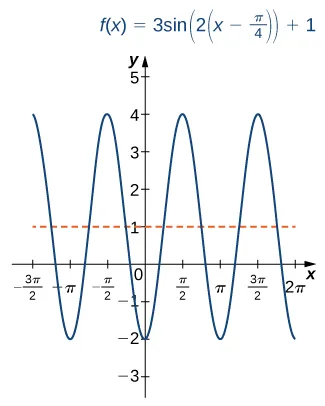
Problem Set 1.3
For the following exercises, convert each angle in degrees to radians. Write the answer as a multiple of \(\pi\).
Problem 1. \(240°\)
Problem 2. \(15°\)
Problem 3. \(-60°\)
Problem 4. \(-225°\)
Problem 5. \(330°\)
Solutions 1–5
Problem 1
Step 1 — Apply the conversion factor: Multiply by \(\frac{\pi}{180°}\).
$$240° \cdot \frac{\pi}{180°} = \frac{240\pi}{180} = \frac{4\pi}{3}.$$Answer: \(\dfrac{4\pi}{3}\) rad.
Problem 2
Step 1 — Apply the conversion factor:
$$15° \cdot \frac{\pi}{180°} = \frac{15\pi}{180} = \frac{\pi}{12}.$$Answer: \(\dfrac{\pi}{12}\) rad.
Problem 3
Step 1 — Apply the conversion factor:
$$-60° \cdot \frac{\pi}{180°} = \frac{-60\pi}{180} = -\frac{\pi}{3}.$$Answer: \(-\dfrac{\pi}{3}\) rad.
Problem 4
Step 1 — Apply the conversion factor:
$$-225° \cdot \frac{\pi}{180°} = \frac{-225\pi}{180} = -\frac{5\pi}{4}.$$Answer: \(-\dfrac{5\pi}{4}\) rad.
Problem 5
Step 1 — Apply the conversion factor:
$$330° \cdot \frac{\pi}{180°} = \frac{330\pi}{180} = \frac{11\pi}{6}.$$Answer: \(\dfrac{11\pi}{6}\) rad.
For the following exercises, convert each angle in radians to degrees.
Problem 6. \(\dfrac{\pi}{2}\) rad
Problem 7. \(\dfrac{7\pi}{6}\) rad
Problem 8. \(\dfrac{11\pi}{2}\) rad
Problem 9. \(-3\pi\) rad
Problem 10. \(\dfrac{5\pi}{12}\) rad
Evaluate the following functional values.
Problem 11. \(\cos\!\left(\dfrac{4\pi}{3}\right)\)
Problem 12. \(\tan\!\left(\dfrac{19\pi}{4}\right)\)
Problem 13. \(\sin\!\left(-\dfrac{3\pi}{4}\right)\)
Problem 14. \(\sec\!\left(\dfrac{\pi}{6}\right)\)
Problem 15. \(\sin\!\left(\dfrac{\pi}{12}\right)\)
Problem 16. \(\cos\!\left(\dfrac{5\pi}{12}\right)\)


Solutions 6–16
Problem 6
Step 1 — Apply the conversion factor: Multiply by \(\frac{180°}{\pi}\).
$$\frac{\pi}{2} \cdot \frac{180°}{\pi} = \frac{180°}{2} = 90°.$$Answer: \(90°\).
Problem 7
Step 1 — Multiply by \(\frac{180°}{\pi}\):
$$\frac{7\pi}{6} \cdot \frac{180°}{\pi} = \frac{7 \cdot 180°}{6} = \frac{1260°}{6} = 210°.$$Answer: \(210°\).
Problem 8
Step 1 — Multiply by \(\frac{180°}{\pi}\):
$$\frac{11\pi}{2} \cdot \frac{180°}{\pi} = \frac{11 \cdot 180°}{2} = \frac{1980°}{2} = 990°.$$Answer: \(990°\).
Problem 9
Step 1 — Multiply by \(\frac{180°}{\pi}\):
$$-3\pi \cdot \frac{180°}{\pi} = -3 \cdot 180° = -540°.$$Answer: \(-540°\).
Problem 10
Step 1 — Multiply by \(\frac{180°}{\pi}\):
$$\frac{5\pi}{12} \cdot \frac{180°}{\pi} = \frac{5 \cdot 180°}{12} = \frac{900°}{12} = 75°.$$Answer: \(75°\).
Problem 11
Step 1 — Locate the angle. \(\frac{4\pi}{3}\) is in the third quadrant. Reference angle: \(\frac{4\pi}{3} - \pi = \frac{\pi}{3}\). In QIII, cosine is negative.
Step 2 — Apply the reference angle: \(\cos\!\left(\frac{\pi}{3}\right) = \frac{1}{2}\), so \(\cos\!\left(\frac{4\pi}{3}\right) = -\frac{1}{2}\).
Answer: \(-\dfrac{1}{2}\).
Problem 12
Step 1 — Reduce the angle. \(\frac{19\pi}{4} = 4\pi + \frac{3\pi}{4}\), so the angle is coterminal with \(\frac{3\pi}{4}\) (QII). Reference angle: \(\pi - \frac{3\pi}{4} = \frac{\pi}{4}\). In QII, tangent is negative.
Step 2 — Compute: \(\tan\!\left(\frac{\pi}{4}\right) = 1\), so \(\tan\!\left(\frac{19\pi}{4}\right) = -1\).
Answer: \(-1\).
Problem 13
Step 1 — Locate the angle. \(-\frac{3\pi}{4}\) is in QIII (negative rotation). Reference angle: \(\frac{3\pi}{4} - \frac{\pi}{2} = \frac{\pi}{4}\)... more directly, the reference angle is \(\frac{\pi}{4}\). In QIII, sine is negative.
Step 2 — Compute: \(\sin\!\left(\frac{\pi}{4}\right) = \frac{\sqrt{2}}{2}\), so \(\sin\!\left(-\frac{3\pi}{4}\right) = -\frac{\sqrt{2}}{2}\).
Answer: \(-\dfrac{\sqrt{2}}{2}\).
Problem 14
Step 1 — Locate the angle. \(\frac{\pi}{6}\) is in QI. \(\cos\!\left(\frac{\pi}{6}\right) = \frac{\sqrt{3}}{2}\).
Step 2 — Apply the reciprocal identity: \(\sec\theta = \frac{1}{\cos\theta}\).
$$\sec\!\left(\frac{\pi}{6}\right) = \frac{1}{\cos(\pi/6)} = \frac{1}{\sqrt{3}/2} = \frac{2}{\sqrt{3}} = \frac{2\sqrt{3}}{3}.$$Answer: \(\dfrac{2\sqrt{3}}{3}\).
Problem 15
Step 1 — Use the half-angle or difference formula. Write \(\frac{\pi}{12} = \frac{\pi}{3} - \frac{\pi}{4}\).
$$\sin\!\left(\frac{\pi}{12}\right) = \sin\!\left(\frac{\pi}{3} - \frac{\pi}{4}\right) = \sin\frac{\pi}{3}\cos\frac{\pi}{4} - \cos\frac{\pi}{3}\sin\frac{\pi}{4}.$$Step 2 — Substitute known values:
$$= \frac{\sqrt{3}}{2}\cdot\frac{\sqrt{2}}{2} - \frac{1}{2}\cdot\frac{\sqrt{2}}{2} = \frac{\sqrt{6}}{4} - \frac{\sqrt{2}}{4} = \frac{\sqrt{6}-\sqrt{2}}{4}.$$Answer: \(\dfrac{\sqrt{6}-\sqrt{2}}{4}\).
Problem 16
Step 1 — Write \(\frac{5\pi}{12} = \frac{\pi}{3} + \frac{\pi}{12}\). More conveniently, use \(\frac{5\pi}{12} = \frac{\pi}{4} + \frac{\pi}{6}\).
$$\cos\!\left(\frac{5\pi}{12}\right) = \cos\!\left(\frac{\pi}{4} + \frac{\pi}{6}\right) = \cos\frac{\pi}{4}\cos\frac{\pi}{6} - \sin\frac{\pi}{4}\sin\frac{\pi}{6}.$$Step 2 — Substitute:
$$= \frac{\sqrt{2}}{2}\cdot\frac{\sqrt{3}}{2} - \frac{\sqrt{2}}{2}\cdot\frac{1}{2} = \frac{\sqrt{6}}{4} - \frac{\sqrt{2}}{4} = \frac{\sqrt{6}-\sqrt{2}}{4}.$$Answer: \(\dfrac{\sqrt{6}-\sqrt{2}}{4}\).
For the following exercises, consider triangle \(ABC\), a right triangle with a right angle at \(C\). a. Find the missing side of the triangle. b. Find the six trigonometric function values for the angle at \(A\). Where necessary, simplify to a fraction or round to three decimal places.
Problem 17. \(a = 4, c = 7\)
Problem 18. \(a = 21, c = 29\)
Problem 19. \(a = 85.3, b = 125.5\)
Problem 20. \(b = 40, c = 41\)
Problem 21. \(a = 84, b = 13\)
Problem 22. \(b = 28, c = 35\)
Solutions 17–22
Problem 17
Step 1 — Find the missing side. Given \(a = 4\) (side opposite \(A\)) and \(c = 7\) (hypotenuse). Use the Pythagorean theorem:
$$b = \sqrt{c^2 - a^2} = \sqrt{49 - 16} = \sqrt{33}.$$Step 2 — Find the six trig values for angle \(A\):
- \(\sin A = \dfrac{a}{c} = \dfrac{4}{7}\) - \(\cos A = \dfrac{b}{c} = \dfrac{\sqrt{33}}{7}\) - \(\tan A = \dfrac{a}{b} = \dfrac{4}{\sqrt{33}} = \dfrac{4\sqrt{33}}{33}\) - \(\csc A = \dfrac{7}{4}\) - \(\sec A = \dfrac{7}{\sqrt{33}} = \dfrac{7\sqrt{33}}{33}\) - \(\cot A = \dfrac{\sqrt{33}}{4}\)
Answer: \(b = \sqrt{33}\approx 5.745\); trig values as above.
Problem 18
Step 1 — Find the missing side. Given \(a = 21\), \(c = 29\) (hypotenuse).
$$b = \sqrt{29^2 - 21^2} = \sqrt{841 - 441} = \sqrt{400} = 20.$$Step 2 — Six trig values for angle \(A\):
- \(\sin A = \dfrac{21}{29}\) - \(\cos A = \dfrac{20}{29}\) - \(\tan A = \dfrac{21}{20}\) - \(\csc A = \dfrac{29}{21}\) - \(\sec A = \dfrac{29}{20}\) - \(\cot A = \dfrac{20}{21}\)
Answer: \(b = 20\); trig values as above.
Problem 19
Step 1 — Find the missing side. Given \(a = 85.3\) (opposite \(A\)) and \(b = 125.5\) (adjacent). The hypotenuse:
$$c = \sqrt{a^2 + b^2} = \sqrt{85.3^2 + 125.5^2} = \sqrt{7276.09 + 15750.25} = \sqrt{23026.34} \approx 151.745.$$Step 2 — Six trig values (rounded to three decimal places):
- \(\sin A = \dfrac{a}{c} \approx \dfrac{85.3}{151.745} \approx 0.562\) - \(\cos A = \dfrac{b}{c} \approx \dfrac{125.5}{151.745} \approx 0.827\) - \(\tan A = \dfrac{a}{b} = \dfrac{85.3}{125.5} \approx 0.680\) - \(\csc A \approx 1.780\) - \(\sec A \approx 1.209\) - \(\cot A \approx 1.471\)
Answer: \(c \approx 151.745\); trig values as above.
Problem 20
Step 1 — Find the missing side. Given \(b = 40\) (adjacent) and \(c = 41\) (hypotenuse).
$$a = \sqrt{41^2 - 40^2} = \sqrt{1681 - 1600} = \sqrt{81} = 9.$$Step 2 — Six trig values for angle \(A\):
- \(\sin A = \dfrac{9}{41}\) - \(\cos A = \dfrac{40}{41}\) - \(\tan A = \dfrac{9}{40}\) - \(\csc A = \dfrac{41}{9}\) - \(\sec A = \dfrac{41}{40}\) - \(\cot A = \dfrac{40}{9}\)
Answer: \(a = 9\); trig values as above.
Problem 21
Step 1 — Find the missing side. Given \(a = 84\) (opposite) and \(b = 13\) (adjacent).
$$c = \sqrt{84^2 + 13^2} = \sqrt{7056 + 169} = \sqrt{7225} = 85.$$Step 2 — Six trig values for angle \(A\):
- \(\sin A = \dfrac{84}{85}\) - \(\cos A = \dfrac{13}{85}\) - \(\tan A = \dfrac{84}{13}\) - \(\csc A = \dfrac{85}{84}\) - \(\sec A = \dfrac{85}{13}\) - \(\cot A = \dfrac{13}{84}\)
Answer: \(c = 85\); trig values as above.
Problem 22
Step 1 — Find the missing side. Given \(b = 28\) (adjacent) and \(c = 35\) (hypotenuse).
$$a = \sqrt{35^2 - 28^2} = \sqrt{1225 - 784} = \sqrt{441} = 21.$$Step 2 — Six trig values for angle \(A\):
- \(\sin A = \dfrac{21}{35} = \dfrac{3}{5}\) - \(\cos A = \dfrac{28}{35} = \dfrac{4}{5}\) - \(\tan A = \dfrac{21}{28} = \dfrac{3}{4}\) - \(\csc A = \dfrac{5}{3}\) - \(\sec A = \dfrac{5}{4}\) - \(\cot A = \dfrac{4}{3}\)
Answer: \(a = 21\); trig values as above.
For the following exercises, \(P\) is a point on the unit circle. a. Find the (exact) missing coordinate value of each point and b. find the values of the six trigonometric functions for the angle \(\theta\) with a terminal side that passes through point \(P\). Rationalize denominators.
Problem 23. \(P\!\left(\dfrac{7}{25}, y\right), y > 0\)
Problem 24. \(P\!\left(\dfrac{-15}{17}, y\right), y < 0\)
Problem 25. \(P\!\left(x, \dfrac{\sqrt{7}}{3}\right), x < 0\)
Problem 26. \(P\!\left(x, \dfrac{-\sqrt{15}}{4}\right), x > 0\)
Solutions 23–26
Problem 23
Step 1 — Find \(y\). Using \(x^2 + y^2 = 1\) (unit circle):
$$y = \sqrt{1 - \left(\frac{7}{25}\right)^2} = \sqrt{1 - \frac{49}{625}} = \sqrt{\frac{576}{625}} = \frac{24}{25} \quad (y > 0).$$Step 2 — Six trig values with \(x = \frac{7}{25}\), \(y = \frac{24}{25}\):
- \(\sin\theta = \dfrac{24}{25}\), \(\cos\theta = \dfrac{7}{25}\), \(\tan\theta = \dfrac{24}{7}\) - \(\csc\theta = \dfrac{25}{24}\), \(\sec\theta = \dfrac{25}{7}\), \(\cot\theta = \dfrac{7}{24}\)
Answer: \(y = \dfrac{24}{25}\); trig values as above.
Problem 24
Step 1 — Find \(y\). With \(x = -\frac{15}{17}\):
$$y = -\sqrt{1 - \frac{225}{289}} = -\sqrt{\frac{64}{289}} = -\frac{8}{17} \quad (y < 0).$$Step 2 — Six trig values (QIII):
- \(\sin\theta = -\dfrac{8}{17}\), \(\cos\theta = -\dfrac{15}{17}\), \(\tan\theta = \dfrac{8}{15}\) - \(\csc\theta = -\dfrac{17}{8}\), \(\sec\theta = -\dfrac{17}{15}\), \(\cot\theta = \dfrac{15}{8}\)
Answer: \(y = -\dfrac{8}{17}\); trig values as above.
Problem 25
Step 1 — Find \(x\). With \(y = \frac{\sqrt{7}}{3}\):
$$x = -\sqrt{1 - \frac{7}{9}} = -\sqrt{\frac{2}{9}} = -\frac{\sqrt{2}}{3} \quad (x < 0).$$Step 2 — Six trig values (QII):
- \(\sin\theta = \dfrac{\sqrt{7}}{3}\), \(\cos\theta = -\dfrac{\sqrt{2}}{3}\), \(\tan\theta = -\dfrac{\sqrt{7}}{\sqrt{2}} = -\dfrac{\sqrt{14}}{2}\) - \(\csc\theta = \dfrac{3}{\sqrt{7}} = \dfrac{3\sqrt{7}}{7}\), \(\sec\theta = -\dfrac{3}{\sqrt{2}} = -\dfrac{3\sqrt{2}}{2}\), \(\cot\theta = -\dfrac{\sqrt{2}}{\sqrt{7}} = -\dfrac{\sqrt{14}}{7}\)
Answer: \(x = -\dfrac{\sqrt{2}}{3}\); trig values as above.
Problem 26
Step 1 — Find \(x\). With \(y = -\frac{\sqrt{15}}{4}\):
$$x = \sqrt{1 - \frac{15}{16}} = \sqrt{\frac{1}{16}} = \frac{1}{4} \quad (x > 0).$$Step 2 — Six trig values (QIV):
- \(\sin\theta = -\dfrac{\sqrt{15}}{4}\), \(\cos\theta = \dfrac{1}{4}\), \(\tan\theta = -\sqrt{15}\) - \(\csc\theta = -\dfrac{4}{\sqrt{15}} = -\dfrac{4\sqrt{15}}{15}\), \(\sec\theta = 4\), \(\cot\theta = -\dfrac{1}{\sqrt{15}} = -\dfrac{\sqrt{15}}{15}\)
Answer: \(x = \dfrac{1}{4}\); trig values as above.
For the following exercises, simplify each expression by writing it in terms of sines and cosines, then simplify. The final answer does not have to be in terms of sine and cosine only.
Problem 27. \(\tan^2 x + \sin x \csc x\)
Problem 28. \(\sec x \sin x \cot x\)
Problem 29. \(\dfrac{\tan^2 x}{\sec^2 x}\)
Problem 30. \(\sec x - \cos x\)
Problem 31. \((1 + \tan\theta)^2 - 2\tan\theta\)
Problem 32. \(\sin x(\csc x - \sin x)\)
Problem 33. \(\dfrac{\cos t}{\sin t} + \dfrac{\sin t}{1 + \cos t}\)
Problem 34. \(\dfrac{1 + \tan^2\alpha}{1 + \cot^2\alpha}\)
Solutions 27–34
Problem 27
Step 1 — Write in terms of sin and cos:
$$\tan^2 x + \sin x\csc x = \frac{\sin^2 x}{\cos^2 x} + \sin x \cdot \frac{1}{\sin x} = \frac{\sin^2 x}{\cos^2 x} + 1.$$Step 2 — Combine using the Pythagorean identity \(\sin^2 x + \cos^2 x = 1\):
$$= \frac{\sin^2 x + \cos^2 x}{\cos^2 x} = \frac{1}{\cos^2 x} = \sec^2 x.$$Answer: \(\sec^2 x\).
Problem 28
Step 1 — Expand:
$$\sec x\sin x\cot x = \frac{1}{\cos x} \cdot \sin x \cdot \frac{\cos x}{\sin x}.$$Step 2 — Cancel:
$$= \frac{\sin x \cos x}{\cos x \sin x} = 1.$$Answer: \(1\).
Problem 29
Step 1 — Write in terms of sin and cos:
$$\frac{\tan^2 x}{\sec^2 x} = \frac{\sin^2 x/\cos^2 x}{1/\cos^2 x} = \frac{\sin^2 x}{\cos^2 x} \cdot \cos^2 x = \sin^2 x.$$Answer: \(\sin^2 x\).
Problem 30
Step 1 — Write in terms of cos:
$$\sec x - \cos x = \frac{1}{\cos x} - \cos x = \frac{1 - \cos^2 x}{\cos x} = \frac{\sin^2 x}{\cos x}.$$Step 2 — Simplify:
$$= \sin x \cdot \frac{\sin x}{\cos x} = \sin x\tan x.$$Answer: \(\sin x\tan x\).
Problem 31
Step 1 — Expand the square:
$$(1 + \tan\theta)^2 - 2\tan\theta = 1 + 2\tan\theta + \tan^2\theta - 2\tan\theta = 1 + \tan^2\theta.$$Step 2 — Apply the Pythagorean identity:
$$= \sec^2\theta.$$Answer: \(\sec^2\theta\).
Problem 32
Step 1 — Expand:
$$\sin x(\csc x - \sin x) = \sin x\csc x - \sin^2 x = 1 - \sin^2 x.$$Step 2 — Apply the Pythagorean identity:
$$= \cos^2 x.$$Answer: \(\cos^2 x\).
Problem 33
Step 1 — Combine fractions using the common denominator \(\sin t(1 + \cos t)\):
$$\frac{\cos t}{\sin t} + \frac{\sin t}{1 + \cos t} = \frac{\cos t(1 + \cos t) + \sin^2 t}{\sin t(1 + \cos t)}.$$Step 2 — Expand the numerator:
$$= \frac{\cos t + \cos^2 t + \sin^2 t}{\sin t(1 + \cos t)} = \frac{\cos t + 1}{\sin t(1 + \cos t)} = \frac{1}{\sin t} = \csc t.$$Answer: \(\csc t\).
Problem 34
Step 1 — Write using Pythagorean identities:
$$\frac{1 + \tan^2\alpha}{1 + \cot^2\alpha} = \frac{\sec^2\alpha}{\csc^2\alpha}.$$Step 2 — Convert to sin/cos:
$$= \frac{1/\cos^2\alpha}{1/\sin^2\alpha} = \frac{\sin^2\alpha}{\cos^2\alpha} = \tan^2\alpha.$$Answer: \(\tan^2\alpha\).
For the following exercises, verify that each equation is an identity.
Problem 35. \(\dfrac{\tan\theta\cot\theta}{\csc\theta} = \sin\theta\)
Problem 36. \(\dfrac{\sec^2\theta}{\tan\theta} = \sec\theta\csc\theta\)
Problem 37. \(\dfrac{\sin t}{\csc t} + \dfrac{\cos t}{\sec t} = 1\)
Problem 38. \(\dfrac{\sin x}{\cos x + 1} + \dfrac{\cos x - 1}{\sin x} = 0\)
Problem 39. \(\cot\gamma + \tan\gamma = \sec\gamma\csc\gamma\)
Problem 40. \(\sin^2\beta + \tan^2\beta + \cos^2\beta = \sec^2\beta\)
Problem 41. \(\dfrac{1}{1 - \sin\alpha} + \dfrac{1}{1 + \sin\alpha} = 2\sec^2\alpha\)
Problem 42. \(\dfrac{\tan\theta - \cot\theta}{\sin\theta\cos\theta} = \sec^2\theta - \csc^2\theta\)
Solutions 35–42
Problem 35
Step 1 — Simplify the left side:
$$\frac{\tan\theta\cot\theta}{\csc\theta} = \frac{(\tan\theta)(1/\tan\theta)}{1/\sin\theta} = \frac{1}{1/\sin\theta} = \sin\theta.$$Answer: Identity verified: both sides equal \(\sin\theta\).
Problem 36
Step 1 — Simplify:
$$\frac{\sec^2\theta}{\tan\theta} = \frac{1/\cos^2\theta}{\sin\theta/\cos\theta} = \frac{1}{\cos^2\theta}\cdot\frac{\cos\theta}{\sin\theta} = \frac{1}{\cos\theta\sin\theta} = \sec\theta\csc\theta.$$Answer: Identity verified.
Problem 37
Step 1 — Simplify each term:
$$\frac{\sin t}{\csc t} + \frac{\cos t}{\sec t} = \frac{\sin t}{1/\sin t} + \frac{\cos t}{1/\cos t} = \sin^2 t + \cos^2 t.$$Step 2 — Apply the Pythagorean identity:
$$= 1.$$Answer: Identity verified.
Problem 38
Step 1 — Combine fractions with common denominator \(\sin x(\cos x + 1)\):
$$\frac{\sin x}{\cos x+1} + \frac{\cos x-1}{\sin x} = \frac{\sin^2 x + (\cos x-1)(\cos x+1)}{\sin x(\cos x+1)}.$$Step 2 — Expand the numerator:
$$\sin^2 x + \cos^2 x - 1 = 1 - 1 = 0.$$Answer: The left side equals \(0\). Identity verified.
Problem 39
Step 1 — Write in terms of sin and cos:
$$\cot\gamma + \tan\gamma = \frac{\cos\gamma}{\sin\gamma} + \frac{\sin\gamma}{\cos\gamma} = \frac{\cos^2\gamma + \sin^2\gamma}{\sin\gamma\cos\gamma} = \frac{1}{\sin\gamma\cos\gamma}.$$Step 2 — Recognize the right side:
$$\sec\gamma\csc\gamma = \frac{1}{\cos\gamma}\cdot\frac{1}{\sin\gamma} = \frac{1}{\sin\gamma\cos\gamma}.$$Answer: Both sides equal \(\dfrac{1}{\sin\gamma\cos\gamma}\). Identity verified.
Problem 40
Step 1 — Group using the Pythagorean identity:
$$\sin^2\beta + \tan^2\beta + \cos^2\beta = (\sin^2\beta + \cos^2\beta) + \tan^2\beta = 1 + \tan^2\beta.$$Step 2 — Apply the second Pythagorean identity:
$$= \sec^2\beta.$$Answer: Identity verified.
Problem 41
Step 1 — Combine fractions:
$$\frac{1}{1-\sin\alpha} + \frac{1}{1+\sin\alpha} = \frac{(1+\sin\alpha)+(1-\sin\alpha)}{(1-\sin\alpha)(1+\sin\alpha)} = \frac{2}{1-\sin^2\alpha}.$$Step 2 — Apply the Pythagorean identity \(1 - \sin^2\alpha = \cos^2\alpha\):
$$= \frac{2}{\cos^2\alpha} = 2\sec^2\alpha.$$Answer: Identity verified.
Problem 42
Step 1 — Simplify the left side:
$$\frac{\tan\theta - \cot\theta}{\sin\theta\cos\theta} = \frac{\frac{\sin\theta}{\cos\theta} - \frac{\cos\theta}{\sin\theta}}{\sin\theta\cos\theta} = \frac{\frac{\sin^2\theta - \cos^2\theta}{\sin\theta\cos\theta}}{\sin\theta\cos\theta} = \frac{\sin^2\theta - \cos^2\theta}{\sin^2\theta\cos^2\theta}.$$Step 2 — Split the fraction:
$$= \frac{\sin^2\theta}{\sin^2\theta\cos^2\theta} - \frac{\cos^2\theta}{\sin^2\theta\cos^2\theta} = \frac{1}{\cos^2\theta} - \frac{1}{\sin^2\theta} = \sec^2\theta - \csc^2\theta.$$Answer: Identity verified.
For the following exercises, solve the trigonometric equations on the interval \(0 \le \theta < 2\pi\).
Problem 43. \(2\sin\theta - 1 = 0\)
Problem 44. \(1 + \cos\theta = \dfrac{1}{2}\)
Problem 45. \(2\tan^2\theta = 2\)
Problem 46. \(4\sin^2\theta - 2 = 0\)
Problem 47. \(\sqrt{3}\cot\theta + 1 = 0\)
Problem 48. \(3\sec\theta - 2\sqrt{3} = 0\)
Problem 49. \(2\cos\theta\sin\theta = \sin\theta\)
Problem 50. \(\csc^2\theta + 2\csc\theta + 1 = 0\)
Solutions 43–50
Problem 43
Step 1 — Solve: \(2\sin\theta = 1 \Rightarrow \sin\theta = \frac{1}{2}\).
Step 2 — Find all solutions on \([0, 2\pi)\). \(\sin\theta = \frac{1}{2}\) at \(\theta = \frac{\pi}{6}\) (QI) and \(\theta = \pi - \frac{\pi}{6} = \frac{5\pi}{6}\) (QII).
Answer: \(\theta = \dfrac{\pi}{6}, \dfrac{5\pi}{6}\).
Problem 44
Step 1 — Solve: \(\cos\theta = \frac{1}{2} - 1 = -\frac{1}{2}\).
Step 2 — Find solutions. \(\cos\theta = -\frac{1}{2}\) at \(\theta = \frac{2\pi}{3}\) (QII) and \(\theta = \frac{4\pi}{3}\) (QIII).
Answer: \(\theta = \dfrac{2\pi}{3}, \dfrac{4\pi}{3}\).
Problem 45
Step 1 — Solve: \(\tan^2\theta = 1 \Rightarrow \tan\theta = \pm 1\).
Step 2 — Find solutions. \(\tan\theta = 1\) at \(\theta = \frac{\pi}{4}, \frac{5\pi}{4}\); \(\tan\theta = -1\) at \(\theta = \frac{3\pi}{4}, \frac{7\pi}{4}\).
Answer: \(\theta = \dfrac{\pi}{4}, \dfrac{3\pi}{4}, \dfrac{5\pi}{4}, \dfrac{7\pi}{4}\).
Problem 46
Step 1 — Solve: \(\sin^2\theta = \frac{1}{2} \Rightarrow \sin\theta = \pm\frac{\sqrt{2}}{2}\).
Step 2 — Find solutions. \(\sin\theta = \frac{\sqrt{2}}{2}\) at \(\frac{\pi}{4}, \frac{3\pi}{4}\); \(\sin\theta = -\frac{\sqrt{2}}{2}\) at \(\frac{5\pi}{4}, \frac{7\pi}{4}\).
Answer: \(\theta = \dfrac{\pi}{4}, \dfrac{3\pi}{4}, \dfrac{5\pi}{4}, \dfrac{7\pi}{4}\).
Problem 47
Step 1 — Solve: \(\cot\theta = -\frac{1}{\sqrt{3}}\), which means \(\tan\theta = -\sqrt{3}\).
Step 2 — Find solutions. \(\tan\theta = -\sqrt{3}\) at \(\theta = \pi - \frac{\pi}{3} = \frac{2\pi}{3}\) (QII) and \(\theta = 2\pi - \frac{\pi}{3} = \frac{5\pi}{3}\) (QIV).
Answer: \(\theta = \dfrac{2\pi}{3}, \dfrac{5\pi}{3}\).
Problem 48
Step 1 — Solve: \(\sec\theta = \frac{2\sqrt{3}}{3}\), so \(\cos\theta = \frac{3}{2\sqrt{3}} = \frac{\sqrt{3}}{2}\).
Step 2 — Find solutions. \(\cos\theta = \frac{\sqrt{3}}{2}\) at \(\theta = \frac{\pi}{6}\) (QI) and \(\theta = \frac{11\pi}{6}\) (QIV).
Answer: \(\theta = \dfrac{\pi}{6}, \dfrac{11\pi}{6}\).
Problem 49
Step 1 — Rearrange and factor:
$$2\cos\theta\sin\theta - \sin\theta = 0 \Rightarrow \sin\theta(2\cos\theta - 1) = 0.$$Step 2 — Solve each factor.
- \(\sin\theta = 0\): \(\theta = 0, \pi\). - \(\cos\theta = \frac{1}{2}\): \(\theta = \frac{\pi}{3}, \frac{5\pi}{3}\).
Answer: \(\theta = 0, \dfrac{\pi}{3}, \pi, \dfrac{5\pi}{3}\).
Problem 50
Step 1 — Factor: Let \(u = \csc\theta\):
$$u^2 + 2u + 1 = (u+1)^2 = 0 \Rightarrow \csc\theta = -1.$$Step 2 — Solve: \(\csc\theta = -1 \Rightarrow \sin\theta = -1 \Rightarrow \theta = \frac{3\pi}{2}\).
Answer: \(\theta = \dfrac{3\pi}{2}\).
For the following exercises, each graph is of the form \(y = A\sin Bx\) or \(y = A\cos Bx,\) where \(B > 0\). Write the equation of the graph.
Problem 51. Write the equation of the graph shown below.


Problem 52. Write the equation of the graph shown below.


Problem 53. Write the equation of the graph shown below.


Problem 54. Write the equation of the graph shown below.


Solutions 51–54
Problem 51
Step 1 — Read off the parameters. The graph starts at \(y = 0\) at \(x = 0\), so it's a sine function. Identify amplitude \(|A|\) from the maximum/minimum values and period from the distance between peaks.
Note: The exact values of \(A\) and \(B\) for problems 1.3.51–1.3.54 depend on the specific graphs in the figures. The approach below applies to each.
Step 2 — General approach:
- Amplitude \(|A|\): Half the total vertical range (max minus min). - Period \(T\): Horizontal distance for one full cycle; then \(B = \frac{2\pi}{T}\). - Choose sine or cosine based on the function's value at \(x = 0\).
For a graph with amplitude 2 and period \(\pi\) starting at \(y = 0\): \(y = 2\sin(2x)\).
Answer: See the figure; apply the method above to read off the specific \(A\) and \(B\) values.
Problem 52
Step 1 — Identify the parameters from the graph. Determine whether the function starts at its maximum (cosine) or at zero (sine) at \(x = 0\).
Step 2 — Apply the amplitude–period formula. Amplitude \(= \frac{\text{max} - \text{min}}{2}\); period \(T\) from the graph gives \(B = \frac{2\pi}{T}\).
Answer: Read \(A\) and \(B\) from Figure 1.3.52 using the method above.
Problem 53
Step 1 — Identify the parameters from the graph. Determine whether the function starts at its maximum (cosine) or at zero (sine) at \(x = 0\).
Step 2 — Apply the amplitude–period formula. Amplitude \(= \frac{\text{max} - \text{min}}{2}\); period \(T\) from the graph gives \(B = \frac{2\pi}{T}\).
Answer: Read \(A\) and \(B\) from Figure 1.3.53 using the method above.
Problem 54
Step 1 — Identify the parameters from the graph. Determine whether the function starts at its maximum (cosine) or at zero (sine) at \(x = 0\).
Step 2 — Apply the amplitude–period formula. Amplitude \(= \frac{\text{max} - \text{min}}{2}\); period \(T\) from the graph gives \(B = \frac{2\pi}{T}\).
Answer: Read \(A\) and \(B\) from Figure 1.3.54 using the method above.
For the following exercises, find a. the amplitude, b. the period, and c. the phase shift with direction for each function.
Problem 55. \(y = \sin\!\left(x - \dfrac{\pi}{4}\right)\)
Problem 56. \(y = 3\cos(2x + 3)\)
Problem 57. \(y = \dfrac{-1}{2}\sin\!\left(\dfrac{1}{4}x\right)\)
Problem 58. \(y = 2\cos\!\left(x - \dfrac{\pi}{3}\right)\)
Problem 59. \(y = -3\sin(\pi x + 2)\)
Problem 60. \(y = 4\cos\!\left(2x - \dfrac{\pi}{2}\right)\)
Problem 61. [T] The diameter of a wheel rolling on the ground is 40 in. If the wheel rotates through an angle of \(120°,\) how many inches does it move? Approximate to the nearest whole inch.
Problem 62. [T] Find the length of the arc intercepted by central angle \(\theta\) in a circle of radius \(r\). Round to the nearest hundredth.
a) \(r = 12.8\) cm, \(\theta = \dfrac{5\pi}{6}\) rad
b) \(r = 4.378\) cm, \(\theta = \dfrac{7\pi}{6}\) rad
c) \(r = 0.964\) cm, \(\theta = 50°\)
d) \(r = 8.55\) cm, \(\theta = 325°\)
Problem 63. [T] As a point \(P\) moves around a circle, the measure of the angle changes. The measure of how fast the angle is changing is called angular speed, \(\omega,\) and is given by \(\omega = \theta/t,\) where \(\theta\) is in radians and \(t\) is time. Find the angular speed for the given data. Round to the nearest thousandth.
a) \(\theta = \dfrac{7\pi}{4}\) rad, \(t = 10\) sec
b) \(\theta = \dfrac{3\pi}{5}\) rad, \(t = 8\) sec
c) \(\theta = \dfrac{2\pi}{9}\) rad, \(t = 1\) min
d) \(\theta = 23.76\) rad, \(t = 14\) min
Problem 64. [T] A total of 250,000 m² of land is needed to build a nuclear power plant. Suppose it is decided that the area on which the power plant is to be built should be circular.
a) Find the radius of the circular land area.
b) If the land area is to form a \(45°\) sector of a circle instead of a whole circle, find the length of the curved side.
Problem 65. [T] The area of an isosceles triangle with equal sides of length \(x\) is \(\dfrac{1}{2}x^2\sin\theta,\) where \(\theta\) is the angle formed by the two sides. Find the area of an isosceles triangle with equal sides of length 8 in. and angle \(\theta = 5\pi/12\) rad.
Problem 66. [T] A particle travels in a circular path at a constant angular speed \(\omega.\) The angular speed is modeled by the function \(\omega = 9|\cos(\pi t - \pi/12)|.\) Determine the angular speed at \(t = 9\) sec.
Problem 67. [T] An alternating current for outlets in a home has voltage given by the function \(V(t) = 150\cos(368t),\) where \(V\) is the voltage in volts at time \(t\) in seconds.
a) Find the period of the function and interpret its meaning.
b) Determine the number of periods that occur when 1 sec has passed.
Problem 68. [T] The number of hours of daylight in a northeast city is modeled by the function
$$N(t) = 12 + 3\sin\!\left[\frac{2\pi}{365}(t - 79)\right],$$where \(t\) is the number of days after January 1.
a) Find the amplitude and period.
b) Determine the number of hours of daylight on the longest day of the year.
c) Determine the number of hours of daylight on the shortest day of the year.
d) Determine the number of hours of daylight 90 days after January 1.
e) Sketch the graph of the function for one period starting on January 1.
Problem 69. [T] Suppose that \(T = 50 + 10\sin\!\left[\dfrac{\pi}{12}(t - 8)\right]\) is a mathematical model of the temperature (in degrees Fahrenheit) at \(t\) hours after midnight on a certain day of the week.
a) Determine the amplitude and period.
b) Find the temperature 7 hours after midnight.
c) At what time does \(T = 60°\)?
d) Sketch the graph of \(T\) over \(0 \le t \le 24.\)
Problem 70. [T] The function \(H(t) = 8\sin\!\left(\dfrac{\pi}{6}t\right)\) models the height \(H\) (in feet) of the tide \(t\) hours after midnight. Assume that \(t = 0\) is midnight.
a) Find the amplitude and period.
b) Graph the function over one period.
c) What is the height of the tide at 4:30 a.m.?
Solutions 55–70
Problem 55
Step 1 — Identify parameters from \(y = \sin\!\left(x - \frac{\pi}{4}\right)\).
- \(A = 1\), \(B = 1\), phase shift \(\alpha = \frac{\pi}{4}\).
a) Amplitude: \(|A| = 1\).
b) Period: \(\dfrac{2\pi}{B} = \dfrac{2\pi}{1} = 2\pi\).
c) Phase shift: \(\frac{\pi}{4}\) to the right.
Answer: Amplitude = 1, Period = \(2\pi\), Phase shift = \(\dfrac{\pi}{4}\) right.
Problem 56
Step 1 — Rewrite in standard form. \(y = 3\cos(2x + 3) = 3\cos\!\left(2\!\left(x + \frac{3}{2}\right)\right)\).
a) Amplitude: \(|A| = 3\).
b) Period: \(\dfrac{2\pi}{2} = \pi\).
c) Phase shift: \(\frac{3}{2}\) units to the left (since \(\alpha = -\frac{3}{2}\)).
Answer: Amplitude = 3, Period = \(\pi\), Phase shift = \(\dfrac{3}{2}\) left.
Problem 57
Step 1 — Identify parameters from \(y = -\frac{1}{2}\sin\!\left(\frac{1}{4}x\right)\).
a) Amplitude: \(|A| = \frac{1}{2}\).
b) Period: \(\dfrac{2\pi}{1/4} = 8\pi\).
c) Phase shift: None (\(\alpha = 0\)).
Answer: Amplitude = \(\dfrac{1}{2}\), Period = \(8\pi\), No phase shift.
Problem 58
Step 1 — Identify parameters from \(y = 2\cos\!\left(x - \frac{\pi}{3}\right)\).
a) Amplitude: \(2\).
b) Period: \(2\pi\).
c) Phase shift: \(\dfrac{\pi}{3}\) to the right.
Answer: Amplitude = 2, Period = \(2\pi\), Phase shift = \(\dfrac{\pi}{3}\) right.
Problem 59
Step 1 — Rewrite in standard form. \(y = -3\sin(\pi x + 2) = -3\sin\!\left(\pi\!\left(x + \frac{2}{\pi}\right)\right)\).
a) Amplitude: \(|-3| = 3\).
b) Period: \(\dfrac{2\pi}{\pi} = 2\).
c) Phase shift: \(\dfrac{2}{\pi}\) to the left.
Answer: Amplitude = 3, Period = 2, Phase shift = \(\dfrac{2}{\pi}\) left.
Problem 60
Step 1 — Rewrite. \(y = 4\cos\!\left(2x - \frac{\pi}{2}\right) = 4\cos\!\left(2\!\left(x - \frac{\pi}{4}\right)\right)\).
a) Amplitude: \(4\).
b) Period: \(\dfrac{2\pi}{2} = \pi\).
c) Phase shift: \(\dfrac{\pi}{4}\) to the right.
Answer: Amplitude = 4, Period = \(\pi\), Phase shift = \(\dfrac{\pi}{4}\) right.
Problem 61
Step 1 — Convert the angle. \(120° = \frac{2\pi}{3}\) rad.
Step 2 — Find the arc length. The wheel has diameter 40 in, so radius \(r = 20\) in. Arc length \(s = r\theta\):
$$s = 20 \cdot \frac{2\pi}{3} = \frac{40\pi}{3} \approx 41.888 \approx 42 \text{ in.}$$Note on the calculator: compute \(40\pi/3\) and round to the nearest whole number.
Answer: The wheel moves approximately 42 inches.
Problem 62
Step 1 — Apply the arc length formula \(s = r\theta\). Convert degrees to radians where needed (\(\theta_{\text{rad}} = \theta_{\text{deg}} \cdot \pi/180\)).
a) \(s = 12.8 \cdot \frac{5\pi}{6} = \frac{64\pi}{6} \approx \frac{201.06}{6} \approx 33.51\) cm.
b) \(s = 4.378 \cdot \frac{7\pi}{6} \approx 4.378 \cdot 3.6652 \approx 16.05\) cm.
c) \(\theta = 50° \cdot \frac{\pi}{180} \approx 0.8727\) rad; \(s = 0.964 \cdot 0.8727 \approx 0.84\) cm.
d) \(\theta = 325° \cdot \frac{\pi}{180} \approx 5.6723\) rad; \(s = 8.55 \cdot 5.6723 \approx 48.50\) cm.
Answer: a) \(\approx 33.51\) cm, b) \(\approx 16.05\) cm, c) \(\approx 0.84\) cm, d) \(\approx 48.50\) cm.
Problem 63
Step 1 — Apply \(\omega = \theta/t\). Convert time units to match \(\theta\) (radians).
a) \(\omega = \frac{7\pi/4}{10} = \frac{7\pi}{40} \approx 0.550\) rad/sec.
b) \(\omega = \frac{3\pi/5}{8} = \frac{3\pi}{40} \approx 0.236\) rad/sec.
c) \(t = 1\) min = 60 sec; \(\omega = \frac{2\pi/9}{60} = \frac{2\pi}{540} = \frac{\pi}{270} \approx 0.012\) rad/sec.
d) \(t = 14\) min = 840 sec; \(\omega = \frac{23.76}{840} \approx 0.028\) rad/sec.
Answer: a) \(\approx 0.550\) rad/sec, b) \(\approx 0.236\) rad/sec, c) \(\approx 0.012\) rad/sec, d) \(\approx 0.028\) rad/sec.
Problem 64
Step 1 — Part a: Find the radius. Area of a full circle: \(\pi r^2 = 250{,}000\) m².
$$r = \sqrt{\frac{250000}{\pi}} \approx \sqrt{79577.5} \approx 282.1 \text{ m}.$$Step 2 — Part b: Sector arc length. A \(45°\) sector has central angle \(\theta = \frac{\pi}{4}\) rad. Arc length:
$$s = r\theta \approx 282.1 \cdot \frac{\pi}{4} \approx 282.1 \cdot 0.7854 \approx 221.6 \text{ m}.$$Answer: a) \(r \approx 282.1\) m; b) Arc length \(\approx 221.6\) m.
Problem 65
Step 1 — Apply the area formula. \(A = \frac{1}{2}x^2\sin\theta\) with \(x = 8\) in and \(\theta = \frac{5\pi}{12}\) rad.
$$A = \frac{1}{2}(8)^2\sin\!\left(\frac{5\pi}{12}\right) = 32\sin\!\left(\frac{5\pi}{12}\right).$$Step 2 — Evaluate. \(\frac{5\pi}{12} = 75°\), so \(\sin(75°) = \frac{\sqrt{6}+\sqrt{2}}{4} \approx 0.9659\).
$$A \approx 32 \cdot 0.9659 \approx 30.91 \text{ in}^2.$$Answer: \(A \approx 30.91\) in².
Problem 66
Step 1 — Plug in \(t = 9\). \(\omega = 9|\cos(\pi\cdot 9 - \pi/12)| = 9|\cos(9\pi - \pi/12)|\).
Step 2 — Simplify the angle. \(9\pi - \frac{\pi}{12} = \frac{108\pi - \pi}{12} = \frac{107\pi}{12}\). Since \(\cos\) has period \(2\pi\), reduce: \(\frac{107\pi}{12} = 8\pi + \frac{11\pi}{12}\). So \(\cos\!\left(\frac{107\pi}{12}\right) = \cos\!\left(\frac{11\pi}{12}\right)\).
\(\frac{11\pi}{12} = \pi - \frac{\pi}{12}\), so \(\cos\!\left(\frac{11\pi}{12}\right) = -\cos\!\left(\frac{\pi}{12}\right) \approx -0.9659\).
$$\omega = 9 \cdot |-0.9659| \approx 8.693 \text{ rad/sec.}$$Answer: \(\omega \approx 8.693\) rad/sec.
Problem 67
Step 1 — Identify the period. \(V(t) = 150\cos(368t)\) has \(B = 368\), so:
$$T = \frac{2\pi}{368} = \frac{\pi}{184} \approx 0.01707 \text{ sec.}$$Interpretation: The voltage completes one full oscillation (one AC cycle) approximately every 0.017 seconds.
Step 2 — Count cycles per second. Number of periods in 1 sec:
$$N = \frac{1}{T} = \frac{368}{2\pi} \approx 58.6 \text{ cycles/sec.}$$Note on the calculator: compute \(368/(2\pi)\) to get the frequency in Hertz.
Answer: Period \(\approx 0.01707\) sec (approximately 58.6 oscillations per second — close to 60 Hz AC current).
Problem 68
Step 1 — Read the parameters. \(N(t) = 12 + 3\sin\!\left[\frac{2\pi}{365}(t-79)\right]\).
a) Amplitude: \(3\) (daylight varies 3 hours above/below the 12-hour mean). Period: \(\frac{2\pi}{2\pi/365} = 365\) days (one year).
b) Longest day: Maximum occurs when \(\sin = 1\): \(N_{\max} = 12 + 3 = 15\) hours.
c) Shortest day: Minimum occurs when \(\sin = -1\): \(N_{\min} = 12 - 3 = 9\) hours.
d) Day 90: \(N(90) = 12 + 3\sin\!\left[\frac{2\pi}{365}(11)\right] = 12 + 3\sin(0.1893) \approx 12 + 3(0.1883) \approx 12.565\) hours.
e) Sketch: A sine curve centered at \(N = 12\), amplitude 3, period 365 days, shifted right 79 days (maximum near day 79 + 91 = day 170, approximately June 21).
Note on the calculator: Graph \(y = 12 + 3\sin(2\pi(x-79)/365)\) for \(0 \le x \le 365\).
Answer: a) Amplitude = 3, Period = 365 days; b) 15 hours; c) 9 hours; d) ≈ 12.56 hours.
Problem 69
Step 1 — Read the parameters. \(T = 50 + 10\sin\!\left[\frac{\pi}{12}(t-8)\right]\).
a) Amplitude: \(10\)°F. Period: \(\frac{2\pi}{\pi/12} = 24\) hours.
b) Temperature at \(t = 7\):
$$T(7) = 50 + 10\sin\!\left[\frac{\pi}{12}(7-8)\right] = 50 + 10\sin\!\left(-\frac{\pi}{12}\right) \approx 50 + 10(-0.2588) \approx 47.4°\text{F}.$$c) When does \(T = 60\)?
$$60 = 50 + 10\sin\!\left[\frac{\pi}{12}(t-8)\right] \Rightarrow \sin\!\left[\frac{\pi}{12}(t-8)\right] = 1 \Rightarrow \frac{\pi}{12}(t-8) = \frac{\pi}{2} \Rightarrow t = 14.$$So \(T = 60°\) at \(t = 14\) (2 p.m.).
d) Sketch: A sine curve centered at \(T = 50\), amplitude 10, period 24, shifted right by 8. Maximum at \(t = 14\) (2 p.m.), minimum at \(t = 2\) (2 a.m.).
Answer: a) Amplitude = 10°F, Period = 24 hours; b) ≈ 47.4°F; c) \(t = 14\) (2:00 p.m.).
Problem 70
Step 1 — Read the parameters. \(H(t) = 8\sin\!\left(\frac{\pi}{6}t\right)\).
a) Amplitude: \(8\) ft. Period: \(\frac{2\pi}{\pi/6} = 12\) hours.
b) Sketch: A sine curve on \([0, 12]\), starting at 0 (midnight), rising to a peak of 8 ft at \(t = 3\) (3:00 a.m.), back to 0 at \(t = 6\), down to \(-8\) ft at \(t = 9\), returning to 0 at \(t = 12\).
c) Height at 4:30 a.m.: Convert to decimal hours: \(t = 4.5\).
$$H(4.5) = 8\sin\!\left(\frac{\pi}{6} \cdot 4.5\right) = 8\sin\!\left(\frac{3\pi}{4}\right) = 8 \cdot \frac{\sqrt{2}}{2} = 4\sqrt{2} \approx 5.657 \text{ ft.}$$Answer: a) Amplitude = 8 ft, Period = 12 hours; c) \(H \approx 5.657\) ft (or exactly \(4\sqrt{2}\) ft).
Key Terms
radians — a unit of angle measure equal to the arc length on a unit circle; \(180° = \pi\) rad.
trigonometric functions — the six functions (sine, cosine, tangent, cosecant, secant, cotangent) defined via the unit circle and encoding ratios of side lengths in a right triangle.
trigonometric identity — an equation involving trigonometric functions that is true for all angles for which both sides are defined.
periodic functions — functions that repeat their values on a regular interval; the period is the length of the shortest such interval.
1.4 Inverse Functions
Learning Objectives
- Determine the conditions for when a function has an inverse.
- Use the horizontal line test to recognize when a function is one-to-one.
- Find the inverse of a given function.
- Draw the graph of an inverse function.
- Evaluate inverse trigonometric functions.
Think of a function as a machine: you drop in an input, and it produces exactly one output. An inverse function reverses that process — it takes the output and hands back the original input. But not every function can be reversed cleanly. In this section we figure out exactly when a function has an inverse, how to find it, how to draw it, and how to apply the idea to the six trigonometric functions — giving us a toolkit of six new inverse trig functions that are indispensable in calculus.
1.4.1 Existence of an Inverse Function
Given a function \(f\) with domain \(D\) and range \(R\), its inverse function (if it exists) is the function \(f^{-1}\) with domain \(R\) and range \(D\) such that \(f^{-1}(y) = x\) if \(f(x) = y\). In other words, for a function \(f\) and its inverse \(f^{-1}\),
$$ f^{-1}(f(x)) = x \quad \text{for all } x \text{ in } D, \quad \text{and} \quad f(f^{-1}(y)) = y \quad \text{for all } y \text{ in } R. $$Note that \(f^{-1}\) is read as "f inverse." The \(-1\) is NOT an exponent: \(f^{-1}(x) \ne \frac{1}{f(x)}\). Figure 1.37 shows the domain-and-range relationship between \(f\) and \(f^{-1}\).


Figure 1.37 — Given a function \(f\) and its inverse \(f^{-1}\), \(f^{-1}(y) = x\) if and only if \(f(x) = y\). The range of \(f\) becomes the domain of \(f^{-1}\) and the domain of \(f\) becomes the range of \(f^{-1}\).
We say \(f\) is a one-to-one function if \(f(x_1) \ne f(x_2)\) whenever \(x_1 \ne x_2\).
"One-to-one" means no two guests (inputs) get the same seat (output). If two people try to share a seat, we cannot reverse the seating chart and tell just from the seat which person was there. One-to-one functions are precisely the functions whose seating chart CAN be reversed uniquely.
A quick graphical check exists: the horizontal line test. If every horizontal line crosses the graph at most once, the function is one-to-one. (Compare this to the vertical line test, which checks whether a curve is a function at all. The horizontal line test checks whether that function is one-to-one.)
Rule: Horizontal Line Test
A function \(f\) is one-to-one if and only if every horizontal line intersects the graph of \(f\) no more than once.
Figure 1.38 — (a) The function \(f(x) = x^2\) is not one-to-one because it fails the horizontal line test. (b) The function \(f(x) = x^3\) is one-to-one because it passes the horizontal line test.
We start with a concrete example. Consider \(f(x) = x^3 + 4\). If we get an output \(y\), we can solve \(y = x^3 + 4\) for \(x\): subtract 4, then take the cube root to get \(x = \sqrt[3]{y - 4}\). That formula defines \(x\) as a function of \(y\), and it perfectly "undoes" whatever \(f\) did. We call this the inverse function and write \(f^{-1}(y) = \sqrt[3]{y - 4}\). Notice \(f^{-1}(f(x)) = \sqrt[3]{(x^3 + 4) - 4} = x\) — the composition brings us right back to where we started.
Not every function can be undone this cleanly. Try \(f(x) = x^2\): solving \(y = x^2\) gives \(x = \pm\sqrt{y}\). Two answers! For any positive \(y\) there are two inputs (\(\sqrt{y}\) and \(-\sqrt{y}\)) that produce it, so we cannot point to a single "original" input. The culprit is that \(f(x) = x^2\) sends two different inputs to the same output. Functions that avoid this problem — where each output came from exactly one input — are called one-to-one functions.
Is the function \(f\) graphed below one-to-one?


Solution
Apply the horizontal line test. The function \(f(x) = x^3 - x\) is a cubic with a local max and a local min, which means some horizontal lines cross it three times. Therefore, \(f\) is not one-to-one on its natural domain.
Answer: Not one-to-one.
For each of the following functions, use the horizontal line test to determine whether it is one-to-one.
- 
- 
Solution
- Since the horizontal line \(y = n\) for any integer \(n \ge 0\) intersects the graph more than once, this function is not one-to-one.


- Since every horizontal line intersects the graph at most once, this function is one-to-one.


1.4.2 Finding a Function's Inverse
Because a one-to-one function sends each input to a unique output, we can always work backwards: given any output \(y\) in the range, there is exactly one input \(x\) in the domain with \(f(x) = y\). To find that input algebraically:
Problem-Solving Strategy: Finding an Inverse Function
Step 1. Write the function as \(y = f(x)\).
Step 2. Solve the equation for \(x\) in terms of \(y\). The result is \(x = f^{-1}(y)\).
Step 3. Interchange \(x\) and \(y\) so the inverse is written as \(y = f^{-1}(x)\).
Step 4. State the domain and range of \(f^{-1}\): the domain of \(f^{-1}\) is the range of \(f\), and the range of \(f^{-1}\) is the domain of \(f\). Verify by checking \(f^{-1}(f(x)) = x\).
Find the inverse of \(f(x) = \dfrac{3x}{x - 2}\). State the domain and range of the inverse function.
Solution
Step 1. Set \(y = \dfrac{3x}{x - 2}\).
Step 2. Solve for \(x\): $$ y(x - 2) = 3x \implies yx - 2y = 3x \implies yx - 3x = 2y \implies x(y - 3) = 2y \implies x = \frac{2y}{y - 3}. $$
Step 3. Interchange \(x\) and \(y\): $$ f^{-1}(x) = \frac{2x}{x - 3}. $$
Step 4. The original function \(f\) has domain \(\{x \mid x \ne 2\}\) and range \(\{y \mid y \ne 3\}\). Therefore \(f^{-1}\) has domain \(\{x \mid x \ne 3\}\) and range \(\{y \mid y \ne 2\}\).
Answer: \(f^{-1}(x) = \dfrac{2x}{x - 3}\), domain \(x \ne 3\), range \(y \ne 2\).
Find the inverse for \(f(x) = 3x - 4\). State the domain and range of the inverse function. Verify that \(f^{-1}(f(x)) = x\).
Solution
Step 1. Write \(y = 3x - 4\).
Step 2. Solve for \(x\): $$ 3x = y + 4 \implies x = \tfrac{1}{3}y + \tfrac{4}{3}. $$
Step 3. Interchange \(x\) and \(y\): $$ f^{-1}(x) = \tfrac{1}{3}x + \tfrac{4}{3}. $$
Step 4. Since the domain of \(f\) is \((-\infty, \infty)\), the range of \(f^{-1}\) is \((-\infty, \infty)\). Since the range of \(f\) is \((-\infty, \infty)\), the domain of \(f^{-1}\) is \((-\infty, \infty)\).
Verification: $$ f^{-1}(f(x)) = f^{-1}(3x - 4) = \tfrac{1}{3}(3x - 4) + \tfrac{4}{3} = x - \tfrac{4}{3} + \tfrac{4}{3} = x. \checkmark $$
Answer: \(f^{-1}(x) = \dfrac{1}{3}x + \dfrac{4}{3}\), with domain and range both \((-\infty, \infty)\).
Graphing Inverse Functions
The graphs of \(f\) and \(f^{-1}\) are mirror images of each other across the line \(y = x\). Here is why: if the point \((a, b)\) is on the graph of \(f\) (meaning \(b = f(a)\)), then \(a = f^{-1}(b)\), so the point \((b, a)\) is on the graph of \(f^{-1}\). Swapping \(x\)- and \(y\)-coordinates is exactly the reflection over \(y = x\).
Figure 1.39 — (a) The graph of this function \(f\) shows point \((a, b)\) on the graph of \(f\). (b) Since \((a, b)\) is on the graph of \(f\), the point \((b, a)\) is on the graph of \(f^{-1}\). The graph of \(f^{-1}\) is a reflection of the graph of \(f\) about the line \(y = x\).
Sketch the graph of \(f(x) = 2x + 3\) and the graph of its inverse using the symmetry property of inverse functions.
Solution
First find \(f^{-1}\): solving \(y = 2x + 3\) for \(x\) gives \(x = \dfrac{y - 3}{2}\), so \(f^{-1}(x) = \dfrac{x - 3}{2}\).
The graph of \(f\) is a line with slope 2 and \(y\)-intercept 3. The graph of \(f^{-1}\) is a line with slope \(\dfrac{1}{2}\) and \(y\)-intercept \(-\dfrac{3}{2}\). Both graphs are reflections of each other across the line \(y = x\).
Answer: \(f^{-1}(x) = \dfrac{x - 3}{2}\); the two lines are mirror images across \(y = x\).
For the graph of \(f\) shown below, sketch a graph of \(f^{-1}\) by using symmetry about the line \(y = x\). Identify the domain and range of \(f^{-1}\).


Answer: Domain of \(f^{-1}\) is \([0, \infty)\); range of \(f^{-1}\) is \([-2, \infty)\).
Restricting Domains
Since \(f(x) = x^2\) fails the horizontal line test, it has no inverse on all of \((-\infty, \infty)\). But we can salvage the situation by shrinking the domain. If we restrict to \([0, \infty)\), then \(g(x) = x^2\) on that subdomain is one-to-one, and its inverse is \(g^{-1}(x) = \sqrt{x}\). Alternatively, restricting to \((-\infty, 0]\) gives \(h(x) = x^2\) which is also one-to-one, with inverse \(h^{-1}(x) = -\sqrt{x}\).
A restricted domain is a subset of the natural domain chosen specifically to make a function one-to-one so that an inverse exists.
![Figure 1.40 — (a) For g(x) = x^2 restricted to [0, ∞), g^-1(x) = sqrt(x). (b) For h(x) = x^2 restricted to (-∞, 0], h^-1(x) = -sqrt(x).](../images/figure_1.40_light.png?v=20260612)

Figure 1.40 — (a) For \(g(x) = x^2\) restricted to \([0, \infty)\), \(g^{-1}(x) = \sqrt{x}\). (b) For \(h(x) = x^2\) restricted to \((-\infty, 0]\), \(h^{-1}(x) = -\sqrt{x}\).
Consider \(f(x) = \dfrac{1}{x^2}\) restricted to the domain \((-\infty, 0)\). Verify that \(f\) is one-to-one on this domain. Determine the domain and range of the inverse of \(f\) and find a formula for \(f^{-1}\).
Solution
One-to-one check: On \((-\infty, 0)\), as \(x\) decreases from 0 to \(-\infty\), \(f(x) = 1/x^2\) strictly decreases from \(+\infty\) to 0. A strictly monotone function is always one-to-one.
Range of \(f\): \(f(x) = 1/x^2 > 0\) for all \(x \ne 0\), and the range on \((-\infty, 0)\) is \((0, \infty)\).
Inverse formula: Solve \(y = 1/x^2\) for \(x\) (with \(x < 0\)): $$ x^2 = \frac{1}{y} \implies x = \pm\frac{1}{\sqrt{y}}. $$ Since \(x < 0\), we take \(x = -\dfrac{1}{\sqrt{y}}\). Swapping \(x\) and \(y\): $$ f^{-1}(x) = -\frac{1}{\sqrt{x}}. $$
- Domain of \(f^{-1}\): \((0, \infty)\) - Range of \(f^{-1}\): \((-\infty, 0)\)
Answer: \(f^{-1}(x) = -\dfrac{1}{\sqrt{x}}\), domain \((0, \infty)\), range \((-\infty, 0)\).
Consider \(f(x) = (x + 1)^2\).
- Sketch the graph of \(f\) and use the horizontal line test to show that \(f\) is not one-to-one.
- Show that \(f\) is one-to-one on the restricted domain \([-1, \infty)\). Determine the domain and range for the inverse of \(f\) on this restricted domain and find a formula for \(f^{-1}\).
Solution
Part 1. The graph of \(f(x) = (x+1)^2\) is the parabola \(y = x^2\) shifted left by 1. Since horizontal lines above the vertex cross it twice, \(f\) is not one-to-one.


Part 2. On \([-1, \infty)\), the parabola only extends to the right of its vertex at \((-1, 0)\). Every horizontal line above 0 hits this half-parabola exactly once — it passes the horizontal line test, so \(f\) is one-to-one on this restricted domain.


The domain and range of \(f^{-1}\) are the range and domain of \(f\), respectively. On \([-1, \infty)\), the range of \(f\) is \([0, \infty)\). Therefore: - Domain of \(f^{-1}\): \([0, \infty)\) - Range of \(f^{-1}\): \([-1, \infty)\)
To find the formula, solve \(y = (x+1)^2\) for \(x\): $$ x + 1 = \pm\sqrt{y} \implies x = -1 \pm \sqrt{y}. $$ Since we restricted to \(x \ge -1\), we need the \(+\) sign: \(x = -1 + \sqrt{y}\). Swapping \(x\) and \(y\): $$ f^{-1}(x) = -1 + \sqrt{x}. $$
Answer: \(f^{-1}(x) = -1 + \sqrt{x}\), with domain \([0, \infty)\) and range \([-1, \infty)\).
1.4.3 Inverse Trigonometric Functions
The inverse sine function, denoted \(\sin^{-1}\) or \(\arcsin\), and the inverse cosine function, denoted \(\cos^{-1}\) or \(\arccos\), are defined on the domain \(D = \{x \mid -1 \le x \le 1\}\) as follows:
$$ \begin{array}{l} \sin^{-1}(x) = y \quad \text{if and only if} \quad \sin(y) = x \quad \text{and} \quad -\dfrac{\pi}{2} \le y \le \dfrac{\pi}{2}; \\[6pt] \cos^{-1}(x) = y \quad \text{if and only if} \quad \cos(y) = x \quad \text{and} \quad 0 \le y \le \pi. \end{array} $$The inverse tangent function, denoted \(\tan^{-1}\) or \(\arctan\), and the inverse cotangent function, denoted \(\cot^{-1}\) or \(\text{arccot}\), are defined on the domain \(D = \{x \mid -\infty < x < \infty\}\) as follows:
$$ \begin{array}{l} \tan^{-1}(x) = y \quad \text{if and only if} \quad \tan(y) = x \quad \text{and} \quad -\dfrac{\pi}{2} < y < \dfrac{\pi}{2}; \\[6pt] \cot^{-1}(x) = y \quad \text{if and only if} \quad \cot(y) = x \quad \text{and} \quad 0 < y < \pi. \end{array} $$The inverse cosecant function, denoted \(\csc^{-1}\) or \(\text{arccsc}\), and the inverse secant function, denoted \(\sec^{-1}\) or \(\text{arcsec}\), are defined on the domain \(D = \{x \mid |x| \ge 1\}\) as follows:
$$ \begin{array}{l} \csc^{-1}(x) = y \quad \text{if and only if} \quad \csc(y) = x \quad \text{and} \quad -\dfrac{\pi}{2} \le y \le \dfrac{\pi}{2}, \; y \ne 0; \\[6pt] \sec^{-1}(x) = y \quad \text{if and only if} \quad \sec(y) = x \quad \text{and} \quad 0 \le y \le \pi, \; y \ne \dfrac{\pi}{2}. \end{array} $$The graphs of all six inverse trigonometric functions are reflections of the corresponding restricted trig functions across the line \(y = x\) (Figure 1.41).
Figure 1.41 — The graph of each of the inverse trigonometric functions is a reflection about the line \(y = x\) of the corresponding restricted trigonometric function.
When you evaluate an inverse trig function, the output is always an angle (in radians, unless stated otherwise), and that angle must lie within the specified restricted domain. Two common pitfalls to remember:
- \(\sin^{-1}(\sin(\pi)) \ne \pi\). Here, \(\sin(\pi) = 0\) and \(\sin^{-1}(0) = 0 \ne \pi\), because \(\pi\) is outside the range \(\left[-\dfrac{\pi}{2}, \dfrac{\pi}{2}\right]\) of \(\sin^{-1}\).
- \(\sin(\sin^{-1}(y)) = y\) for all \(y \in [-1, 1]\). This one works cleanly because the output of \(\sin^{-1}\) is automatically in the domain of \(\sin\).
In summary:
$$ \sin(\sin^{-1} y) = y \quad \text{if } -1 \le y \le 1, $$ $$ \sin^{-1}(\sin x) = x \quad \text{if } -\frac{\pi}{2} \le x \le \frac{\pi}{2}, $$ $$ \cos(\cos^{-1} y) = y \quad \text{if } -1 \le y \le 1, $$ $$ \cos^{-1}(\cos x) = x \quad \text{if } 0 \le x \le \pi. $$Why does choosing the "right" restricted domain matter? Different choices of restricted domain give different inverse functions, even though the values agree on the overlap. The conventions below — \(\left[-\frac{\pi}{2}, \frac{\pi}{2}\right]\) for sine and arctangent, \([0, \pi]\) for cosine and arccotangent — are universal across textbooks, calculators, and computer algebra systems. Learning them once means your answers will always match everyone else's.
Similar identities hold for the other four pairs. The key rule: the outer-undoes-inner identity holds only when the input is in the range of the inner inverse function.
The six trigonometric functions are periodic — they repeat the same output values over and over — so each one is decidedly not one-to-one on its full domain. The solution is to restrict each trig function to a carefully chosen interval where it is one-to-one, and then define its inverse on that piece.
Consider the sine function (see Figure 1.34 below). On the interval \(\left[-\dfrac{\pi}{2}, \dfrac{\pi}{2}\right]\), sine sweeps through every value in \([-1, 1]\) exactly once — it passes the horizontal line test. We restrict to this interval by convention, and that gives us the inverse sine function.
Evaluate \(\cos^{-1}\!\left(-\dfrac{\sqrt{3}}{2}\right)\).
Solution
We need \(\theta \in [0, \pi]\) such that \(\cos\theta = -\dfrac{\sqrt{3}}{2}\). That angle is \(\theta = \dfrac{5\pi}{6}\) (in the second quadrant, where cosine is negative).
$$\cos^{-1}\!\left(-\frac{\sqrt{3}}{2}\right) = \frac{5\pi}{6}.$$Evaluate each of the following.
- \(\sin^{-1}\!\left(-\dfrac{\sqrt{3}}{2}\right)\)
- \(\tan\!\left(\tan^{-1}\!\left(-\dfrac{1}{\sqrt{3}}\right)\right)\)
- \(\cos^{-1}\!\left(\cos\!\left(\dfrac{5\pi}{4}\right)\right)\)
- \(\sin^{-1}\!\left(\cos\!\left(\dfrac{2\pi}{3}\right)\right)\)
Solution
Part 1. We need \(\theta \in \left[-\dfrac{\pi}{2}, \dfrac{\pi}{2}\right]\) with \(\sin\theta = -\dfrac{\sqrt{3}}{2}\). That angle is \(\theta = -\dfrac{\pi}{3}\).
$$\sin^{-1}\!\left(-\frac{\sqrt{3}}{2}\right) = -\frac{\pi}{3}.$$Part 2. Since \(\tan^{-1}(-1/\sqrt{3}) = -\pi/6\), we evaluate \(\tan(-\pi/6) = -1/\sqrt{3}\). So:
$$\tan\!\left(\tan^{-1}\!\left(-\frac{1}{\sqrt{3}}\right)\right) = -\frac{1}{\sqrt{3}}.$$This is just the outer-undoes-inner identity at work: \(-1/\sqrt{3}\) is in the domain of \(\tan^{-1}\), so the composition returns the original value.
Part 3. First, \(\cos(5\pi/4) = -\sqrt{2}/2\). Now we need \(\theta \in [0, \pi]\) with \(\cos\theta = -\sqrt{2}/2\). That is \(\theta = 3\pi/4\).
$$\cos^{-1}\!\left(\cos\!\left(\frac{5\pi}{4}\right)\right) = \frac{3\pi}{4}.$$Note: \(5\pi/4\) is NOT in \([0, \pi]\), so the answer is not \(5\pi/4\) — the inverse cosine returns the angle within its restricted range.
Part 4. First, \(\cos(2\pi/3) = -1/2\). So we need \(\sin^{-1}(-1/2)\): the angle \(\theta \in \left[-\dfrac{\pi}{2}, \dfrac{\pi}{2}\right]\) with \(\sin\theta = -1/2\) is \(\theta = -\pi/6\).
$$\sin^{-1}\!\left(\cos\!\left(\frac{2\pi}{3}\right)\right) = -\frac{\pi}{6}.$$Student Project: Maximum Values and Inverse Trigonometric Functions
In many areas of science, engineering, and mathematics, it is useful to know the maximum value a function can attain, even if we do not know its exact value at every instant. If a function describes the strength of a roof beam, we need the maximum weight the beam can support. If a function describes a train's speed, we need its maximum before it jumps the tracks. Safe design depends on knowing maximum values.
This project explores a simple function whose maximum value depends on two parameters.
- Consider the graph (Figure 1.42) of \(y = \sin x + \cos x\). Describe its overall shape. Is it periodic? How do you know?


Figure 1.42 — The graph of \(y = \sin x + \cos x\).
Using a graphing calculator or other graphing device, estimate the \(x\)- and \(y\)-values of the maximum point for the graph (the first such point where \(x > 0\)). It may be helpful to express the \(x\)-value as a multiple of \(\pi\).
- Now consider other graphs of the form \(y = A\sin x + B\cos x\) for various values of \(A\) and \(B\). Sketch the graph when \(A = 2\) and \(B = 1\), and find the \(x\)- and \(y\)-values for the maximum point. (Remember to express the \(x\)-value as a multiple of \(\pi\), if possible.) Has it moved?
- Repeat for \(A = 1\), \(B = 2\). Is there any relationship to what you found in part (2)?
- Complete the following table, adding a few choices of your own for \(A\) and \(B\):
| \(A\) | \(B\) | \(x\) | \(y\) | \(A\) | \(B\) | \(x\) | \(y\) |
|---|---|---|---|---|---|---|---|
| 0 | 1 | \(\sqrt{3}\) | 1 | ||||
| 1 | 0 | 1 | \(\sqrt{3}\) | ||||
| 1 | 1 | 12 | 5 | ||||
| 1 | 2 | 5 | 12 | ||||
| 2 | 1 | 2 | 2 | ||||
| 3 | 4 | 4 | 3 |
- Try to figure out the formula for the \(y\)-values.
- The formula for the \(x\)-values is a little harder. The most helpful points from the table are \((A, B) = (1, 1),\, (1, \sqrt{3}),\, (\sqrt{3}, 1)\). (Hint: Consider inverse trigonometric functions.)
- If you found formulas for parts (5) and (6), show that they work together. That is, substitute the \(x\)-value formula you found into \(y = A\sin x + B\cos x\) and simplify it to arrive at the \(y\)-value formula you found.
Problem Set 1.4
For the following exercises, use the horizontal line test to determine whether each of the given graphs is one-to-one.
Problem 1. Is the function graphed below one-to-one?


Problem 2. Is the function graphed below one-to-one?
![Problem 1.4.184 — a strictly increasing curve on x ∈ [0, 7] for the horizontal-line-test exercise.](../images/figure_ex_1.4.184_light.png?v=20260612)

Problem 3. Is the function graphed below one-to-one?


Problem 4. Is the function graphed below one-to-one?


Problem 5. Is the function graphed below one-to-one?


Problem 6. Is the function graphed below one-to-one?


Solutions 1–6
Problem 1
Step 1 — Apply the horizontal line test: A decreasing straight line passes the horizontal line test because every horizontal line can intersect a strictly decreasing line at most once.
Answer: Yes, this function is one-to-one.
Problem 2
Step 1 — Apply the horizontal line test: The graph shows a function that is always increasing. A strictly increasing function passes the horizontal line test because every horizontal line intersects it at most once.
Answer: Yes, this function is one-to-one.
Problem 3
Step 1 — Apply the horizontal line test: A semicircle (upper or lower half) has a turning point — horizontal lines near the top of the arc intersect the graph at two points.
Answer: No, this function is not one-to-one (fails the horizontal line test).
Problem 4
Step 1 — Apply the horizontal line test: The graph shows a curved function that increases and then turns. Based on the description (resembling a curve that is not strictly monotone), horizontal lines in some range will intersect it more than once.
Answer: No, this function is not one-to-one (fails the horizontal line test).
Problem 5
Step 1 — Apply the horizontal line test: The graph is described as a curved function that is always increasing. A strictly increasing function passes the horizontal line test.
Answer: Yes, this function is one-to-one.
Problem 6
Step 1 — Apply the horizontal line test: The graph increases in a straight line from one region and then levels off or changes — this suggests it is not strictly monotone everywhere.
Step 2 — Note the shape: A function that increases on part of its domain and is constant or decreasing elsewhere is not one-to-one if any horizontal line crosses it more than once.
Answer: No, this function is not one-to-one (fails the horizontal line test).
For the following exercises, a. find the inverse function, and b. find the domain and range of the inverse function.
Problem 7. \(f(x) = x^2 - 4,\; x \ge 0\)
Problem 8. \(f(x) = \sqrt[3]{x - 4}\)
Problem 9. \(f(x) = x^3 + 1\)
Problem 10. \(f(x) = (x - 1)^2,\; x \le 1\)
Problem 11. \(f(x) = \sqrt{x - 1}\)
Problem 12. \(f(x) = \dfrac{1}{x + 2}\)
Solutions 7–12
Problem 7
Step 1 — Find the inverse: Write \(y = x^2 - 4\) with \(x \ge 0\). Solve for \(x\): $$y + 4 = x^2 \implies x = \sqrt{y + 4}$$ (taking the positive root since \(x \ge 0\)). Swap \(x\) and \(y\): $$f^{-1}(x) = \sqrt{x + 4}.$$
Step 2 — Domain and range of \(f^{-1}\): - Domain of \(f\) is \([0, \infty)\); range of \(f\) is \([-4, \infty)\) (since \(f(0) = -4\) and \(f\) increases without bound). - Therefore domain of \(f^{-1}\) is \([-4, \infty)\) and range of \(f^{-1}\) is \([0, \infty)\).
Answer: \(f^{-1}(x) = \sqrt{x + 4}\), domain \([-4, \infty)\), range \([0, \infty)\).
Problem 8
Step 1 — Find the inverse: Write \(y = \sqrt[3]{x - 4}\). Cube both sides: $$y^3 = x - 4 \implies x = y^3 + 4.$$ Swap \(x\) and \(y\): $$f^{-1}(x) = x^3 + 4.$$
Step 2 — Domain and range of \(f^{-1}\): The original function \(f\) has domain \((-\infty, \infty)\) and range \((-\infty, \infty)\). So \(f^{-1}\) has domain \((-\infty, \infty)\) and range \((-\infty, \infty)\).
Answer: \(f^{-1}(x) = x^3 + 4\), domain \((-\infty, \infty)\), range \((-\infty, \infty)\).
Problem 9
Step 1 — Find the inverse: Write \(y = x^3 + 1\). Solve for \(x\): $$x^3 = y - 1 \implies x = (y - 1)^{1/3}.$$ Swap: $$f^{-1}(x) = (x - 1)^{1/3}.$$
Step 2 — Domain and range: Both \(f\) and \(f^{-1}\) have domain and range \((-\infty, \infty)\).
Answer: \(f^{-1}(x) = (x-1)^{1/3}\), domain \((-\infty, \infty)\), range \((-\infty, \infty)\).
Problem 10
Step 1 — Find the inverse: Write \(y = (x-1)^2\) with \(x \le 1\). Take the square root: $$\sqrt{y} = |x - 1| = 1 - x \quad (\text{since } x \le 1 \text{ means } x - 1 \le 0).$$ So \(x = 1 - \sqrt{y}\). Swap: $$f^{-1}(x) = 1 - \sqrt{x}.$$
Step 2 — Domain and range: On \((-\infty, 1]\), \(f(x) = (x-1)^2\) ranges over \([0, \infty)\). So: - Domain of \(f^{-1}\): \([0, \infty)\) - Range of \(f^{-1}\): \((-\infty, 1]\)
Answer: \(f^{-1}(x) = 1 - \sqrt{x}\), domain \([0, \infty)\), range \((-\infty, 1]\).
Problem 11
Step 1 — Find the inverse: Write \(y = \sqrt{x - 1}\). Square both sides: $$y^2 = x - 1 \implies x = y^2 + 1.$$ Swap: $$f^{-1}(x) = x^2 + 1.$$
Step 2 — Domain and range: - Domain of \(f\) is \([1, \infty)\); range of \(f\) is \([0, \infty)\). - Domain of \(f^{-1}\): \([0, \infty)\); range of \(f^{-1}\): \([1, \infty)\).
Answer: \(f^{-1}(x) = x^2 + 1\), domain \([0, \infty)\), range \([1, \infty)\).
Problem 12
Step 1 — Find the inverse: Write \(y = \dfrac{1}{x + 2}\). Solve for \(x\): $$y(x + 2) = 1 \implies x + 2 = \frac{1}{y} \implies x = \frac{1}{y} - 2.$$ Swap: $$f^{-1}(x) = \frac{1}{x} - 2 = \frac{1 - 2x}{x}.$$
Step 2 — Domain and range: - Domain of \(f\) is \(\{x \mid x \ne -2\}\); range of \(f\) is \(\{y \mid y \ne 0\}\). - Domain of \(f^{-1}\): \(\{x \mid x \ne 0\}\); range of \(f^{-1}\): \(\{y \mid y \ne -2\}\).
Answer: \(f^{-1}(x) = \dfrac{1}{x} - 2\), domain \(x \ne 0\), range \(y \ne -2\).
For the following exercises, use the graph of \(f\) to sketch the graph of its inverse function.
Problem 13. Sketch the graph of \(f^{-1}\) for the function graphed below.


Problem 14. Sketch the graph of \(f^{-1}\) for the function graphed below.


Problem 15. Sketch the graph of \(f^{-1}\) for the function graphed below.


Problem 16. Sketch the graph of \(f^{-1}\) for the function graphed below.


Solutions 13–16
Problem 13
Step 1 — Sketch and reflect: The graph of \(f\) (an increasing straight line) passes through the origin along a positive slope. To sketch \(f^{-1}\), reflect the graph over the line \(y = x\).
Step 2 — Identify domain/range of \(f^{-1}\): Read these from the graph of \(f\) — the range of \(f\) becomes the domain of \(f^{-1}\), and vice versa.
Answer: Sketch the reflection of the straight-line graph over \(y = x\). The result is also a straight line; the roles of domain and range are swapped.
Problem 14
Step 1 — Sketch and reflect: The graph of \(f\) is a decreasing curved function. Reflect each point \((a, b)\) to \((b, a)\) across \(y = x\).
Answer: Sketch the mirror image of the decreasing curve over the line \(y = x\). The reflected graph is an increasing curve with domain equal to the range of \(f\) and range equal to the domain of \(f\).
Problem 15
Step 1 — Sketch and reflect: The graph is an increasing straight line with a steeper slope. Reflect over \(y = x\) to obtain \(f^{-1}\).
Answer: The inverse is also a straight line with slope equal to the reciprocal of \(f\)'s slope; domain and range are swapped.
Problem 16
Step 1 — Sketch and reflect: The graph is a decreasing curved function. Reflecting over \(y = x\) gives an increasing curve.
Answer: The reflection of the decreasing curve over \(y = x\) is an increasing curve. The domain and range of \(f^{-1}\) are the range and domain of \(f\), respectively.
For the following exercises, use composition to determine which pairs of functions are inverses.
Problem 17. \(f(x) = 8x,\quad g(x) = \dfrac{x}{8}\)
Problem 18. \(f(x) = 8x + 3,\quad g(x) = \dfrac{x - 3}{8}\)
Problem 19. \(f(x) = 5x - 7,\quad g(x) = \dfrac{x + 5}{7}\)
Problem 20. \(f(x) = \dfrac{2}{3}x + 2,\quad g(x) = \dfrac{3}{2}x + 3\)
Problem 21. \(f(x) = \dfrac{1}{x - 1},\; x \ne 1,\quad g(x) = \dfrac{1}{x} + 1,\; x \ne 0\)
Problem 22. \(f(x) = x^3 + 1,\quad g(x) = (x - 1)^{1/3}\)
Problem 23. \(f(x) = x^2 + 2x + 1,\; x \ge -1,\quad g(x) = -1 + \sqrt{x},\; x \ge 0\)
Problem 24. \(f(x) = \sqrt{4 - x^2},\; 0 \le x \le 2,\quad g(x) = \sqrt{4 - x^2},\; 0 \le x \le 2\)
Solutions 17–24
Problem 17
Step 1 — Check via composition: Compute \(f(g(x))\): $$f(g(x)) = f!\left(\frac{x}{8}\right) = 8 \cdot \frac{x}{8} = x.$$
Step 2 — Verify the other direction: $$g(f(x)) = g(8x) = \frac{8x}{8} = x.$$
Both compositions equal \(x\), so \(f\) and \(g\) are inverses.
Answer: Yes, \(f\) and \(g\) are inverses of each other.
Problem 18
Step 1 — Compute \(f(g(x))\): $$f(g(x)) = 8!\left(\frac{x-3}{8}\right) + 3 = (x - 3) + 3 = x.$$
Step 2 — Compute \(g(f(x))\): $$g(f(x)) = \frac{(8x+3)-3}{8} = \frac{8x}{8} = x.$$
Answer: Yes, \(f\) and \(g\) are inverses.
Problem 19
Step 1 — Compute \(f(g(x))\): $$f(g(x)) = 5!\left(\frac{x+5}{7}\right) - 7 = \frac{5x + 25}{7} - 7 = \frac{5x + 25 - 49}{7} = \frac{5x - 24}{7}.$$
This does NOT equal \(x\) in general, so \(f\) and \(g\) are NOT inverses.
Answer: No, \(f(x) = 5x - 7\) and \(g(x) = \dfrac{x+5}{7}\) are not inverses. (The correct inverse of \(f\) would be \(f^{-1}(x) = \dfrac{x+7}{5}\).)
Problem 20
Step 1 — Compute \(f(g(x))\): $$f(g(x)) = \frac{2}{3}!\left(\frac{3}{2}x + 3\right) + 2 = x + 2 + 2 = x + 4.$$
This is not \(x\), so \(f\) and \(g\) are NOT inverses.
Answer: No, they are not inverses. (The correct inverse of \(f\) would have \(f^{-1}(x) = \dfrac{3}{2}(x-2) = \dfrac{3x}{2} - 3\).)
Problem 21
Step 1 — Compute \(f(g(x))\): $$f(g(x)) = f!\left(\frac{1}{x} + 1\right) = \frac{1}{\left(\frac{1}{x}+1\right) - 1} = \frac{1}{\frac{1}{x}} = x.$$
Step 2 — Compute \(g(f(x))\): $$g(f(x)) = g!\left(\frac{1}{x-1}\right) = \frac{1}{\frac{1}{x-1}} + 1 = (x-1) + 1 = x.$$
Answer: Yes, \(f\) and \(g\) are inverses (on their respective domains \(x \ne 1\) and \(x \ne 0\)).
Problem 22
Step 1 — Compute \(f(g(x))\): $$f(g(x)) = \left((x-1)^{1/3}\right)^3 + 1 = (x-1) + 1 = x.$$
Step 2 — Compute \(g(f(x))\): $$g(f(x)) = \left((x^3+1) - 1\right)^{1/3} = \left(x^3\right)^{1/3} = x.$$
Answer: Yes, \(f\) and \(g\) are inverses.
Problem 23
Step 1 — Compute \(f(g(x))\): $$f(g(x)) = \left(-1 + \sqrt{x}\right)^2 + 2!\left(-1 + \sqrt{x}\right) + 1 = \left(\sqrt{x}\right)^2 = x.$$ (Using the fact that \((-1+\sqrt{x})^2 + 2(-1+\sqrt{x}) + 1 = ((-1+\sqrt{x})+1)^2 = (\sqrt{x})^2 = x\).)
Step 2 — Compute \(g(f(x))\) for \(x \ge -1\): $$g(f(x)) = -1 + \sqrt{x^2+2x+1} = -1 + \sqrt{(x+1)^2} = -1 + (x+1) = x.$$ (Since \(x \ge -1\), \(|x+1| = x+1\).)
Answer: Yes, \(f\) and \(g\) are inverses on their respective domains.
Problem 24
Step 1 — Compute \(f(g(x))\): $$f(g(x)) = \sqrt{4 - \left(\sqrt{4-x^2}\right)^2} = \sqrt{4 - (4 - x^2)} = \sqrt{x^2} = x$$ (since \(0 \le x \le 2\)).
Step 2 — Compute \(g(f(x))\): By symmetry, same calculation gives \(x\).
Answer: Yes, \(f = g\) and each is its own inverse on \([0, 2]\).
For the following exercises, evaluate the functions. Give the exact value.
Problem 25. \(\tan^{-1}\!\left(\dfrac{\sqrt{3}}{3}\right)\)
Problem 26. \(\cos^{-1}\!\left(-\dfrac{\sqrt{2}}{2}\right)\)
Problem 27. \(\cot^{-1}(1)\)
Problem 28. \(\sin^{-1}(-1)\)
Problem 29. \(\cos^{-1}\!\left(\dfrac{\sqrt{3}}{2}\right)\)
Problem 30. \(\cos\!\left(\tan^{-1}(\sqrt{3})\right)\)
Problem 31. \(\sin\!\left(\cos^{-1}\!\left(\dfrac{\sqrt{2}}{2}\right)\right)\)
Problem 32. \(\sin^{-1}\!\left(\sin\!\left(\dfrac{\pi}{3}\right)\right)\)
Problem 33. \(\tan^{-1}\!\left(\tan\!\left(-\dfrac{\pi}{6}\right)\right)\)
Problem 34. The function \(C = T(F) = \dfrac{5}{9}(F - 32)\) converts degrees Fahrenheit to degrees Celsius.
a) Find the inverse function \(F = T^{-1}(C)\).
b) What is the inverse function used for?
Problem 35. [T] The velocity \(V\) (in centimeters per second) of blood in an artery at a distance \(x\) cm from the center of the artery can be modeled by the function \(V = f(x) = 500(0.04 - x^2)\) for \(0 \le x \le 0.2\).
a) Find \(x = f^{-1}(V)\).
b) Interpret what the inverse function is used for.
c) Find the distance from the center of an artery with a velocity of 15 cm/sec, 10 cm/sec, and 5 cm/sec.
Problem 36. A function that converts dress sizes in the United States to those in Europe is given by \(D(x) = 2x + 24\).
a) Find the European dress sizes that correspond to sizes 6, 8, 10, and 12 in the United States.
b) Find the function that converts European dress sizes to U.S. dress sizes.
c) Use part b. to find the dress sizes in the United States that correspond to 46, 52, 62, and 70.
Problem 37. [T] The cost to remove a toxin from a lake is modeled by the function \(C(p) = 75p/(85 - p)\), where \(C\) is the cost (in thousands of dollars) and \(p\) is the amount of toxin in a small lake (measured in parts per billion [ppb]). This model is valid only when the amount of toxin is less than 85 ppb.
a) Find the cost to remove 25 ppb, 40 ppb, and 50 ppb of the toxin from the lake.
b) Find the inverse function.
c) Use part b. to determine how much of the toxin is removed for $50,000.
Problem 38. [T] A race car is accelerating at a velocity given by \(v(t) = \dfrac{25}{4}t + 54\), where \(v\) is the velocity (in feet per second) at time \(t\).
a) Find the velocity of the car at 10 sec.
b) Find the inverse function.
c) Use part b. to determine how long it takes for the car to reach a speed of 150 ft/sec.
Problem 39. [T] An airplane's Mach number \(M\) is the ratio of its speed to the speed of sound. When a plane is flying at a constant altitude, its Mach angle is given by \(\mu = 2\sin^{-1}\!\left(\dfrac{1}{M}\right)\). Find the Mach angle (to the nearest degree) for the following Mach numbers.
a) \(M = 1.4\)
b) \(M = 2.8\)
c) \(M = 4.3\)
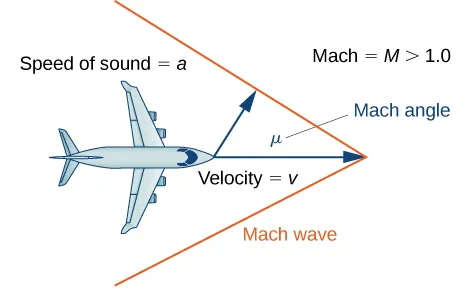
Problem 40. [T] Using \(\mu = 2\sin^{-1}\!\left(\dfrac{1}{M}\right)\), find the Mach number \(M\) for the following angles.
a) \(\mu = \dfrac{\pi}{6}\)
b) \(\mu = \dfrac{2\pi}{7}\)
c) \(\mu = \dfrac{3\pi}{8}\)
Problem 41. [T] The average temperature (in degrees Celsius) of a city in the northern United States can be modeled by \(T(x) = 5 + 18\sin\!\left[\dfrac{\pi}{6}(x - 4.6)\right]\), where \(x\) is time in months and \(x = 1.00\) corresponds to January 1. Determine the day(s) (month and day) when the average temperature is \(21°\text{C}\). Use the integer portion of your answer(s) as the month and calculate the day of the month from the decimal portion.
Problem 42. [T] The depth (in feet) of water at a dock changes with the rise and fall of tides. It is modeled by \(D(t) = 5\sin\!\left(\dfrac{\pi}{6}t - \dfrac{7\pi}{6}\right) + 8\), where \(t\) is the number of hours after midnight. Determine the first time after midnight when the depth is 11.75 ft.
Problem 43. [T] An object moving in simple harmonic motion is modeled by \(s(t) = -6\cos\!\left(\dfrac{\pi t}{2}\right)\), where \(s\) is measured in inches and \(t\) is measured in seconds. Determine the first time when the distance moved is 4.5 in.
Problem 44. [T] A local art gallery has a portrait 3 ft in height that is hung 2.5 ft above the eye level of an average person. The viewing angle \(\theta\) can be modeled by \(\theta = \tan^{-1}\!\dfrac{5.5}{x} - \tan^{-1}\!\dfrac{2.5}{x}\), where \(x\) is the distance (in feet) from the portrait. Find the viewing angle when a person is 4 ft from the portrait.
Problem 45. [T] Use a calculator to evaluate \(\tan^{-1}(\tan(2.1))\) and \(\cos^{-1}(\cos(2.1))\). Explain the results of each.
Problem 46. [T] Use a calculator to evaluate \(\sin(\sin^{-1}(-2))\) and \(\tan(\tan^{-1}(-2))\). Explain the results of each.
Solutions 25–46
Problem 25
Step 1 — Identify the angle: We need \(\theta \in \left(-\dfrac{\pi}{2}, \dfrac{\pi}{2}\right)\) such that \(\tan\theta = \dfrac{\sqrt{3}}{3} = \dfrac{1}{\sqrt{3}}\). That angle is \(\theta = \dfrac{\pi}{6}\).
Answer: \(\tan^{-1}\!\left(\dfrac{\sqrt{3}}{3}\right) = \dfrac{\pi}{6}\).
Problem 26
Step 1 — Identify the angle: We need \(\theta \in [0, \pi]\) such that \(\cos\theta = -\dfrac{\sqrt{2}}{2}\). That is \(\theta = \dfrac{3\pi}{4}\) (second quadrant, where cosine is negative).
Answer: \(\cos^{-1}\!\left(-\dfrac{\sqrt{2}}{2}\right) = \dfrac{3\pi}{4}\).
Problem 27
Step 1 — Identify the angle: We need \(\theta \in (0, \pi)\) such that \(\cot\theta = 1\), meaning \(\tan\theta = 1\). That is \(\theta = \dfrac{\pi}{4}\).
Answer: \(\cot^{-1}(1) = \dfrac{\pi}{4}\).
Problem 28
Step 1 — Identify the angle: We need \(\theta \in \left[-\dfrac{\pi}{2}, \dfrac{\pi}{2}\right]\) such that \(\sin\theta = -1\). That is \(\theta = -\dfrac{\pi}{2}\).
Answer: \(\sin^{-1}(-1) = -\dfrac{\pi}{2}\).
Problem 29
Step 1 — Identify the angle: We need \(\theta \in [0, \pi]\) such that \(\cos\theta = \dfrac{\sqrt{3}}{2}\). That is \(\theta = \dfrac{\pi}{6}\) (first quadrant).
Answer: \(\cos^{-1}\!\left(\dfrac{\sqrt{3}}{2}\right) = \dfrac{\pi}{6}\).
Problem 30
Step 1 — Find \(\tan^{-1}(\sqrt{3})\): We need \(\theta \in \left(-\dfrac{\pi}{2}, \dfrac{\pi}{2}\right)\) with \(\tan\theta = \sqrt{3}\). That is \(\theta = \dfrac{\pi}{3}\).
Step 2 — Evaluate \(\cos(\pi/3)\): $$\cos!\left(\frac{\pi}{3}\right) = \frac{1}{2}.$$
Answer: \(\cos\!\left(\tan^{-1}(\sqrt{3})\right) = \dfrac{1}{2}\).
Problem 31
Step 1 — Find \(\cos^{-1}\!\left(\dfrac{\sqrt{2}}{2}\right)\): We need \(\theta \in [0, \pi]\) with \(\cos\theta = \dfrac{\sqrt{2}}{2}\). That is \(\theta = \dfrac{\pi}{4}\).
Step 2 — Evaluate \(\sin(\pi/4)\): $$\sin!\left(\frac{\pi}{4}\right) = \frac{\sqrt{2}}{2}.$$
Answer: \(\sin\!\left(\cos^{-1}\!\left(\dfrac{\sqrt{2}}{2}\right)\right) = \dfrac{\sqrt{2}}{2}\).
Problem 32
Step 1 — Check domain: \(\dfrac{\pi}{3} \in \left[-\dfrac{\pi}{2}, \dfrac{\pi}{2}\right]\), so the outer-undoes-inner identity applies directly.
$$\sin^{-1}\!\left(\sin\!\left(\frac{\pi}{3}\right)\right) = \frac{\pi}{3}.$$Answer: \(\dfrac{\pi}{3}\).
Problem 33
Step 1 — Check domain: \(-\dfrac{\pi}{6} \in \left(-\dfrac{\pi}{2}, \dfrac{\pi}{2}\right)\), so the outer-undoes-inner identity applies.
$$\tan^{-1}\!\left(\tan\!\left(-\frac{\pi}{6}\right)\right) = -\frac{\pi}{6}.$$Answer: \(-\dfrac{\pi}{6}\).
Problem 34
Part a — Find the inverse function:
Step 1: Write \(C = \dfrac{5}{9}(F - 32)\). Solve for \(F\): $$\frac{9C}{5} = F - 32 \implies F = \frac{9C}{5} + 32.$$
So \(T^{-1}(C) = \dfrac{9C}{5} + 32\).
Part b — Interpret:
The inverse function converts Celsius back to Fahrenheit. For example, a weather forecast in degrees Celsius can be converted to degrees Fahrenheit using this formula.
Answer: \(F = T^{-1}(C) = \dfrac{9C}{5} + 32\); it converts Celsius temperatures to Fahrenheit.
Problem 35
Part a — Find \(x = f^{-1}(V)\):
Step 1: Write \(V = 500(0.04 - x^2)\). Solve for \(x\) (with \(0 \le x \le 0.2\)): $$\frac{V}{500} = 0.04 - x^2 \implies x^2 = 0.04 - \frac{V}{500} \implies x = \sqrt{0.04 - \frac{V}{500}}.$$
(Taking the positive root since \(x \ge 0\).)
$$f^{-1}(V) = \sqrt{0.04 - \frac{V}{500}}.$$Part b — Interpret:
The inverse function gives the distance from the center of the artery at which blood is flowing at velocity \(V\) cm/sec. Doctors can use this to locate where blood is moving at a specified speed.
Part c — Find distances:
- \(V = 15\): \(x = \sqrt{0.04 - 15/500} = \sqrt{0.04 - 0.03} = \sqrt{0.01} = 0.1\) cm. - \(V = 10\): \(x = \sqrt{0.04 - 10/500} = \sqrt{0.04 - 0.02} = \sqrt{0.02} \approx 0.1414\) cm. - \(V = 5\): \(x = \sqrt{0.04 - 5/500} = \sqrt{0.04 - 0.01} = \sqrt{0.03} \approx 0.1732\) cm.
Answer: \(f^{-1}(V) = \sqrt{0.04 - V/500}\); distances are 0.1 cm, ≈ 0.1414 cm, ≈ 0.1732 cm.
Problem 36
Part a — European sizes for U.S. sizes 6, 8, 10, 12:
$$D(6) = 2(6)+24 = 36, \quad D(8) = 40, \quad D(10) = 44, \quad D(12) = 48.$$Part b — Inverse function (European → U.S.):
Solve \(y = 2x + 24\) for \(x\): \(x = \dfrac{y - 24}{2}\). So \(D^{-1}(y) = \dfrac{y - 24}{2}\).
Part c — U.S. sizes for European 46, 52, 62, 70:
$$D^{-1}(46) = 11, \quad D^{-1}(52) = 14, \quad D^{-1}(62) = 19, \quad D^{-1}(70) = 23.$$Answer: a) 36, 40, 44, 48. b) \(D^{-1}(x) = \dfrac{x - 24}{2}\). c) 11, 14, 19, 23.
Problem 37
Part a — Cost to remove 25, 40, 50 ppb:
$$C(25) = \frac{75(25)}{85-25} = \frac{1875}{60} = 31.25 \text{ (thousand dollars)}.$$ $$C(40) = \frac{75(40)}{85-40} = \frac{3000}{45} \approx 66.67 \text{ (thousand dollars)}.$$ $$C(50) = \frac{75(50)}{85-50} = \frac{3750}{35} \approx 107.14 \text{ (thousand dollars)}.$$Part b — Inverse function:
Write \(C = \dfrac{75p}{85 - p}\). Solve for \(p\): $$C(85 - p) = 75p \implies 85C - Cp = 75p \implies 85C = 75p + Cp = p(75 + C) \implies p = \frac{85C}{75 + C}.$$
So \(C^{-1}(C) = \dfrac{85C}{75 + C}\).
Part c — Toxin removed for $50,000:
$50,000 = 50 thousand dollars, so \(C = 50\): $$p = \frac{85(50)}{75 + 50} = \frac{4250}{125} = 34 \text{ ppb}.$$
Answer: a) ≈ $31,250; ≈ $66,667; ≈ $107,143. b) \(p = \dfrac{85C}{75 + C}\). c) 34 ppb.
Problem 38
Part a — Velocity at \(t = 10\) sec:
$$v(10) = \frac{25}{4}(10) + 54 = 62.5 + 54 = 116.5 \text{ ft/sec}.$$Part b — Inverse function:
Write \(v = \dfrac{25}{4}t + 54\). Solve for \(t\): $$v - 54 = \frac{25}{4}t \implies t = \frac{4(v - 54)}{25}.$$
So \(v^{-1}(v) = \dfrac{4(v-54)}{25}\).
Part c — Time to reach 150 ft/sec:
$$t = \frac{4(150 - 54)}{25} = \frac{4(96)}{25} = \frac{384}{25} = 15.36 \text{ sec}.$$Answer: a) 116.5 ft/sec. b) \(t = \dfrac{4(v-54)}{25}\). c) 15.36 seconds.
Problem 39
Note on the calculator: Use the formula \(\mu = 2\sin^{-1}(1/M)\) with a calculator in radian mode, then convert to degrees by multiplying by \(180/\pi\).
Part a — \(M = 1.4\): $$\mu = 2\sin^{-1}!\left(\frac{1}{1.4}\right) = 2\sin^{-1}(0.7143) \approx 2(0.7754) \approx 1.5508 \text{ rad} \approx 89°.$$
Part b — \(M = 2.8\): $$\mu = 2\sin^{-1}!\left(\frac{1}{2.8}\right) \approx 2\sin^{-1}(0.3571) \approx 2(0.3652) \approx 0.7303 \text{ rad} \approx 42°.$$
Part c — \(M = 4.3\): $$\mu = 2\sin^{-1}!\left(\frac{1}{4.3}\right) \approx 2\sin^{-1}(0.2326) \approx 2(0.2341) \approx 0.4682 \text{ rad} \approx 27°.$$
Answer: Approximately 89°, 42°, and 27°.
Problem 40
Solve \(\mu = 2\sin^{-1}(1/M)\) for \(M\): Rearranging: \(\sin(\mu/2) = 1/M\), so \(M = \dfrac{1}{\sin(\mu/2)}\).
Part a — \(\mu = \pi/6\): $$M = \frac{1}{\sin(\pi/12)} = \frac{1}{\sin(15°)} \approx \frac{1}{0.2588} \approx 3.86.$$
Part b — \(\mu = 2\pi/7\): $$M = \frac{1}{\sin(\pi/7)} \approx \frac{1}{\sin(25.71°)} \approx \frac{1}{0.4339} \approx 2.30.$$
Part c — \(\mu = 3\pi/8\): $$M = \frac{1}{\sin(3\pi/16)} \approx \frac{1}{\sin(33.75°)} \approx \frac{1}{0.5556} \approx 1.80.$$
Answer: Approximately \(M \approx 3.86\), \(M \approx 2.30\), \(M \approx 1.80\).
Problem 41
Step 1 — Set up the equation: We want \(T(x) = 21\): $$5 + 18\sin!\left[\frac{\pi}{6}(x - 4.6)\right] = 21.$$
Step 2 — Isolate the sine: $$18\sin!\left[\frac{\pi}{6}(x - 4.6)\right] = 16 \implies \sin!\left[\frac{\pi}{6}(x - 4.6)\right] = \frac{8}{9}.$$
Step 3 — Solve for \(x\): Let \(u = \dfrac{\pi}{6}(x - 4.6)\). Then \(\sin u = 8/9\), so: $$u = \sin^{-1}(8/9) \approx 1.0956 \quad \text{or} \quad u = \pi - 1.0956 \approx 2.0460.$$
For \(u_1 \approx 1.0956\): $$\frac{\pi}{6}(x - 4.6) = 1.0956 \implies x - 4.6 = \frac{6(1.0956)}{\pi} \approx 2.091 \implies x \approx 6.691.$$
Month 6, day: \(0.691 \times 30 \approx 21\) → approximately June 21.
For \(u_2 \approx 2.0460\): $$x - 4.6 = \frac{6(2.0460)}{\pi} \approx 3.909 \implies x \approx 8.509.$$
Month 8, day: \(0.509 \times 31 \approx 16\) → approximately August 16.
Answer: The average temperature is 21°C on approximately June 21 and August 16.
Problem 42
Step 1 — Set up the equation: We want \(D(t) = 11.75\): $$5\sin!\left(\frac{\pi}{6}t - \frac{7\pi}{6}\right) + 8 = 11.75.$$
Step 2 — Isolate the sine: $$5\sin!\left(\frac{\pi}{6}t - \frac{7\pi}{6}\right) = 3.75 \implies \sin!\left(\frac{\pi}{6}t - \frac{7\pi}{6}\right) = 0.75.$$
Step 3 — Solve: Let \(u = \dfrac{\pi}{6}t - \dfrac{7\pi}{6}\). Then \(\sin u = 0.75\): $$u = \sin^{-1}(0.75) \approx 0.8481 \quad \text{or} \quad u = \pi - 0.8481 \approx 2.2935.$$
For \(u \approx 0.8481\): $$\frac{\pi}{6}t = \frac{7\pi}{6} + 0.8481 \implies t = \frac{6}{\pi}!\left(\frac{7\pi}{6} + 0.8481\right) = 7 + \frac{6(0.8481)}{\pi} \approx 7 + 1.620 = 8.620 \text{ hours.}$$
So the first time after midnight is approximately 8 hours 37 minutes, or about 8:37 AM.
Answer: The depth is 11.75 ft for the first time at approximately \(t \approx 8.62\) hours after midnight (about 8:37 AM).
Problem 43
Step 1 — Set up the equation: We want the first \(t > 0\) when \(|s(t)| = 4.5\). Since \(s(t) = -6\cos(\pi t/2)\), we solve: $$\left|-6\cos!\left(\frac{\pi t}{2}\right)\right| = 4.5 \implies \left|\cos!\left(\frac{\pi t}{2}\right)\right| = 0.75.$$
Step 2 — Solve: \(\cos(\pi t/2) = \pm 0.75\).
For \(\cos(\pi t/2) = 0.75\): $$\frac{\pi t}{2} = \cos^{-1}(0.75) \approx 0.7227 \implies t \approx \frac{2(0.7227)}{\pi} \approx 0.460 \text{ sec.}$$
For \(\cos(\pi t/2) = -0.75\): $$\frac{\pi t}{2} = \cos^{-1}(-0.75) \approx 2.4189 \implies t \approx \frac{2(2.4189)}{\pi} \approx 1.540 \text{ sec.}$$
The first positive solution is \(t \approx 0.460\) sec.
Answer: The distance first reaches 4.5 inches at \(t \approx 0.46\) seconds.
Problem 44
Step 1 — Plug in \(x = 4\): $$\theta = \tan^{-1}!\left(\frac{5.5}{4}\right) - \tan^{-1}!\left(\frac{2.5}{4}\right) = \tan^{-1}(1.375) - \tan^{-1}(0.625).$$
Step 2 — Evaluate: $$\tan^{-1}(1.375) \approx 0.9420 \text{ rad}, \quad \tan^{-1}(0.625) \approx 0.5586 \text{ rad}.$$
$$\theta \approx 0.9420 - 0.5586 \approx 0.3834 \text{ rad} \approx 21.96°.$$Answer: The viewing angle is approximately 0.383 radians (about 22°) when the person stands 4 ft from the portrait.
Problem 45
Part 1 — \(\tan^{-1}(\tan(2.1))\):
\(2.1\) radians is NOT in \((-\pi/2, \pi/2) \approx (-1.571, 1.571)\). Because \(\tan\) has period \(\pi\), we find the equivalent angle in the range: \(2.1 - \pi \approx 2.1 - 3.1416 \approx -1.042\).
$$\tan^{-1}(\tan(2.1)) \approx -1.042 \approx 2.1 - \pi.$$Part 2 — \(\cos^{-1}(\cos(2.1))\):
\(2.1 \in [0, \pi] \approx [0, 3.14]\), so the outer-undoes-inner identity applies directly:
$$\cos^{-1}(\cos(2.1)) = 2.1.$$Explanation: For \(\cos^{-1}\), any input in \([0, \pi]\) passes through unchanged. For \(\tan^{-1}\), the identity only holds when the argument is in \((-\pi/2, \pi/2)\); otherwise the result is the angle in that range with the same tangent value.
Answer: \(\tan^{-1}(\tan(2.1)) \approx 2.1 - \pi \approx -1.042\); \(\cos^{-1}(\cos(2.1)) = 2.1\).
Problem 46
Part 1 — \(\sin(\sin^{-1}(-2))\):
The domain of \(\sin^{-1}\) is \([-1, 1]\). Since \(-2 \notin [-1, 1]\), \(\sin^{-1}(-2)\) is undefined. Therefore \(\sin(\sin^{-1}(-2))\) is also undefined.
Note on calculator: Most calculators return an error (domain error) for \(\sin^{-1}(-2)\).
Part 2 — \(\tan(\tan^{-1}(-2))\):
The domain of \(\tan^{-1}\) is all real numbers, so \(\tan^{-1}(-2)\) is defined. By the outer-undoes-inner identity (since \(-2\) is in the domain of \(\tan^{-1}\)): $$\tan(\tan^{-1}(-2)) = -2.$$
Explanation: The sine function only takes values in \([-1, 1]\), so its inverse is only defined for inputs in that interval. The tangent function takes all real values, so its inverse is defined everywhere.
Answer: \(\sin(\sin^{-1}(-2))\) is undefined; \(\tan(\tan^{-1}(-2)) = -2\).
Key Terms
inverse function — a function \(f^{-1}\) that reverses the operation of \(f\); \(f^{-1}(f(x)) = x\) for all \(x\) in the domain of \(f\).
one-to-one function — a function in which no two distinct inputs produce the same output; required for an inverse to exist.
horizontal line test — a graphical test: a function is one-to-one if and only if every horizontal line intersects its graph at most once.
restricted domain — a subset of a function's natural domain chosen to make the function one-to-one so that an inverse exists.
inverse trigonometric functions — the six functions \(\sin^{-1}\), \(\cos^{-1}\), \(\tan^{-1}\), \(\cot^{-1}\), \(\sec^{-1}\), \(\csc^{-1}\) defined by restricting the corresponding trig functions to standard intervals where they are one-to-one.
1.5 Exponential and Logarithmic Functions
Learning Objectives
- Identify the form of an exponential function.
- Explain the difference between the graphs of \(x^b\) and \(b^x\).
- Recognize the significance of the number \(e\).
- Identify the form of a logarithmic function.
- Explain the relationship between exponential and logarithmic functions.
- Describe how to calculate a logarithm to a different base.
- Identify the hyperbolic functions, their graphs, and basic identities.
In this section we examine exponential and logarithmic functions. We use the properties of these functions to solve equations involving exponential or logarithmic terms, and we study the meaning and importance of the number \(e\). We also define hyperbolic and inverse hyperbolic functions, which involve combinations of exponential and logarithmic functions. (Note that we present alternative definitions of exponential and logarithmic functions in the chapter on Applications of Integration, and prove that the functions have the same properties with either definition.)
1.5.1 Exponential Functions
Exponential functions arise in many applications. One common example is population growth.
For example, if a population starts with \(P_0\) individuals and then grows at an annual rate of \(2\%,\) its population after 1 year is
$$ P(1) = P_0 + 0.02P_0 = P_0(1 + 0.02) = P_0(1.02). $$Its population after 2 years is
$$ P(2) = P(1) + 0.02P(1) = P(1)(1.02) = P_0(1.02)^2. $$In general, its population after \(t\) years is
$$ P(t) = P_0(1.02)^t, $$which is an exponential function. More generally, any function of the form \(f(x) = b^x,\) where \(b > 0, b \neq 1,\) is an exponential function with base \(b\) and exponent \(x\). Exponential functions have constant bases and variable exponents. Note that a function of the form \(f(x) = x^b\) for some constant \(b\) is not an exponential function but a power function.
Here is a simple way to keep the two straight: if the variable is in the exponent, it's exponential (\(2^x\) grows explosively as \(x\) grows). If the variable is in the base and the exponent is a fixed number, it's a power function (\(x^2\) is just a parabola). Both can get large, but exponentials eventually lap power functions by an enormous margin — that gap is one of the big themes of calculus.
To see the difference between an exponential function and a power function, we compare \(y = x^2\) and \(y = 2^x\). In the table below, we see that both \(2^x\) and \(x^2\) approach infinity as \(x \to \infty\). Eventually, however, \(2^x\) becomes larger than \(x^2\) and grows more rapidly as \(x \to \infty\). In the opposite direction, as \(x \to -\infty\), \(x^2 \to \infty\), whereas \(2^x \to 0\). The line \(y = 0\) is a horizontal asymptote for \(y = 2^x\).
| \(x\) | \(x^2\) | \(2^x\) |
|---|---|---|
| \(-3\) | \(9\) | \(1/8\) |
| \(-2\) | \(4\) | \(1/4\) |
| \(-1\) | \(1\) | \(1/2\) |
| \(0\) | \(0\) | \(1\) |
| \(1\) | \(1\) | \(2\) |
| \(2\) | \(4\) | \(4\) |
| \(3\) | \(9\) | \(8\) |
| \(4\) | \(16\) | \(16\) |
| \(5\) | \(25\) | \(32\) |
In Figure 1.43, we graph both \(y = x^2\) and \(y = 2^x\) to show how the graphs differ.
Figure 1.43 — Both \(2^x\) and \(x^2\) approach infinity as \(x\to\infty,\) but \(2^x\) grows more rapidly than \(x^2.\) As \(x\to-\infty,\) \(x^2\to\infty,\) whereas \(2^x\to0.\)
Evaluating Exponential Functions
Recall the properties of exponents. If \(x\) is a positive integer, then we define \(b^x = b \cdot b \cdots b\) (with \(x\) factors of \(b\)). If \(x\) is a negative integer, then \(x = -y\) for some positive integer \(y,\) and we define \(b^x = b^{-y} = 1/b^y\). Also, \(b^0\) is defined to be \(1\). If \(x\) is a rational number, then \(x = p/q,\) where \(p\) and \(q\) are integers and \(b^x = b^{p/q} = \sqrt[q]{b^p}\). For example, \(9^{3/2} = \sqrt{9^3} = 27\).
How is \(b^x\) defined if \(x\) is an irrational number — for example, \(2^{\sqrt{2}}\)? This is too complex a question for us to answer fully right now; however, we can make an approximation. In Table 1.5.2, we list some rational numbers approaching \(\sqrt{2},\) and the values of \(2^x\) for each rational number \(x\). If we choose rational numbers \(x\) getting closer and closer to \(\sqrt{2},\) the values of \(2^x\) get closer and closer to some number \(L\). We define that number \(L\) to be \(2^{\sqrt{2}}\).
| \(x\) | \(2^x\) |
|---|---|
| \(1.4\) | \(2.639\) |
| \(1.41\) | \(2.657\) |
| \(1.414\) | \(2.664\) |
| \(1.4142\) | \(2.665\) |
| \(1.41421\) | \(2.6651\) |
| \(1.414213\) | \(2.66514\) |
Given the exponential function \(f(x) = 100 \cdot 3^{x/2},\) evaluate \(f(4)\) and \(f(10)\).
Solution
For \(f(4)\):
$$ f(4) = 100 \cdot 3^{4/2} = 100 \cdot 3^2 = 100 \cdot 9 = 900. $$For \(f(10)\):
$$ f(10) = 100 \cdot 3^{10/2} = 100 \cdot 3^5 = 100 \cdot 243 = 24300. $$Answer: \(f(4) = 900\) and \(f(10) = 24300.\)
Suppose a particular population of bacteria is known to double in size every \(4\) hours. If a culture starts with \(1000\) bacteria, the number of bacteria after \(4\) hours is \(n(4) = 1000 \cdot 2\). The number of bacteria after \(8\) hours is \(n(8) = n(4) \cdot 2 = 1000 \cdot 2^2\). In general, the number of bacteria after \(4m\) hours is \(n(4m) = 1000 \cdot 2^m\). Letting \(t = 4m,\) we see that the number of bacteria after \(t\) hours is
$$ n(t) = 1000 \cdot 2^{t/4}. $$Find the number of bacteria after \(6\) hours, \(10\) hours, and \(24\) hours.
Solution
Step 1 — Plug in \(t = 6\):
$$ n(6) = 1000 \cdot 2^{6/4} = 1000 \cdot 2^{3/2} = 1000 \cdot 2\sqrt{2} \approx 2828 \text{ bacteria.} $$Step 2 — Plug in \(t = 10\):
$$ n(10) = 1000 \cdot 2^{10/4} = 1000 \cdot 2^{5/2} = 1000 \cdot 4\sqrt{2} \approx 5657 \text{ bacteria.} $$Step 3 — Plug in \(t = 24\):
$$ n(24) = 1000 \cdot 2^{24/4} = 1000 \cdot 2^6 = 64000 \text{ bacteria.} $$Answer: After 6 hours: approximately \(2828\) bacteria; after 10 hours: approximately \(5657\) bacteria; after 24 hours: \(64,000\) bacteria.
Graphing Exponential Functions
For any base \(b > 0, b \neq 1,\) the exponential function \(f(x) = b^x\) is defined for all real numbers \(x\) and satisfies \(b^x > 0\). Therefore, the domain of \(f(x) = b^x\) is \((-\infty, \infty)\) and the range is \((0, \infty)\). To graph \(b^x,\) we note:
- If \(b > 1\): \(b^x\) is increasing on \((-\infty, \infty)\). It approaches \(\infty\) as \(x \to \infty\) and approaches \(0\) as \(x \to -\infty\).
- If \(0 < b < 1\): \(f(x) = b^x\) is decreasing on \((-\infty, \infty)\). It approaches \(0\) as \(x \to \infty\) and approaches \(\infty\) as \(x \to -\infty\).
Figure 1.44 — If \(b>1,\) then \(b^x\) is increasing on \((-\infty,\infty).\) If \(0<b<1,\) then \(b^x\) is decreasing on \((-\infty,\infty).\)
Note that exponential functions satisfy the general laws of exponents. We state them here as a rule for reference.
Rule: Laws of Exponents
For any constants \(a > 0, b > 0,\) and for all \(x\) and \(y\):
1. \(b^x \cdot b^y = b^{x+y}\)
2. \(\dfrac{b^x}{b^y} = b^{x-y}\)
3. \((b^x)^y = b^{xy}\)
4. \((ab)^x = a^x b^x\)
5. \(\dfrac{a^x}{b^x} = \left(\dfrac{a}{b}\right)^x\)
Use the laws of exponents to simplify \(\dfrac{6x^{-3}y^2}{12x^{-4}y^5}\).
Solution
Answer: \(\dfrac{x}{2y^3}\).
Use the laws of exponents to simplify each of the following expressions.
- \(\dfrac{(2x^{2/3})^3}{(4x^{-1/3})^2}\)
- \(\dfrac{(x^3 y^{-1})^2}{(xy^2)^{-2}}\)
Solution
Part 1:
$$ \frac{(2x^{2/3})^3}{(4x^{-1/3})^2} = \frac{2^3(x^{2/3})^3}{4^2(x^{-1/3})^2} = \frac{8x^2}{16x^{-2/3}} = \frac{x^2 \cdot x^{2/3}}{2} = \frac{x^{8/3}}{2}. $$Part 2:
$$ \frac{(x^3 y^{-1})^2}{(xy^2)^{-2}} = \frac{(x^3)^2 (y^{-1})^2}{x^{-2}(y^2)^{-2}} = \frac{x^6 y^{-2}}{x^{-2} y^{-4}} = x^6 x^2 y^{-2} y^4 = x^8 y^2. $$Answer: Part 1: \(\dfrac{x^{8/3}}{2}\). Part 2: \(x^8 y^2\).
1.5.2 The Number \(e\)
A special type of exponential function appears frequently in real-world applications. To describe it, consider the following example of exponential growth, which arises from compounding interest in a savings account. Suppose a person invests \(P\) dollars in a savings account with an annual interest rate \(r,\) compounded annually. The amount of money after 1 year is
$$ A(1) = P + rP = P(1 + r). $$The amount of money after \(2\) years is
$$ A(2) = A(1) + rA(1) = P(1+r) + rP(1+r) = P(1+r)^2. $$More generally, the amount after \(t\) years is
$$ A(t) = P(1+r)^t. $$If the money is compounded \(2\) times per year, the amount of money after half a year is
$$ A\!\left(\tfrac{1}{2}\right) = P + \tfrac{r}{2} P = P\!\left(1 + \tfrac{r}{2}\right). $$After \(t\) years, compounding \(n\) times per year gives
$$ A(t) = P\!\left(1 + \frac{r}{n}\right)^{nt}. $$What happens as \(n \to \infty\) (continuous compounding)? To answer this, let \(m = n/r\) and write
$$ \left(1 + \frac{r}{n}\right)^{nt} = \left(1 + \frac{1}{m}\right)^{mrt}, $$and examine the behavior of \(\left(1 + 1/m\right)^m\) as \(m \to \infty\).
| \(m\) | \(\left(1+\tfrac{1}{m}\right)^m\) |
|---|---|
| \(10\) | \(2.5937\) |
| \(100\) | \(2.7048\) |
| \(1000\) | \(2.7169\) |
| \(10000\) | \(2.71815\) |
| \(100000\) | \(2.71827\) |
Looking at this table, it appears that \((1+1/m)^m\) is approaching a number between \(2.7\) and \(2.8\) as \(m \to \infty\). In fact, \((1+1/m)^m\) does approach some number as \(m \to \infty\). We call this number \(e\). To six decimal places of accuracy,
$$ e \approx 2.718282. $$The letter \(e\) was first used to represent this number by the Swiss mathematician Leonhard Euler during the 1720s. Although Euler did not discover the number, he showed many important connections between \(e\) and logarithmic functions. We still use the notation \(e\) today to honor Euler's work.
Returning to our savings account example, if a person puts \(P\) dollars in an account at an annual interest rate \(r,\) compounded continuously, then
$$ A(t) = Pe^{rt}. $$Since functions involving base \(e\) arise often in applications, we call the function \(f(x) = e^x\) the natural exponential function.
Since \(e > 1,\) we know \(e^x\) is increasing on \((-\infty, \infty)\). In Figure 1.45, we show a graph of \(f(x) = e^x\) along with a tangent line to the graph at \(x = 0\). (We give a precise definition of tangent line in the next chapter; informally, a tangent line to the graph of \(f\) at \(x = a\) is a line that passes through the point \((a, f(a))\) and has the same "slope" as \(f\) at that point.) The function \(f(x) = e^x\) is the only exponential function \(b^x\) with a tangent line at \(x = 0\) that has a slope of 1. This property makes \(e^x\) the most natural and convenient exponential function for calculus.


Figure 1.45 — The graph of \(f(x)=e^x\) has a tangent line with slope \(1\) at \(x=0.\)
If \(\$750\) is invested in an account at an annual interest rate of \(4\%,\) compounded continuously, find a formula for the amount of money in the account after \(t\) years. Find the amount of money after \(30\) years.
Solution
Formula: Using \(P = 750\) and \(r = 0.04\):
$$ A(t) = 750e^{0.04t}. $$After 30 years:
$$ A(30) = 750e^{0.04 \cdot 30} = 750e^{1.2} \approx \$2{,}490.59. $$Answer: \(A(t) = 750e^{0.04t}\). After 30 years, approximately \(\$2{,}490.59\).
Suppose \(\$500\) is invested in an account at an annual interest rate of \(r = 5.5\%,\) compounded continuously.
- Let \(t\) denote the number of years after the initial investment and \(A(t)\) denote the amount of money in the account at time \(t\). Find a formula for \(A(t)\).
- Find the amount of money in the account after \(10\) years and after \(20\) years.
Solution
Part 1 — Build the formula:
The formula for continuous compounding is \(A(t) = Pe^{rt}.\) Here \(P = 500\) and \(r = 0.055\) (5.5% written as a decimal). Therefore,
$$ A(t) = 500e^{0.055t}. $$Part 2 — Evaluate at \(t = 10\) and \(t = 20\):
$$ A(10) = 500e^{0.055 \cdot 10} = 500e^{0.55} \approx \$866.63. $$ $$ A(20) = 500e^{0.055 \cdot 20} = 500e^{1.1} \approx \$1{,}502.08. $$Answer: After 10 years, approximately \(\$866.63\); after 20 years, approximately \(\$1{,}502.08\).
1.5.3 Logarithmic Functions
Using our understanding of exponential functions, we can discuss their inverses, which are the logarithmic functions. These come in handy when we need to consider any phenomenon that varies over a wide range of values, such as pH in chemistry or decibels in sound levels.
The exponential function \(f(x) = b^x\) is one-to-one, with domain \((-\infty, \infty)\) and range \((0, \infty).\) Therefore, it has an inverse function, called the logarithmic function with base \(b\). For any \(b > 0, b \neq 1,\) the logarithmic function with base \(b,\) denoted \(\log_b,\) has domain \((0, \infty)\) and range \((-\infty, \infty),\) and satisfies
$$ \log_b(x) = y \quad \text{if and only if} \quad b^y = x. $$For example,
$$ \begin{array}{lll} \log_2(8) = 3 & & \text{since } 2^3 = 8, \\[4pt] \log_{10}\!\left(\tfrac{1}{100}\right) = -2 & & \text{since } 10^{-2} = \tfrac{1}{100}, \\[4pt] \log_b(1) = 0 & & \text{since } b^0 = 1 \text{ for any base } b > 0. \end{array} $$Furthermore, since \(y = \log_b(x)\) and \(y = b^x\) are inverse functions,
$$ \log_b(b^x) = x \quad \text{and} \quad b^{\log_b(x)} = x. $$A logarithm answers the question: "What power do I raise \(b\) to in order to get \(x\)?" If someone tells you \(\log_2(32) = 5,\) they are saying: raise 2 to the power 5 and you get 32. Anytime you see a logarithm, translate it into an exponent question — that habit makes log algebra feel mechanical rather than mysterious.
The most commonly used logarithmic function is \(\log_e.\) Since this function uses the natural base \(e,\) it is called the natural logarithm. We use the notation \(\ln(x)\) or \(\ln x\) to mean \(\log_e(x).\) For example,
$$ \ln(e) = \log_e(e) = 1, \quad \ln(e^3) = \log_e(e^3) = 3, \quad \ln(1) = \log_e(1) = 0. $$Since \(f(x) = e^x\) and \(g(x) = \ln(x)\) are inverses of each other,
$$ \ln(e^x) = x \quad \text{and} \quad e^{\ln x} = x, $$and their graphs are symmetric about the line \(y = x\) (Figure 1.46).


Figure 1.46 — The functions \(y=e^x\) and \(y=\ln(x)\) are inverses of each other, so their graphs are symmetric about the line \(y=x.\)
In general, for any base \(b > 0, b \neq 1,\) the function \(g(x) = \log_b(x)\) is symmetric about the line \(y = x\) with the function \(f(x) = b^x\). Using this fact and the graphs of the exponential functions, we graph functions \(\log_b\) for several values of \(b > 1\) (Figure 1.47).
Figure 1.47 — Graphs of \(y=\log_b(x)\) are depicted for \(b=2,e,10.\)
Before solving equations, let's review the basic properties of logarithms.
Rule: Properties of Logarithms
If \(a, b, c > 0, b \neq 1,\) and \(r\) is any real number, then
| Property | Formula |
|---|---|
| Product rule | \(\log_b(ac) = \log_b a + \log_b c\) |
| Quotient rule | \(\log_b\!\left(\dfrac{a}{c}\right) = \log_b a - \log_b c\) |
| Power rule | \(\log_b(a^r) = r \log_b a\) |
| Change of base | \(\log_b a = \dfrac{\log_c a}{\log_c b}\) |
Solve \(\dfrac{e^{2x}}{3 + e^{2x}} = \dfrac{1}{2}\).
Solution
Cross-multiply: \(2e^{2x} = 3 + e^{2x},\) so \(e^{2x} = 3.\) Taking natural logs:
$$ 2x = \ln 3, \quad \text{so} \quad x = \frac{\ln 3}{2}. $$Answer: \(x = \dfrac{\ln 3}{2}\).
Solve each of the following equations for \(x.\)
- \(5^x = 2\)
- \(e^x + 6e^{-x} = 5\)
Solution
Part 1 — Apply the natural logarithm to both sides:
$$ \ln 5^x = \ln 2. $$Using the power property of logarithms:
$$ x \ln 5 = \ln 2, $$so
$$ x = \frac{\ln 2}{\ln 5}. $$Part 2 — Multiply both sides by \(e^x\):
$$ e^{2x} + 6 = 5e^x. $$Rewrite as
$$ e^{2x} - 5e^x + 6 = 0. $$This is a quadratic in \(e^x\):
$$ (e^x)^2 - 5(e^x) + 6 = 0. $$Factor:
$$ (e^x - 3)(e^x - 2) = 0. $$So \(e^x = 3\) or \(e^x = 2\). Taking natural logs:
$$ x = \ln 3 \quad \text{or} \quad x = \ln 2. $$Answer: Part 1: \(x = \dfrac{\ln 2}{\ln 5}\). Part 2: \(x = \ln 3\) and \(x = \ln 2\).
Solve \(\ln(x^3) - 4\ln(x) = 1\).
Solution
Apply the power property: \(\ln(x^3) = 3\ln x,\) so \(3\ln x - 4\ln x = 1,\) giving \(-\ln x = 1,\) and thus
$$ \ln x = -1, \quad x = e^{-1} = \frac{1}{e}. $$Check: \(x = 1/e > 0\): valid.
Answer: \(x = \dfrac{1}{e}\).
When evaluating a logarithmic function with a calculator, you may have noticed that the only options are \(\log_{10}\) (the common logarithm) or \(\ln\) (the natural logarithm). However, exponential functions and logarithm functions can be expressed in terms of any desired base \(b.\) If you need to use a calculator to evaluate an expression with a different base, you can apply the change-of-base formulas first. Using this change of base, we typically write a given exponential or logarithmic function in terms of the natural exponential and natural logarithmic functions.
Rule: Change-of-Base Formulas
Let \(a > 0, b > 0,\) and \(a \neq 1, b \neq 1.\) Then:
1. \(a^x = b^{x \log_b a}\)
2. \(\log_a x = \dfrac{\log_b x}{\log_b a}\)
Solve each of the following equations for \(x.\)
- \(\ln\!\left(\dfrac{1}{x}\right) = 4\)
- \(\log_{10}\!\sqrt{x} + \log_{10} x = 2\)
- \(\ln(2x) - 3\ln(x^2) = 0\)
Solution
Part 1 — Use the definition of the natural log:
$$ \ln\!\left(\frac{1}{x}\right) = 4 \quad \Leftrightarrow \quad e^4 = \frac{1}{x}, \quad \text{so} \quad x = \frac{1}{e^4} = e^{-4}. $$Part 2 — Use product and power properties:
$$ \log_{10}\!\sqrt{x} + \log_{10} x = \log_{10}\!\left(x\sqrt{x}\right) = \log_{10} x^{3/2} = \frac{3}{2}\log_{10} x. $$So \(\dfrac{3}{2}\log_{10} x = 2,\) meaning \(\log_{10} x = \dfrac{4}{3},\) and
$$ x = 10^{4/3} = 10\sqrt[3]{10}. $$Part 3 — Apply the power property first:
$$ \ln(2x) - \ln(x^6) = 0. $$Using the quotient property:
$$ \ln\!\left(\frac{2}{x^5}\right) = 0 \quad \Rightarrow \quad \frac{2}{x^5} = 1 \quad \Rightarrow \quad x = \sqrt[5]{2}. $$Check that \(x = \sqrt[5]{2} > 0\): valid.
Answer: Part 1: \(x = e^{-4}\). Part 2: \(x = 10^{4/3}\). Part 3: \(x = \sqrt[5]{2}\).
Proof
For the first formula, we use the power property: \(\log_b(a^x) = x \log_b a,\) so
$$ b^{\log_b(a^x)} = b^{x \log_b a}. $$Since \(b^x\) and \(\log_b(x)\) are inverse functions, \(b^{\log_b(a^x)} = a^x,\) and combining:
$$ a^x = b^{x \log_b a}. $$For the second formula, let \(u = \log_b a,\) \(v = \log_a x,\) \(w = \log_b x.\) Then \(b^u = a,\) \(a^v = x,\) \(b^w = x.\) We want to show \(u \cdot v = w\):
$$ b^{uv} = (b^u)^v = a^v = x = b^w. $$Since exponential functions are one-to-one, \(uv = w.\) \(\square\)
Use the change-of-base formula and a calculating utility to evaluate \(\log_4 6\).
Solution
Answer: \(\log_4 6 \approx 1.2925\).
Use a calculating utility to evaluate \(\log_3 7\) with the change-of-base formula.
Solution
Using the second change-of-base formula with \(b = e\):
$$ \log_3 7 = \frac{\ln 7}{\ln 3} \approx \frac{1.9459}{1.0986} \approx 1.7712. $$Answer: \(\log_3 7 \approx 1.7712\).
Compare the relative severity of a magnitude \(8.4\) earthquake with a magnitude \(7.4\) earthquake.
Solution
Answer: A magnitude \(8.4\) earthquake is exactly \(10\) times more intense than a magnitude \(7.4\) earthquake.
Figure 1.48 — (credit: modification of work by Robb Hannawacker, NPS)
In 1935, Charles Richter developed a scale (now known as the Richter scale) to measure the magnitude of an earthquake. The scale is a base-10 logarithmic scale. Consider two earthquakes with magnitudes \(R_1\) and \(R_2\) (where \(R_1 > R_2\)) and corresponding wave amplitudes \(A_1\) and \(A_2\). The magnitudes and amplitudes satisfy
$$ R_1 - R_2 = \log_{10}\!\left(\frac{A_1}{A_2}\right). $$Consider an earthquake that measures \(8\) on the Richter scale and one that measures \(7\):
$$ 8 - 7 = \log_{10}\!\left(\frac{A_1}{A_2}\right) = 1, \quad \text{so} \quad \frac{A_1}{A_2} = 10. $$The first earthquake is \(10\) times as intense as the second. If one earthquake measures \(8\) and another measures \(6\):
$$ \log_{10}\!\left(\frac{A_1}{A_2}\right) = 2, \quad \text{so} \quad A_1 = 100 A_2. $$How can we use logarithmic functions to compare the magnitude \(9\) earthquake in Japan in 2011 with the magnitude \(7.3\) earthquake in Haiti in 2010?
Solution
Using the Richter scale equation:
$$ 9 - 7.3 = \log_{10}\!\left(\frac{A_1}{A_2}\right) = 1.7. $$Therefore,
$$ \frac{A_1}{A_2} = 10^{1.7} \approx 50. $$Answer: The earthquake in Japan was approximately \(50\) times more intense than the earthquake in Haiti.
1.5.4 Hyperbolic Functions
The name cosh rhymes with "gosh," whereas sinh is pronounced "cinch." Tanh, sech, csch, and coth are pronounced "tanch," "seech," "coseech," and "cotanch," respectively.
Using the definition of \(\cosh(x)\) and principles of physics, it can be shown that the height of a hanging chain, such as the one in Figure 1.49, can be described by the function \(h(x) = a\cosh(x/a) + c\) for certain constants \(a\) and \(c.\)
But why are these functions called hyperbolic? Consider the quantity \(\cosh^2 t - \sinh^2 t:\)
$$ \cosh^2 t - \sinh^2 t = \frac{e^{2t} + 2 + e^{-2t}}{4} - \frac{e^{2t} - 2 + e^{-2t}}{4} = 1. $$This identity is the analog of the trigonometric identity \(\cos^2 t + \sin^2 t = 1.\) Given a value \(t,\) the point \((x, y) = (\cosh t, \sinh t)\) lies on the unit hyperbola \(x^2 - y^2 = 1\) (Figure 1.50).


Figure 1.50 — The unit hyperbola \(\cosh^2 t - \sinh^2 t = 1.\)
Let's derive the formula for \(\sinh^{-1} x\). Suppose \(y = \sinh^{-1} x,\) so \(x = \sinh y = \dfrac{e^y - e^{-y}}{2}.\) Then
$$ e^y - 2x - e^{-y} = 0. $$Multiplying by \(e^y\):
$$ e^{2y} - 2xe^y - 1 = 0. $$This is quadratic in \(e^y,\) with solution
$$ e^y = \frac{2x \pm \sqrt{4x^2 + 4}}{2} = x \pm \sqrt{x^2 + 1}. $$Since \(e^y > 0,\) we take the positive sign, giving
$$ y = \ln\!\left(x + \sqrt{x^2 + 1}\right). $$Hyperbolic functions look exotic, but they are simply specific combinations of \(e^x\) and \(e^{-x}\) that show up repeatedly in real-world curved shapes and physics. The reason they resemble trigonometric functions is no accident: just as \(\cos\) and \(\sin\) parametrize the unit circle \(x^2 + y^2 = 1,\) the functions \(\cosh\) and \(\sinh\) parametrize the unit hyperbola \(x^2 - y^2 = 1.\) That structural parallel carries through to their identities and calculus properties.
The hyperbolic functions are defined in terms of certain combinations of \(e^x\) and \(e^{-x}\). These functions arise naturally in various engineering and physics applications, including the study of water waves and vibrations of elastic membranes. Another common use for a hyperbolic function is the representation of a hanging chain or cable, also known as a catenary (Figure 1.49). If we introduce a coordinate system so that the low point of the chain lies along the \(y\)-axis, we can describe the height of the chain in terms of a hyperbolic function.
Figure 1.49 — The shape of a strand of silk in a spider's web can be described in terms of a hyperbolic function. The same shape applies to a chain or cable hanging from two supports with only its own weight. (credit: "Mtpaley", Wikimedia Commons)
Verify that the point \((\cosh t, \sinh t)\) satisfies the equation \(x^2 - y^2 = 1\).
Solution
We substitute \(x = \cosh t\) and \(y = \sinh t\):
$$ x^2 - y^2 = \cosh^2 t - \sinh^2 t = \frac{e^{2t}+2+e^{-2t}}{4} - \frac{e^{2t}-2+e^{-2t}}{4} = \frac{4}{4} = 1. \checkmark $$Answer: The point \((\cosh t, \sinh t)\) always satisfies \(x^2 - y^2 = 1\) for every real \(t\).
Graphs of Hyperbolic Functions
To graph \(\cosh x\) and \(\sinh x,\) we make use of the fact that both functions approach \(\tfrac{1}{2}e^x\) as \(x \to \infty,\) since \(e^{-x} \to 0\) as \(x \to \infty\). As \(x \to -\infty,\) \(\cosh x\) approaches \(\tfrac{1}{2}e^{-x},\) whereas \(\sinh x\) approaches \(-\tfrac{1}{2}e^{-x}.\) Using the graphs of \(\tfrac{1}{2}e^x, \tfrac{1}{2}e^{-x},\) and \(-\tfrac{1}{2}e^{-x}\) as guides, we graph \(\cosh x\) and \(\sinh x.\) To graph \(\tanh x,\) we use the facts that \(\tanh(0) = 0,\) \(-1 < \tanh(x) < 1\) for all \(x,\) \(\tanh x \to 1\) as \(x \to \infty,\) and \(\tanh x \to -1\) as \(x \to -\infty.\) The graphs of the other three hyperbolic functions can be sketched using the graphs of \(\cosh x, \sinh x,\) and \(\tanh x\) (Figure 1.51).


Figure 1.51 — The hyperbolic functions involve combinations of \(e^x\) and \(e^{-x}.\)
Identities Involving Hyperbolic Functions
The identity \(\cosh^2 t - \sinh^2 t = 1\) is one of several identities involving the hyperbolic functions. The first four properties below follow easily from the definitions of hyperbolic sine and hyperbolic cosine. Except for some differences in signs, most of these properties are analogous to trigonometric identities.
Rule: Identities Involving Hyperbolic Functions
1. \(\cosh(-x) = \cosh x\)
2. \(\sinh(-x) = -\sinh x\)
3. \(\cosh x + \sinh x = e^x\)
4. \(\cosh x - \sinh x = e^{-x}\)
5. \(\cosh^2 x - \sinh^2 x = 1\)
6. \(1 - \tanh^2 x = \text{sech}^2 x\)
7. \(\coth^2 x - 1 = \text{csch}^2 x\)
8. \(\sinh(x \pm y) = \sinh x \cosh y \pm \cosh x \sinh y\)
9. \(\cosh(x \pm y) = \cosh x \cosh y \pm \sinh x \sinh y\)
- Simplify \(\sinh(5\ln x).\)
- If \(\sinh x = 3/4,\) find the values of the remaining five hyperbolic functions.
Solution
Part 1 — Use the definition of \(\sinh\):
$$ \sinh(5\ln x) = \frac{e^{5\ln x} - e^{-5\ln x}}{2} = \frac{e^{\ln(x^5)} - e^{\ln(x^{-5})}}{2} = \frac{x^5 - x^{-5}}{2}. $$Part 2 — Use the Pythagorean identity:
$$ \cosh^2 x = 1 + \sinh^2 x = 1 + \left(\frac{3}{4}\right)^2 = 1 + \frac{9}{16} = \frac{25}{16}. $$Since \(\cosh x \geq 1\) for all \(x,\) we must have \(\cosh x = 5/4.\) Then:
$$ \tanh x = \frac{\sinh x}{\cosh x} = \frac{3/4}{5/4} = \frac{3}{5}. $$ $$ \text{csch}\, x = \frac{1}{\sinh x} = \frac{4}{3}, \quad \text{sech}\, x = \frac{1}{\cosh x} = \frac{4}{5}, \quad \coth x = \frac{\cosh x}{\sinh x} = \frac{5}{3}. $$Answer: Part 1: \(\dfrac{x^5 - x^{-5}}{2}\). Part 2: \(\cosh x = 5/4,\) \(\tanh x = 3/5,\) \(\text{csch}\, x = 4/3,\) \(\text{sech}\, x = 4/5,\) \(\coth x = 5/3.\)
Simplify \(\cosh(2\ln x).\)
Solution
Answer: \(\dfrac{x^2 + x^{-2}}{2}\).
Inverse Hyperbolic Functions
From the graphs of the hyperbolic functions, we see that all of them are one-to-one except \(\cosh x\) and \(\text{sech}\, x.\) If we restrict the domains of these two functions to the interval \([0, \infty),\) then all the hyperbolic functions are one-to-one, and we can define the inverse hyperbolic functions. Since the hyperbolic functions themselves involve exponential functions, the inverse hyperbolic functions involve logarithmic functions.
Evaluate each of the following expressions.
- \(\sinh^{-1}(2)\)
- \(\tanh^{-1}(1/4)\)
Solution
Part 1:
$$ \sinh^{-1}(2) = \ln\!\left(2 + \sqrt{4+1}\right) = \ln\!\left(2 + \sqrt{5}\right) \approx 1.4436. $$Part 2:
$$ \tanh^{-1}\!\left(\frac{1}{4}\right) = \frac{1}{2}\ln\!\left(\frac{1 + \frac{1}{4}}{1 - \frac{1}{4}}\right) = \frac{1}{2}\ln\!\left(\frac{\frac{5}{4}}{\frac{3}{4}}\right) = \frac{1}{2}\ln\!\left(\frac{5}{3}\right) \approx 0.2554. $$Answer: Part 1: \(\approx 1.4436\). Part 2: \(\approx 0.2554\).
Evaluate \(\tanh^{-1}(1/2).\)
Solution
Answer: \(\dfrac{1}{2}\ln 3 \approx 0.5493\).
Problem Set 1.5
For the following exercises, evaluate the given exponential functions as indicated, accurate to two significant digits after the decimal.
Problem 1. \(f(x) = 5^x\)
a) \(x = 3\)
b) \(x = \dfrac{1}{2}\)
c) \(x = \sqrt{2}\)
Problem 2. \(f(x) = (0.3)^x\)
a) \(x = -1\)
b) \(x = 4\)
c) \(x = -1.5\)
Problem 3. \(f(x) = 10^x\)
a) \(x = -2\)
b) \(x = 4\)
c) \(x = \dfrac{5}{3}\)
Problem 4. \(f(x) = e^x\)
a) \(x = 2\)
b) \(x = -3.2\)
c) \(x = \pi\)
a) \(y = 4^{-x}\)
b) \(y = 3^{x-1}\)
c) \(y = 2^{x+1}\)
d) \(y = \left(\dfrac{1}{2}\right)^x + 2\)
e) \(y = -3^{-x}\)
f) \(y = 1 - 5^x\)
Solutions 1–4
Problem 1
Step 1 — Evaluate at each given \(x\):
$$ f(3) = 5^3 = 125.00 $$ $$ f\!\left(\tfrac{1}{2}\right) = 5^{1/2} = \sqrt{5} \approx 2.24. $$ $$ f(\sqrt{2}) = 5^{\sqrt{2}} \approx 5^{1.41421} \approx 9.74. $$Answer: a) \(125.00\), b) \(\approx 2.24\), c) \(\approx 9.74\).
Problem 2
Step 1 — Evaluate at each given \(x\):
$$ f(-1) = (0.3)^{-1} = \frac{1}{0.3} \approx 3.33. $$ $$ f(4) = (0.3)^4 = 0.0081 \approx 0.01. $$ $$ f(-1.5) = (0.3)^{-1.5} = \frac{1}{(0.3)^{1.5}} = \frac{1}{0.3\sqrt{0.3}} \approx \frac{1}{0.1643} \approx 6.09. $$Answer: a) \(\approx 3.33\), b) \(\approx 0.01\), c) \(\approx 6.09\).
Problem 3
Step 1 — Evaluate at each given \(x\):
$$ f(-2) = 10^{-2} = 0.01. $$ $$ f(4) = 10^4 = 10000.00. $$ $$ f\!\left(\tfrac{5}{3}\right) = 10^{5/3} = 10^{1.6\overline{6}} \approx 46.42. $$Answer: a) \(0.01\), b) \(10000.00\), c) \(\approx 46.42\).
Problem 4
Step 1 — Evaluate at each given \(x\):
$$ f(2) = e^2 \approx 7.39. $$ $$ f(-3.2) = e^{-3.2} \approx 0.04. $$ $$ f(\pi) = e^{\pi} \approx 23.14. $$Answer: a) \(\approx 7.39\), b) \(\approx 0.04\), c) \(\approx 23.14\).
For the following exercises, match the exponential equation to the correct graph.
Problem 5. (Match graph)


Problem 6. (Match graph)


Problem 7. (Match graph)


Problem 8. (Match graph)


Problem 9. (Match graph)


Problem 10. (Match graph)


Solutions 5–10
Problem 5
Step 1 — Identify the graph's characteristics:
The graph shows a decreasing curve (as \(x\) increases the function decreases), positive \(y\)-values only, passing near \((0, 1)\). A decreasing exponential with base \(> 1\) is of the form \(y = b^{-x}\) or \(y = (1/b)^x\).
Step 2 — Match to the list:
The function \(y = 4^{-x}\) is decreasing and positive for all \(x\), which matches this graph.
Answer: a) \(y = 4^{-x}\).
Problem 6
Step 1 — Identify the graph's characteristics:
The graph starts below the \(x\)-axis (negative values), approaches \(0\) from below as \(x \to -\infty\), and decreases to large negative values as \(x \to \infty\).
Step 2 — Match to the list:
\(y = -3^{-x}\) is always negative and approaches \(0^-\) as \(x \to \infty\), matching this shape.
Answer: e) \(y = -3^{-x}\).
Problem 7
Step 1 — Identify the graph's characteristics:
The graph shows an increasing curve that stays above a horizontal asymptote at \(y = 0,\) passes through a small positive value near \(x = -4,\) and increases steeply for positive \(x\).
Step 2 — Match to the list:
\(y = 2^{x+1}\) is an increasing exponential shifted left by 1. At \(x = 0\), \(y = 2\); at \(x = -1\), \(y = 1\). This matches an increasing curve passing through \((-1, 1)\) and \((0, 2)\).
Answer: c) \(y = 2^{x+1}\).
Problem 8
Step 1 — Identify the graph's characteristics:
The graph is decreasing, stays above a horizontal asymptote at \(y = 0,\) but is positive and decreasing — consistent with a base \(> 1\) raised to \(-x\), or with a vertical shift.
Step 2 — Match to the list:
\(y = 3^{x-1}\) is an increasing exponential shifted right by 1; however the description says "decreasing." Reconsidering: the graph shows positive values that decrease, consistent with \(y = (1/2)^x + 2\) — wait, that has asymptote at \(y = 2\). The graph described has asymptote near \(y = 0\) and decreases. \(y = 4^{-x}\) was already used. The remaining decreasing option is \(y = 3^{x-1}\) only if \(x < 0\) range dominates.
Actually, reviewing the alt text: "decreasing curved function" in range \(-5\) to \(5\) on \(x\), \(-5\) to \(5\) on \(y\). This matches \(y = 1 - 5^x\): at \(x = 0\), \(y = 0\); for \(x > 0\) it decreases rapidly; has horizontal asymptote \(y = 1\) as \(x \to -\infty\).
Answer: f) \(y = 1 - 5^x\).
Problem 9
Step 1 — Identify the graph's characteristics:
The graph shows an increasing curve that starts near \(-5\) on the \(y\)-axis as \(x\) is very negative and increases. Alt text: "curved increasing function that increa[ses]" in range \(x: -5\) to \(5\), \(y: -5\) to \(5\).
Step 2 — Match to the list:
\(y = 3^{x-1}\): increasing, passes through \((1, 1)\) and \((0, 1/3)\). Rises from near zero to high values.
Answer: b) \(y = 3^{x-1}\).
Problem 10
Step 1 — Identify the graph's characteristics:
The alt text says: "curved increasing function that starts" in range \(y: -2\) to \(8\), \(x: -5\) to \(5\). A function that starts above 2 when \(x \to -\infty\) and increases suggests a vertical shift.
Step 2 — Match to the list:
\(y = (1/2)^x + 2\): as \(x \to \infty\), \((1/2)^x \to 0\), so \(y \to 2\) (horizontal asymptote at \(y=2\)), and as \(x \to -\infty\), \((1/2)^x \to \infty\), so \(y\) increases. This gives a decreasing function, not increasing. Re-reading: the graph is "of a curved increasing function that starts" — this combined with the \(y\)-range \(-2\) to \(8\) suggests a function that starts around 2 and increases. The function \(y = 3^{x-1}\) was already used. The remaining is \(y = (1/2)^x + 2\).
Answer: d) \(y = \left(\dfrac{1}{2}\right)^x + 2\).
For the following exercises, sketch the graph of the exponential function. Determine the domain, range, and horizontal asymptote.
Problem 11. \(f(x) = e^x + 2\)
Problem 12. \(f(x) = -2^x\)
Problem 13. \(f(x) = 3^{x+1}\)
Problem 14. \(f(x) = 4^x - 1\)
Problem 15. \(f(x) = 1 - 2^{-x}\)
Problem 16. \(f(x) = 5^{x+1} + 2\)
Problem 17. \(f(x) = e^{-x} - 1\)
Solutions 11–17
Problem 11
Step 1 — Analyze the function \(f(x) = e^x + 2\):
This is the natural exponential shifted up by 2.
- Domain: \((-\infty, \infty)\) — exponentials are defined for all real \(x\). - Range: \((2, \infty)\) — since \(e^x > 0\), we have \(e^x + 2 > 2\). - Horizontal asymptote: \(y = 2\) (as \(x \to -\infty\), \(e^x \to 0\)).
Sketch: Standard rising exponential curve, but lifted up by 2 units.
Answer: Domain: \((-\infty, \infty)\); Range: \((2, \infty)\); Horizontal asymptote: \(y = 2\).
Problem 12
Step 1 — Analyze \(f(x) = -2^x\):
This reflects \(2^x\) across the \(x\)-axis.
- Domain: \((-\infty, \infty)\). - Range: \((-\infty, 0)\) — since \(2^x > 0\), \(-2^x < 0\). - Horizontal asymptote: \(y = 0\) (as \(x \to -\infty\), \(-2^x \to 0^-\)).
Answer: Domain: \((-\infty, \infty)\); Range: \((-\infty, 0)\); Horizontal asymptote: \(y = 0\).
Problem 13
Step 1 — Analyze \(f(x) = 3^{x+1}\):
This is \(3^x\) shifted left by 1.
- Domain: \((-\infty, \infty)\). - Range: \((0, \infty)\). - Horizontal asymptote: \(y = 0\).
At \(x = 0\): \(f(0) = 3^1 = 3\).
Answer: Domain: \((-\infty, \infty)\); Range: \((0, \infty)\); Horizontal asymptote: \(y = 0\).
Problem 14
Step 1 — Analyze \(f(x) = 4^x - 1\):
This is \(4^x\) shifted down by 1.
- Domain: \((-\infty, \infty)\). - Range: \((-1, \infty)\) — since \(4^x > 0\), \(4^x - 1 > -1\). - Horizontal asymptote: \(y = -1\).
Answer: Domain: \((-\infty, \infty)\); Range: \((-1, \infty)\); Horizontal asymptote: \(y = -1\).
Problem 15
Step 1 — Analyze \(f(x) = 1 - 2^{-x}\):
As \(x \to \infty\): \(2^{-x} \to 0\), so \(f(x) \to 1\). As \(x \to -\infty\): \(2^{-x} \to \infty\), so \(f(x) \to -\infty\).
- Domain: \((-\infty, \infty)\). - Range: \((-\infty, 1)\). - Horizontal asymptote: \(y = 1\).
Answer: Domain: \((-\infty, \infty)\); Range: \((-\infty, 1)\); Horizontal asymptote: \(y = 1\).
Problem 16
Step 1 — Analyze \(f(x) = 5^{x+1} + 2\):
Shift \(5^x\) left 1 unit and up 2 units.
- Domain: \((-\infty, \infty)\). - Range: \((2, \infty)\). - Horizontal asymptote: \(y = 2\).
Answer: Domain: \((-\infty, \infty)\); Range: \((2, \infty)\); Horizontal asymptote: \(y = 2\).
Problem 17
Step 1 — Analyze \(f(x) = e^{-x} - 1\):
This is the natural exponential reflected across the \(y\)-axis, then shifted down 1.
- Domain: \((-\infty, \infty)\). - Range: \((-1, \infty)\) — since \(e^{-x} > 0\), \(e^{-x} - 1 > -1\). - Horizontal asymptote: \(y = -1\) (as \(x \to \infty\), \(e^{-x} \to 0\)).
Answer: Domain: \((-\infty, \infty)\); Range: \((-1, \infty)\); Horizontal asymptote: \(y = -1\).
For the following exercises, write the equation in equivalent exponential form.
Problem 18. \(\log_3 81 = 4\)
Problem 19. \(\log_8 2 = \dfrac{1}{3}\)
Problem 20. \(\log_5 1 = 0\)
Problem 21. \(\log_5 25 = 2\)
Problem 22. \(\log 0.1 = -1\)
Problem 23. \(\ln\!\left(\dfrac{1}{e^3}\right) = -3\)
Problem 24. \(\log_9 3 = 0.5\)
Problem 25. \(\ln 1 = 0\)
Solutions 18–25
Problem 18
Step 1 — Convert \(\log_3 81 = 4\) to exponential form:
By definition, \(\log_b x = y \Leftrightarrow b^y = x\). So \(\log_3 81 = 4\) becomes:
$$ 3^4 = 81. $$Answer: \(3^4 = 81\).
Problem 19
Step 1 — Convert \(\log_8 2 = \frac{1}{3}\):
$$ 8^{1/3} = 2. $$Answer: \(8^{1/3} = 2\).
Problem 20
Step 1 — Convert \(\log_5 1 = 0\):
$$ 5^0 = 1. $$Answer: \(5^0 = 1\).
Problem 21
Step 1 — Convert \(\log_5 25 = 2\):
$$ 5^2 = 25. $$Answer: \(5^2 = 25\).
Problem 22
Step 1 — Convert \(\log 0.1 = -1\) (base 10):
$$ 10^{-1} = 0.1. $$Answer: \(10^{-1} = 0.1\).
Problem 23
Step 1 — Convert \(\ln(1/e^3) = -3\):
$$ e^{-3} = \frac{1}{e^3}. $$Answer: \(e^{-3} = \dfrac{1}{e^3}\).
Problem 24
Step 1 — Convert \(\log_9 3 = 0.5\):
$$ 9^{0.5} = 3. $$Answer: \(9^{0.5} = 3\).
Problem 25
Step 1 — Convert \(\ln 1 = 0\):
$$ e^0 = 1. $$Answer: \(e^0 = 1\).
For the following exercises, write the equation in equivalent logarithmic form.
Problem 26. \(2^3 = 8\)
Problem 27. \(4^{-2} = \dfrac{1}{16}\)
Problem 28. \(10^2 = 100\)
Problem 29. \(9^0 = 1\)
Problem 30. \(\left(\dfrac{1}{3}\right)^3 = \dfrac{1}{27}\)
Problem 31. \(\sqrt[3]{64} = 4\)
Problem 32. \(e^x = y\)
Problem 33. \(9^y = 150\)
Problem 34. \(b^3 = 45\)
Problem 35. \(4^{-3/2} = 0.125\)
Solutions 26–35
Problem 26
Step 1 — Convert \(2^3 = 8\) to logarithmic form:
By definition, \(b^y = x \Leftrightarrow \log_b x = y\). So:
$$ \log_2 8 = 3. $$Answer: \(\log_2 8 = 3\).
Problem 27
Step 1 — Convert \(4^{-2} = \frac{1}{16}\):
$$ \log_4\!\left(\frac{1}{16}\right) = -2. $$Answer: \(\log_4\!\left(\dfrac{1}{16}\right) = -2\).
Problem 28
Step 1 — Convert \(10^2 = 100\):
$$ \log_{10}(100) = 2, \quad \text{i.e.,} \quad \log(100) = 2. $$Answer: \(\log 100 = 2\).
Problem 29
Step 1 — Convert \(9^0 = 1\):
$$ \log_9(1) = 0. $$Answer: \(\log_9 1 = 0\).
Problem 30
Step 1 — Convert \(\left(\frac{1}{3}\right)^3 = \frac{1}{27}\):
$$ \log_{1/3}\!\left(\frac{1}{27}\right) = 3. $$Answer: \(\log_{1/3}\!\left(\dfrac{1}{27}\right) = 3\).
Problem 31
Step 1 — Convert \(\sqrt[3]{64} = 4\):
Write \(\sqrt[3]{64} = 64^{1/3} = 4,\) so the base is \(64\) and the exponent is \(1/3\):
$$ \log_{64}(4) = \frac{1}{3}. $$Answer: \(\log_{64} 4 = \dfrac{1}{3}\).
Problem 32
Step 1 — Convert \(e^x = y\):
$$ \ln(y) = x. $$Answer: \(\ln y = x\).
Problem 33
Step 1 — Convert \(9^y = 150\):
$$ \log_9(150) = y. $$Answer: \(\log_9 150 = y\).
Problem 34
Step 1 — Convert \(b^3 = 45\):
$$ \log_b(45) = 3. $$Answer: \(\log_b 45 = 3\).
Problem 35
Step 1 — Convert \(4^{-3/2} = 0.125\):
$$ \log_4(0.125) = -\frac{3}{2}. $$Answer: \(\log_4(0.125) = -\dfrac{3}{2}\).
For the following exercises, sketch the graph of the logarithmic function. Determine the domain, range, and vertical asymptote.
Problem 36. \(f(x) = 3 + \ln x\)
Problem 37. \(f(x) = \ln(x-1)\)
Problem 38. \(f(x) = \ln(-x)\)
Problem 39. \(f(x) = 1 - \ln x\)
Problem 40. \(f(x) = \log x - 1\)
Problem 41. \(f(x) = \ln(x+1)\)
Solutions 36–41
Problem 36
Step 1 — Analyze \(f(x) = 3 + \ln x\):
This is \(\ln x\) shifted up by 3.
- Domain: \((0, \infty)\) — logarithm requires positive argument. - Range: \((-\infty, \infty)\). - Vertical asymptote: \(x = 0\).
At \(x = 1\): \(f(1) = 3 + 0 = 3\). The graph crosses the \(x\)-axis where \(\ln x = -3\), i.e., \(x = e^{-3} \approx 0.05\).
Answer: Domain: \((0, \infty)\); Range: \((-\infty, \infty)\); Vertical asymptote: \(x = 0\).
Problem 37
Step 1 — Analyze \(f(x) = \ln(x-1)\):
- Domain: \(x - 1 > 0\), so \(x > 1\), i.e., \((1, \infty)\). - Range: \((-\infty, \infty)\). - Vertical asymptote: \(x = 1\).
Answer: Domain: \((1, \infty)\); Range: \((-\infty, \infty)\); Vertical asymptote: \(x = 1\).
Problem 38
Step 1 — Analyze \(f(x) = \ln(-x)\):
- Domain: \(-x > 0\), so \(x < 0\), i.e., \((-\infty, 0)\). - Range: \((-\infty, \infty)\). - Vertical asymptote: \(x = 0\).
Answer: Domain: \((-\infty, 0)\); Range: \((-\infty, \infty)\); Vertical asymptote: \(x = 0\).
Problem 39
Step 1 — Analyze \(f(x) = 1 - \ln x\):
- Domain: \((0, \infty)\). - Range: \((-\infty, \infty)\) — as \(x \to \infty\), \(\ln x \to \infty\) so \(f \to -\infty\); as \(x \to 0^+\), \(\ln x \to -\infty\) so \(f \to \infty\). - Vertical asymptote: \(x = 0\).
Answer: Domain: \((0, \infty)\); Range: \((-\infty, \infty)\); Vertical asymptote: \(x = 0\).
Problem 40
Step 1 — Analyze \(f(x) = \log x - 1\):
This is \(\log_{10} x\) shifted down by 1.
- Domain: \((0, \infty)\). - Range: \((-\infty, \infty)\). - Vertical asymptote: \(x = 0\).
Answer: Domain: \((0, \infty)\); Range: \((-\infty, \infty)\); Vertical asymptote: \(x = 0\).
Problem 41
Step 1 — Analyze \(f(x) = \ln(x+1)\):
- Domain: \(x + 1 > 0\), so \(x > -1\), i.e., \((-1, \infty)\). - Range: \((-\infty, \infty)\). - Vertical asymptote: \(x = -1\).
Answer: Domain: \((-1, \infty)\); Range: \((-\infty, \infty)\); Vertical asymptote: \(x = -1\).
For the following exercises, use properties of logarithms to write the expressions as a sum, difference, and/or product of logarithms.
Problem 42. \(\log x^4 y\)
Problem 43. \(\log_3 \dfrac{9a^3}{b}\)
Problem 44. \(\ln a\sqrt[3]{b}\)
Problem 45. \(\log_5 \sqrt{125xy^3}\)
Problem 46. \(\log_4 \dfrac{\sqrt[3]{xy}}{64}\)
Problem 47. \(\ln\!\left(\dfrac{6}{\sqrt{e^3}}\right)\)
Solutions 42–47
Problem 42
Step 1 — Apply product and power rules:
$$ \log x^4 y = \log x^4 + \log y = 4\log x + \log y. $$Answer: \(4\log x + \log y\).
Problem 43
Step 1 — Expand using quotient and power rules:
$$ \log_3 \frac{9a^3}{b} = \log_3 9 + \log_3 a^3 - \log_3 b = 2 + 3\log_3 a - \log_3 b. $$(Since \(\log_3 9 = \log_3 3^2 = 2\).)
Answer: \(2 + 3\log_3 a - \log_3 b\).
Problem 44
Step 1 — Rewrite and apply product and power rules:
$$ \ln a\sqrt[3]{b} = \ln a + \ln b^{1/3} = \ln a + \frac{1}{3}\ln b. $$Answer: \(\ln a + \dfrac{1}{3}\ln b\).
Problem 45
Step 1 — Simplify inside the radical:
$$ \sqrt{125xy^3} = (125xy^3)^{1/2}, \quad \text{so} $$ $$ \log_5\sqrt{125xy^3} = \frac{1}{2}\log_5(125xy^3) = \frac{1}{2}\!\left(\log_5 125 + \log_5 x + \log_5 y^3\right). $$Step 2 — Evaluate \(\log_5 125 = 3\) and apply power rule:
$$ = \frac{1}{2}(3 + \log_5 x + 3\log_5 y) = \frac{3}{2} + \frac{1}{2}\log_5 x + \frac{3}{2}\log_5 y. $$Answer: \(\dfrac{3}{2} + \dfrac{1}{2}\log_5 x + \dfrac{3}{2}\log_5 y\).
Problem 46
Step 1 — Apply quotient, product, and power rules:
$$ \log_4\frac{\sqrt[3]{xy}}{64} = \log_4(xy)^{1/3} - \log_4 64 = \frac{1}{3}(\log_4 x + \log_4 y) - 3. $$(Since \(\log_4 64 = \log_4 4^3 = 3\).)
Answer: \(\dfrac{1}{3}\log_4 x + \dfrac{1}{3}\log_4 y - 3\).
Problem 47
Step 1 — Rewrite the denominator and apply quotient and power rules:
$$ \ln\!\left(\frac{6}{\sqrt{e^3}}\right) = \ln 6 - \ln e^{3/2} = \ln 6 - \frac{3}{2}. $$Answer: \(\ln 6 - \dfrac{3}{2}\).
For the following exercises, solve the exponential equation exactly.
Problem 48. \(5^x = 125\)
Problem 49. \(e^{3x} - 15 = 0\)
Problem 50. \(8^x = 4\)
Problem 51. \(4^{x+1} - 32 = 0\)
Problem 52. \(3^{x/14} = \dfrac{1}{10}\)
Problem 53. \(10^x = 7.21\)
Problem 54. \(4 \cdot 2^{3x} - 20 = 0\)
Problem 55. \(7^{3x-2} = 11\)
Solutions 48–55
Problem 48
Step 1 — Rewrite 125 as a power of 5:
\(125 = 5^3\), so \(5^x = 5^3\), giving \(x = 3\).
Answer: \(x = 3\).
Problem 49
Step 1 — Isolate the exponential:
\(e^{3x} = 15\).
Step 2 — Take the natural log:
\(3x = \ln 15\), so \(x = \dfrac{\ln 15}{3}\).
Answer: \(x = \dfrac{\ln 15}{3}\).
Problem 50
Step 1 — Express both sides with a common base:
\(8 = 2^3\) and \(4 = 2^2\), so \(8^x = 2^{3x}\) and \(4 = 2^2\).
Thus \(2^{3x} = 2^2\), giving \(3x = 2\), so \(x = \dfrac{2}{3}\).
Answer: \(x = \dfrac{2}{3}\).
Problem 51
Step 1 — Rewrite \(32 = 2^5\) and \(4 = 2^2\):
\(4^{x+1} = 32 \Rightarrow (2^2)^{x+1} = 2^5 \Rightarrow 2^{2(x+1)} = 2^5\).
Step 2 — Equate exponents:
\(2(x+1) = 5 \Rightarrow x + 1 = \dfrac{5}{2} \Rightarrow x = \dfrac{3}{2}\).
Answer: \(x = \dfrac{3}{2}\).
Problem 52
Step 1 — Take \(\log_{10}\) of both sides:
$$ \frac{x}{14}\log 3 = \log\frac{1}{10} = -1. $$Step 2 — Solve for \(x\):
$$ x = \frac{-14}{\log 3} = \frac{-14}{\ln 3 / \ln 10} = \frac{-14\ln 10}{\ln 3} \approx \frac{-14 \times 2.3026}{1.0986} \approx -29.37. $$Answer: \(x = \dfrac{-14\ln 10}{\ln 3} \approx -29.37\).
Problem 53
Step 1 — Take \(\log_{10}\) of both sides:
$$ x = \log_{10}(7.21) \approx 0.8579. $$Answer: \(x = \log(7.21) \approx 0.8579\).
Problem 54
Step 1 — Isolate the exponential:
\(4 \cdot 2^{3x} = 20 \Rightarrow 2^{3x} = 5\).
Step 2 — Take \(\ln\):
\(3x = \ln 5 \Rightarrow x = \dfrac{\ln 5}{3}\).
Answer: \(x = \dfrac{\ln 5}{3}\).
Problem 55
Step 1 — Take \(\ln\) of both sides:
\((3x-2)\ln 7 = \ln 11\).
Step 2 — Solve for \(x\):
$$ 3x - 2 = \frac{\ln 11}{\ln 7}, \quad 3x = 2 + \frac{\ln 11}{\ln 7}, \quad x = \frac{1}{3}\!\left(2 + \frac{\ln 11}{\ln 7}\right) \approx \frac{1}{3}(2 + 1.2323) \approx 1.0774. $$Answer: \(x = \dfrac{1}{3}\!\left(2 + \dfrac{\ln 11}{\ln 7}\right) \approx 1.0774\).
For the following exercises, solve the logarithmic equation exactly, if possible.
Problem 56. \(\log_3 x = 0\)
Problem 57. \(\log_5 x = -2\)
Problem 58. \(\log_4(x+5) = 0\)
Problem 59. \(\log(2x-7) = 0\)
Problem 60. \(\ln\sqrt{x+3} = 2\)
Problem 61. \(\log_6(x+9) + \log_6 x = 2\)
Problem 62. \(\log_4(x+2) - \log_4(x-1) = 0\)
Problem 63. \(\ln x + \ln(x-2) = \ln 4\)
Solutions 56–63
Problem 56
Step 1 — Rewrite using the definition of logarithm:
\(\log_3 x = 0 \Rightarrow x = 3^0 = 1\).
Answer: \(x = 1\).
Problem 57
Step 1 — Rewrite using the definition:
\(\log_5 x = -2 \Rightarrow x = 5^{-2} = \dfrac{1}{25}\).
Answer: \(x = \dfrac{1}{25}\).
Problem 58
Step 1 — Rewrite:
\(\log_4(x+5) = 0 \Rightarrow x + 5 = 4^0 = 1 \Rightarrow x = -4\).
Step 2 — Check domain: \(x + 5 = 1 > 0\). Valid.
Answer: \(x = -4\).
Problem 59
Step 1 — Rewrite (base 10):
\(\log(2x-7) = 0 \Rightarrow 2x - 7 = 10^0 = 1 \Rightarrow 2x = 8 \Rightarrow x = 4\).
Step 2 — Check: \(2(4) - 7 = 1 > 0\). Valid.
Answer: \(x = 4\).
Problem 60
Step 1 — Exponentiate both sides:
\(\ln\sqrt{x+3} = 2 \Rightarrow \sqrt{x+3} = e^2 \Rightarrow x + 3 = e^4 \Rightarrow x = e^4 - 3\).
Step 2 — Check domain: \(e^4 - 3 > 0\). Valid.
Answer: \(x = e^4 - 3 \approx 51.60\).
Problem 61
Step 1 — Combine logs using product rule:
\(\log_6(x+9) + \log_6 x = \log_6[x(x+9)] = 2 \Rightarrow x(x+9) = 6^2 = 36\).
Step 2 — Solve the quadratic:
\(x^2 + 9x - 36 = 0 \Rightarrow (x+12)(x-3) = 0\).
So \(x = 3\) or \(x = -12\).
Step 3 — Check domain: Both arguments must be positive. For \(x = 3\): \(x + 9 = 12 > 0\) and \(x = 3 > 0\). Valid. For \(x = -12\): \(\log_6(-12)\) is undefined.
Answer: \(x = 3\).
Problem 62
Step 1 — Combine logs:
\(\log_4(x+2) - \log_4(x-1) = \log_4\!\left(\dfrac{x+2}{x-1}\right) = 0\).
Step 2 — Exponentiate:
\(\dfrac{x+2}{x-1} = 4^0 = 1 \Rightarrow x + 2 = x - 1\).
This gives \(2 = -1\), which is a contradiction. No solution.
Answer: No solution.
Problem 63
Step 1 — Combine left-hand logs:
\(\ln[x(x-2)] = \ln 4 \Rightarrow x(x-2) = 4\).
Step 2 — Solve the quadratic:
\(x^2 - 2x - 4 = 0 \Rightarrow x = \dfrac{2 \pm \sqrt{4+16}}{2} = 1 \pm \sqrt{5}\).
Step 3 — Check domain: Both \(x > 0\) and \(x - 2 > 0\) (i.e., \(x > 2\)) must hold. \(1 + \sqrt{5} \approx 3.24 > 2\). Valid. \(1 - \sqrt{5} < 0\). Invalid.
Answer: \(x = 1 + \sqrt{5}\).
For the following exercises, use the change-of-base formula and either base 10 or base \(e\) to evaluate the given expressions. Answer in exact form and in approximate form, rounding to four decimal places.
Problem 64. \(\log_5 47\)
Problem 65. \(\log_7 82\)
Problem 66. \(\log_6 103\)
Problem 67. \(\log_{0.5} 211\)
Problem 68. \(\log_2 \pi\)
Problem 69. \(\log_{0.2} 0.452\)
Problem 70. Rewrite the following expressions in terms of exponentials and simplify.
a) \(2\cosh(\ln x)\)
b) \(\cosh 4x + \sinh 4x\)
c) \(\cosh 2x - \sinh 2x\)
d) \(\ln(\cosh x + \sinh x) + \ln(\cosh x - \sinh x)\)
Problem 71. [T] The number of bacteria \(N\) in a culture after \(t\) days can be modeled by the function \(N(t) = 1300 \cdot 2^{t/4}.\) Find the number of bacteria present after 15 days.
Problem 72. [T] The demand \(D\) (in millions of barrels) for oil in an oil-rich country is given by the function \(D(p) = 150 \cdot (2.7)^{-0.25p},\) where \(p\) is the price (in dollars) of a barrel of oil. Find the amount of oil demanded (to the nearest million barrels) when the price is between \(\$15\) and \(\$20\).
Problem 73. [T] The amount \(A\) of a \(\$100,000\) investment paying continuously and compounded for \(t\) years is given by \(A(t) = 100000 \cdot e^{0.055t}.\) Find the amount \(A\) accumulated in 5 years.
Problem 74. [T] An investment is compounded monthly, quarterly, or yearly and is given by the function \(A = P\!\left(1 + \dfrac{j}{n}\right)^{nt},\) where \(A\) is the value of the investment at time \(t,\) \(P\) is the initial principal, \(j\) is the annual interest rate, and \(n\) is the number of times the interest is compounded per year. Given a yearly interest rate of \(3.5\%\) and an initial principal of \(\$100,000,\) find the amount \(A\) accumulated in 5 years for interest that is compounded:
a) daily
b) monthly
c) quarterly
d) yearly
Problem 75. [T] The concentration of hydrogen ions in a substance is denoted by \([\text{H}^+],\) measured in moles per liter. The pH of a substance is defined by the logarithmic function \(\text{pH} = -\log[\text{H}^+].\) This function is used to measure the acidity of a substance. The pH of water is 7. A substance with a pH less than 7 is an acid, whereas one with a pH greater than 7 is a base.
Find the pH of the following substances. Round answers to one digit. Determine whether the substance is an acid or a base.
a) Eggs: \([\text{H}^+] = 1.6 \times 10^{-8}\) mol/L
b) Beer: \([\text{H}^+] = 3.16 \times 10^{-3}\) mol/L
c) Tomato Juice: \([\text{H}^+] = 7.94 \times 10^{-5}\) mol/L
Problem 76. [T] Iodine-131 is a radioactive substance that decays according to the function \(Q(t) = Q_0 \cdot e^{-0.08664t},\) where \(Q_0\) is the initial quantity and \(t\) is in days. Determine how long it takes (to the nearest day) for 95% of a quantity to decay.
Problem 77. [T] According to the World Bank, at the end of 2013 (\(t = 0\)) the U.S. population was 316 million and was increasing according to the model
$$ P(t) = 316e^{0.0074t}, $$where \(P\) is measured in millions of people and \(t\) is measured in years after 2013.
a) Based on this model, what will be the population of the United States in 2020?
b) Determine when the U.S. population will be twice what it is in 2013.
Problem 78. [T] The amount \(A\) accumulated after \(\$1000\) is invested for \(t\) years at an interest rate of 4% is modeled by \(A(t) = 1000(1.04)^t.\)
a) Find the amount accumulated after 5 years and 10 years.
b) Determine how long it takes for the original investment to triple.
Problem 79. [T] A bacterial colony grown in a lab is known to double in number in 12 hours. Suppose, initially, there are 1000 bacteria present.
a) Use the exponential function \(Q = Q_0 e^{kt}\) to determine the value \(k,\) which is the growth rate of the bacteria. Round to four decimal places.
b) Determine approximately how long it takes for 200,000 bacteria to grow.
Problem 80. [T] The rabbit population on a game reserve doubles every 6 months. Suppose there were 120 rabbits initially.
a) Use the exponential function \(P = P_0 a^t\) to determine the growth rate constant \(a.\) Round to four decimal places.
b) Use the function in part a to determine approximately how long it takes for the rabbit population to reach 3500.
Problem 81. [T] The 1906 earthquake in San Francisco had a magnitude of 8.3 on the Richter scale. At the same time, in Japan, an earthquake with magnitude 4.9 caused only minor damage. Approximately how much more intense was the San Francisco earthquake than the Japanese earthquake?
Solutions 64–81
Problem 64
Step 1 — Apply change-of-base formula:
$$ \log_5 47 = \frac{\ln 47}{\ln 5} = \frac{3.8501}{1.6094} \approx 2.3921. $$Answer: \(\log_5 47 = \dfrac{\ln 47}{\ln 5} \approx 2.3921\).
Problem 65
Step 1 — Apply change-of-base formula:
$$ \log_7 82 = \frac{\ln 82}{\ln 7} = \frac{4.4067}{1.9459} \approx 2.2646. $$Answer: \(\log_7 82 = \dfrac{\ln 82}{\ln 7} \approx 2.2646\).
Problem 66
Step 1 — Apply change-of-base formula:
$$ \log_6 103 = \frac{\ln 103}{\ln 6} = \frac{4.6347}{1.7918} \approx 2.5872. $$Answer: \(\log_6 103 = \dfrac{\ln 103}{\ln 6} \approx 2.5872\).
Problem 67
Step 1 — Apply change-of-base formula:
$$ \log_{0.5} 211 = \frac{\ln 211}{\ln 0.5} = \frac{5.3510}{-0.6931} \approx -7.7206. $$Answer: \(\log_{0.5} 211 = \dfrac{\ln 211}{\ln 0.5} \approx -7.7206\).
Problem 68
Step 1 — Apply change-of-base formula:
$$ \log_2 \pi = \frac{\ln \pi}{\ln 2} = \frac{1.1447}{0.6931} \approx 1.6514. $$Answer: \(\log_2 \pi = \dfrac{\ln\pi}{\ln 2} \approx 1.6514\).
Problem 69
Step 1 — Apply change-of-base formula:
$$ \log_{0.2} 0.452 = \frac{\ln 0.452}{\ln 0.2} = \frac{-0.7930}{-1.6094} \approx 0.4927. $$Answer: \(\log_{0.2} 0.452 = \dfrac{\ln 0.452}{\ln 0.2} \approx 0.4927\).
Problem 70
Step 1 — Part a: Simplify \(2\cosh(\ln x)\).
$$ 2\cosh(\ln x) = 2 \cdot \frac{e^{\ln x} + e^{-\ln x}}{2} = e^{\ln x} + e^{-\ln x} = x + \frac{1}{x}. $$Step 2 — Part b: Simplify \(\cosh 4x + \sinh 4x\).
Using the identity \(\cosh u + \sinh u = e^u\):
$$ \cosh 4x + \sinh 4x = e^{4x}. $$Step 3 — Part c: Simplify \(\cosh 2x - \sinh 2x\).
Using the identity \(\cosh u - \sinh u = e^{-u}\):
$$ \cosh 2x - \sinh 2x = e^{-2x}. $$Step 4 — Part d: Simplify \(\ln(\cosh x + \sinh x) + \ln(\cosh x - \sinh x)\).
$$ = \ln[(\cosh x + \sinh x)(\cosh x - \sinh x)] = \ln[\cosh^2 x - \sinh^2 x] = \ln 1 = 0. $$Answer: a) \(x + \dfrac{1}{x}\), b) \(e^{4x}\), c) \(e^{-2x}\), d) \(0\).
Problem 71
Step 1 — Set up the model and plug in \(t = 15\):
$$ N(15) = 1300 \cdot 2^{15/4} = 1300 \cdot 2^{3.75}. $$Step 2 — Evaluate \(2^{3.75}\):
$$ 2^{3.75} = 2^3 \cdot 2^{0.75} = 8 \cdot 2^{3/4} \approx 8 \times 1.6818 = 13.454. $$ $$ N(15) \approx 1300 \times 13.454 \approx 17490 \text{ bacteria.} $$Answer: Approximately \(17490\) bacteria are present after 15 days.
Problem 72
Step 1 — Evaluate \(D(15)\):
$$ D(15) = 150 \cdot (2.7)^{-0.25 \times 15} = 150 \cdot (2.7)^{-3.75} \approx 150 \cdot 0.01878 \approx 2.8 \approx 3 \text{ million barrels.} $$Step 2 — Evaluate \(D(20)\):
$$ D(20) = 150 \cdot (2.7)^{-5} \approx 150 \cdot 0.004049 \approx 0.607 \approx 1 \text{ million barrel.} $$Answer: At \(p = \$15\): approximately \(3\) million barrels; at \(p = \$20\): approximately \(1\) million barrel.
Problem 73
Step 1 — Plug in \(t = 5\):
$$ A(5) = 100000 \cdot e^{0.055 \times 5} = 100000 \cdot e^{0.275} \approx 100000 \times 1.3165 \approx \$131650. $$Answer: After 5 years, approximately \(\$131,650\).
Problem 74
Step 1 — Set \(P = 100000,\) \(j = 0.035,\) \(t = 5\):
a) Daily (\(n = 365\)):
$$ A = 100000\!\left(1 + \frac{0.035}{365}\right)^{365 \times 5} \approx 100000 \times 1.19096 \approx \$119,096. $$b) Monthly (\(n = 12\)):
$$ A = 100000\!\left(1 + \frac{0.035}{12}\right)^{60} \approx 100000 \times 1.19064 \approx \$119,064. $$c) Quarterly (\(n = 4\)):
$$ A = 100000\!\left(1 + \frac{0.035}{4}\right)^{20} \approx 100000 \times 1.18985 \approx \$118,985. $$d) Yearly (\(n = 1\)):
$$ A = 100000(1.035)^5 \approx 100000 \times 1.18769 \approx \$118,769. $$Answer: a) \(\approx \$119,096\); b) \(\approx \$119,064\); c) \(\approx \$118,985\); d) \(\approx \$118,769\).
Problem 75
Step 1 — Recall the pH formula: \(\text{pH} = -\log[\text{H}^+]\).
a) Eggs: \([\text{H}^+] = 1.6 \times 10^{-8}\):
$$ \text{pH} = -\log(1.6 \times 10^{-8}) = -({\log 1.6 + \log 10^{-8}}) = -(0.204 - 8) \approx 7.8 \approx 8. $$Since pH \(> 7\): base.
b) Beer: \([\text{H}^+] = 3.16 \times 10^{-3}\):
$$ \text{pH} = -\log(3.16 \times 10^{-3}) = -(0.500 - 3) = 2.5 \approx 3. $$Since pH \(< 7\): acid.
c) Tomato Juice: \([\text{H}^+] = 7.94 \times 10^{-5}\):
$$ \text{pH} = -\log(7.94 \times 10^{-5}) = -(0.900 - 5) = 4.1 \approx 4. $$Since pH \(< 7\): acid.
Answer: a) pH \(\approx 8\) (base); b) pH \(\approx 3\) (acid); c) pH \(\approx 4\) (acid).
Problem 76
Step 1 — Set up the equation for 95% decay:
We want \(Q(t) = 0.05 Q_0\) (only 5% remains):
$$ 0.05 Q_0 = Q_0 e^{-0.08664t} \Rightarrow e^{-0.08664t} = 0.05. $$Step 2 — Solve for \(t\):
$$ -0.08664t = \ln(0.05) = -2.9957, \quad t = \frac{2.9957}{0.08664} \approx 34.58 \approx 35 \text{ days.} $$Answer: It takes approximately \(35\) days for 95% of the iodine-131 to decay.
Problem 77
Step 1 — Part a: Population in 2020 (\(t = 7\)):
$$ P(7) = 316 e^{0.0074 \times 7} = 316 e^{0.0518} \approx 316 \times 1.0532 \approx 332.8 \text{ million.} $$Step 2 — Part b: When does \(P(t) = 2 \times 316 = 632\)?
$$ 632 = 316 e^{0.0074t} \Rightarrow e^{0.0074t} = 2 \Rightarrow 0.0074t = \ln 2 \approx 0.6931 \Rightarrow t \approx 93.7 \text{ years.} $$So approximately in the year \(2013 + 94 = 2107\).
Answer: a) \(\approx 332.8\) million; b) \(\approx 94\) years after 2013 (year 2107).
Problem 78
Step 1 — Part a: Evaluate at \(t = 5\) and \(t = 10\):
$$ A(5) = 1000(1.04)^5 \approx 1000 \times 1.21665 = \$1216.65. $$ $$ A(10) = 1000(1.04)^{10} \approx 1000 \times 1.48024 = \$1480.24. $$Step 2 — Part b: Find \(t\) such that \(A(t) = 3000\):
$$ 3 = (1.04)^t \Rightarrow t = \frac{\ln 3}{\ln 1.04} = \frac{1.0986}{0.03922} \approx 28.01 \text{ years.} $$Answer: a) After 5 years: \(\$1216.65\); after 10 years: \(\$1480.24\). b) Approximately \(28\) years.
Problem 79
Step 1 — Part a: Find \(k\) using the doubling time of 12 hours:
At \(t = 12\), \(Q = 2Q_0\):
$$ 2Q_0 = Q_0 e^{12k} \Rightarrow e^{12k} = 2 \Rightarrow k = \frac{\ln 2}{12} = \frac{0.6931}{12} \approx 0.0578. $$Step 2 — Part b: Find \(t\) when \(Q = 200000\):
$$ 200000 = 1000 e^{0.0578t} \Rightarrow e^{0.0578t} = 200 \Rightarrow t = \frac{\ln 200}{0.0578} = \frac{5.2983}{0.0578} \approx 91.7 \text{ hours.} $$Answer: a) \(k \approx 0.0578\); b) approximately \(91.7\) hours.
Problem 80
Step 1 — Part a: Find \(a\) using doubling time of 6 months (\(t = 0.5\) years):
At \(t = 0.5\), \(P = 2 \times 120 = 240\):
$$ 240 = 120 a^{0.5} \Rightarrow a^{0.5} = 2 \Rightarrow a = 4. $$So \(a = 4.0000\).
Step 2 — Part b: Find \(t\) when \(P = 3500\):
$$ 3500 = 120 \cdot 4^t \Rightarrow 4^t = \frac{3500}{120} = 29.167 \Rightarrow t = \frac{\ln(29.167)}{\ln 4} = \frac{3.3730}{1.3863} \approx 2.43 \text{ years.} $$Answer: a) \(a = 4.0000\); b) approximately \(2.43\) years.
Problem 81
Step 1 — Apply the Richter scale formula:
$$ R_1 - R_2 = \log_{10}\!\left(\frac{A_1}{A_2}\right), \quad 8.3 - 4.9 = 3.4. $$Step 2 — Compute the intensity ratio:
$$ \frac{A_1}{A_2} = 10^{3.4} \approx 2512. $$Answer: The San Francisco earthquake was approximately \(2512\) times more intense than the Japanese earthquake.
Key Terms
population growth — The exponential increase of a population modeled by \(P(t) = P_0 b^t\).
base — In an exponential function \(b^x,\) the constant \(b > 0, b \neq 1\).
exponent — The variable or power to which the base is raised.
compounding interest — A process of earning interest on interest, leading to exponential account growth.
number \(e\) — The irrational constant \(e \approx 2.718282,\) defined as \(\displaystyle\lim_{m\to\infty}\left(1+\tfrac{1}{m}\right)^m\).
natural exponential function — The function \(f(x) = e^x\).
natural logarithm — The function \(\ln x = \log_e x,\) the inverse of \(e^x\).
common logarithm — The function \(\log_{10} x,\) often written \(\log x\).
Richter scale — A base-10 logarithmic scale measuring earthquake intensity via \(R_1 - R_2 = \log_{10}(A_1/A_2)\).
hyperbolic functions — Functions \(\cosh x, \sinh x, \tanh x,\) etc., defined using \(e^x\) and \(e^{-x}\); analogous to trigonometric functions but for the unit hyperbola.