A.2 Hypergeometric Distribution
Learning Objectives
By the end of this section, you will be able to:
- list the five characteristics of a hypergeometric experiment and tell one apart from a binomial experiment;
- identify the group of interest, the second group, and the sample size in a word problem, and say what values the random variable takes on;
- write the probability question for a hypergeometric setting in symbols;
- read and use the notation \(X \sim H(r, b, n)\), and compute a hypergeometric probability with the counting formula;
- calculate the mean and standard deviation of a hypergeometric distribution and say in plain words what the mean measures.
A.2.1 What Makes an Experiment Hypergeometric
A hypergeometric experiment is a statistical experiment with all five of the following characteristics.
- You take samples from two groups.
- You are concerned with a group of interest, called the first group.
- You sample without replacement from the combined groups.
- Each pick is not independent, since sampling is without replacement.
- You are not dealing with Bernoulli trials.
The outcomes of a hypergeometric experiment fit a hypergeometric probability distribution, and the random variable \(X\) counts the items from the group of interest that end up in the chosen sample:
$$X = \text{the number of items from the group of interest in the sample}$$Binomial trials are like drawing a marble and dropping it back in — the bag never changes. Hypergeometric draws keep the marble. Every pick makes the bag smaller and shifts the odds for the next one.
Characteristics 3 and 4 are the pair that does the work, and one concrete case makes them obvious. Suppose you want to choose a softball team of ten players from a combined group of 11 men and 13 women, 24 people in all. The probability of picking a woman first is \(\frac{13}{24}\). Now look at the second pick. If a woman was picked first, the probability of picking a man second is \(\frac{11}{23}\). If a man was picked first, that same probability is \(\frac{10}{23}\). The denominator dropped to 23 because someone left the pool, and the numerator depends on who left. The probability of the second pick depends on what happened in the first pick, which is exactly what "not independent" means.
Characteristic 5 follows from that. A Bernoulli trial is a single yes/no trial with a fixed success probability, and the binomial and geometric distributions are both built out of them. Here the success probability changes as you draw, so there is no fixed \(p\) to build on.
Definition A.2.1 — One player leaves the pool and does not come back, so the very next probability is a different number.
Naming the group of interest is the first move in every problem, and it is not always the group that sounds important. The group of interest is whichever group the probability question counts. If the question asks about defective laptops, the defective ones are the group of interest even though they are the smaller and less desirable pile.
Definition A.2.2 — The sample has four people in it, but X counts only the two who came from the group of interest.
A bag contains letter tiles. Forty-four of the tiles are vowels, and 56 are consonants. Seven tiles are picked at random. You want to know the probability that four of the seven tiles are vowels. What is the group of interest, the size of the group of interest, and the size of the sample?
Solution
Step 1 — Read what the question counts. It asks for the probability that four of the tiles are vowels, so the vowels are what we are counting.
Step 2 — Name the group of interest and its size. The group of interest is the vowel tiles, and there are 44 of them. The second group is the 56 consonant tiles.
Step 3 — Find the sample size. Seven tiles are picked, and any of them could be a vowel or a consonant, so the sample size is 7.
Answer: The group of interest is the vowels; the size of the group of interest is 44; the size of the sample is 7.
A candy dish contains 100 jelly beans and 80 gumdrops. Fifty candies are picked at random. What is the probability that 35 of the 50 are gumdrops?
Solution
Step 1 — Find the two groups. The two groups are the jelly beans and the gumdrops.
Step 2 — Decide which one is the group of interest. The probability question asks about picking gumdrops, so the group of interest (the first group) is the gumdrops. The size of the group of interest is 80. The size of the second group, the jelly beans, is 100.
Step 3 — Find the sample size. Fifty candies are picked, and each one is either a jelly bean or a gumdrop, so the size of the sample is 50.
Step 4 — Name the random variable and its values. Let \(X\) be the number of gumdrops in the sample of 50. Then \(X\) takes on the values \(x = 0, 1, 2, \ldots, 50\).
Answer: The probability statement written mathematically is \(P(X = 35)\).
A gross of eggs contains 144 eggs. A particular gross is known to have 12 cracked eggs. An inspector named Daniel Xiong randomly chooses 15 for inspection. He wants to know the probability that, among the 15, at most three are cracked. What is \(X\), and what values does it take on?
Solution
Step 1 — Name the random variable. The question counts cracked eggs, so let \(X\) be the number of cracked eggs in the sample of 15.
Step 2 — Find the largest value \(X\) could reach. The sample is 15 eggs, but the whole gross holds only 12 cracked ones, so 12 is the ceiling. \(X\) cannot be 13, 14, or 15.
Answer: \(X\) is the number of cracked eggs in the sample of 15, and it takes on the values \(x = 0, 1, 2, \ldots, 12\).
Suppose a shipment of 100 laptops is known to have ten defective laptops. An inspector named Erin Whitaker randomly chooses 12 for inspection. She is interested in determining the probability that, among the 12 laptops, at most two are defective. Write the probability statement mathematically.
Solution
Step 1 — Find the two groups. The two groups are the 90 non-defective laptops and the 10 defective laptops.
Step 2 — Decide which one is the group of interest. The probability question asks for the probability of at most two defective laptops, so the defective group is the group of interest.
Step 3 — Find the sample size. The size of the sample is 12 laptops. They may be non-defective or defective.
Step 4 — Name the random variable and its values. Let \(X\) be the number of defective laptops in the sample of 12. Then \(X\) takes on the values \(x = 0, 1, 2, \ldots, 10\). Notice that \(X\) may not take on the values 11 or 12: the sample size is 12, but there are only 10 defective laptops in the whole shipment.
Answer: The probability statement is \(P(X \leq 2)\).
A.2.2 Setting Up a Hypergeometric Problem
Most of the work in a hypergeometric problem happens before any arithmetic. You have to sort the wording into four things: which two groups are mixed, which one the question counts, how many you drew, and what the question is asking in symbols. Get those four right and the formula that comes later is mechanical.
Committees, juries, hands of cards, quality-control samples, and audits are all drawn without replacement — nobody serves on a committee twice. That makes this the distribution behind most real sampling problems, even though it gets less classroom time than the binomial.
The next problem walks all four steps in the order you should always take them, and the Try It Now before it asks you to justify why the tools of this section apply at all. That justification is worth practicing on its own. In a homework set the distributions arrive one after another, and picking the wrong one costs you the whole problem no matter how clean the arithmetic is. The tell is almost always the same phrase: if items are removed and not put back, and you are counting how many of your draws came from one particular pile, you are looking at a hypergeometric setting. If each trial resets and the odds hold steady, you are back in binomial or geometric territory. One more habit saves time on every problem in this section: before writing anything down, say out loud what one draw is and what the whole pool is. A draw is one carton off the palette, one page of the catalog, one card off the deck. The pool is everything the draw could have come from, and it never changes size during the problem even though what is left in it does.
A palette has 200 milk cartons. Of the 200 cartons, it is known that ten of them have leaked and cannot be sold. A stock clerk named Imani Brooks randomly chooses 18 for inspection. She wants to know the probability that among the 18, no more than two are leaking. Give five reasons why this is a hypergeometric problem.
Solution
Step 1 — Check for two groups. There are two groups: the 10 leaking cartons and the 190 cartons that are fine.
Step 2 — Check for a group of interest. The question counts leaking cartons, so the 10 leaking cartons are the group of interest.
Step 3 — Check the sampling method. The clerk pulls 18 cartons off the palette and does not put them back, so this is sampling without replacement.
Step 4 — Check independence. Because nothing is replaced, each pick changes what is left on the palette, so the picks are not independent.
Step 5 — Check the trial type. Since the probability of pulling a leaking carton changes with every pick, these are not Bernoulli trials.
Answer: All five characteristics hold — two groups, a group of interest, sampling without replacement, dependent picks, and no Bernoulli trials — so this is a hypergeometric problem.
You are president of an on-campus special events organization. You need a committee of seven students to plan a special birthday party for the president of the college. Your organization consists of 18 women and 15 men. You are interested in the number of men on your committee. If the members of the committee are randomly selected, what is the probability that your committee has more than four men?
This is a hypergeometric problem because you are choosing your committee from two groups, men and women.
a. Are you choosing with or without replacement?
b. What is the group of interest?
c. How many are in the group of interest?
d. How many are in the other group?
e. Let \(X =\) _______ on the committee. What values does \(X\) take on?
f. The probability question is \(P(\underline{\phantom{XXXXX}})\).
Solution
Part a — with or without replacement. Without replacement. Once a student is on the committee, that student is not put back in the pool to be picked again.
Part b — the group of interest. The men, because the probability question counts men.
Part c — the size of the group of interest. 15 men.
Part d — the size of the other group. 18 women.
Part e — the random variable and its values. Let \(X\) be the number of men on the committee. The committee has seven seats and there are 15 men available, so the seats are the limit: \(X = 0, 1, 2, \ldots, 7\).
Part f — the probability question. "More than four men" means strictly more than four, so the question is \(P(X > 4)\).
Answer: a. without; b. the men; c. 15 men; d. 18 women; e. \(X\) is the number of men on the committee, \(X = 0, 1, 2, \ldots, 7\); f. \(P(X > 4)\).
A.2.3 Notation, the Formula, and the Mean
Three symbols carry every hypergeometric problem, and it is worth being careful about them, because they are not the letters you might guess. Two of them count people or objects in the population, and only the third one counts your sample.
For \(X \sim H(r, b, n)\), the probability that exactly \(x\) items from the group of interest appear in the sample is
$$P(X = x) = \frac{\binom{r}{x}\binom{b}{n-x}}{\binom{r+b}{n}}$$For \(X \sim H(r, b, n)\), the mean and standard deviation are
$$\mu = \frac{nr}{r+b} \qquad\text{and}\qquad \sigma = \sqrt{\frac{rbn(r+b-n)}{(r+b)^{2}(r+b-1)}}$$The shorthand for a hypergeometric distribution is
$$X \sim H(r, b, n)$$read as "\(X\) is a random variable with a hypergeometric distribution." The three parameters are:
- \(r\) = the size of the group of interest (the first group),
- \(b\) = the size of the second group,
- \(n\) = the size of the chosen sample.
Because the sample is drawn from the two groups combined, \(n \leq r + b\).
The random variable \(X\) counts the items from the group of interest that land in the sample, so \(X\) may take on the values \(0, 1, \ldots\) up to the size of the group of interest. In some problems the smallest possible value is larger than zero: if you draw 18 cartons from a palette where only 10 are good, at least eight of your draws must be bad ones.
Read the formula as a fraction of counts. The denominator counts every possible sample of size \(n\) from the whole population of \(r + b\) items. The numerator counts only the samples we want: choose \(x\) of the \(r\) items from the group of interest, and fill the remaining \(n - x\) seats from the \(b\) items in the second group. Favorable outcomes over total outcomes, exactly like the basic probability rules in Chapter 3.
Definition A.2.4 — The formula is one fraction: the 150 committees you want over the 330 committees there are.
The TI-83+ and TI-84 have built-in binomial and geometric functions, but no hypergeometric function. A number of computer packages, including Microsoft Excel, do have one. Until then, the counting formula above is how you get an exact answer.
The mean is easier than it looks. The fraction \(\frac{r}{r+b}\) is the share of the whole population that belongs to the group of interest, and multiplying it by the sample size \(n\) gives the number of that group you expect your sample to contain. If a quarter of the population is what you are counting and you draw 20, expect about five.
Getting \(r\), \(b\), and \(n\) right is the whole battle, and the place students slip is the first one. It is tempting to make the group of interest whichever group sounds more important, or bigger, or better. It is neither: \(r\) is whatever the probability question counts, even when that is the defective laptops, the cracked eggs, or the leaking cartons. Read the question first, decide what is being counted, and let that choice set \(r\). Everything left over in the population becomes \(b\), and \(n\) is simply how many you drew. The next exercise gives you three numbers and asks for exactly that sorting, with no arithmetic at the end, so treat it as a drill in reading rather than in computing.
Definition A.2.5 — The sample keeps the pool's mix as it shrinks, and that is the whole content of the mean formula.
An intramural basketball team is to be chosen randomly from 15 boys and 12 girls. The team has ten slots. You want to know the probability that eight of the players will be boys. What is the group of interest and the sample?
Solution
Step 1 — Read what the question counts. It asks for the probability that eight of the players are boys, so the boys are what we are counting.
Step 2 — Name the group of interest. The group of interest is the 15 boys. The second group is the 12 girls.
Step 3 — Name the sample. The sample is the ten slots on the team, filled from the 27 students combined.
Answer: The group of interest is the boys, with \(r = 15\); the second group is the girls, with \(b = 12\); the sample is the ten team slots, so \(n = 10\) and \(X \sim H(15, 12, 10)\).
A school site committee is to be chosen randomly from six men and five women. If the committee consists of four members chosen randomly, what is the probability that two of them are men? How many men do you expect to be on the committee?
Solution
Step 1 — Set up the distribution. Let \(X\) be the number of men on the committee of four. The men are the group of interest, so \(r = 6\), \(b = 5\), and \(n = 4\), giving \(X \sim H(6, 5, 4)\). Then \(X\) takes on the values 0, 1, 2, 3, 4.
Step 2 — Apply the probability function. We want \(P(X = 2)\):
$$P(X = 2) = \frac{\binom{6}{2}\binom{5}{2}}{\binom{11}{4}} = \frac{(15)(10)}{330} = \frac{150}{330} = 0.4545$$Step 3 — Find the mean.
$$\mu = \frac{nr}{r+b} = \frac{(4)(6)}{6+5} = \frac{24}{11} = 2.18$$Answer: The probability that there are two men on the committee is about 0.45. You would expect \(\mu = 2.18\), about two, men on the committee.
The whole distribution of \(X \sim H(6, 5, 4)\) is graphed below, not just the one value we computed.
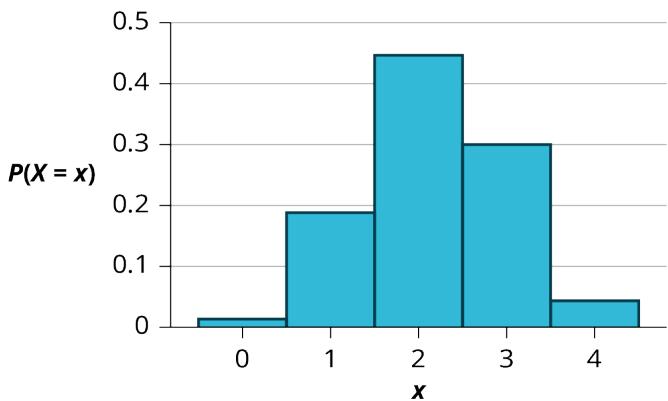
Figure A.2.1 — The distribution of \(X \sim H(6, 5, 4)\). The vertical axis is the probability of \(X\), where \(X\) is the number of men on the committee.
The bar at \(x = 2\) is the tallest, at the 0.4545 we just computed, and the graph leans toward the low-to-middle values because there are only six men to draw from. The two ends are thin: getting no men at all, or filling all four seats with men, each happens well under 5% of the time. Notice too that the mean of 2.18 sits just to the right of the tallest bar, pulled that way by the small but real chance of three or four men.
Problem Set A.2
Problem 1. A group of Martial Arts students is planning on participating in an upcoming demonstration. Six are students of Tae Kwon Do; seven are students of Shotokan Karate. Suppose that eight students are randomly picked to be in the first demonstration. We are interested in the number of Shotokan Karate students in that first demonstration.
a) In words, define the random variable \(X\).
b) List the values that \(X\) may take on.
c) Give the distribution of \(X\). \(X \sim\) _______(_______)
d) How many Shotokan Karate students do we expect to be in that first demonstration?
Solution
Step 1 — Sort the two groups: The question counts Shotokan Karate students, so they are the group of interest with \(r = 7\). The Tae Kwon Do students are the second group with \(b = 6\), and the sample is the \(n = 8\) students picked for the demonstration.
Step 2 — Define the random variable: Let \(X\) be the number of Shotokan Karate students among the eight picked for the first demonstration.
Step 3 — Find the values \(X\) can take: Eight students are picked from only 13 total, and only six of them study Tae Kwon Do. Even if every Tae Kwon Do student were picked, two seats would still have to go to Karate students, so the smallest possible value is \(8 - 6 = 2\). The largest is 7, the number of Karate students available.
Step 4 — Compute the mean: The expected count is the sample size times the share of the population in the group of interest.
$$\mu = \frac{nr}{r+b} = \frac{(8)(7)}{7+6} = \frac{56}{13} \approx 4.31$$Answer: a. \(X\) is the number of Shotokan Karate students in the first demonstration. b. \(X = 2, 3, 4, 5, 6, 7\). c. \(X \sim H(7, 6, 8)\). d. About 4.31 Shotokan Karate students.
Problem 2. In one of its Spring catalogs, L.L. Bean advertised footwear on 29 of its 192 catalog pages. Suppose we randomly survey 20 pages. We are interested in the number of pages that advertise footwear. Each page may be picked at most once.
a) In words, define the random variable \(X\).
b) List the values that \(X\) may take on.
c) Give the distribution of \(X\). \(X \sim\) _______(_______,_______)
d) How many pages do you expect to advertise footwear on them?
e) Calculate the standard deviation.
Solution
Step 1 — Sort the two groups: The question counts pages that advertise footwear, so those are the group of interest with \(r = 29\). The other \(192 - 29 = 163\) pages are the second group, so \(b = 163\), and the sample is \(n = 20\) pages.
Step 2 — Define the random variable: Let \(X\) be the number of pages among the 20 surveyed that advertise footwear.
Step 3 — Find the values \(X\) can take: There are 163 pages without footwear, far more than the 20 surveyed, so all 20 could miss and \(X\) can be 0. There are 29 footwear pages, more than 20, so all 20 could hit. \(X\) runs from 0 to 20.
Step 4 — Compute the mean:
$$\mu = \frac{nr}{r+b} = \frac{(20)(29)}{192} = \frac{580}{192} \approx 3.02$$Step 5 — Compute the standard deviation: Substitute \(r = 29\), \(b = 163\), \(n = 20\), and \(r + b = 192\).
$$\sigma = \sqrt{\frac{rbn(r+b-n)}{(r+b)^{2}(r+b-1)}} = \sqrt{\frac{(29)(163)(20)(172)}{(192)^{2}(191)}} = \sqrt{\frac{16{,}260{,}880}{7{,}041{,}024}} \approx 1.52$$Answer: a. \(X\) is the number of pages out of 20 that advertise footwear. b. \(X = 0, 1, 2, \ldots, 20\). c. \(X \sim H(29, 163, 20)\). d. About 3.02 pages. e. \(\sigma \approx 1.52\) pages.
Problem 3. Suppose that a technology task force is being formed to study technology awareness among instructors. Assume that ten people will be randomly chosen to be on the committee from a group of 28 volunteers, 20 who are technically proficient and eight who are not. We are interested in the number on the committee who are not technically proficient.
a) In words, define the random variable \(X\).
b) List the values that \(X\) may take on.
c) Give the distribution of \(X\). \(X \sim\) _______(_______,_______)
d) How many instructors do you expect on the committee who are not technically proficient?
e) Find the probability that at least five on the committee are not technically proficient.
f) Find the probability that at most three on the committee are not technically proficient.
Solution
Step 1 — Sort the two groups: The question counts the volunteers who are not technically proficient, so they are the group of interest with \(r = 8\). The 20 technically proficient volunteers are the second group, \(b = 20\), and the committee is the sample, \(n = 10\).
Step 2 — Define the random variable: Let \(X\) be the number on the committee who are not technically proficient.
Step 3 — Find the values \(X\) can take: There are 20 proficient volunteers, more than the 10 committee seats, so the committee could contain zero non-proficient members. At the other end there are only eight non-proficient volunteers, so \(X\) tops out at 8. \(X = 0, 1, 2, \ldots, 8\), and \(X \sim H(8, 20, 10)\).
Step 4 — Compute the mean:
$$\mu = \frac{nr}{r+b} = \frac{(10)(8)}{28} = \frac{80}{28} \approx 2.86$$Step 5 — Find \(P(X \geq 5)\): "At least five" means 5, 6, 7, or 8, so add those four terms. The denominator is \(\binom{28}{10} = 13{,}123{,}110\) for all of them.
$$P(X \geq 5) = \frac{\binom{8}{5}\binom{20}{5} + \binom{8}{6}\binom{20}{4} + \binom{8}{7}\binom{20}{3} + \binom{8}{8}\binom{20}{2}}{\binom{28}{10}}$$ $$= \frac{868{,}224 + 135{,}660 + 9{,}120 + 190}{13{,}123{,}110} = \frac{1{,}013{,}194}{13{,}123{,}110} \approx 0.0772$$Step 6 — Find \(P(X \leq 3)\): "At most three" means 0, 1, 2, or 3, so add those four terms over the same denominator.
$$P(X \leq 3) = \frac{184{,}756 + 1{,}343{,}680 + 3{,}527{,}160 + 4{,}341{,}120}{13{,}123{,}110} = \frac{9{,}396{,}716}{13{,}123{,}110} \approx 0.7160$$Both answers make sense next to the mean of 2.86: most committees land at or below three non-proficient members, and five or more is unusual.
Answer: a. \(X\) is the number on the committee who are not technically proficient. b. \(X = 0, 1, 2, \ldots, 8\). c. \(X \sim H(8, 20, 10)\). d. About 2.86 instructors. e. \(P(X \geq 5) \approx 0.0772\). f. \(P(X \leq 3) \approx 0.7160\).
Problem 4. Suppose that nine Massachusetts athletes are scheduled to appear at a charity benefit. The nine are randomly chosen from eight volunteers from the Boston Celtics and four volunteers from the New England Patriots. We are interested in the number of Patriots picked.
a) In words, define the random variable \(X\).
b) List the values that \(X\) may take on.
c) Give the distribution of \(X\). \(X \sim\) _______(_______,_______)
d) Are you choosing the nine athletes with or without replacement?
Solution
Step 1 — Sort the two groups: The question counts Patriots, so they are the group of interest with \(r = 4\). The Celtics volunteers are the second group with \(b = 8\), and the sample is the \(n = 9\) athletes chosen.
Step 2 — Define the random variable: Let \(X\) be the number of New England Patriots volunteers among the nine athletes picked.
Step 3 — Find the values \(X\) can take: Nine athletes are drawn from a pool of only 12, and just eight of them are Celtics. Even if every Celtic were picked, one seat would still go to a Patriot, so the smallest value is \(9 - 8 = 1\). The largest is 4, the number of Patriots available. So \(X = 1, 2, 3, 4\) and \(X \sim H(4, 8, 9)\).
Step 4 — Check how the sample is drawn: Each of the nine seats goes to a different athlete, and nobody appears at the benefit twice, so the athletes are chosen without replacement. That dependence is what makes this hypergeometric rather than binomial.
Answer: a. \(X\) is the number of Patriots among the nine athletes chosen. b. \(X = 1, 2, 3, 4\). c. \(X \sim H(4, 8, 9)\). d. Without replacement.
Problem 5. A bridge hand is defined as 13 cards selected at random and without replacement from a deck of 52 cards. In a standard deck of cards, there are 13 cards from each suit: hearts, spades, clubs, and diamonds. What is the probability of being dealt a hand that does not contain a heart?
a) What is the group of interest?
b) How many are in the group of interest?
c) How many are in the other group?
d) Let \(X =\) _______. What values does \(X\) take on?
e) The probability question is \(P(\underline{\phantom{XXXXX}})\).
f) Find the probability in question.
g) Find the (i) mean and (ii) standard deviation of \(X\).
Solution
Step 1 — Find the group of interest: The question asks about a hand with no hearts, so the hearts are what we are counting. The group of interest is the hearts.
Step 2 — Size both groups and the sample: There are 13 hearts, so \(r = 13\). The other three suits give \(52 - 13 = 39\) cards, so \(b = 39\). A bridge hand is \(n = 13\) cards.
Step 3 — Define the random variable and its values: Let \(X\) be the number of hearts in the 13-card hand. A hand could contain no hearts at all or be all hearts, so \(X = 0, 1, 2, \ldots, 13\) and \(X \sim H(13, 39, 13)\).
Step 4 — Translate the question: "Does not contain a heart" means exactly zero hearts, so the probability question is \(P(X = 0)\).
Step 5 — Compute the probability: Choose none of the 13 hearts and fill all 13 seats from the 39 non-hearts.
$$P(X = 0) = \frac{\binom{13}{0}\binom{39}{13}}{\binom{52}{13}} = \frac{8{,}122{,}425{,}444}{635{,}013{,}559{,}600} \approx 0.0128$$A heart-free hand shows up a little over once in every 100 deals.
Step 6 — Compute the mean and standard deviation:
$$\mu = \frac{nr}{r+b} = \frac{(13)(13)}{52} = \frac{169}{52} = 3.25$$ $$\sigma = \sqrt{\frac{rbn(r+b-n)}{(r+b)^{2}(r+b-1)}} = \sqrt{\frac{(13)(39)(13)(39)}{(52)^{2}(51)}} = \sqrt{\frac{257{,}049}{137{,}904}} \approx 1.37$$The mean of 3.25 is just what you would guess: a quarter of the deck is hearts, and a quarter of 13 cards is 3.25.
Answer: a. the hearts. b. 13. c. 39. d. \(X\) is the number of hearts in the hand, \(X = 0, 1, 2, \ldots, 13\). e. \(P(X = 0)\). f. \(P(X = 0) \approx 0.0128\). g. (i) \(\mu = 3.25\) hearts; (ii) \(\sigma \approx 1.37\) hearts.
Key Terms
hypergeometric experiment — a statistical experiment in which a sample is drawn without replacement from two groups combined, so the picks are not independent and are not Bernoulli trials.
group of interest — the first of the two groups, the one the probability question counts; its size is \(r\).
second group — everything in the population that is not in the group of interest; its size is \(b\).
hypergeometric random variable — the count \(X\) of items from the group of interest that appear in the chosen sample.
\(X \sim H(r, b, n)\) — notation stating that \(X\) has a hypergeometric distribution with group-of-interest size \(r\), second-group size \(b\), and sample size \(n\), where \(n \leq r + b\).